Divide with Partial Quotients
Students use place-value reasoning and partial quotients to divide multi-digit whole numbers by one-digit divisors and interpret remainders.

Illustrations are auto-generated and may be placeholders. They can be refreshed to match the narration.
Connect Multiplication and Division
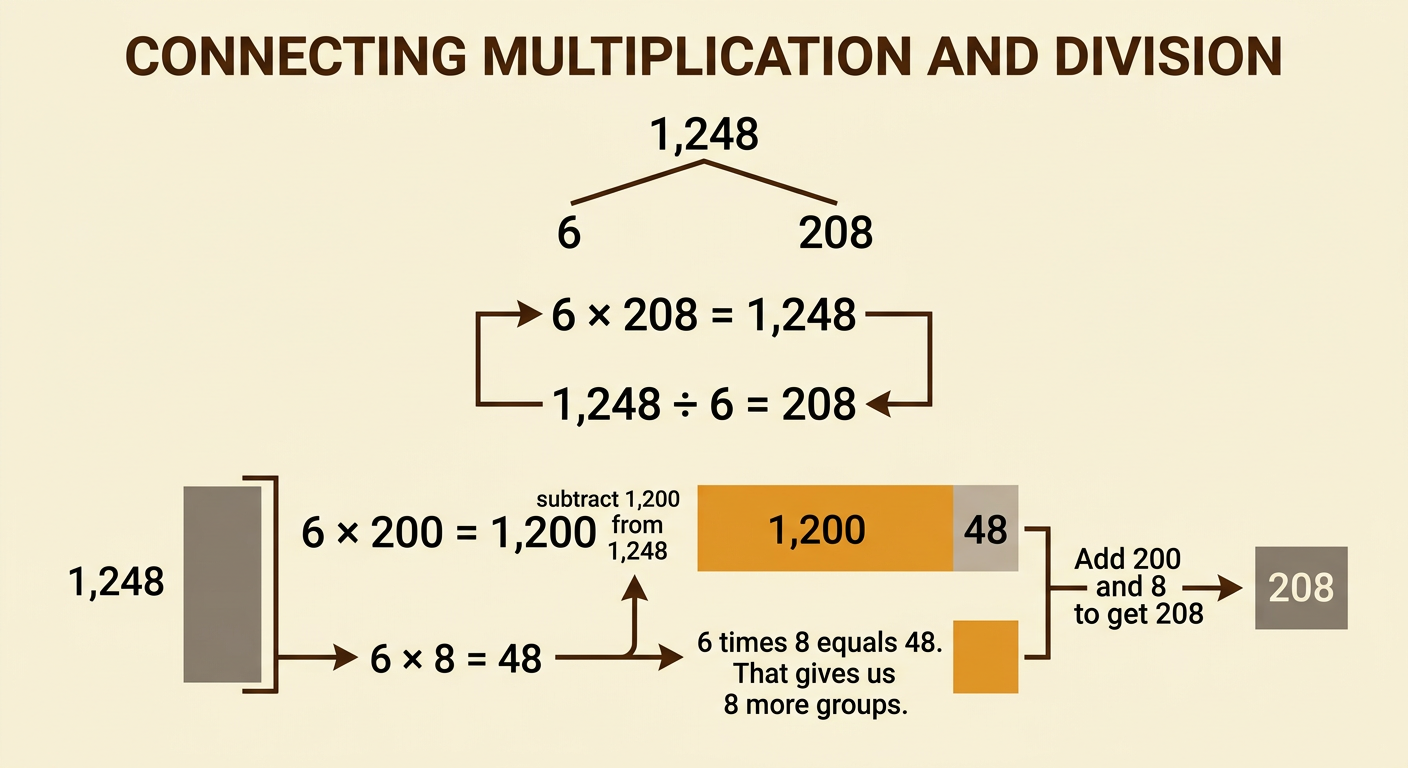
Multiplication and division are inverse operations, which means they can undo each other. To solve 1,248 ÷ 6, think about multiplication facts with 6. Since 6 × 200 = 1,200, you know that 1,200 of the total can be divided into 200 groups of 6. The remaining amount is 48 because 1,248 − 1,200 = 48. Then use 6 × 8 = 48. This means 48 can be divided into 8 more groups of 6. Altogether, there are 200 + 8, or 208, groups. Therefore, 1,248 ÷ 6 = 208. Using multiplication facts and place value helps break a large division problem into familiar, manageable parts.
Estimate the Quotient
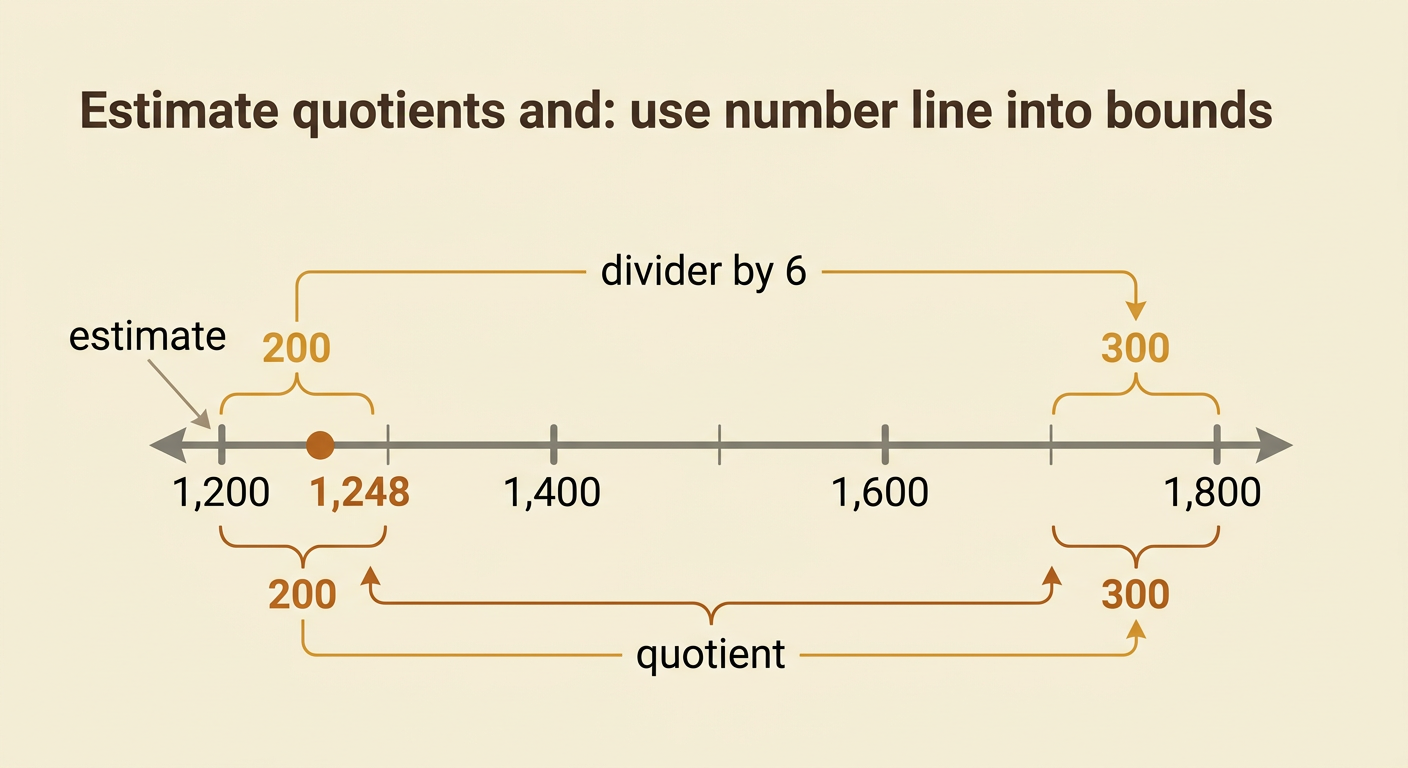
Before dividing, estimate the quotient so you know about how large the answer should be. To estimate 1,248 ÷ 6, use a nearby number that is easy to divide by 6. The number 1,200 is close to 1,248, and 1,200 ÷ 6 = 200. Therefore, the exact quotient should be close to 200. You can also set bounds using multiplication. Since 6 × 200 = 1,200 and 6 × 300 = 1,800, the quotient must be greater than 200 but less than 300. An estimate does not replace the exact answer. Instead, it helps you choose useful partial quotients and decide later whether your exact answer is reasonable.
Subtract Friendly Multiples
Partial quotients are amounts you know can be removed from the dividend. Start with 1,248 ÷ 6. A friendly multiple of 6 is 1,200 because 6 × 200 = 1,200. Write 200 as the first partial quotient, then subtract: 1,248 − 1,200 = 48. Now divide the amount that remains. Since 6 × 8 = 48, write 8 as another partial quotient and subtract: 48 − 48 = 0. The zero means nothing is left to divide. You could choose different friendly multiples, such as 600, 600, and 48. The method still works as long as every number subtracted is a multiple of the divisor and you keep track of each partial quotient.

Combine Partial Quotients
After subtracting friendly multiples, add the partial quotients to find the full quotient. In 1,248 ÷ 6, subtracting 1,200 represented 200 groups of 6. Subtracting the remaining 48 represented 8 more groups of 6. Combine those groups: 200 + 8 = 208. Therefore, 1,248 ÷ 6 = 208. Partial quotients can be different sizes. For example, you might subtract 600 twice, representing 100 groups each time, and then subtract 48, representing 8 groups. The sum would be 100 + 100 + 8 = 208. Different correct choices lead to the same quotient because all the partial quotients count groups of the same divisor.

Interpret the Remainder
Sometimes a dividend cannot be divided evenly. Consider 1,253 ÷ 6. Using partial quotients, subtract 1,200, which represents 200 groups of 6, and then subtract 48, which represents 8 more groups. The amount left is 5, so 1,253 ÷ 6 = 208 remainder 5. The remainder must always be less than the divisor. Its meaning depends on the situation. If 1,253 pencils are packed into boxes that hold 6 pencils, there are 208 full boxes and 5 pencils left over. If every pencil must be packed, one additional box is needed, making 209 boxes in all. Read the question carefully to decide whether to report the remainder, ignore it, or use it to adjust the answer.

Check with Multiplication
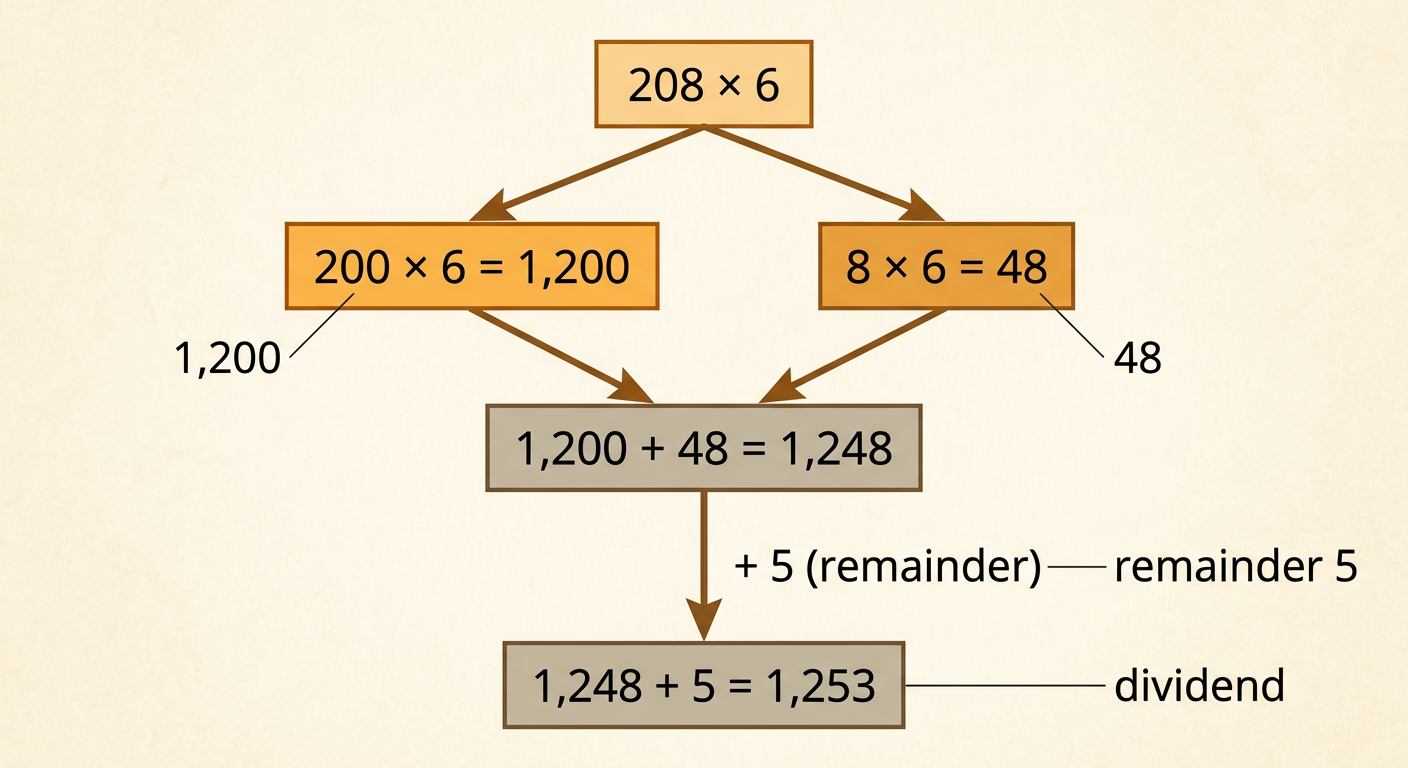
Check a division answer by multiplying the quotient by the divisor and then adding the remainder. For 1,253 ÷ 6 = 208 remainder 5, first multiply 208 × 6. Break 208 into 200 and 8: 200 × 6 = 1,200 and 8 × 6 = 48. Add the products to get 1,248. Then add the remainder: 1,248 + 5 = 1,253. This matches the original dividend, so the quotient and remainder are correct. The check can be written as divisor × quotient + remainder = dividend. If the result does not equal the dividend, review the partial quotients, subtraction, and addition. Also confirm that the remainder is smaller than the divisor.