
Dividing Fractions by Fractions
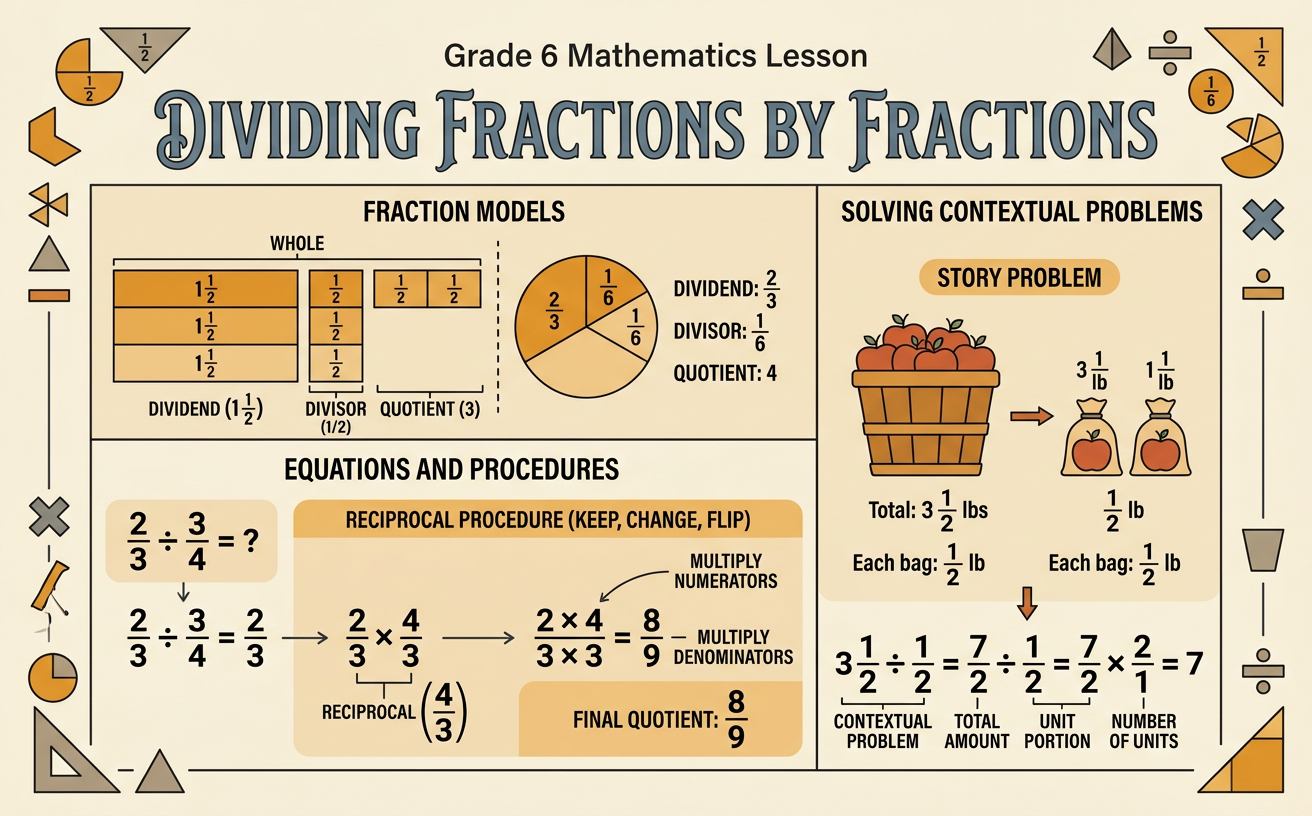
Students use models, equations, and the reciprocal procedure to divide fractions and solve contextual problems.
Illustrations are auto-generated and may be placeholders. They can be refreshed to match the narration.
Connect Division and Fractions
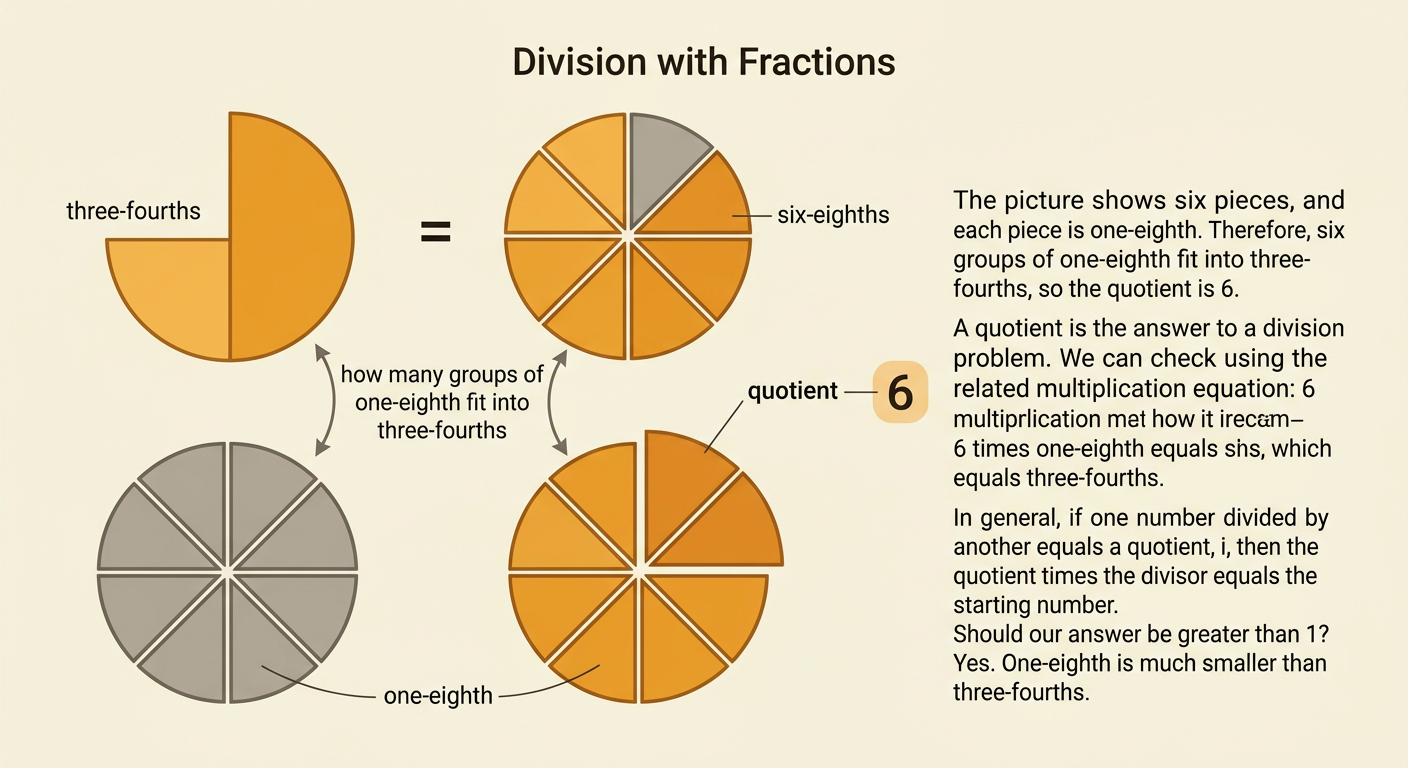
Division can ask how many groups of one number fit into another number. This meaning works with fractions, too. Consider 3/4 ÷ 1/8. The question is, “How many groups of 1/8 are in 3/4?” Rewrite 3/4 in eighths: 3/4 = 6/8. Because six groups of 1/8 make 6/8, the quotient is 6. We can check with a related multiplication equation: 6 × 1/8 = 6/8 = 3/4. In general, a ÷ b = c means that c × b = a. Thinking about the size of the numbers also helps. Since 1/8 is smaller than 3/4, several groups should fit, so a quotient greater than 1 is reasonable.
Model Fraction Division
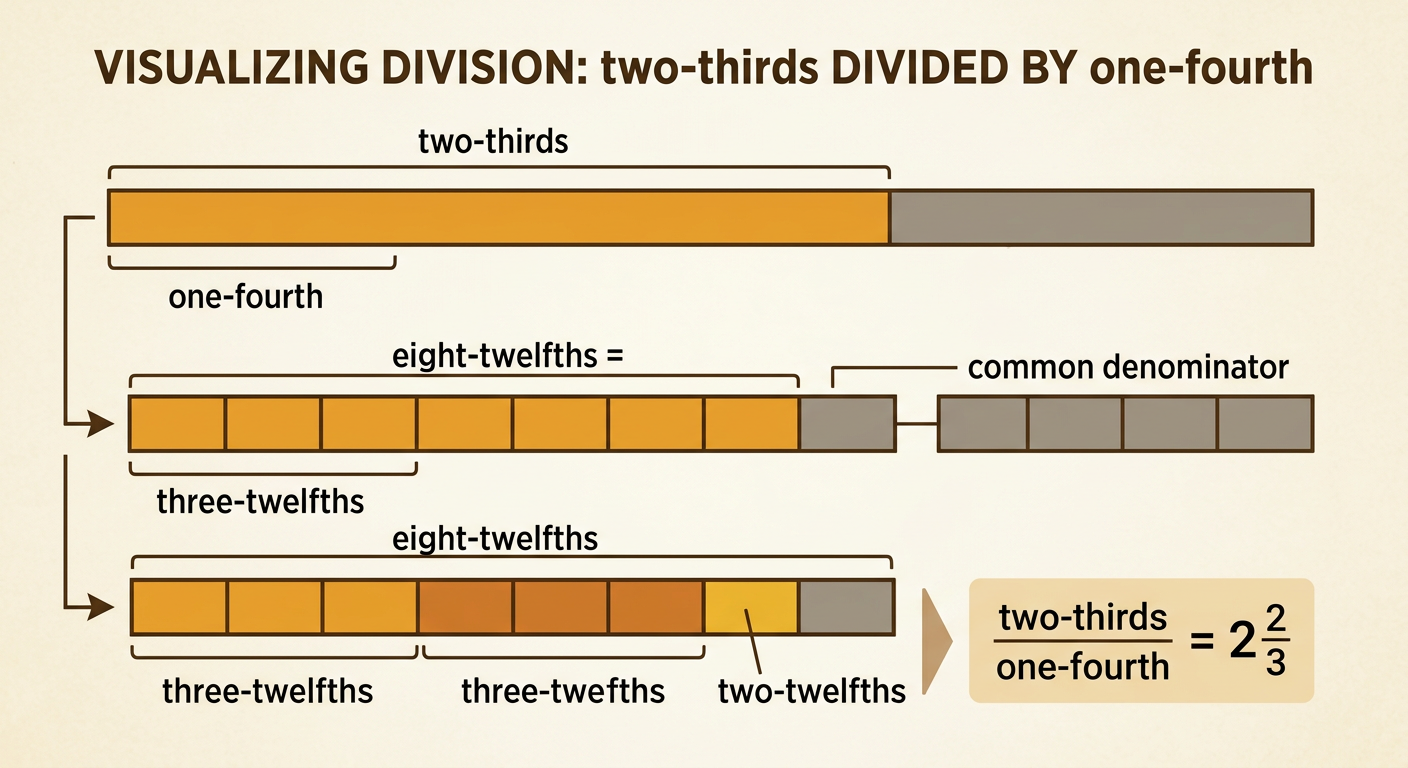
A visual model can show a quotient even when the answer is not a whole number. Find 2/3 ÷ 1/4 by asking how many lengths of 1/4 fit into 2/3. Use twelfths because 12 is a common denominator for 3 and 4. Then 2/3 = 8/12 and 1/4 = 3/12. Two complete groups of 3/12 use 6/12. The remaining 2/12 is two-thirds of another 3/12 group. Therefore, 8/12 contains 2 2/3 groups of 3/12, so 2/3 ÷ 1/4 = 2 2/3. The model also explains why a fractional quotient is possible: part of one divisor-sized group can remain. Common partitions make the dividend and divisor easy to compare.
Multiply by the Reciprocal
A quick way to divide fractions is to multiply by the reciprocal of the divisor. The reciprocal of a nonzero fraction is found by switching its numerator and denominator. For example, the reciprocal of 2/3 is 3/2. To calculate 5/6 ÷ 2/3, keep 5/6, change division to multiplication, and use 3/2: 5/6 × 3/2 = 15/12 = 5/4, or 1 1/4. This procedure works because multiplying 2/3 by 3/2 gives 1. Dividing by 2/3 is therefore equivalent to multiplying by the number that undoes multiplication by 2/3. Remember that only the divisor is replaced by its reciprocal. The dividend stays the same. Check the result with multiplication: 5/4 × 2/3 = 5/6.
Simplify Quotients
Simplify a fraction quotient by canceling common factors before or after multiplying. Consider 7/10 ÷ 14/15. Replace the divisor with its reciprocal: 7/10 × 15/14. Before multiplying, divide 7 and 14 by their common factor 7, leaving 1 and 2. Divide 15 and 10 by their common factor 5, leaving 3 and 2. Now multiply: 1/2 × 3/2 = 3/4. Canceling first keeps the numbers small, but it does not change the value. If you multiply first, you get 105/140, which also simplifies to 3/4. A quotient should be written in simplest form, with no common factor greater than 1 in the numerator and denominator. If the result is improper, it may also be written as a mixed number when the context calls for one.
Solve Real-World Problems
Fraction division can determine how many equal portions can be made. Suppose a craft club has 2 1/4 yards of ribbon and uses 3/8 yard for each project. To find the number of projects, divide the total ribbon by the ribbon per project. First write 2 1/4 as 9/4. Then calculate 9/4 ÷ 3/8 = 9/4 × 8/3. Simplify before multiplying: 9 ÷ 3 = 3 and 8 ÷ 4 = 2. The product is 3 × 2 = 6. The club has enough ribbon for 6 projects. Check the units and meaning: six groups of 3/8 yard use 18/8 yards, which equals 9/4 or 2 1/4 yards. A labeled model and equation connect the quotient to the situation.