Dividing Multi-Digit Whole Numbers with Partial Quotients
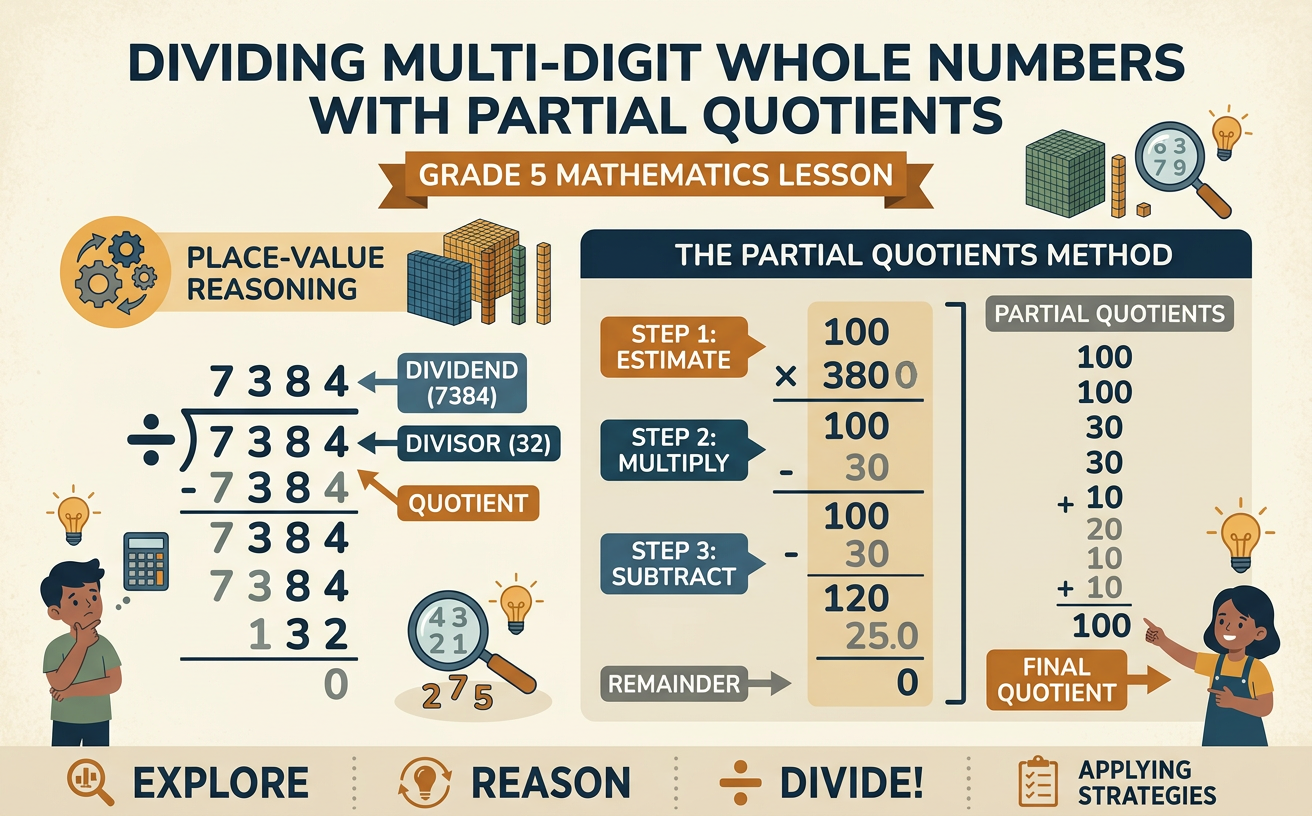
Students use place-value reasoning and partial quotients to divide whole numbers with up to four-digit dividends and two-digit divisors.
Illustrations are auto-generated and may be placeholders. They can be refreshed to match the narration.
Connect Multiplication and Division
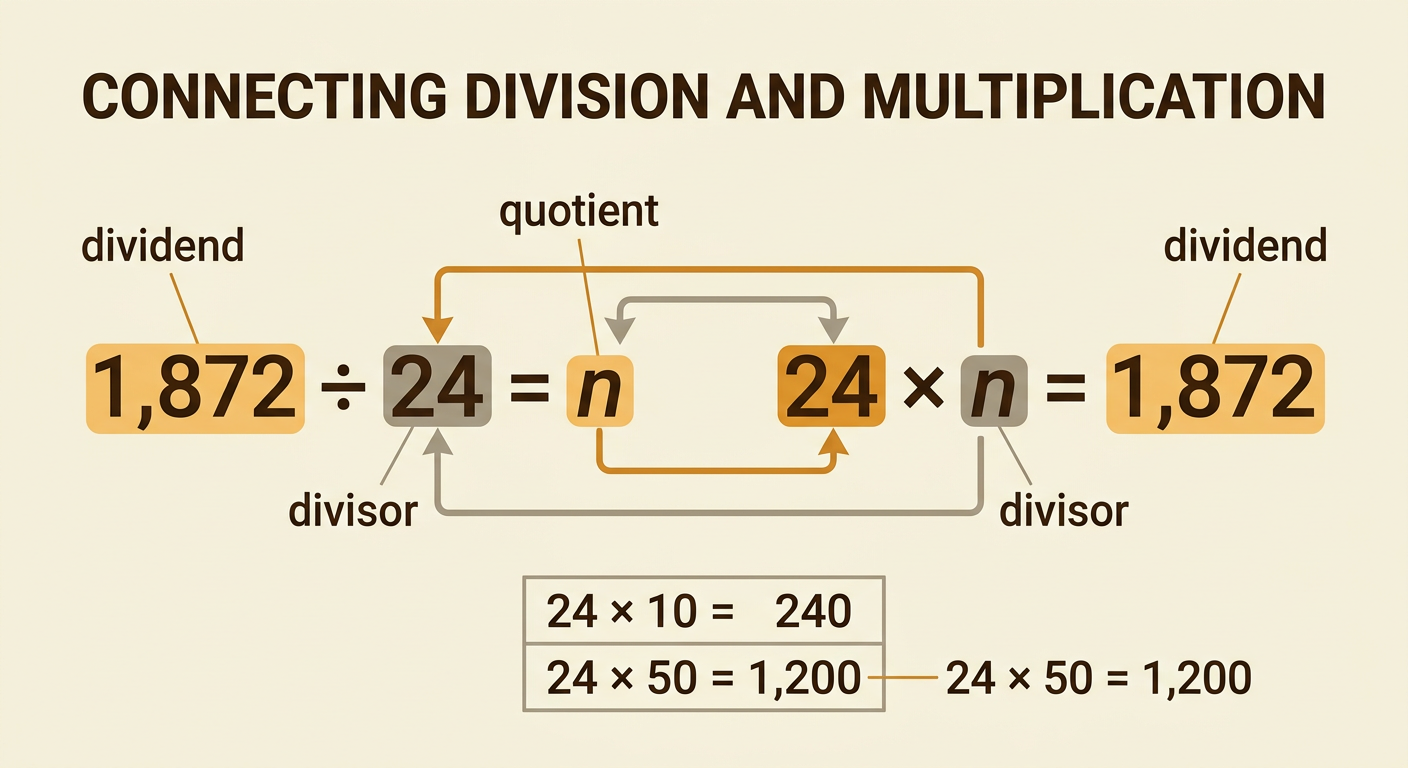
Multiplication and division are inverse operations, so they can undo each other. To find 1,872 ÷ 24, ask, “How many groups of 24 make 1,872?” This question can be written as 24 × n = 1,872, where n is the unknown quotient. Known multiplication facts help you find useful groups. For example, 24 × 10 = 240, so 24 × 50 = 1,200. Each multiplication fact identifies part of the dividend that can be divided into equal groups of 24. You can subtract several helpful multiples instead of finding the entire quotient at once. Later, you will add the numbers of groups to find n. This relationship also helps you check whether your division result is correct.
Estimate the Quotient
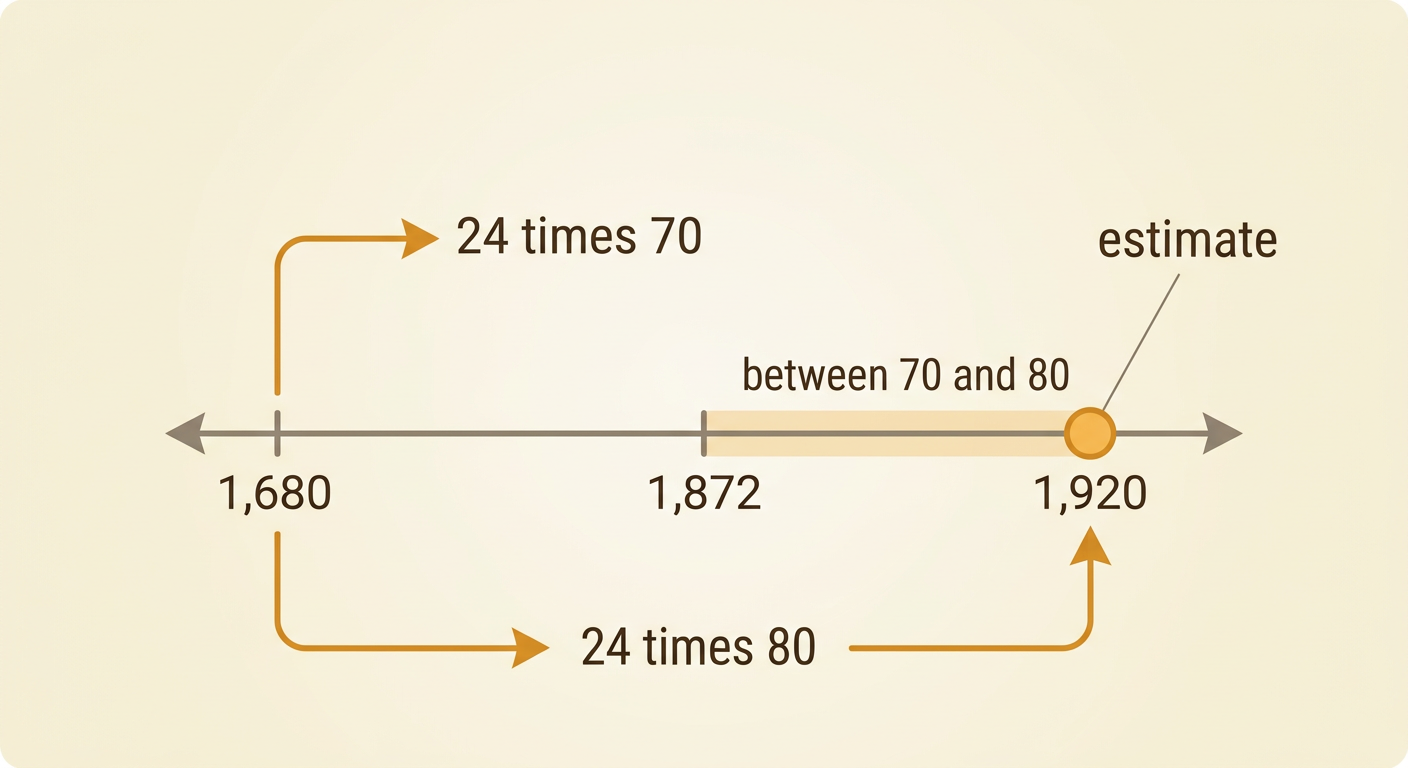
Estimate before dividing so you know about how large the quotient should be. For 1,872 ÷ 24, use nearby compatible numbers that are easy to divide. The number 1,920 is close to 1,872, and 1,920 ÷ 24 = 80 because 24 × 80 = 1,920. Therefore, the exact quotient should be close to 80. You can also find reasonable boundaries. Since 24 × 70 = 1,680 and 24 × 80 = 1,920, the quotient must be between 70 and 80. Estimation helps you select useful partial quotients and notice unreasonable answers. A result such as 8 or 800 would not make sense because it is far outside the estimated range.
Model with Partial Quotients
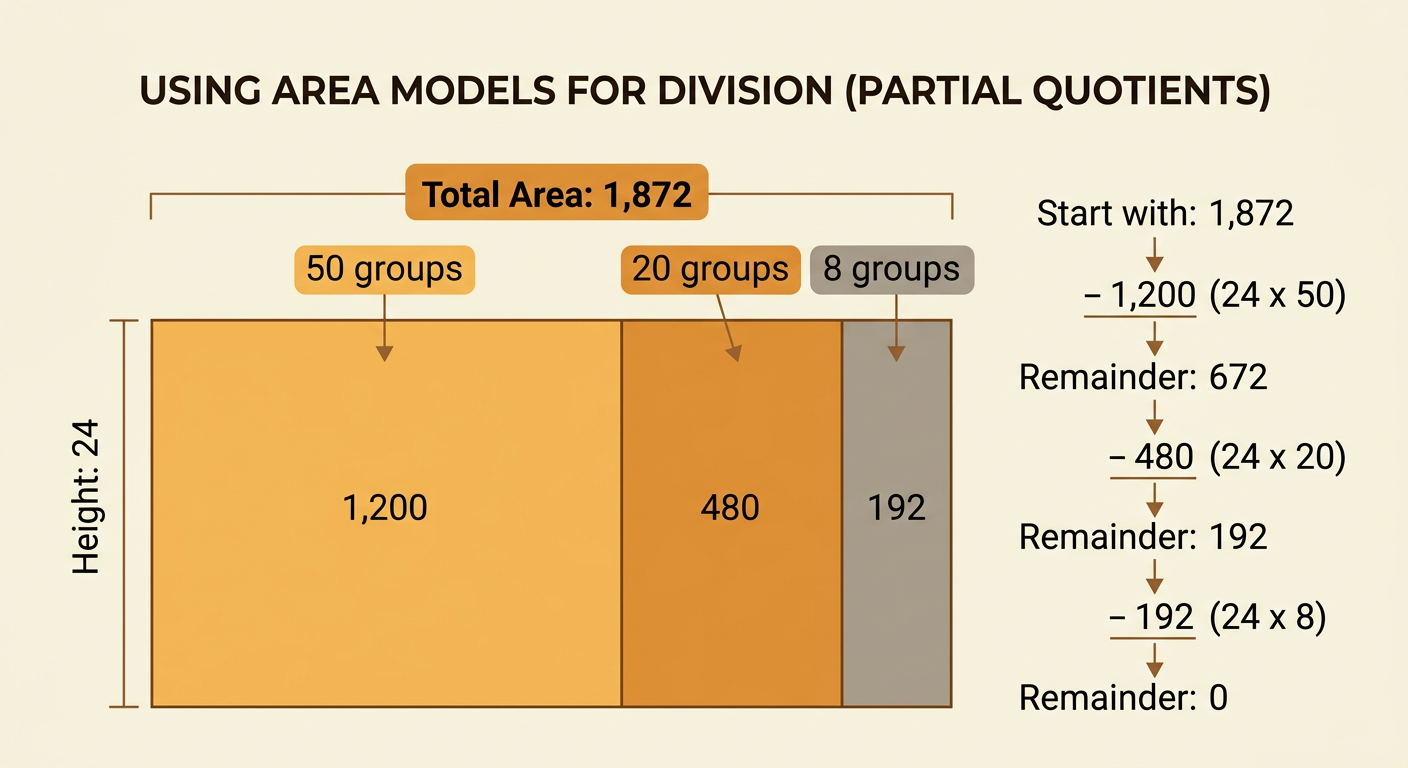
Partial quotients break a division problem into manageable groups. Begin with 1,872 ÷ 24. First take 50 groups of 24 because 24 × 50 = 1,200. Subtract 1,200 from 1,872 to get 672. Next take 20 groups because 24 × 20 = 480. Subtract 480 from 672 to get 192. Finally, take 8 groups because 24 × 8 = 192. Nothing remains. An area model can show the same reasoning. Draw one rectangle with a height of 24 and divide its width into sections of 50, 20, and 8. The section areas are 1,200, 480, and 192. Together, these areas make the original dividend, 1,872.
Combine Partial Quotients
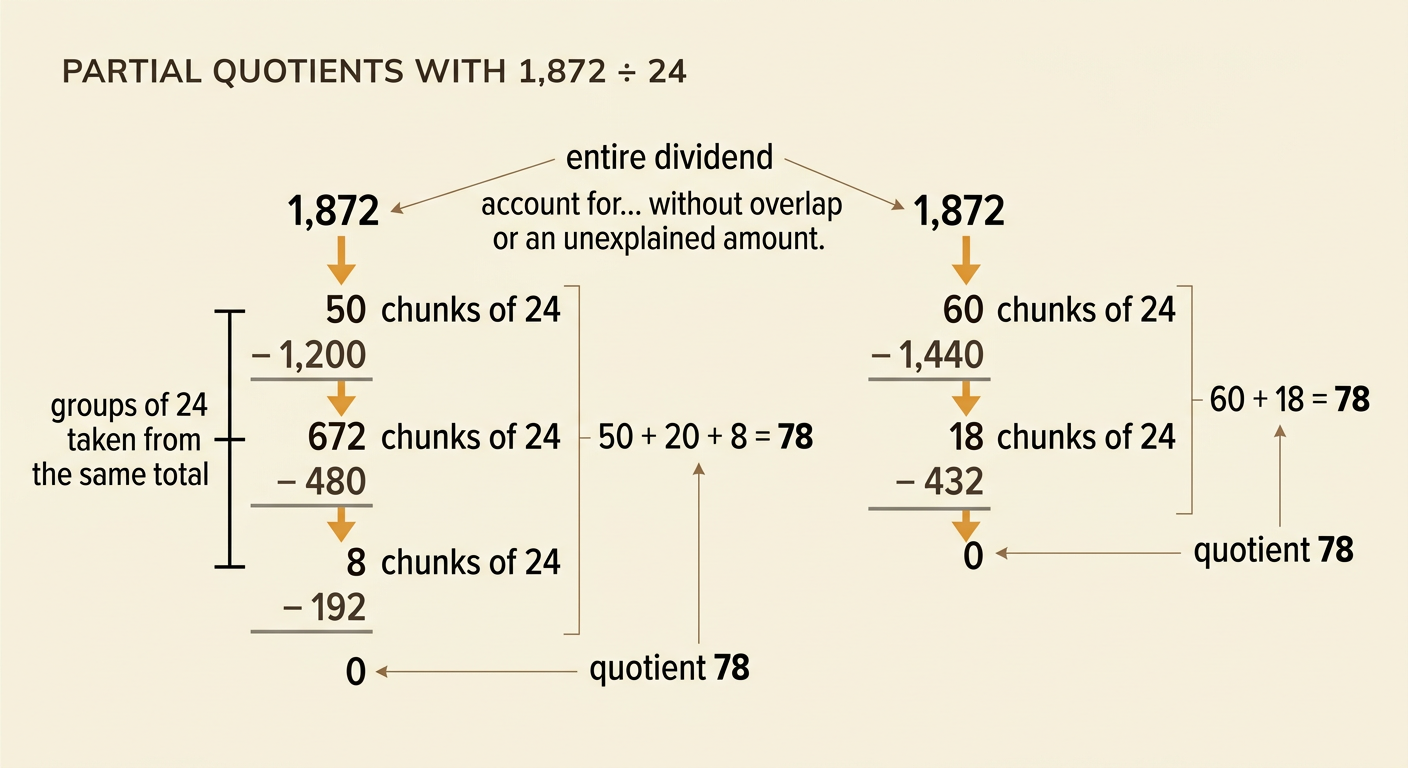
Each partial quotient tells how many groups of the divisor were removed. To finish 1,872 ÷ 24, combine the partial quotients 50, 20, and 8. Add them: 50 + 20 + 8 = 78. Therefore, 1,872 ÷ 24 = 78. The numbers must be added because all three chunks represent groups of 24 from the same dividend. You may choose different useful chunks and still get the same quotient. For example, you could remove 60 groups first because 24 × 60 = 1,440. The remaining 432 equals 24 × 18, so 60 + 18 also equals 78. Partial-quotient methods can look different, but correct methods account for the entire dividend without overlapping or leaving an unexplained amount.
Check with Multiplication
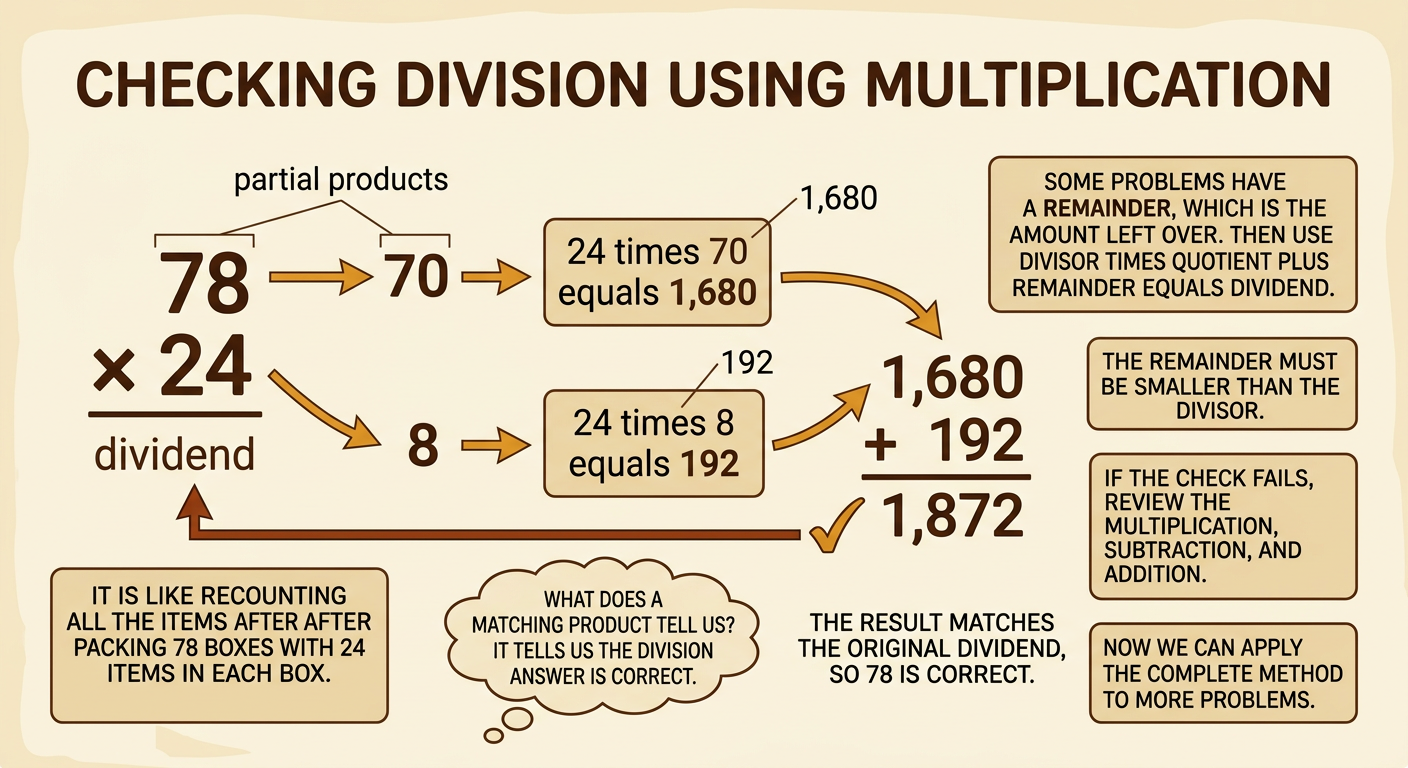
Check a division answer by multiplying the quotient by the divisor. For 1,872 ÷ 24 = 78, calculate 78 × 24. Break 78 into 70 and 8: 24 × 70 = 1,680 and 24 × 8 = 192. Then add the partial products: 1,680 + 192 = 1,872. The product matches the original dividend, so the quotient 78 is correct. If a division problem has a remainder, use divisor × quotient + remainder = dividend. The remainder must always be less than the divisor. Multiplication checks both your arithmetic and your place-value reasoning. If the product does not equal the dividend, review the partial products, subtraction, and addition of the partial quotients.
Independent Practice
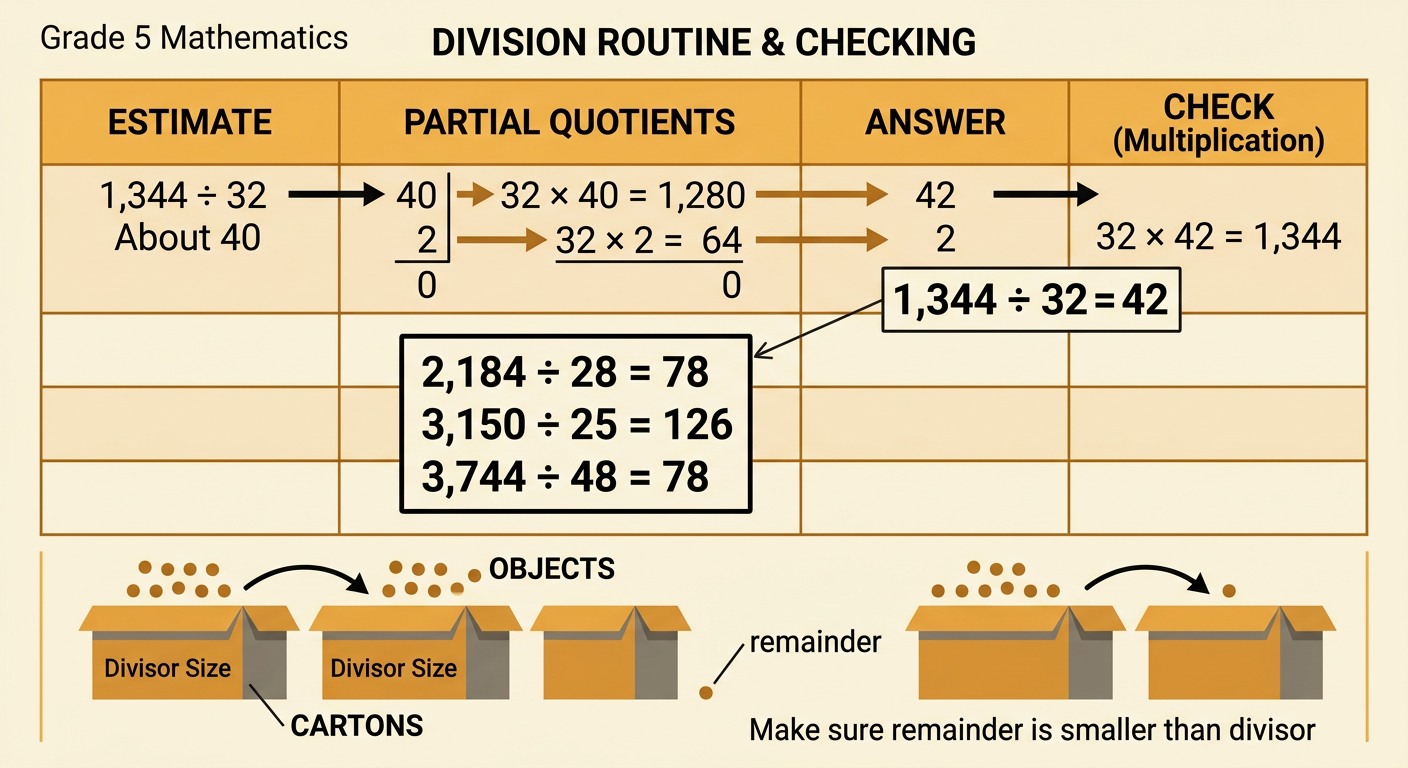
Use estimation and partial quotients to solve each problem, and then check with multiplication. Try 1,344 ÷ 32 first. Since 32 × 40 = 1,280, remove 40 groups and find the remainder: 1,344 − 1,280 = 64. Because 32 × 2 = 64, add 2 more groups. The quotient is 40 + 2 = 42. Check that 32 × 42 = 1,344. Now solve 2,184 ÷ 28, 3,150 ÷ 25, and 3,744 ÷ 48. For each problem, record an estimate, the multiples you subtract, the combined partial quotients, and a multiplication check. If there is a remainder, label it clearly and confirm that it is smaller than the divisor.