
Dividing Unit Fractions and Whole Numbers
Students use visual models and equations to divide unit fractions by whole numbers and whole numbers by unit fractions.
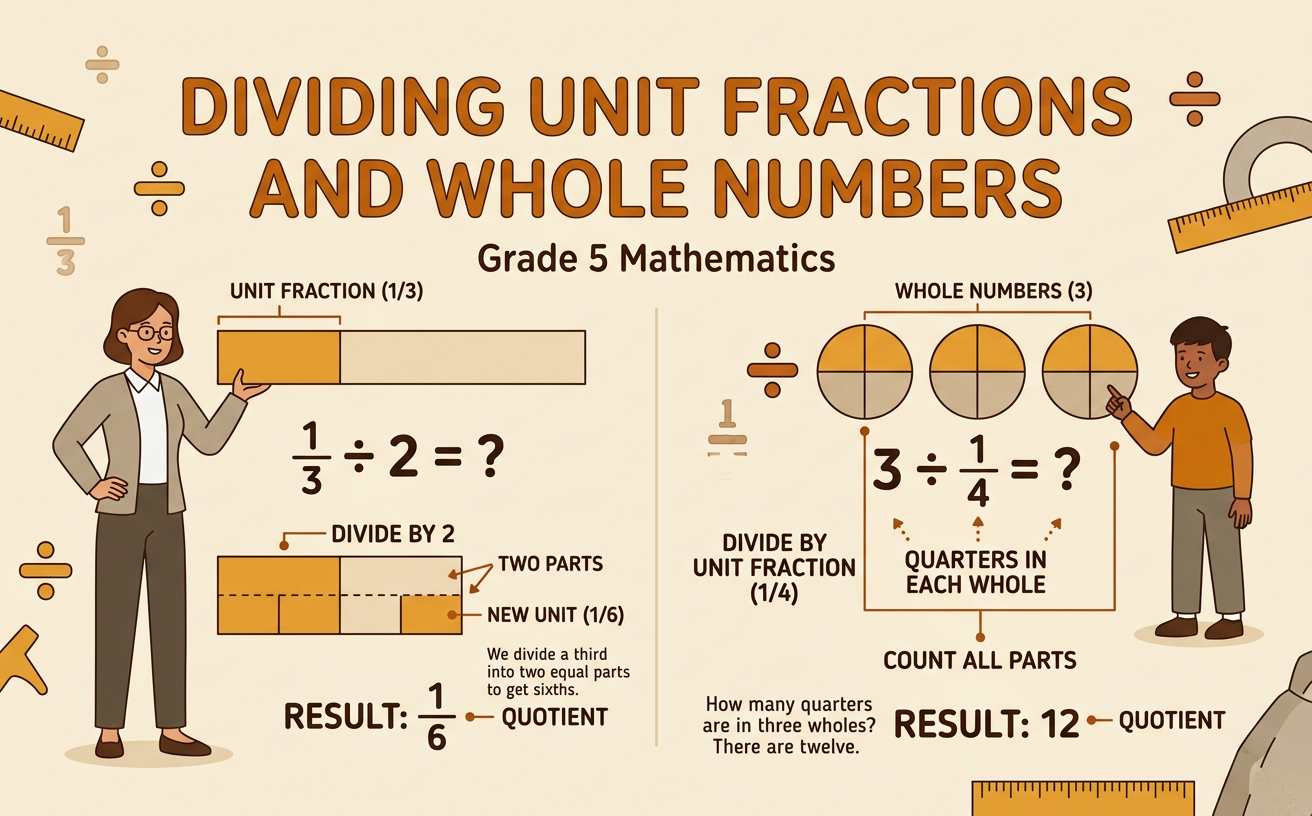
Illustrations are auto-generated and may be placeholders. They can be refreshed to match the narration.
Reviewing Division and Unit Fractions
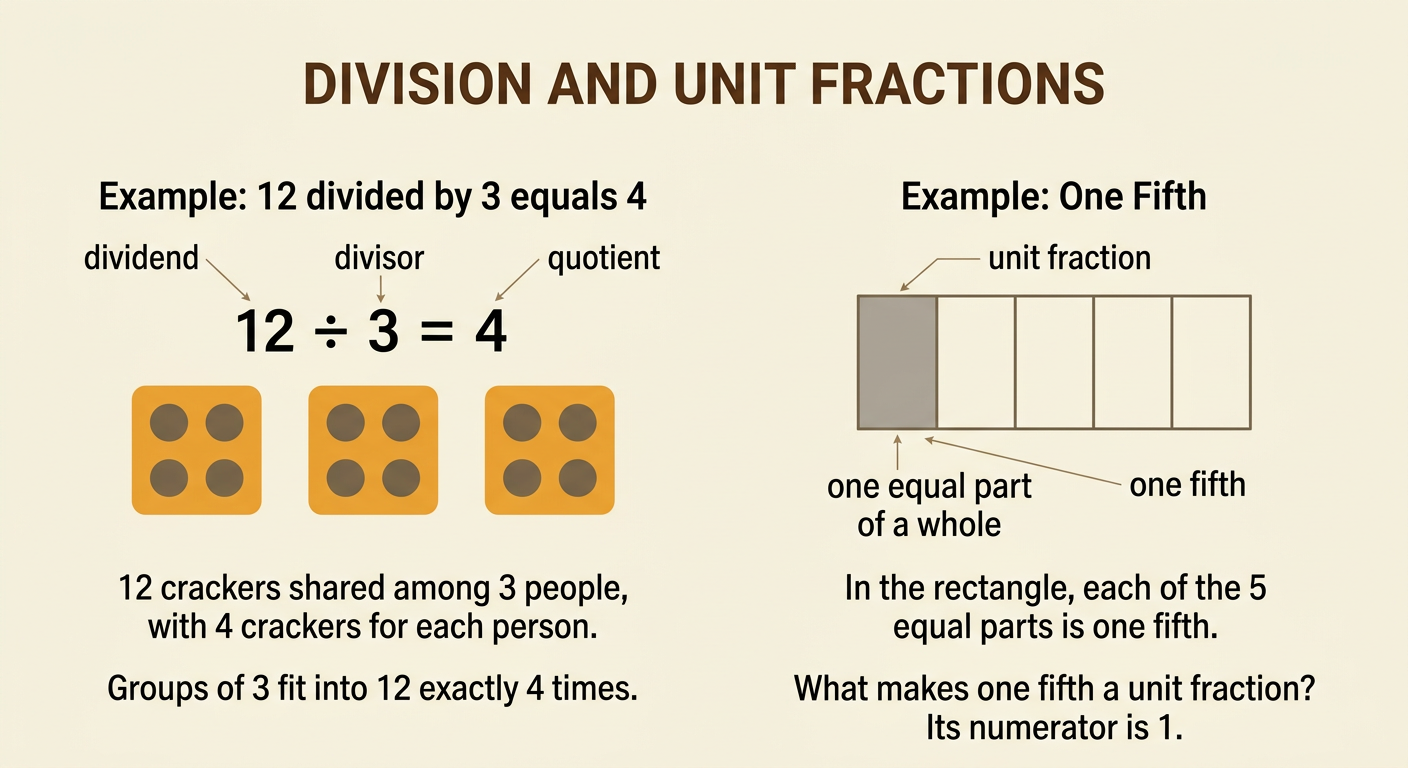
Division can tell how many equal groups can be made or how much belongs in each group. For example, 12 ÷ 3 = 4 means that 12 objects can be separated into 3 equal groups of 4. It also means that 3 objects fit into 12 a total of 4 times. A unit fraction has 1 as its numerator, such as 1/2, 1/3, or 1/8. It represents one equal part of a whole. If a rectangle is divided into 5 equal parts, each part is 1/5 of the rectangle. In this lesson, the divisor or dividend may be a unit fraction. Thinking about equal groups and the size of each fractional part will help you understand each quotient.
Modeling a Unit Fraction Divided by a Whole Number
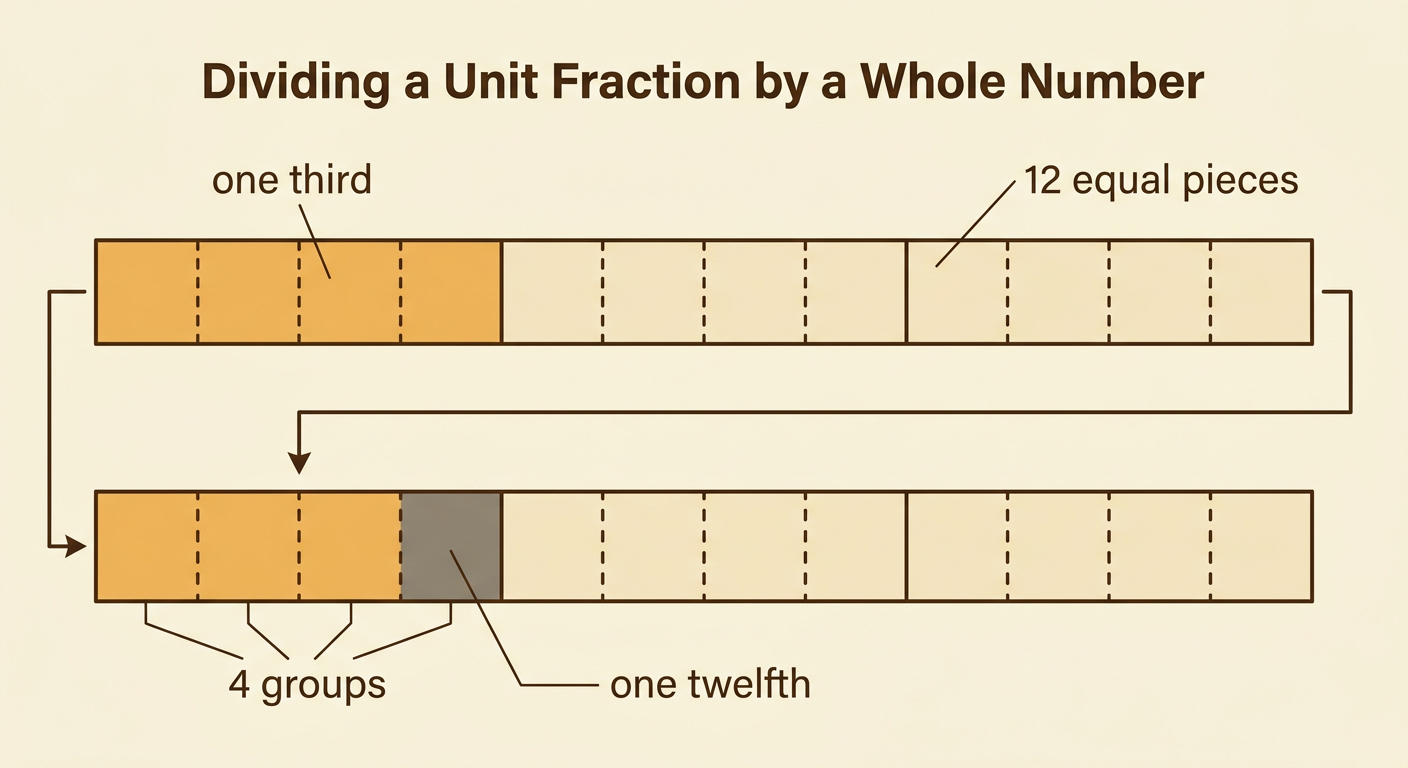
To divide a unit fraction by a whole number, separate the unit fraction into that many equal parts. Consider 1/3 ÷ 4. Begin with one whole rectangle divided into 3 equal sections. One section represents 1/3. Now divide that section into 4 equal pieces. To keep all parts of the whole equal, divide every third into 4 pieces. The whole now has 12 equal pieces. Each small piece is 1/12 of the whole, so 1/3 ÷ 4 = 1/12. The quotient is smaller than 1/3 because the original amount was shared among 4 groups. In general, dividing 1/b by a whole number n gives 1/(b × n), as long as n is not zero.
Modeling a Whole Number Divided by a Unit Fraction
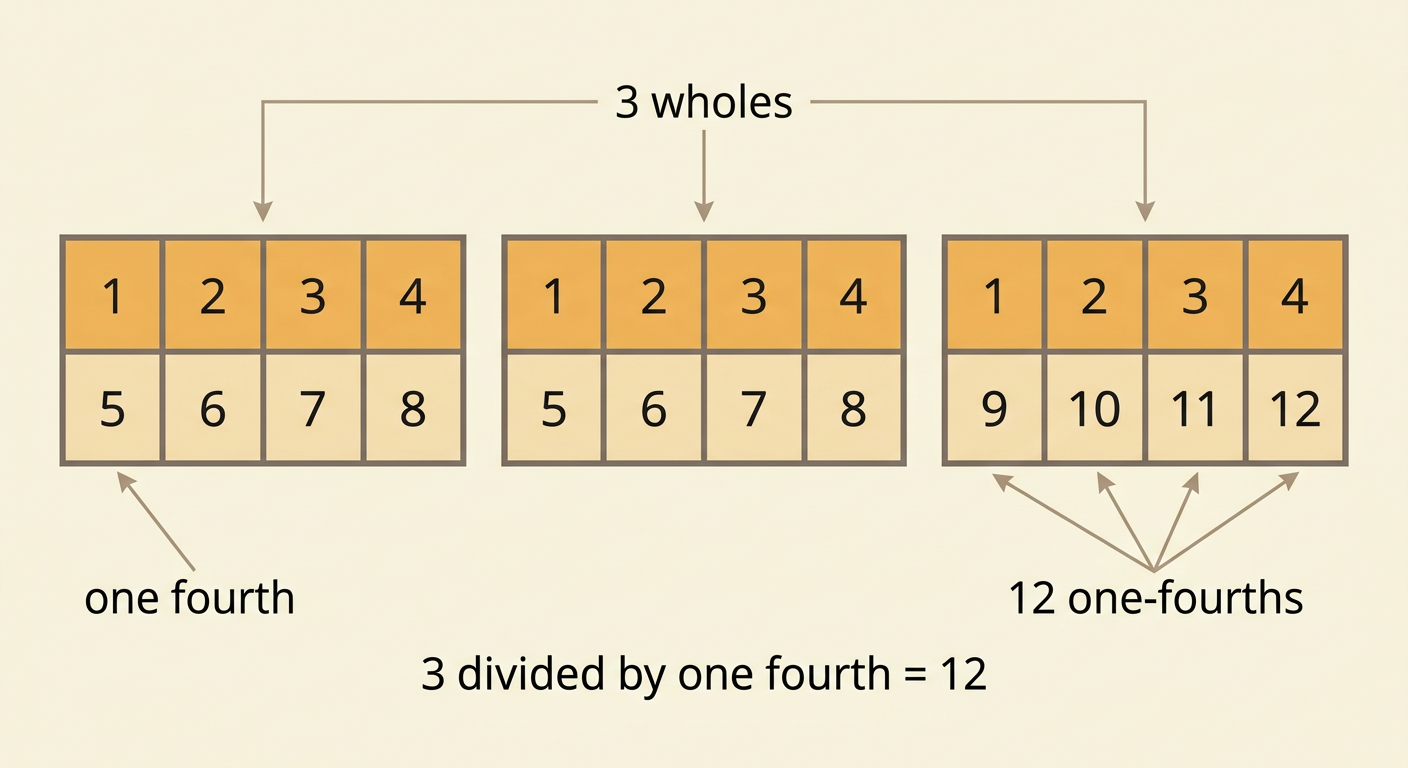
To divide a whole number by a unit fraction, ask how many groups of that unit fraction fit in the whole-number amount. Consider 3 ÷ 1/4. Draw 3 whole bars and divide each bar into 4 equal parts. Each part is 1/4 of one whole. There are 4 one-fourths in each whole, so 3 wholes contain 3 × 4, or 12, one-fourths. Therefore, 3 ÷ 1/4 = 12. The quotient is greater than 3 because many small groups fit into the 3 wholes. This is different from sharing 3 items among 4 people. The divisor 1/4 describes the size of each group, and the quotient tells the number of one-fourth-size groups.
Connecting Models to Equations
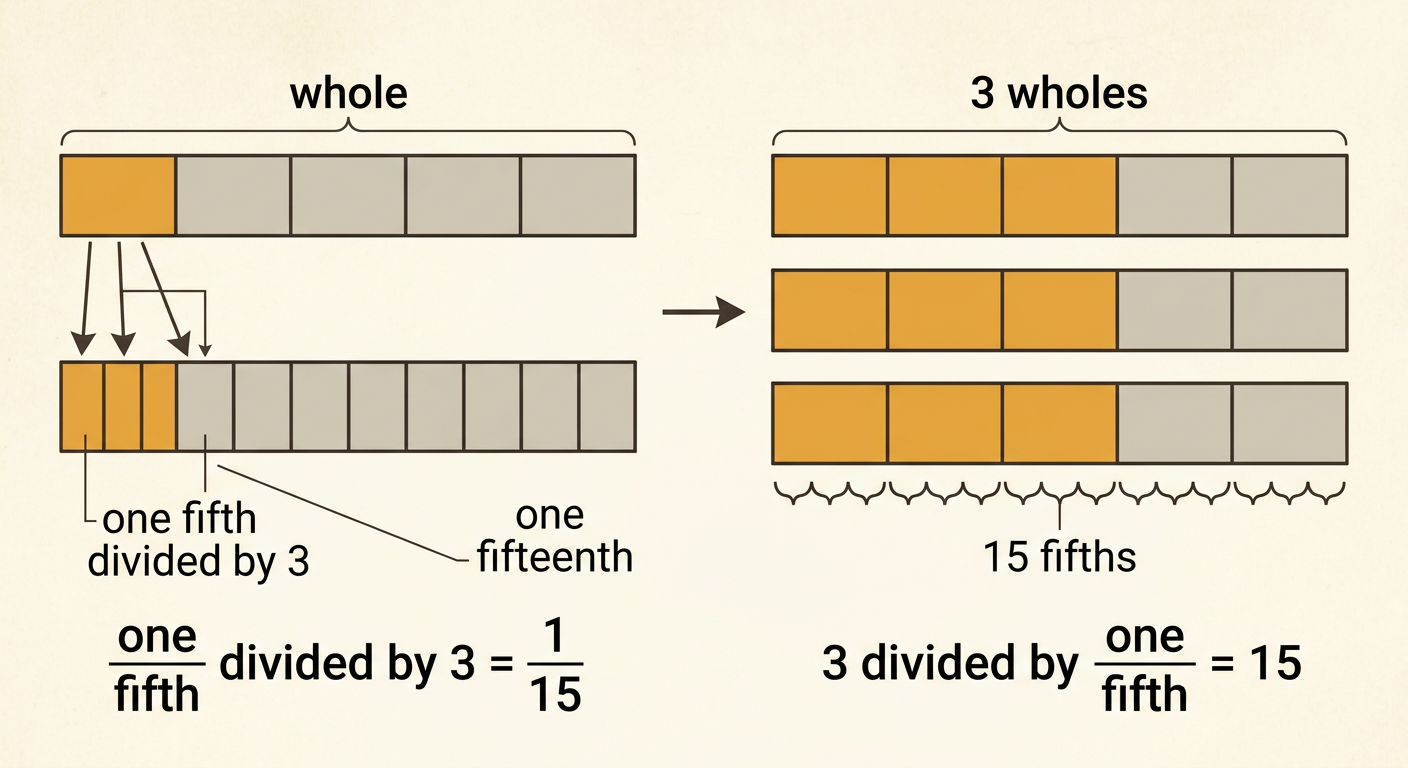
Visual models reveal useful patterns in the equations. For 1/5 ÷ 3, divide one fifth into 3 equal pieces. The whole is then partitioned into 5 × 3 = 15 equal pieces, so 1/5 ÷ 3 = 1/15. For 3 ÷ 1/5, count how many fifths are in 3 wholes. Each whole contains 5 fifths, so 3 × 5 = 15 and 3 ÷ 1/5 = 15. Notice that the same numbers can produce very different quotients when their order changes. Dividing a unit fraction by a whole number makes smaller pieces. Dividing a whole number by a unit fraction counts many fractional groups. Multiplication can check both results: 3 × 1/15 = 1/5, and 15 × 1/5 = 3.
Solving Real-World Division Problems
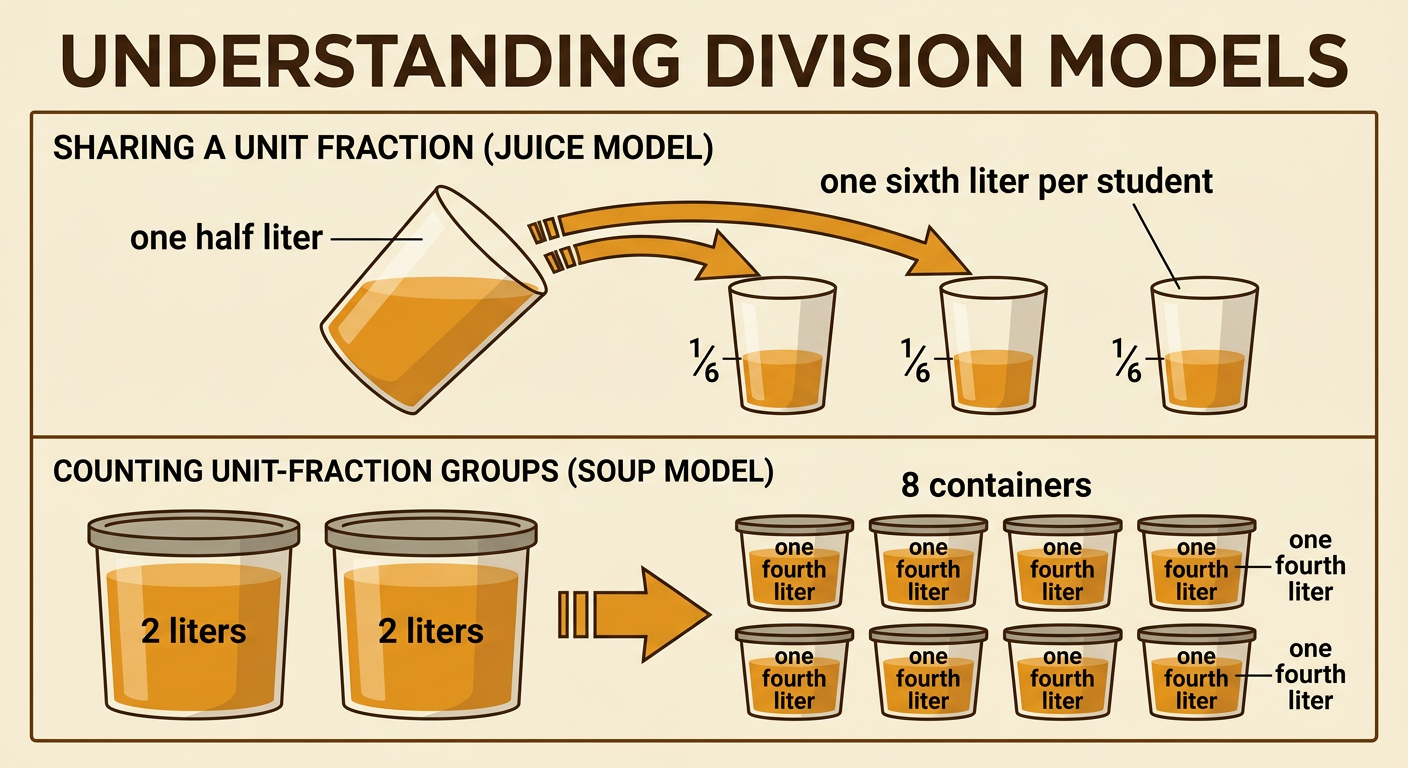
First decide whether the problem involves sharing a unit fraction or counting unit-fraction groups. Suppose 1/2 liter of juice is shared equally among 3 students. The equation is 1/2 ÷ 3. Splitting the half liter into 3 equal amounts gives 1/6 liter per student. Now suppose a cook has 2 liters of soup and fills containers that each hold 1/4 liter. The equation is 2 ÷ 1/4. Each liter fills 4 containers, so 2 liters fill 8 containers. Always include a unit in the answer and check whether the result is reasonable. A shared fractional amount should become smaller. When counting small unit-fraction portions inside several wholes, the number of portions should be greater than the number of wholes.
Exit Check
Use a model or equation to solve each problem, and then check your reasoning. First, find 1/4 ÷ 2. One fourth split into 2 equal parts gives 1/8, so 1/4 ÷ 2 = 1/8. Second, find 4 ÷ 1/3. Each whole contains 3 thirds, so 4 wholes contain 12 thirds and 4 ÷ 1/3 = 12. Finally, imagine that 1/3 yard of ribbon is cut into 5 equal pieces. Each piece is 1/15 yard because 1/3 ÷ 5 = 1/15. Ask yourself two questions: Did the quotient become smaller when a unit fraction was shared? Did the quotient count all the unit-fraction groups when a whole number was divided? If so, your answers match the models.
