Dividing Unit Fractions by Whole Numbers
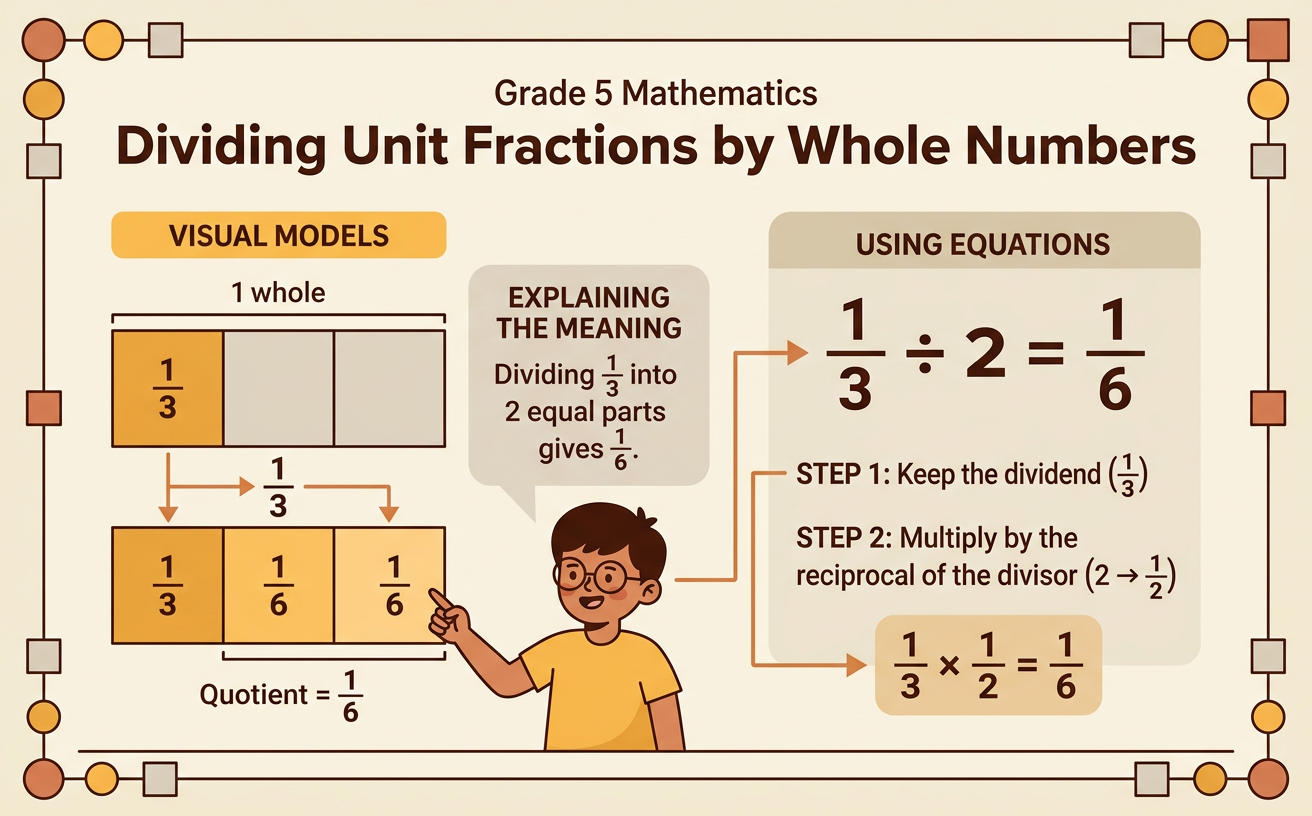
Students use visual models and equations to divide unit fractions by nonzero whole numbers and explain the meaning of the quotient.
Illustrations are auto-generated and may be placeholders. They can be refreshed to match the narration.
Review Unit Fractions
A unit fraction has a numerator of 1. It names one equal part of a whole. The denominator tells how many equal parts make the whole, and the numerator shows that one part is being considered. For example, 1/4 means one of four equal parts. If a rectangular pan of cornbread is cut into four equal pieces, each piece is 1/4 of the whole pan. Unit fractions with larger denominators represent smaller parts. For example, 1/8 is smaller than 1/4 because the same whole is divided into more equal pieces. Always make sure the parts are equal when identifying a unit fraction.

Model Equal Sharing
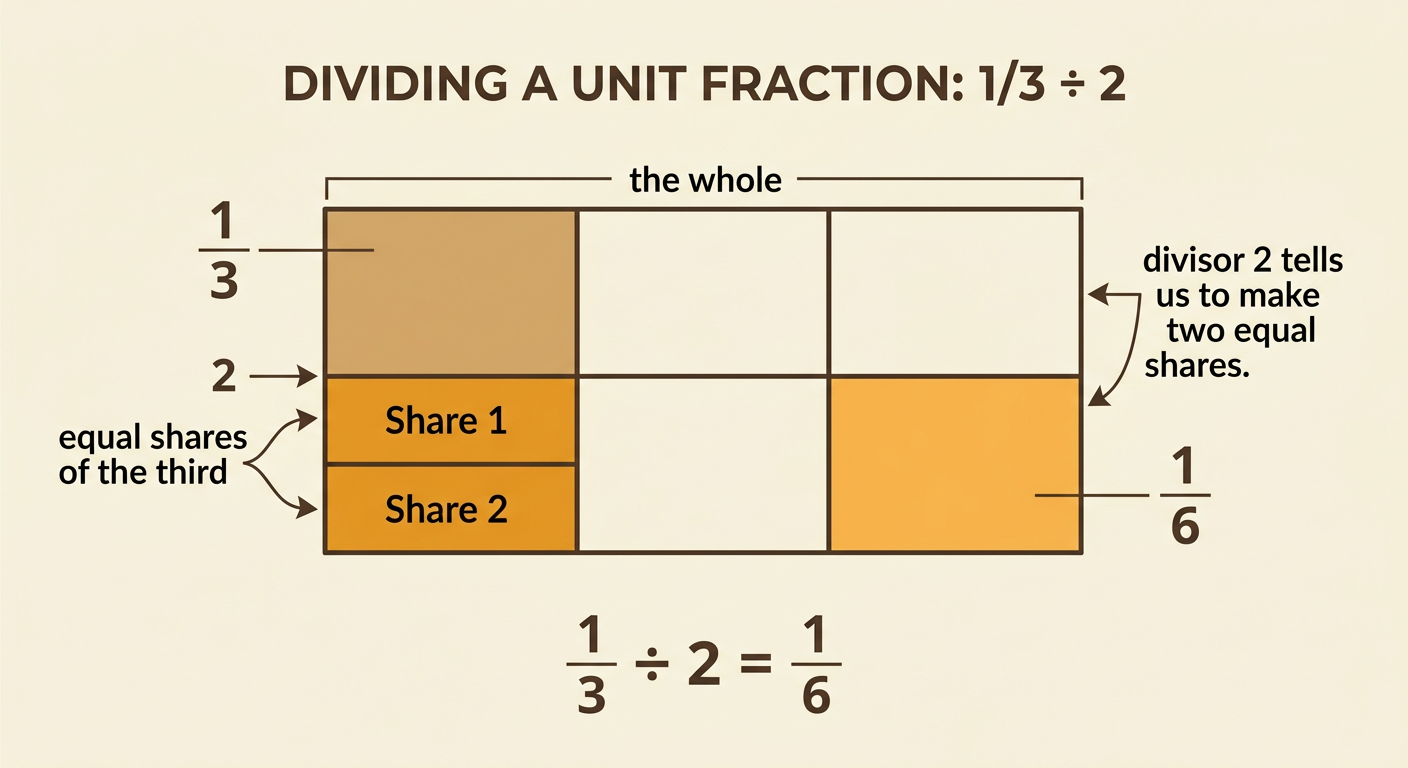
Dividing a unit fraction by a whole number means sharing that fraction equally. Consider 1/3 ÷ 2. Start with one whole divided into three equal parts. One part is 1/3 of the whole. Now divide that 1/3 part into two equal shares. To keep all parts of the whole equal, imagine dividing every third in the same way. The whole now has six equal parts. Each share is one of those six parts, so each share is 1/6 of the whole. Therefore, 1/3 ÷ 2 = 1/6. The divisor 2 tells how many equal shares to make, not how many thirds are in the whole.
Connect Models to Equations
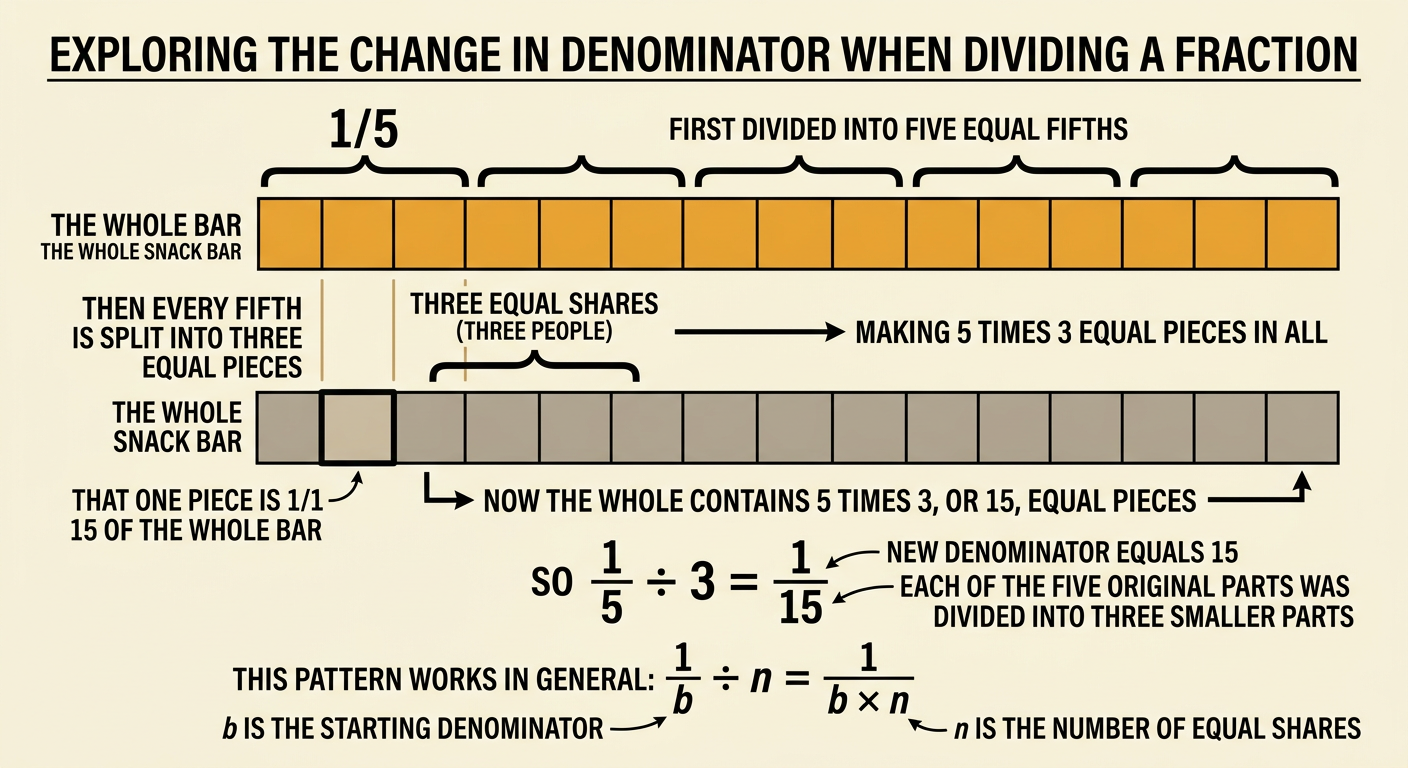
A visual model helps explain the equation for dividing a unit fraction by a whole number. Suppose 1/5 is divided equally among 3 people. Draw one whole divided into five equal fifths. Then divide each fifth into three equal pieces. The whole now contains 5 × 3, or 15, equal pieces. The original 1/5 contains three of those pieces, and sharing them among 3 people gives each person one piece. Each piece is 1/15 of the whole, so 1/5 ÷ 3 = 1/15. In general, 1/b ÷ n = 1/(b × n), where b and n are nonzero whole numbers.
Solve Division Problems
To divide a unit fraction by a nonzero whole number, multiply the fraction’s denominator by the whole number and keep the numerator 1. For example, solve 1/4 ÷ 3. Imagine one whole divided into four equal fourths. Split each fourth into three equal pieces. The whole is now divided into 4 × 3 = 12 equal pieces. One fourth contains three of those pieces. When the three pieces are shared equally among three groups, each group receives one piece, or 1/12 of the whole. Thus, 1/4 ÷ 3 = 1/12. Check that the answer is smaller than 1/4 because dividing into three shares makes each share smaller.

Explain the Quotient
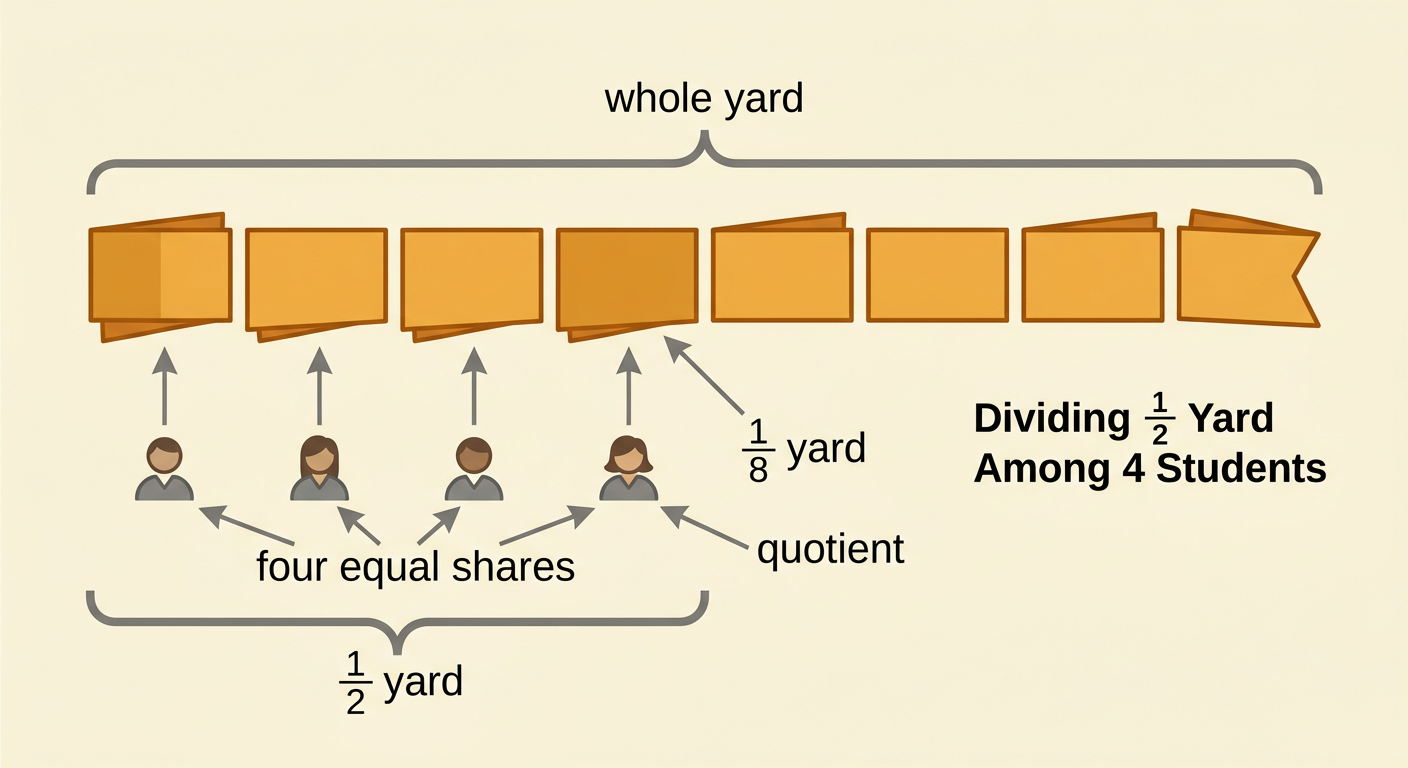
The quotient tells the size of each equal share. Suppose 1/2 yard of ribbon is shared equally among 4 students. The equation is 1/2 ÷ 4 = 1/8. To explain the quotient, say, “When half of a yard is divided into four equal shares, each student receives 1/8 yard.” The quotient 1/8 is measured in relation to the original whole yard, not just the half-yard piece. It is reasonable because 1/8 is smaller than 1/2. A complete explanation should identify the starting amount, the number of equal shares, and the size of each share. It should also include a correct equation with a unit of measurement when appropriate.