Division as an Unknown-Factor Problem
Students connect multiplication and division by finding the missing factor in related equations and fact families.

Illustrations are auto-generated and may be placeholders. They can be refreshed to match the narration.
Review Related Operations
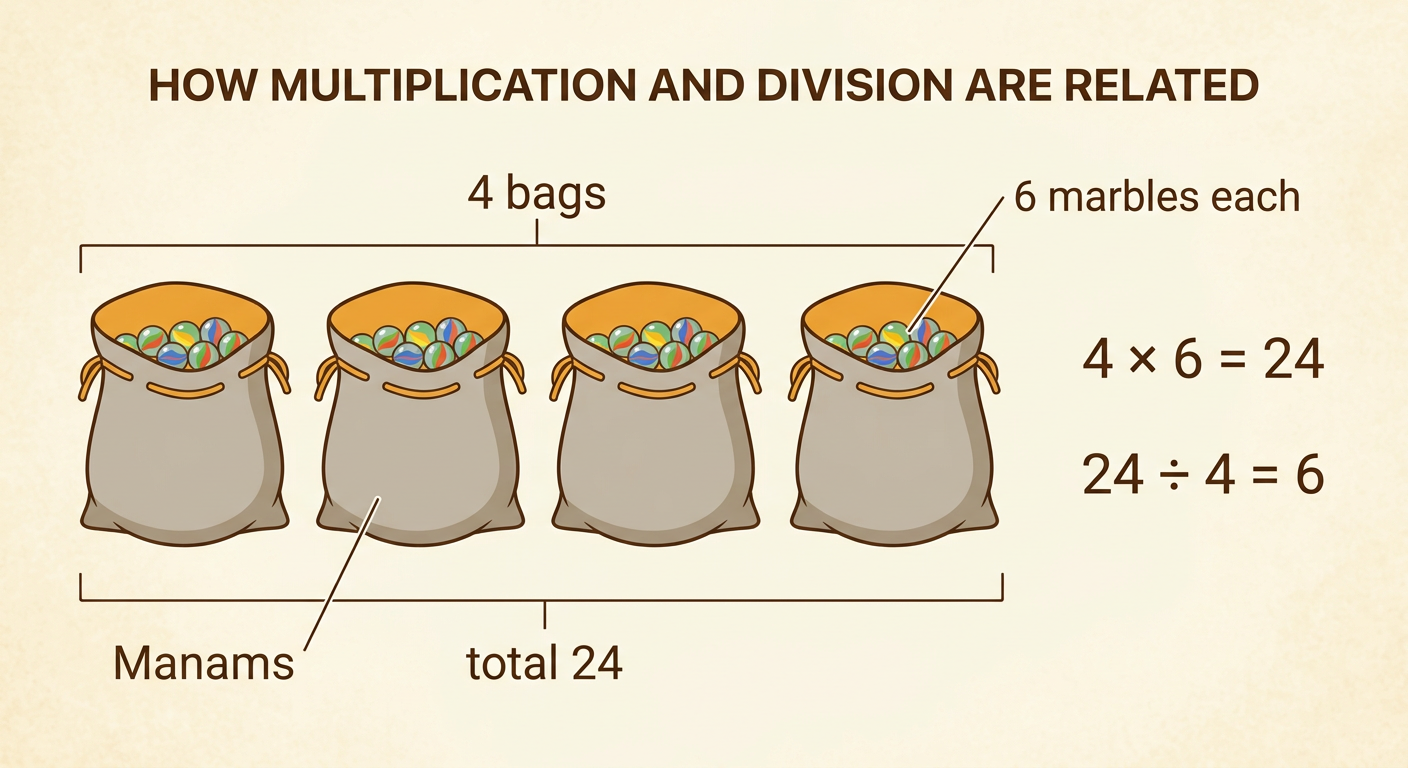
Multiplication and division are related operations. Multiplication joins equal groups to find a total, while division uses a known total to find the size or number of equal groups. Suppose 4 bags hold 6 marbles each. Multiplication shows the total: 4 × 6 = 24. If 24 marbles are shared equally among 4 bags, division finds the number in each bag: 24 ÷ 4 = 6. If the marbles are placed 6 in each bag, 24 ÷ 6 = 4 finds the number of bags. The same three numbers appear because each equation describes the same equal-group situation. You can use a multiplication fact you know to solve a related division fact.
Model a Missing Factor
In division, an unknown factor is a number that is missing from a multiplication equation. To solve 28 ÷ 7, ask, “What number multiplied by 7 equals 28?” Write 7 × ? = 28. Model 28 counters in equal groups of 7. Four groups use all 28 counters, so the missing factor is 4. Therefore, 7 × 4 = 28 and 28 ÷ 7 = 4. You can also skip-count by 7: 7, 14, 21, 28. You counted four multiples, which confirms the answer. Always check by multiplying the divisor and quotient. If their product equals the dividend, the division equation is correct.

Connect Multiplication and Division Equations
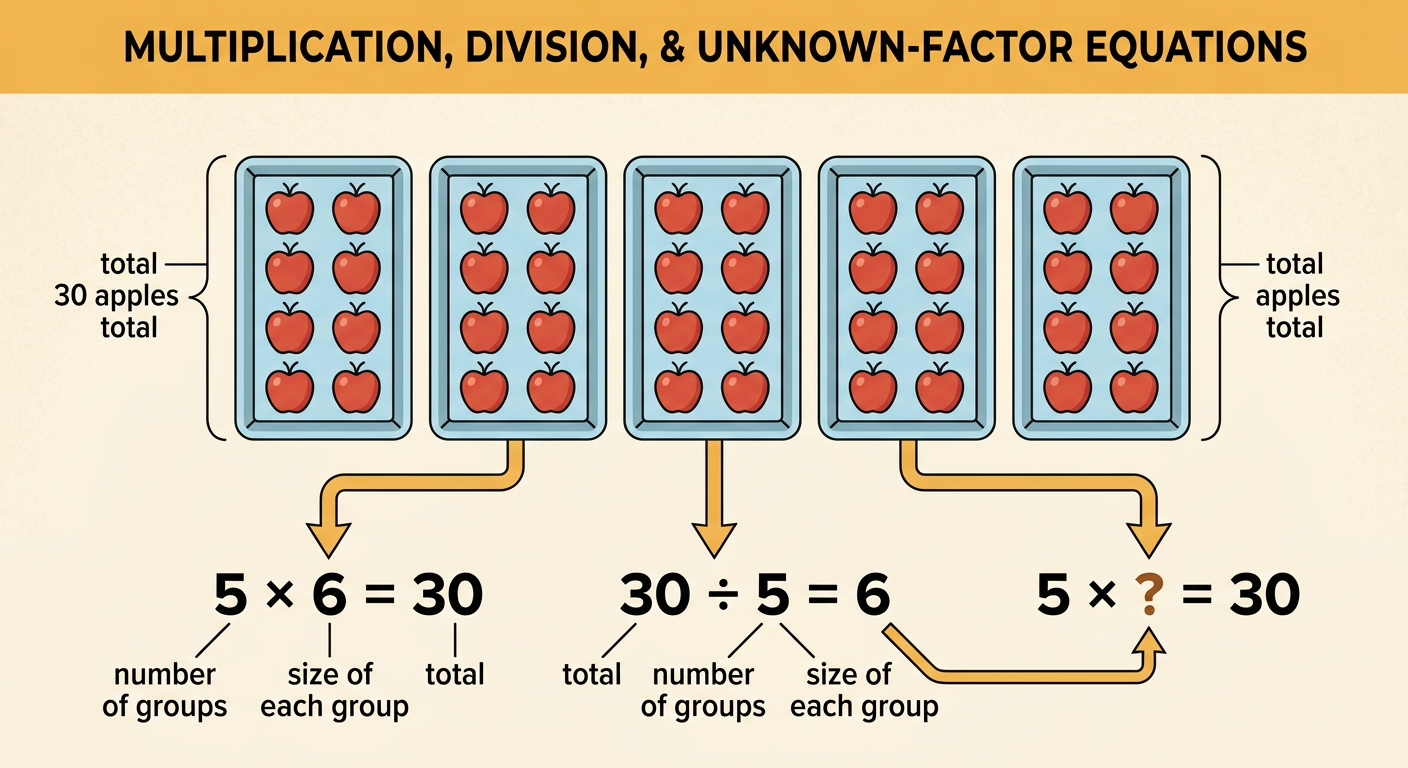
A multiplication equation and a division equation can tell the same story. Imagine 5 trays with 6 apples on each tray. The equation 5 × 6 = 30 gives the total number of apples. Now start with the total and ask how many apples belong on each of 5 trays. The equation becomes 30 ÷ 5 = 6. In unknown-factor form, write 5 × ? = 30. The quotient, 6, fills the missing-factor space. Notice each number’s job: 30 is the total, 5 is the known number of groups, and 6 is the size of each group. Moving between these equations helps you reason instead of guessing.
Build Fact Families
A fact family is a group of multiplication and division equations made from the same three numbers. Use 6, 8, and 48. Since 6 × 8 = 48, changing the factor order gives 8 × 6 = 48. The related division equations are 48 ÷ 6 = 8 and 48 ÷ 8 = 6. To build a fact family, place the product, 48, first in each division equation. Then divide by one factor to find the other factor. Every equation can check another equation in the family. For example, if you solve 48 ÷ 8 = 6, check with 8 × 6 = 48. A fact family usually has four equations, but when both factors are the same, some equations repeat.

Practice Unknown-Factor Problems
When you face an unknown-factor problem, first identify the total and the known factor. For 42 ÷ 6, think 6 × ? = 42. Recall multiples of 6 or draw equal groups. Because 6 × 7 = 42, the quotient is 7. For ? × 8 = 32, use the related equation 32 ÷ 8 = ?. Since 8 × 4 = 32, the missing factor is 4. Try another: 27 ÷ 3 = ?. Think 3 × ? = 27, so the answer is 9. Check every result by multiplying. If 3 × 9 equals 27, your answer fits the original total. Use arrays, skip-counting, or known facts when a solution does not come to mind right away.

Complete an Exit Check
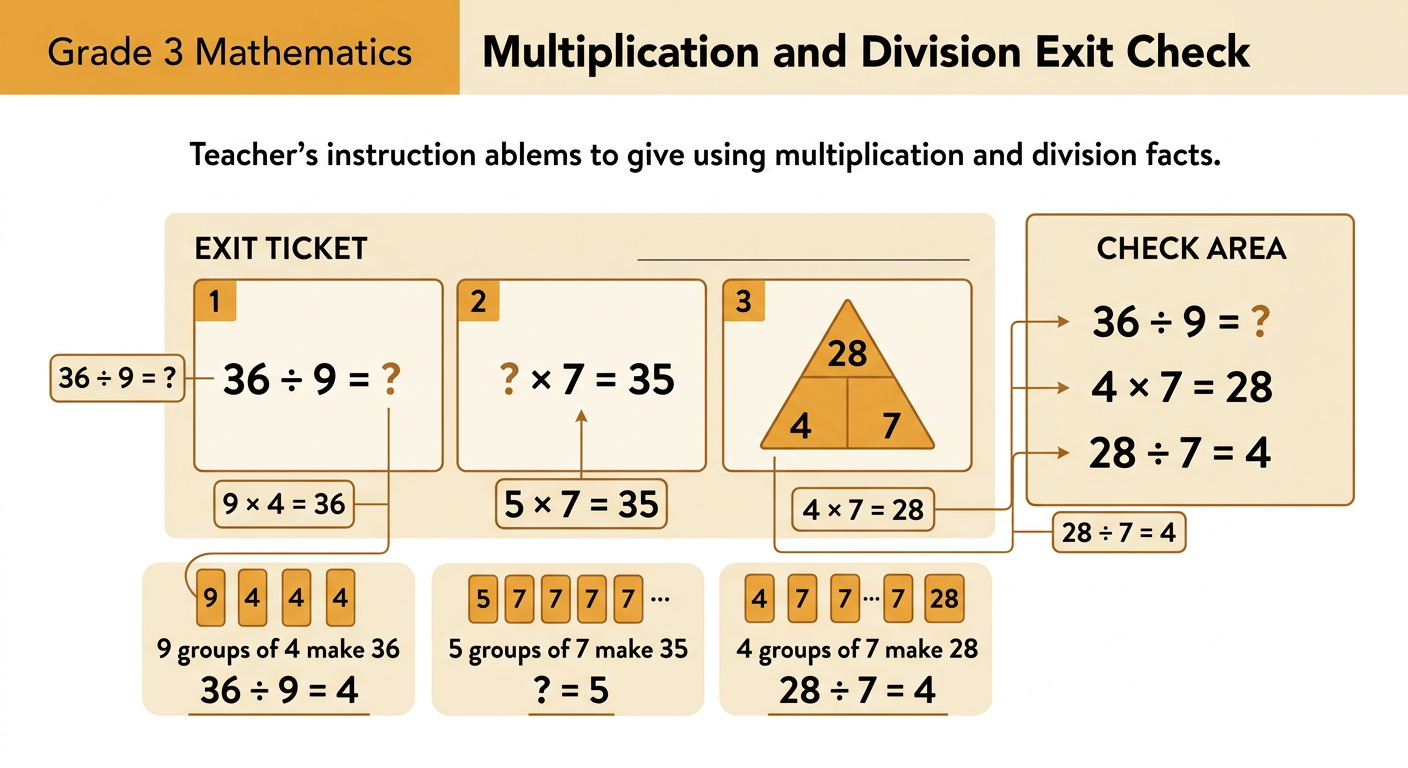
Complete each exit check without looking at the answers until you finish. First, solve 36 ÷ 9 = ?. Rewrite it as 9 × ? = 36. Second, find the missing factor in ? × 7 = 35. Third, use 4, 7, and 28 to write one multiplication equation and one related division equation. Now check your work. The first answer is 4 because 9 × 4 = 36. The second answer is 5 because 5 × 7 = 35. For the third item, one correct pair is 4 × 7 = 28 and 28 ÷ 7 = 4. If an answer was incorrect, draw equal groups and try again. You understand the lesson when you can explain how multiplication verifies each division answer.