Does Mass Change When Substances Are Mixed?
Students measure a sealed bag before and after mixing baking soda and vinegar to discover that the total mass remains the same even when new substances form.
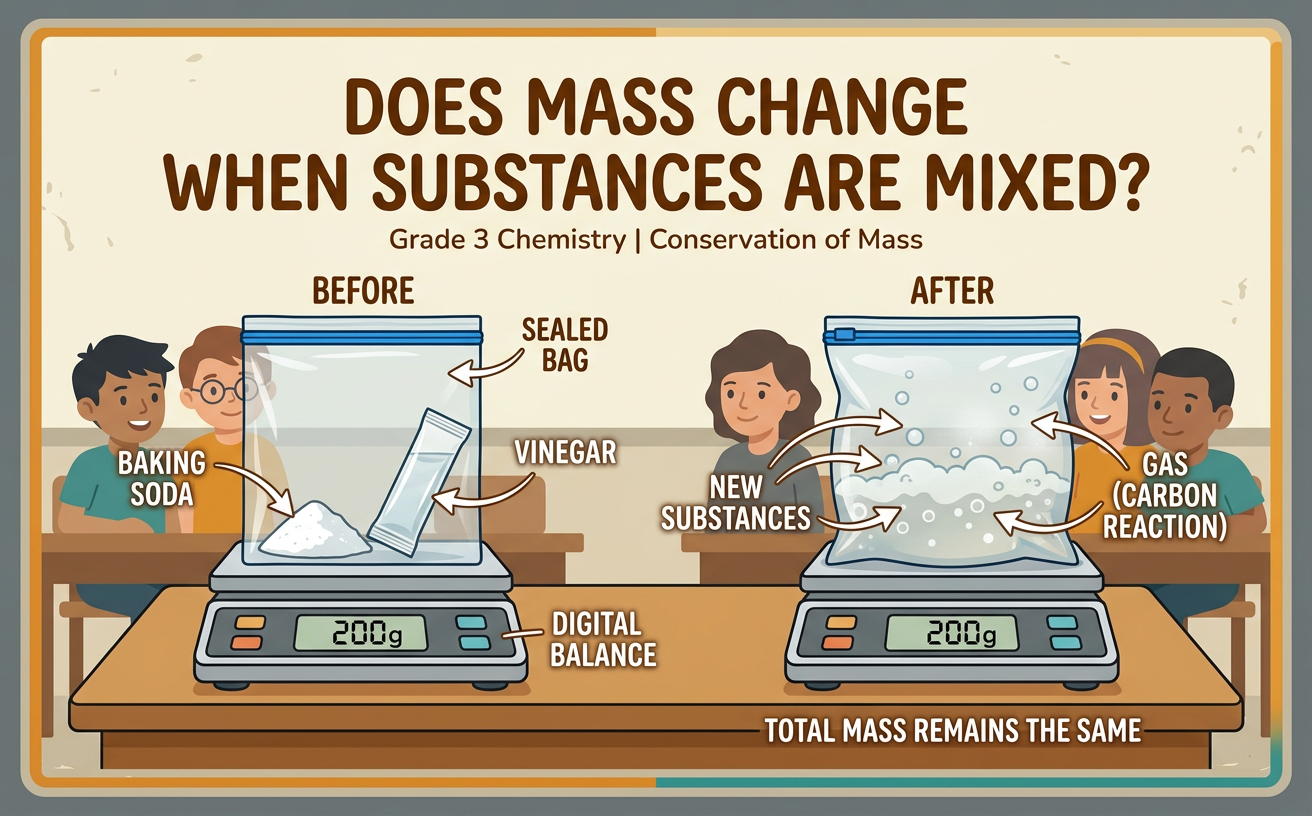
Illustrations are auto-generated and may be placeholders. They can be refreshed to match the narration.
Predict What Will Happen
Before mixing, think about what you may observe. A sealed plastic bag holds a small cup of vinegar and a separate spoonful of baking soda. When they mix, bubbles will form and the bag may puff up. The bubbles are carbon dioxide gas, a new substance made during the change. Predict whether the sealed bag will have more mass, less mass, or the same mass after mixing. For example, you might predict less mass because the baking soda seems to disappear. You might instead predict the same mass because nothing can leave the sealed bag. Record your prediction and explain your reason. A prediction is not a guess to hide or change later. It is an idea that you will test by carefully measuring and comparing evidence.

Measure the Sealed Materials
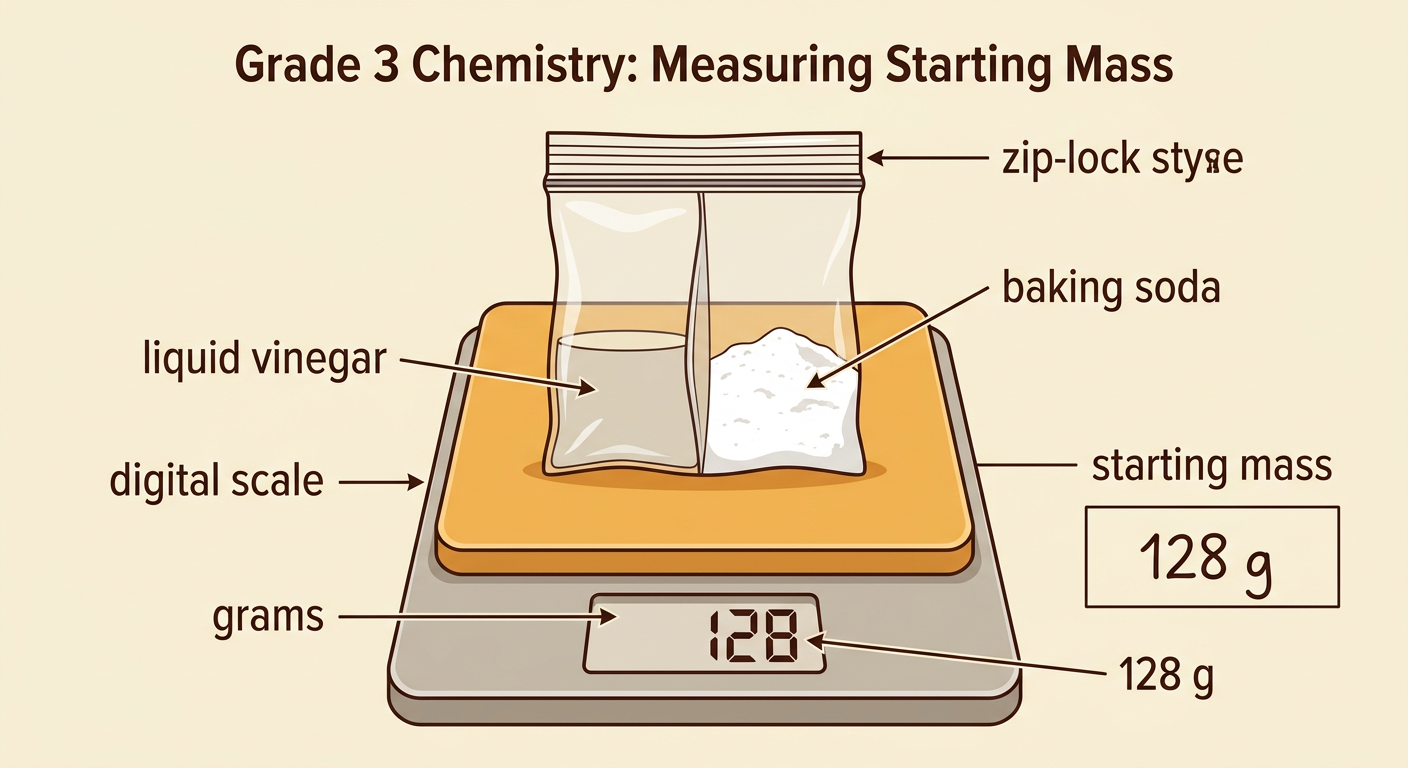
First, measure all the materials before they react. Make sure the vinegar and baking soda are inside the bag but still separated. Press out extra air if your teacher directs you, then seal the bag completely. Place the entire bag on a balance or digital scale. Keep every part of the bag on the scale and wait until the number stops changing. Record the mass in grams. For example, the sealed bag and its contents might have a mass of 128 grams. Include the unit when you write the measurement: 128 g. Do not open the bag or remove anything after measuring. This first number is the starting mass. Careful measurement matters because you will compare it with the mass of the same sealed bag after the reaction.
Mix Without Opening the Bag
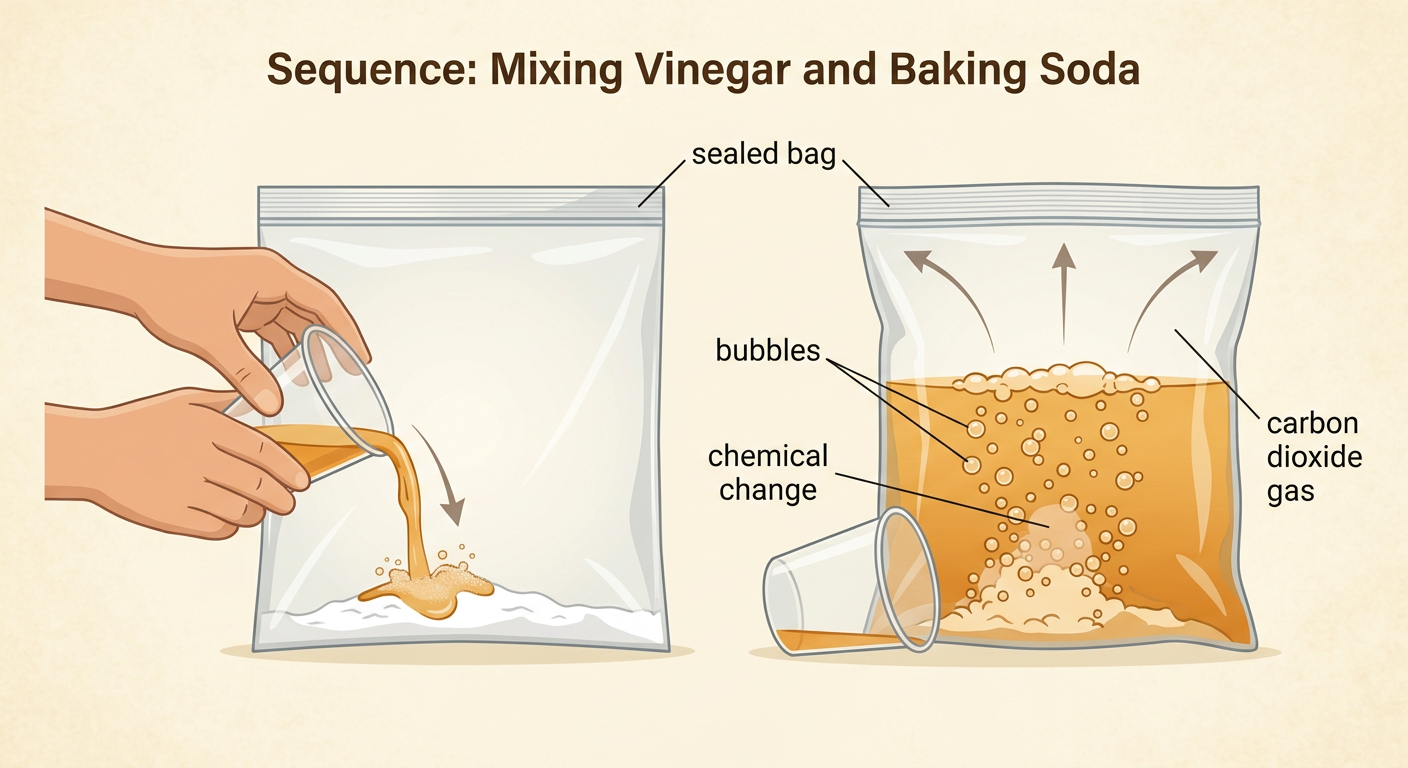
Leave the bag sealed while you mix the materials. Gently tip the small cup so the vinegar touches the baking soda. The mixture will fizz, and many bubbles will appear. The bag may expand as carbon dioxide gas forms. This is evidence that a chemical change is happening and new substances are being made. Even though the baking soda may seem to vanish, its matter has not vanished. Its particles have become parts of different substances. The gas also has mass and remains inside the sealed bag. For example, a puffed-up bag still contains the gas, liquid, and all other materials that were present at the start. Handle the bag gently, keep it away from your face, and follow your teacher’s directions. Do not open or squeeze the bag.
Measure the Bag Again
When the fizzing slows, place the same sealed bag back on the same scale. Do not open it, let gas out, or wipe away any material from inside. Arrange the bag so every part rests on the scale without touching the table or another object. Wait for the display to settle, then record the ending mass in grams. For example, the scale may again read 128 g. If it changes between 127 g and 128 g, wait and ask your teacher how to record the measurement. Small differences can happen because a scale has limited precision or because the bag is touching something. Measure a second time if needed. Using the same scale and the same complete sealed bag makes the comparison fair.

Compare the Mass Data
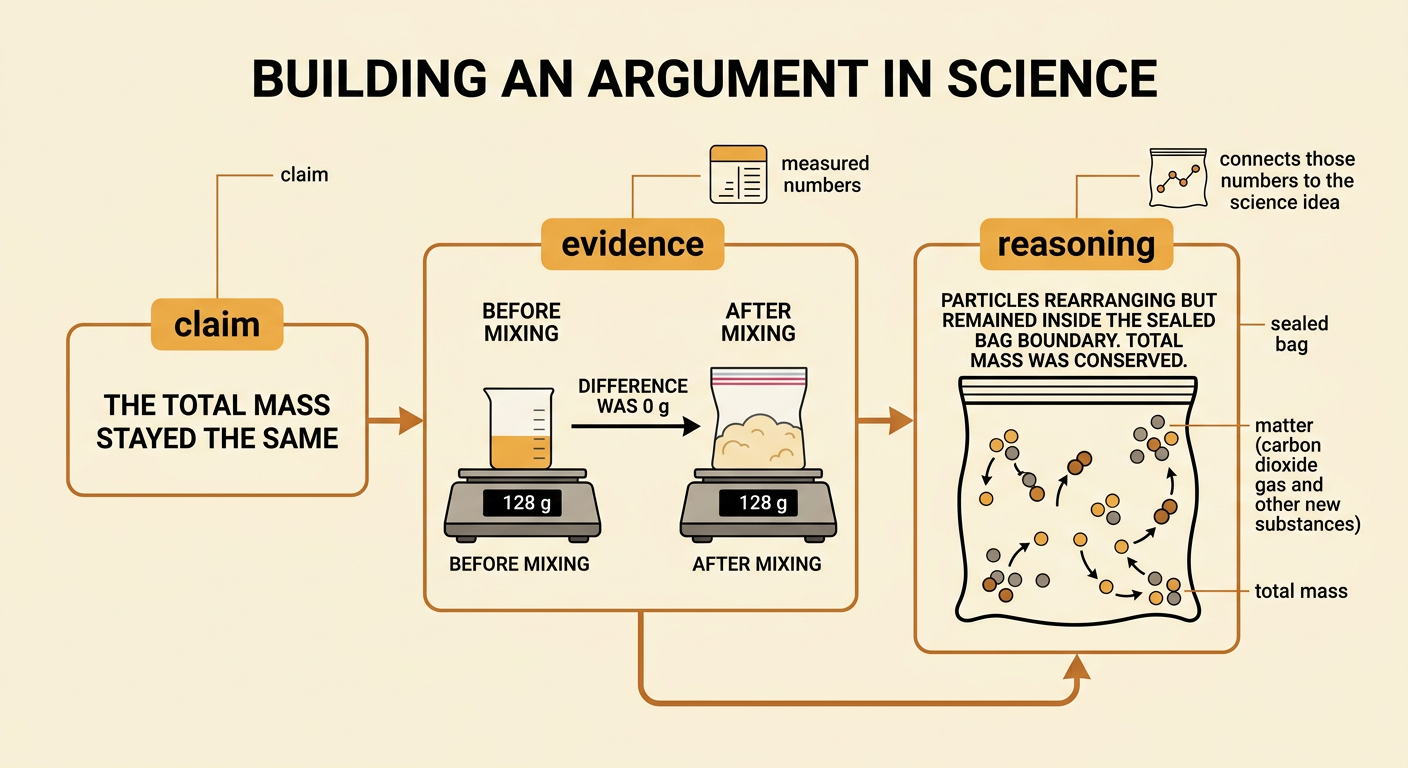
Put the starting and ending masses in a table or bar graph. Label the measurements in grams. Suppose the starting mass was 128 g and the ending mass was 128 g. Subtract to find the difference: 128 g minus 128 g equals 0 g. The equal bars show that the total mass did not change. The bag looks different because it is puffed up, but size and mass are not the same property. If your measurements differ by 1 gram, check whether the bag leaked, touched another object, or was placed differently. A tiny difference may also come from the scale’s precision. Look at results from repeated trials or several groups. The overall pattern should show that mass is conserved when all matter stays inside the sealed bag.

Make a Claim from Evidence
Use the measurements to make a claim and support it with evidence. A clear claim is: The total mass stayed the same when baking soda and vinegar mixed in a sealed bag. Then give numerical evidence. For example: The bag had a mass of 128 g before mixing and 128 g after mixing, so the difference was 0 g. Explain why the evidence supports the claim. The reaction formed carbon dioxide gas and other new substances, but all the matter remained inside the sealed bag. Therefore, the total mass was conserved. You can also address another idea: The bag grew larger, but that does not mean it gained mass. Finish by checking that your argument includes a claim, measured evidence, and reasoning that connects them. Share your argument and compare it with the class data.