Does Sugar Dissolve Faster in Warm or Cool Water?
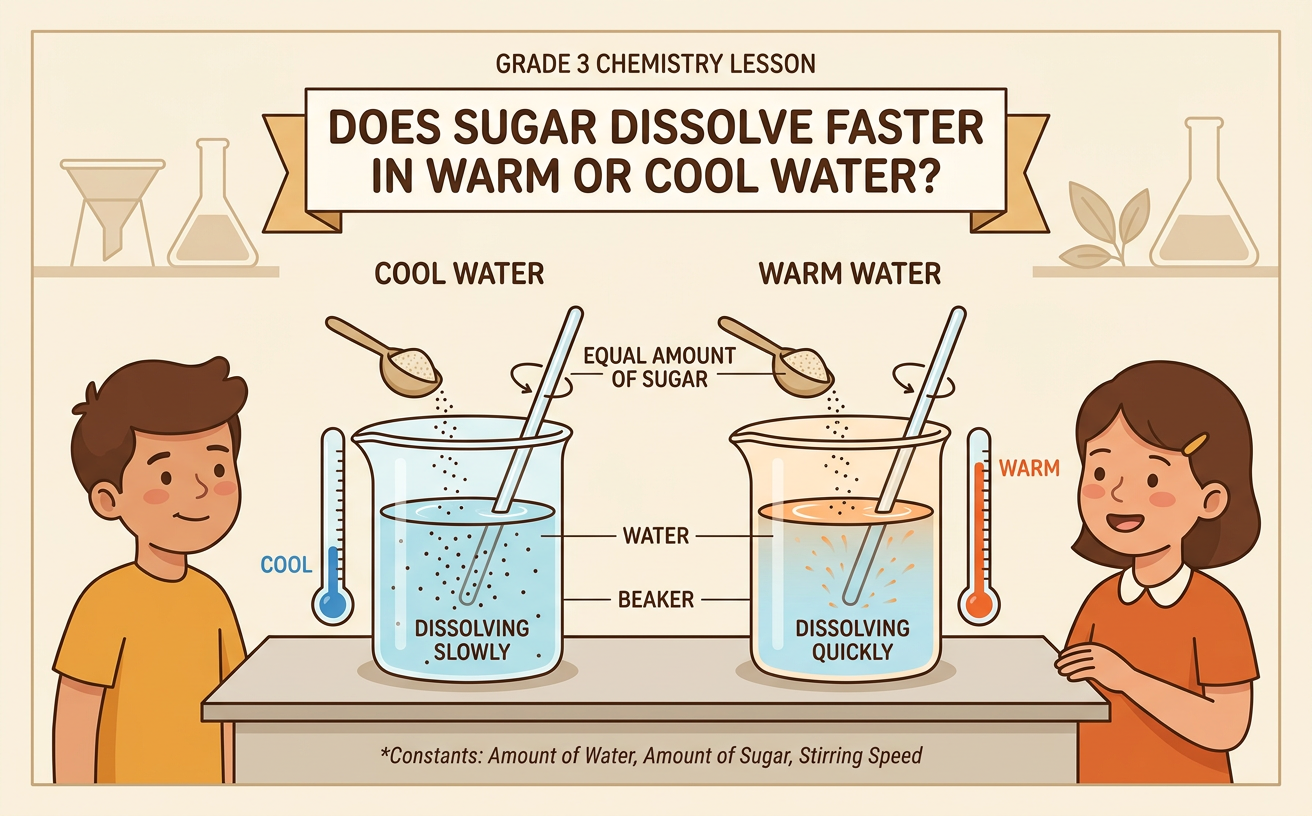
Students conduct a fair test to compare how quickly equal amounts of sugar dissolve in warm and cool water.
Illustrations are auto-generated and may be placeholders. They can be refreshed to match the narration.
Observe Sugar and Water
Look closely at dry sugar before testing it. Sugar is a solid made of many tiny crystals. Water is a liquid. When sugar is stirred into water, the crystals seem to disappear. The sugar has not vanished. It has dissolved, which means its particles have spread throughout the water. The result is a sugar-and-water solution. You can tell the sugar is still there because the water would taste sweet, but do not taste anything during a science investigation unless your teacher says it is safe. For example, when one teaspoon of sugar is added to a clear cup of water, crystals may sink at first. As you stir, fewer crystals remain visible at the bottom. In this investigation, you will observe whether water temperature changes how quickly that happens.

Make a Prediction
A prediction states what you think will happen before you begin a test. Use what you already know to make a prediction about sugar in warm and cool water. You might predict, “Sugar will dissolve faster in warm water than in cool water.” Add a reason for your thinking. For example, you may have noticed that hot cocoa mix blends quickly into warm milk. Scientists often write predictions in an if-then-because form: “If equal amounts of sugar are stirred in warm and cool water, then the sugar in warm water will dissolve first because warmth makes water particles move faster.” Your prediction does not have to be correct. The purpose of the test is to collect evidence. Afterward, you will compare your prediction with the measured results.

Set Up a Fair Test
A fair test changes only one variable at a time. In this test, the variable you change is water temperature. Everything else should stay the same. Use two identical clear cups, the same amount of water in each cup, and equal amounts of the same kind of sugar. For example, place one cup of warm water and one cup of cool water on the same table. Measure one level teaspoon of sugar for each. Use warm water that a teacher or adult has checked; never use very hot or boiling water. Add the sugar at the same time if two students are working together. Stir each cup in the same way, at the same speed, with the same number of turns. These controls help make sure that temperature, not a different cup, amount, or stirring method, causes any difference.

Measure Dissolving Times
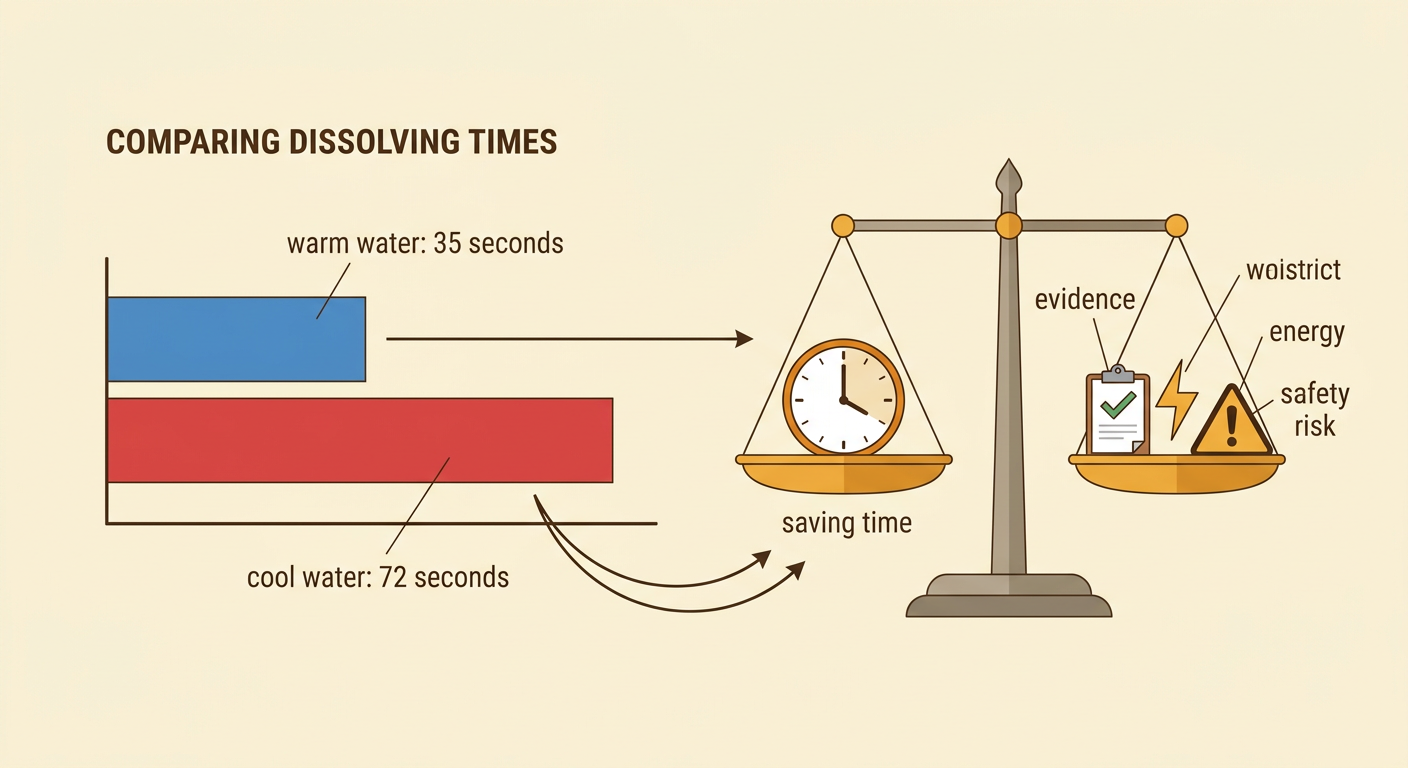
Elapsed time is how much time passes from the start of an event to the end. Use a stopwatch or a clock that shows seconds. Start timing when the sugar enters the water. Stir both cups in the same way. Stop the timer for each cup when no sugar crystals are visible on the bottom or moving through the water. Record each time in a data table. For example, suppose the sugar in warm water dissolves in 35 seconds and the sugar in cool water dissolves in 72 seconds. Write the times beside the correct cup names. Careful measurement makes the comparison more useful. If possible, repeat the test two or three times using fresh water and sugar. Repeated trials can show whether the pattern happens again instead of appearing only once.

Compare Results and Explain
Compare the elapsed times in your data table. A smaller number of seconds means the sugar dissolved faster. In the example, warm water took 35 seconds and cool water took 72 seconds. The warm-water time was 37 seconds shorter, so the sugar dissolved faster in warm water. Warm water particles move faster and interact with the sugar more often, helping pull sugar particles away from the crystals. State whether the evidence supported your prediction. Also consider benefits and costs. Warm water may save time when dissolving sugar for a drink or recipe. However, heating water uses energy, which may cost money and use natural resources. Very warm water can also create a safety risk. Cool water may take longer, but it does not require energy for heating. The best choice depends on whether saving time is worth the added energy, cost, and safety concerns.