
Earth Changes: Fast or Slow?
Students use photographs and simple evidence to compare Earth changes that happen quickly, such as landslides, with changes that occur slowly, such as erosion.

Illustrations are auto-generated and may be placeholders. They can be refreshed to match the narration.
Notice Changes in Earth’s Surface
Earth’s surface includes landforms such as hills, valleys, beaches, and cliffs. The surface can change when rock, soil, sand, or water moves. Some changes are easy to notice because they happen in a short time. Other changes are so slow that people may not notice them each day. For example, waves carry a little sand away from a beach again and again. After many months or years, the beach may look narrower. Wind, flowing water, ice, and gravity can all change the land. People can look at photographs, maps, and the land itself to find signs of change. Cracks, piles of fallen rock, and worn-down surfaces are clues that Earth’s surface has changed.

Compare Fast and Slow Events
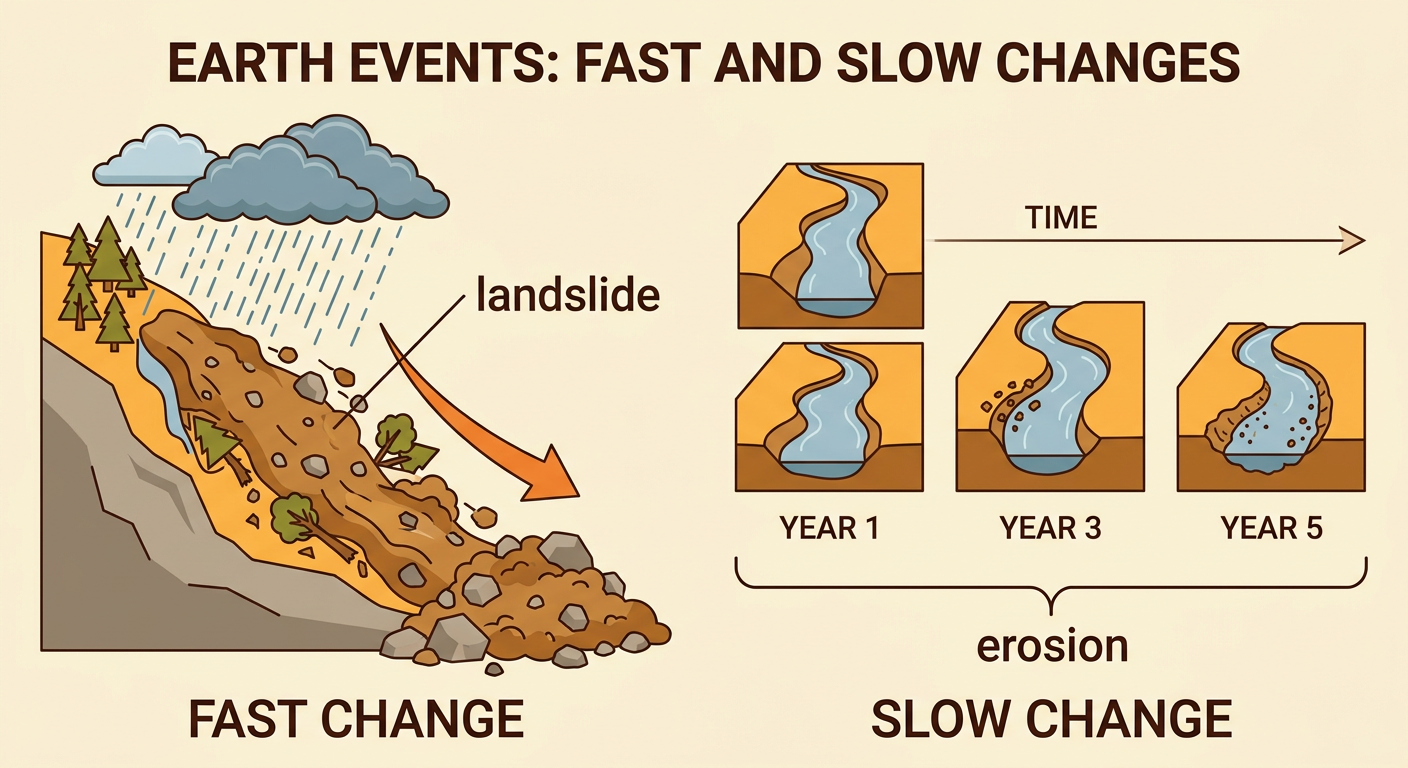
Earth events can happen at different speeds. A landslide is a fast event because a large amount of rock and soil may rush downhill in seconds or minutes. Heavy rain can soak the soil and help start a landslide. Erosion is often a slow change. During erosion, wind or water carries away small pieces of rock and soil. A stream may slowly wear away its banks over many years. Fast does not always mean more important, and slow does not mean nothing is happening. Both kinds of events reshape places. To compare their speeds, ask how long the change takes. Does it happen while a person watches, or does it become clear only after comparing the place over months or years?
Examine Photograph Evidence
Photographs can provide evidence about how a place has changed. Scientists often compare pictures of the same place taken at different times. First, look for features that appear in both photographs, such as a large tree, a bend in a river, or a building. These matching features help you compare the same area. Next, notice what is different. Imagine that an older photograph shows a wide riverbank beside a tree. A photograph taken five years later shows the river much closer to the tree. This is evidence that part of the bank was worn away or carried off. A photograph shows the result of change, but it may not show every cause. Other information, such as rainfall records or observations, can add more evidence.
Sort Earth Changes by Speed
Sorting Earth changes by speed helps us find patterns. Place an event in the fast group if most of the visible change happens in seconds, minutes, hours, or days. Earthquakes, volcanic eruptions, floods, and landslides can change land quickly. Place an event in the slow group if the change usually builds over many months, years, or longer. A river wearing away a canyon, waves eroding a cliff, and sand building up into a dune are usually slow changes. Some events can fit differently depending on the evidence. A flood may quickly wash away soil, but a river can also slowly erode its bank. Always name the specific change and use a time clue. For example, “The hillside collapsed in one minute” belongs in the fast group.

Explain a Claim with Evidence
A claim is a sentence that answers a question. Evidence is information that supports the claim. Suppose two photographs show a cliff before and after a storm. In the first photograph, a large rock sticks out from the cliff. In a photograph taken the next morning, the rock is gone and broken pieces lie below. A strong claim is, “The cliff changed quickly.” The photograph dates and fallen rock are evidence because they show that the change happened overnight. You can connect the evidence to the claim by explaining, “Only one night passed between the photographs, so the rockfall was a fast event.” Use more than one source when possible. A photograph, a map, an eyewitness note, or a weather report can provide helpful evidence about what changed and how long it took.
