Earth’s Energy Budget and the Greenhouse Effect
Students use diagrams and data to explain how incoming solar radiation, reflected energy, and greenhouse gases influence Earth’s temperature.
Illustrations are auto-generated and may be placeholders. They can be refreshed to match the narration.
Tracing Incoming Solar Energy
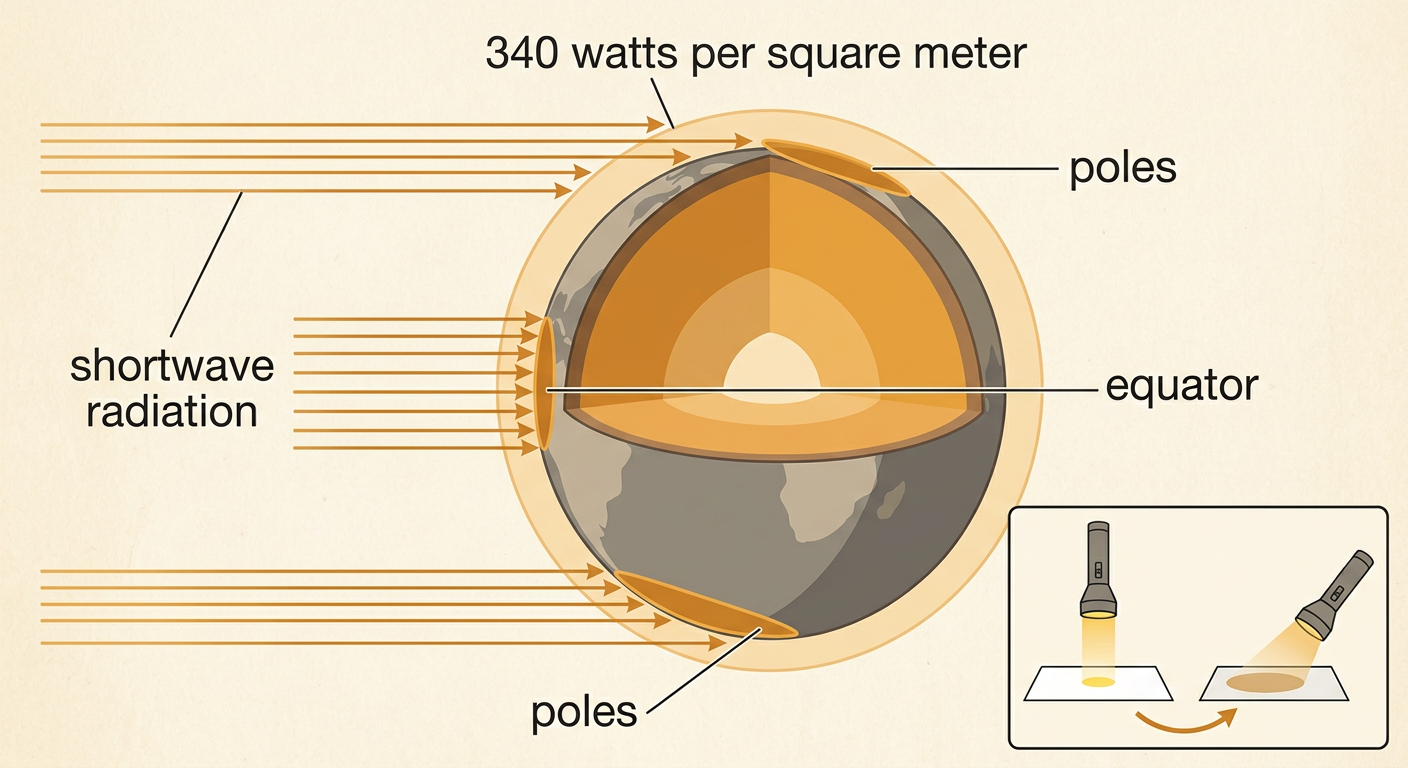
Nearly all energy that drives Earth’s climate begins as radiation from the Sun. This energy travels through space mainly as shortwave radiation, including visible light. At the top of the atmosphere, Earth receives an average of about 340 watts per square meter when sunlight is averaged over the entire planet. However, solar energy is not distributed evenly. Near the equator, sunlight strikes the surface more directly and concentrates energy over a smaller area. Near the poles, sunlight arrives at a lower angle and spreads the same amount of energy over a larger area. For example, a flashlight aimed straight at paper makes a bright, concentrated spot, while the same flashlight tilted sideways makes a wider, dimmer spot. Earth’s rotation, seasons, and curved surface therefore cause variations in incoming energy.
Reflection, Absorption, and Radiation
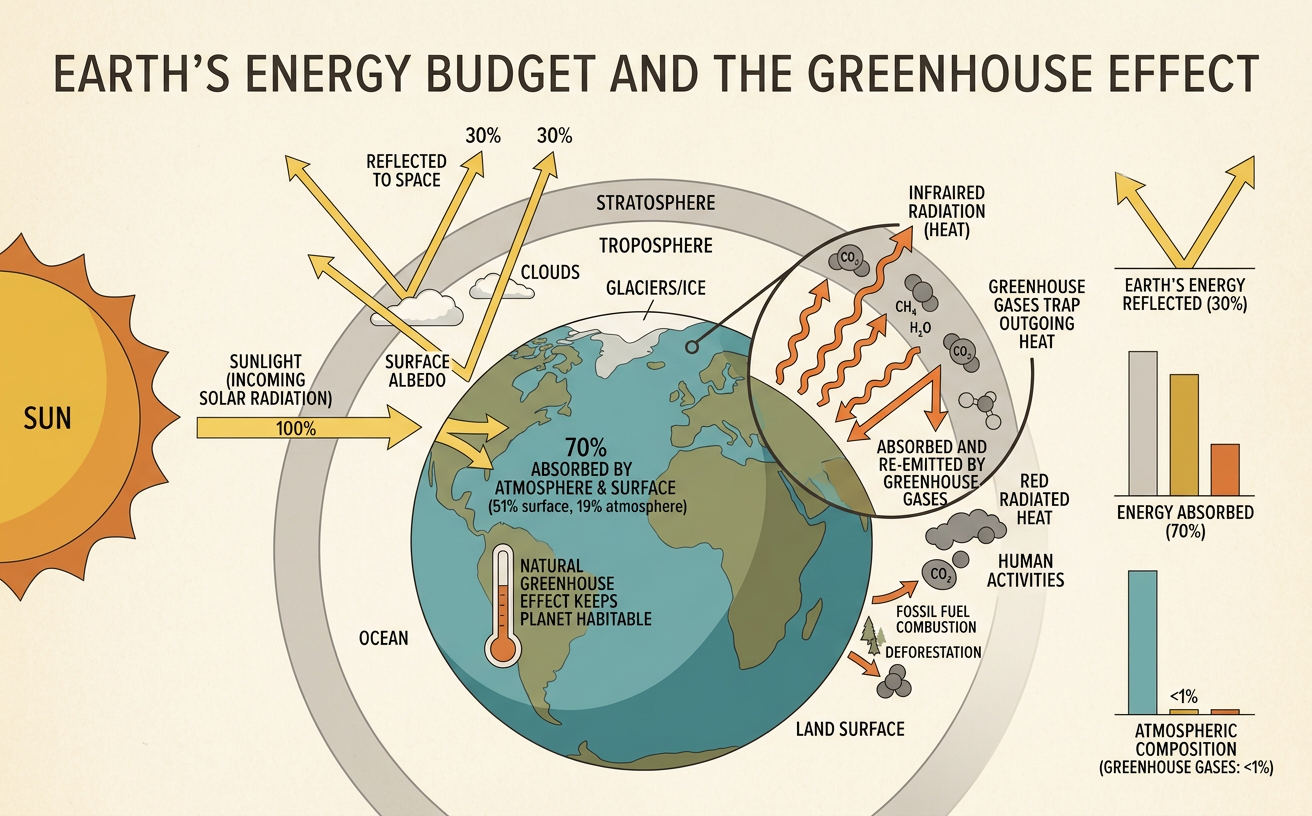
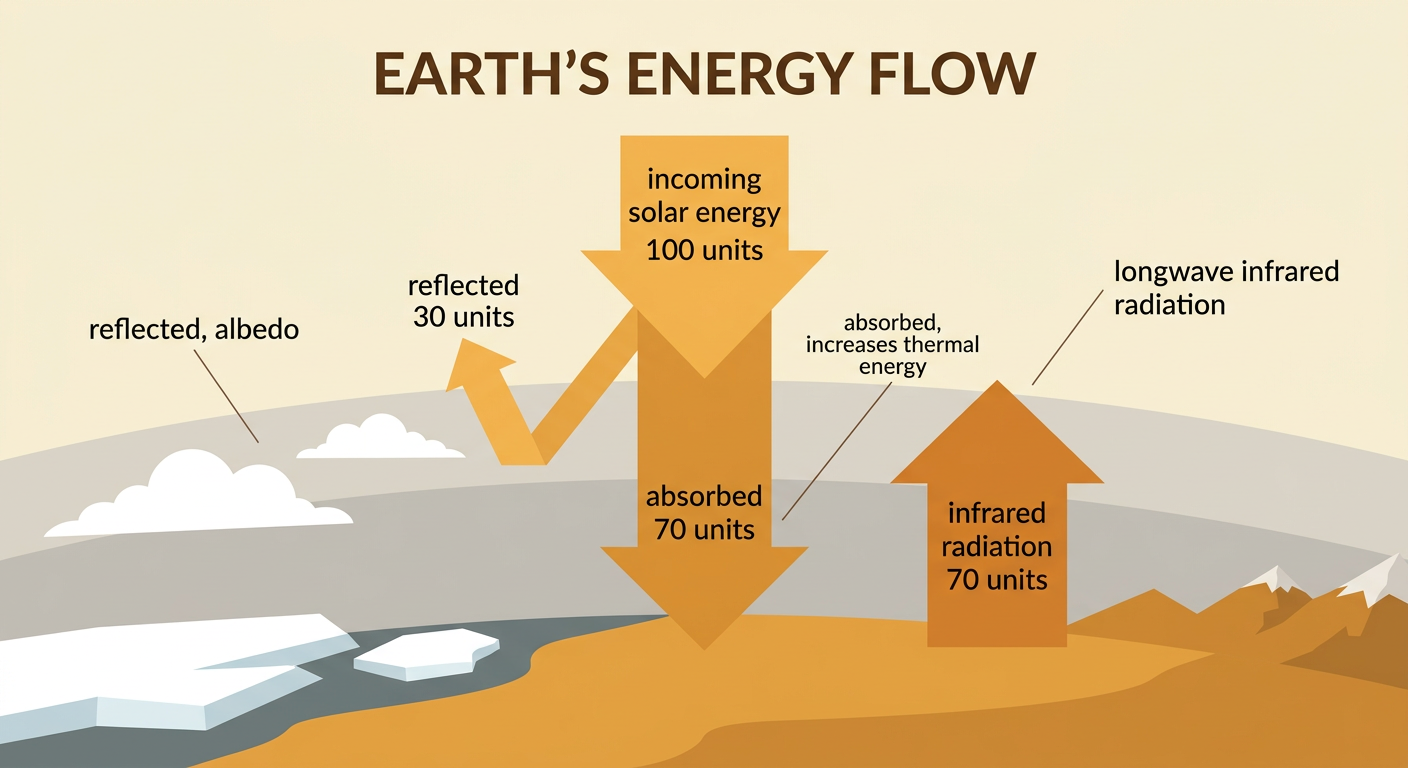
Incoming solar energy can be reflected or absorbed by Earth’s atmosphere, clouds, land, and oceans. About 30 percent is reflected back to space, mainly by clouds, ice, snow, and other bright surfaces. This reflectivity is called albedo. The remaining roughly 70 percent is absorbed by the atmosphere and surface, increasing their thermal energy. Earth then releases energy as longwave infrared radiation because the planet is much cooler than the Sun. In a simple balanced model, 100 units of solar energy arrive, 30 units are reflected, 70 units are absorbed, and 70 units of infrared energy eventually leave for space. For example, fresh snow reflects much more sunlight than dark ocean water. As a result, snow usually absorbs less solar energy and warms more slowly than the ocean under similar sunlight.
How Greenhouse Gases Retain Heat
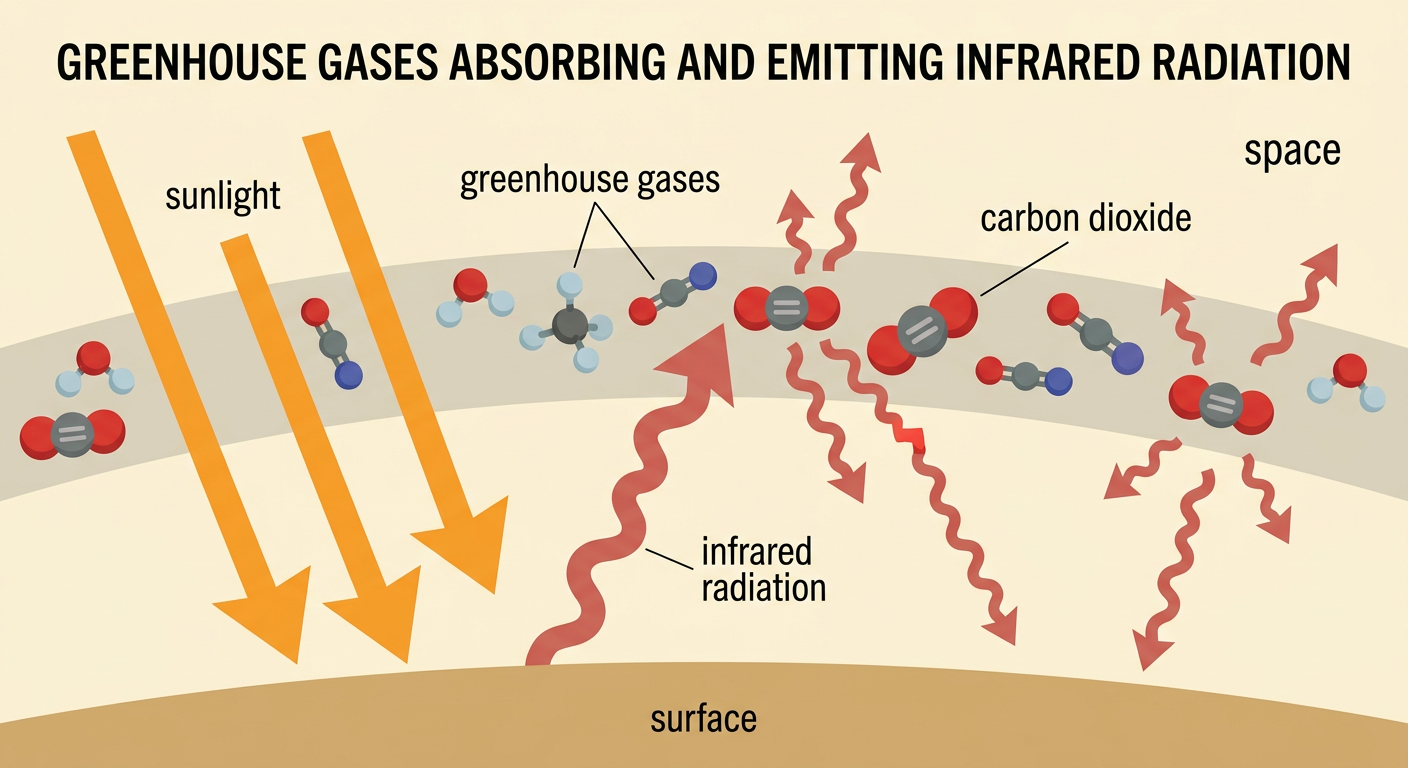
Earth’s surface absorbs solar energy and emits infrared radiation upward. Greenhouse gases, including water vapor, carbon dioxide, methane, and nitrous oxide, absorb specific wavelengths of this outgoing infrared energy. The gas molecules then emit infrared radiation in all directions. Some energy continues toward space, while some returns toward the surface and lower atmosphere. This process slows the transfer of energy from Earth to space and keeps the surface warmer than it would be without greenhouse gases. Greenhouse gases do not create energy or simply form a solid blanket. They change how infrared energy moves through the atmosphere. For example, adding carbon dioxide increases infrared absorption at certain wavelengths. The surface and lower atmosphere then warm until outgoing energy once again balances the energy Earth absorbs from the Sun.
Interpreting an Energy-Budget Model
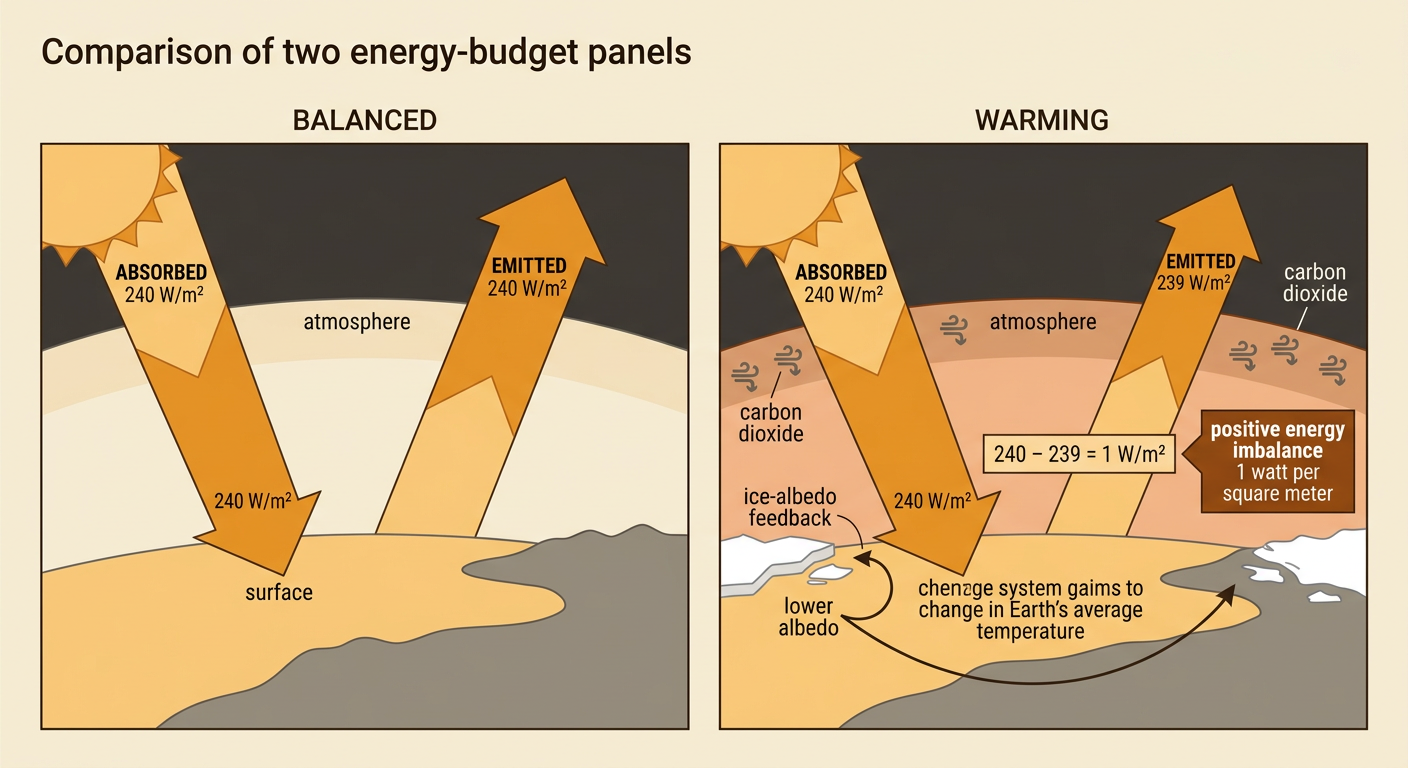
An energy-budget model uses arrows and numbers to represent energy flowing into and out of Earth’s systems. Arrow direction shows where energy moves, while arrow width or a numerical value shows the amount. Suppose a model shows 340 watts per square meter of incoming solar energy, 100 watts per square meter reflected to space, and 240 watts per square meter absorbed. If 240 watts per square meter also leaves as infrared radiation, the budget is balanced and average temperature is expected to remain relatively stable. To translate the diagram into words, state each flow and compare the totals: 340 enters, 100 is reflected, 240 is absorbed, and 240 leaves. Models simplify reality because energy exchanges also occur among the surface, clouds, oceans, and atmosphere. Even so, they help scientists identify whether Earth is gaining or losing energy.

Explaining Changes in Earth’s Temperature
Earth’s average temperature changes when energy entering and leaving the climate system becomes unbalanced. If Earth absorbs more energy than it sends to space, the oceans, land, atmosphere, and ice gain thermal energy and warm. For example, if 240 watts per square meter is absorbed but only 239 watts per square meter initially escapes, the positive difference of 1 watt per square meter produces warming. Increasing greenhouse gas concentrations can create this imbalance by reducing outgoing infrared energy until the climate warms enough to restore balance. Human activities such as burning fossil fuels and clearing forests raise carbon dioxide levels and alter physical systems. Warming can also melt reflective ice, exposing darker water or land that absorbs more sunlight. This ice-albedo feedback strengthens the initial warming and shows how human and physical Earth systems can influence one another.