
Earth’s Gravity: A Force Pulling Downward
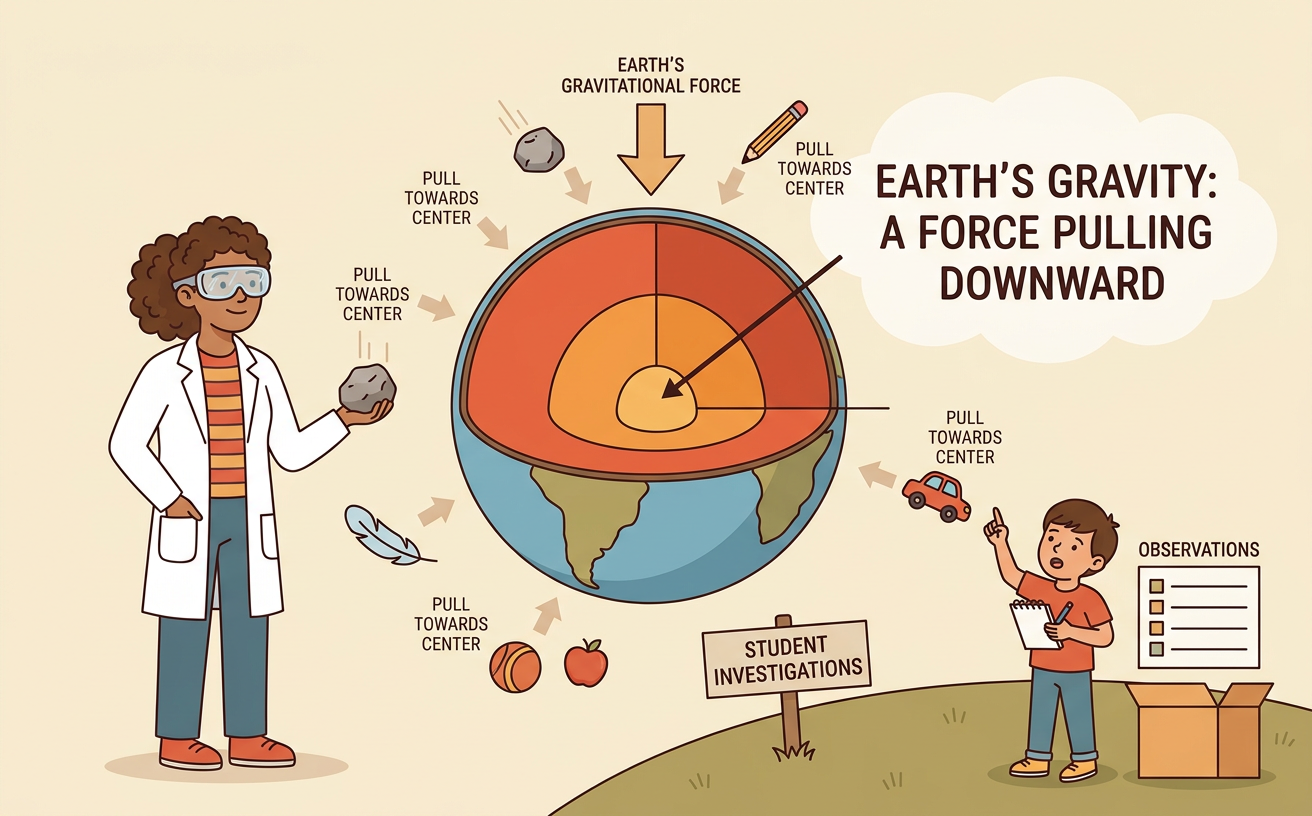
Students investigate falling objects and use observations as evidence to explain that Earth’s gravitational force pulls objects toward the planet’s center.
Illustrations are auto-generated and may be placeholders. They can be refreshed to match the narration.
Observe Falling Objects
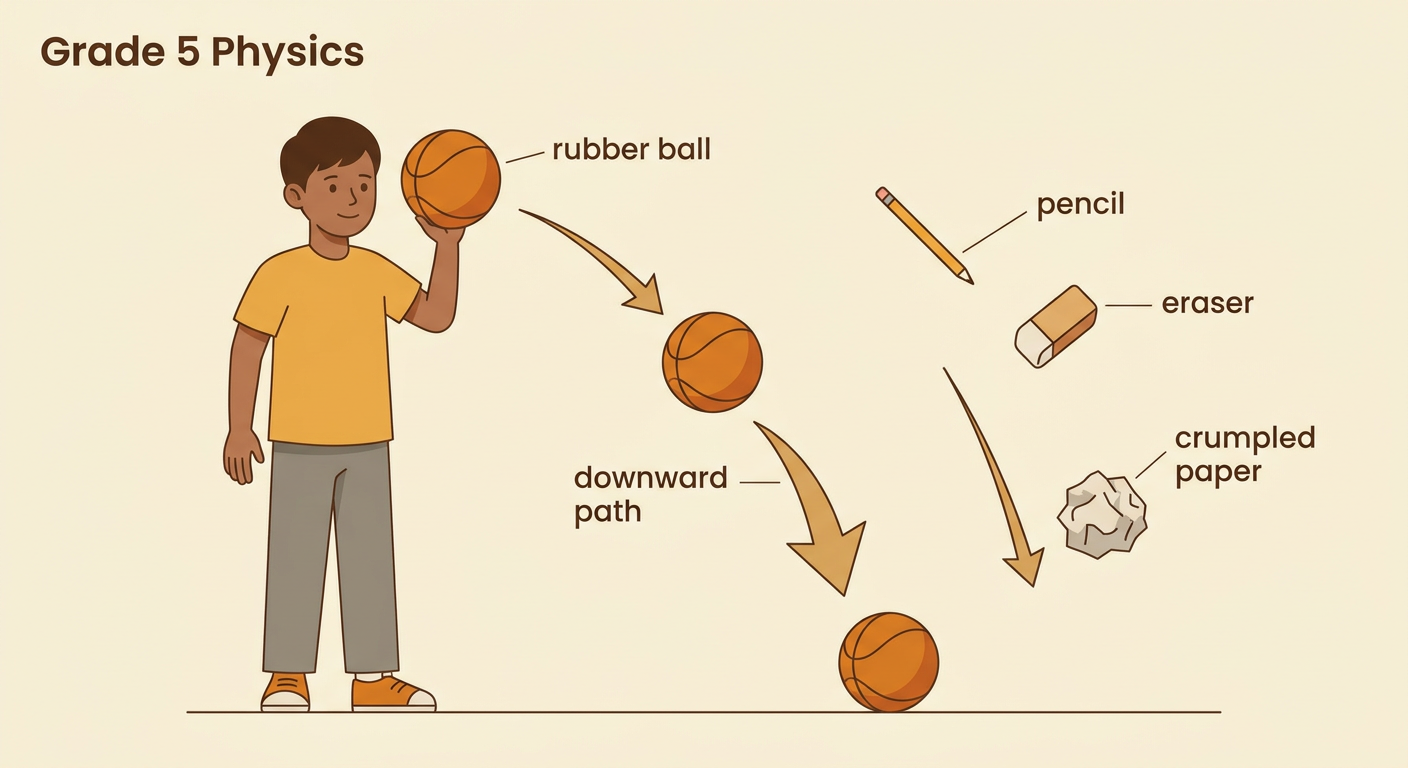
Hold a small rubber ball at shoulder height and release it without pushing. Watch its motion from the moment it leaves your hand until it reaches the floor. The ball begins moving downward because Earth pulls on it. Repeat the observation with a pencil, an eraser, and a crumpled sheet of paper. Release each object from the same height over a clear area. Record what path each object follows and whether it reaches the floor quickly or slowly. The objects may fall at different rates because their shapes and the air affect their motion. However, each object moves toward the ground. A flat sheet of paper may drift sideways, but it still moves downward overall. These repeated observations provide evidence that a force acts on every dropped object.
Define Force and Gravity
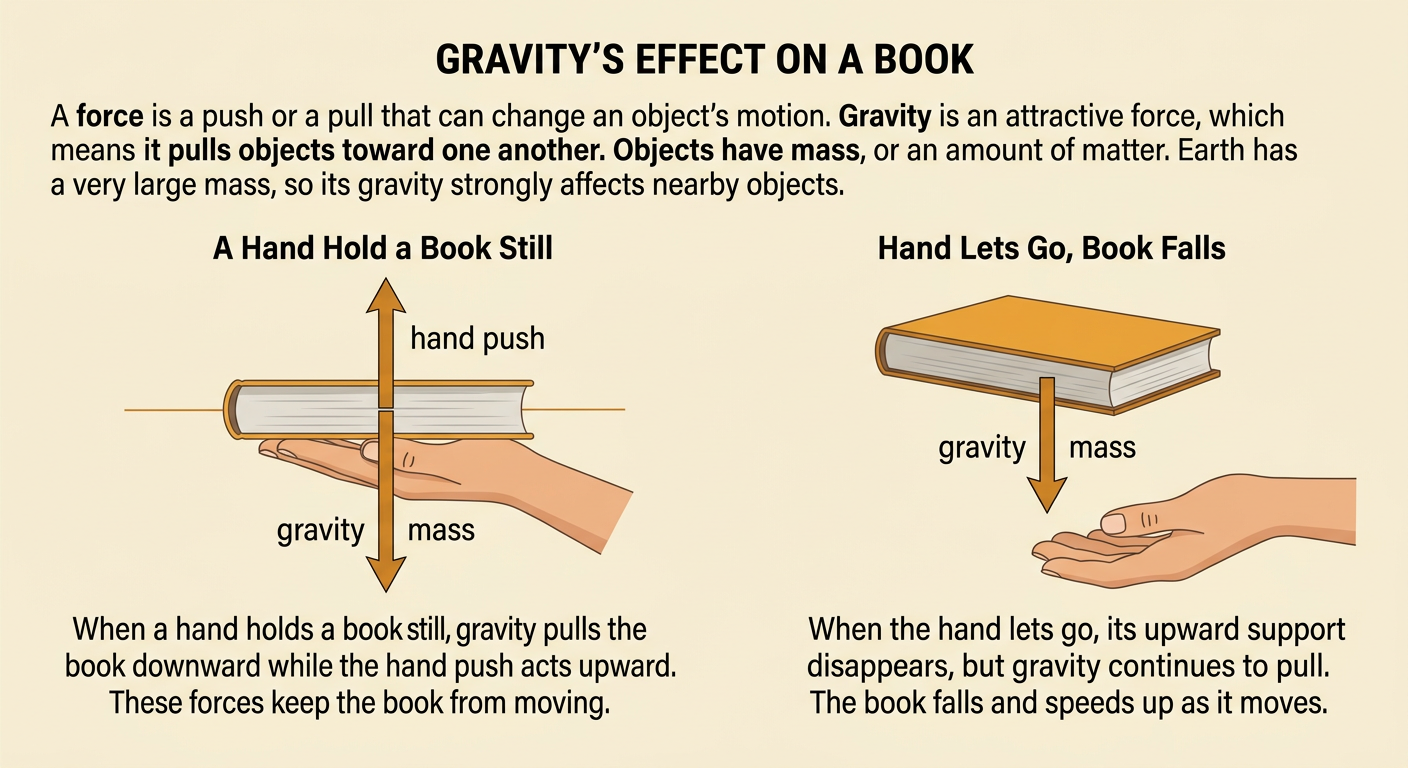
A force is a push or a pull that can change an object’s motion. Gravity is an attractive force between objects that have mass. Earth has a very large mass, so its gravitational pull affects objects near its surface. When you hold a book, Earth’s gravity pulls the book downward, while your hand pushes upward and keeps it from falling. When you let go, your hand no longer supports the book, so it falls. Gravity acts even though you cannot see it or touch it directly. Scientists identify forces by observing their effects on motion. For example, a dropped apple speeds up as it moves toward Earth. That change in motion is evidence that Earth’s gravitational force is pulling on the apple.
Compare Drop-Test Results
A fair drop test changes the object while keeping other conditions the same. Drop a rubber ball, a wooden block, and a crumpled paper ball one at a time from a height of one meter. Do not throw them. Use the same release point and record each result in a table. You might note that all three objects moved downward, while the crumpled paper ball took slightly longer to reach the floor. Repeat each test three times to check whether the pattern is consistent. Compare your results with another group’s observations. If the measurements differ, examine possible causes such as releasing from different heights, timing errors, or air movement. The strongest argument uses repeated results rather than one trial. Even when fall times differ, the shared downward direction supports the idea that Earth pulls each object toward itself.

Identify the Direction of Gravity
Near Earth’s surface, downward means toward the center of Earth. This direction depends on where a person stands. A person in North America and a person on the opposite side of the planet both call the direction toward the ground down. Their downward arrows point in different directions on a page, but both arrows aim toward Earth’s center. Gravity does not pull every object toward the bottom edge of a picture or toward one place on Earth’s surface. It pulls objects toward the planet’s center. For example, if each person drops a ball, each ball falls toward the ground beneath that person. A globe diagram helps explain why people do not fall off the opposite side of Earth: gravity pulls everyone and everything inward toward the same central region.

Build a Claim-Evidence-Reasoning Argument
Use a claim, evidence, and reasoning structure to explain the investigation. A clear claim is: Earth’s gravitational force on nearby objects is directed downward. Evidence should include specific observations from several sources. For example, your group observed that a ball, block, and crumpled paper moved toward the floor in three trials, and another group reported the same direction. A globe model also showed that local downward arrows point toward Earth’s center. In the reasoning, connect the evidence to the claim: a force can change motion, and the repeated downward motion of released objects shows that Earth pulls them toward itself. Review a classmate’s argument and ask whether the evidence is relevant and sufficient. Suggest improvements if the writer relies on only one object or confuses fall time with direction. A strong conclusion explains why the evidence supports the claim.
