
Earth’s Gravity: Why Objects Fall Down
Students observe falling objects, analyze simple measurement data, and use evidence to support the claim that Earth’s gravitational force pulls objects toward the ground.

Illustrations are auto-generated and may be placeholders. They can be refreshed to match the narration.
Observe Falling Objects
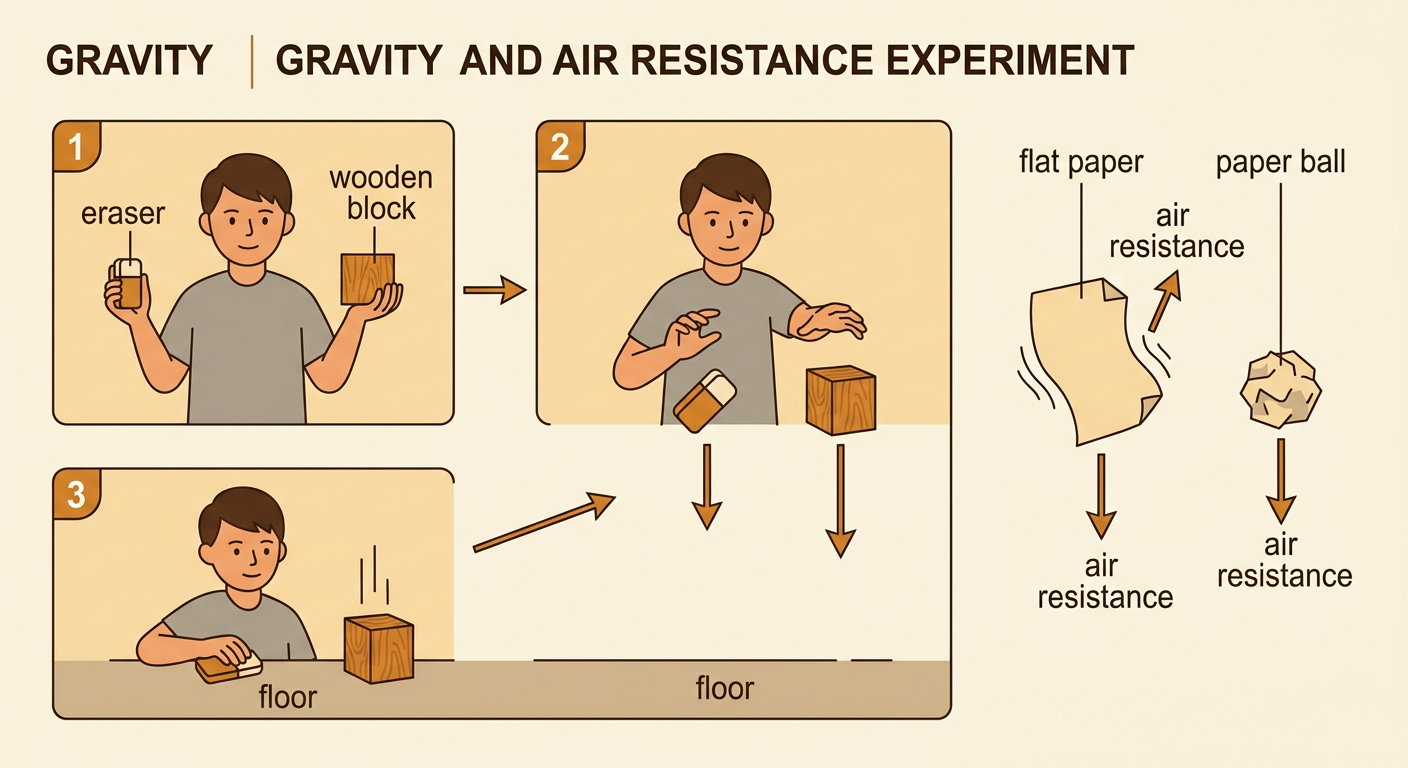
Hold a rubber eraser and a small wooden block at the same height above the floor. Predict what will happen, then release them at the same time without pushing them. Both objects move toward the floor. Repeat the observation with a flat sheet of paper and the same paper crumpled into a ball. The flat paper usually falls more slowly because air pushes against its wide surface. This effect is called air resistance. The observation does not mean gravity stopped pulling the flat paper; gravity pulls every object downward while air resistance can change how quickly it falls. Record only what you can observe, such as the direction of motion, which object landed first, and whether an object fluttered or moved straight down.
Define Gravity and Downward Force
Gravity is an attractive force between objects that have mass. Earth has an enormous amount of mass, so its gravity pulls nearby objects toward Earth’s center. At any place on Earth’s surface, we call that direction down. For example, when an apple leaves your hand, Earth’s gravitational force pulls it downward. The apple also pulls on Earth, but Earth’s motion is too tiny to notice because Earth is vastly more massive. A force can act without visible contact, so Earth does not need to touch the apple to pull it. In a force diagram, an arrow pointing down from the apple represents Earth’s gravitational force. The arrow shows the force’s direction, not the exact path through the planet.

Measure and Record Drop Data
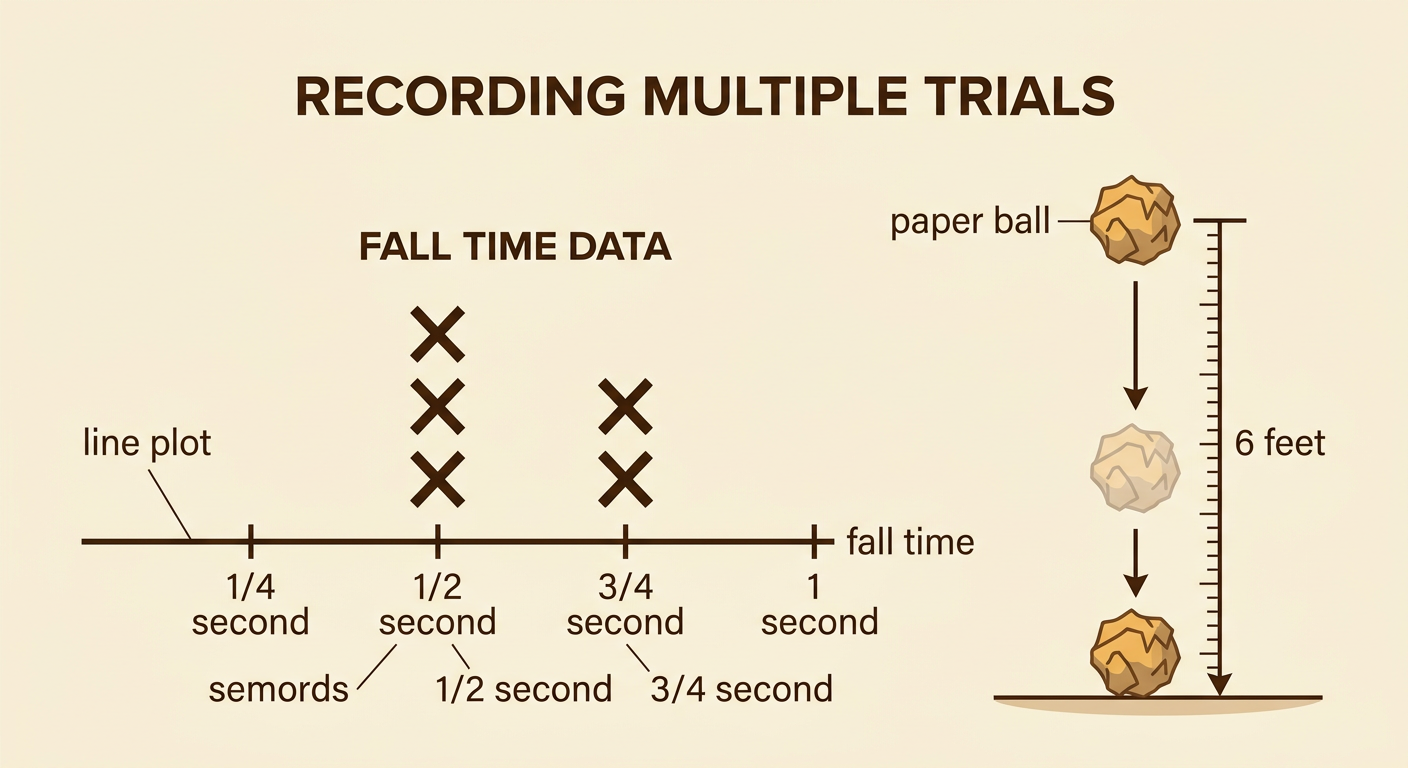
Measurement data help scientists identify patterns. Drop a crumpled paper ball from a measured height of 6 feet and use a slow-motion video or stopwatch to estimate its fall time to the nearest quarter second. Complete five trials under the same conditions. One group might record 1/2, 1/2, 3/4, 1/2, and 3/4 second. Make a line plot with time in seconds on the horizontal axis. Place one X above the matching time for each trial. This plot has three Xs at 1/2 second and two Xs at 3/4 second. All five trials show the ball reaching the ground, while small differences in time may come from releasing or measuring it differently. Keep the object, height, release method, and measuring tool the same so the trials can be compared fairly.
Compare Historical Ideas About Falling Objects
People have explained falling objects in different ways over time. The ancient Greek thinker Aristotle wrote that heavier objects naturally fall faster than lighter ones. Many later writers repeated his idea. More than 1,800 years afterward, Galileo Galilei studied motion using careful observations and experiments, including balls rolling down inclined ramps. Accounts of his work explain that objects fall with the same basic acceleration when air resistance is not an important factor. Compare the sources by asking who created each one, when it was created, what evidence it describes, and whether it is a primary source or a later summary. A translation of Galileo’s own writing and a modern textbook may use different wording, but both can be checked for evidence. Historical claims become stronger when observations and repeatable measurements support them.

Build an Evidence-Based Explanation
Use a claim, evidence, and reasoning structure to explain the investigation. Your claim might be, “Earth’s gravitational force on objects is directed down.” Evidence can include the eraser and block moving toward the floor, every paper-ball trial ending at the ground, and the downward force arrow in the model. Add measurement evidence from the line plot, such as, “All five trials ended with the ball reaching the floor, and three trials measured 1/2 second.” Then explain your reasoning: the repeated downward motion is consistent with a force pulling objects toward Earth. Air resistance can affect fall time, but it does not reverse gravity’s direction. When using an informational text, quote it accurately and explain how the quoted words support the claim. A strong explanation connects every piece of evidence to gravity rather than simply listing observations.
