
Earth's Motions: Days, Years, Seasons, and Shadows
Students model Earth's rotation, revolution, and axial tilt to explain day and night, the year, seasonal patterns, and changing shadows.
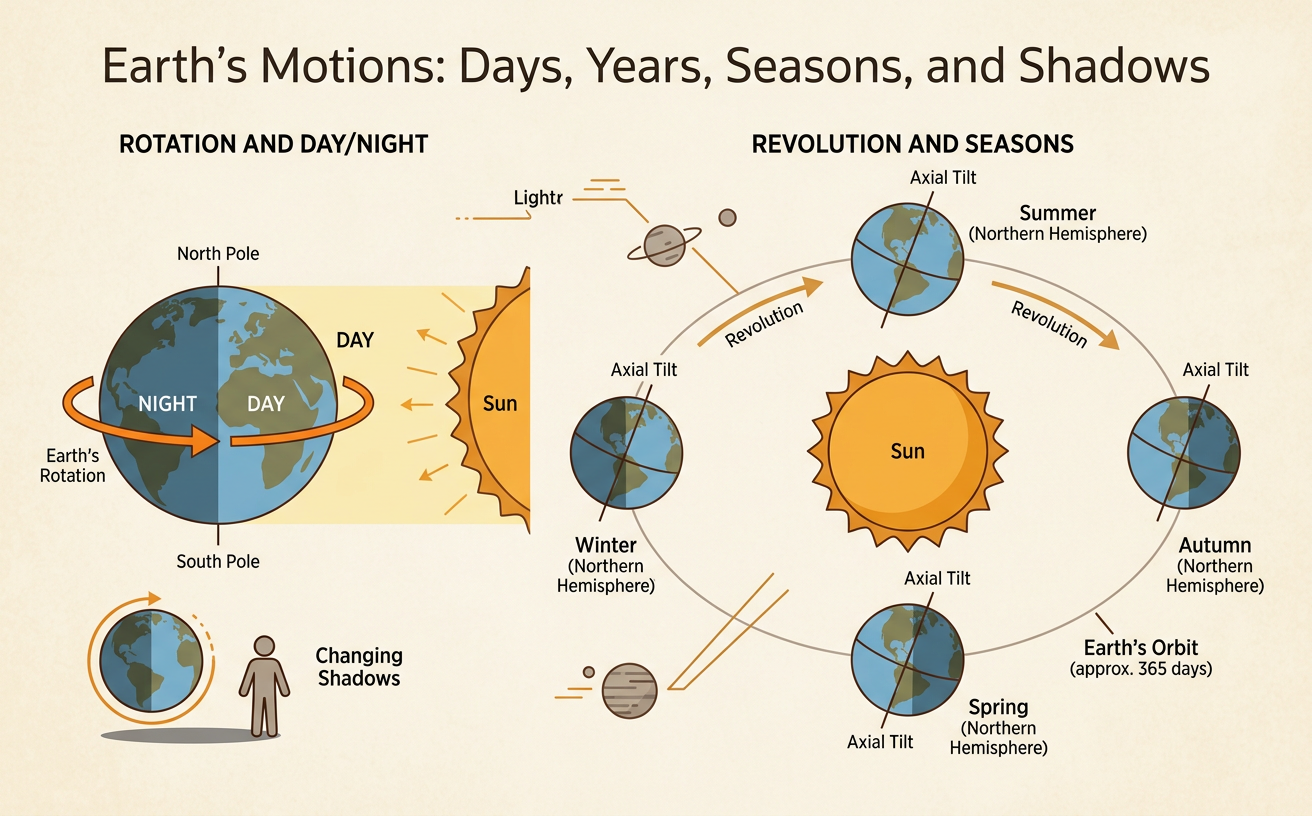
Illustrations are auto-generated and may be placeholders. They can be refreshed to match the narration.
Earth's Rotation Causes Day and Night
Earth rotates, or spins, around an imaginary line called its axis. One complete rotation takes about 24 hours. At any moment, the half of Earth facing the Sun experiences daylight, while the half facing away experiences night. As Earth rotates eastward, locations move into and then out of sunlight. This makes the Sun appear to rise in the east and set in the west, even though Earth's rotation causes the apparent motion. A classroom model can use a lamp as the Sun and a globe as Earth. If a sticker marks Indiana, rotating the globe shows the sticker moving from darkness into light and back again. The model explains why different parts of Earth experience different local times.
Revolution Defines a Year
Earth also revolves, or travels, around the Sun. One complete revolution takes about 365.25 days and defines one year. Earth's orbit is slightly oval but is close to circular. The extra quarter day is why the calendar usually adds a leap day every four years. Rotation and revolution are different motions: rotation produces the daily cycle, while revolution produces the yearly cycle. For example, Earth completes about 365 rotations during one trip around the Sun. A model should show Earth moving around the Sun while continuing to rotate on its own axis. Earth stays in orbit because gravity pulls it toward the Sun while its forward motion keeps it from falling directly into the Sun.
Axial Tilt Produces Seasons
Earth's axis is tilted about 23.5 degrees relative to its orbit. As Earth revolves around the Sun, this axis continues pointing in nearly the same direction. When the Northern Hemisphere tilts toward the Sun, sunlight strikes it more directly and daylight lasts longer, producing warmer summer conditions. When it tilts away, sunlight is less direct and daylight is shorter, producing winter. Indiana experiences summer when the Northern Hemisphere is tilted toward the Sun. At the same time, the Southern Hemisphere experiences winter. Seasons are not caused mainly by changes in Earth's distance from the Sun. In fact, Earth is slightly closer to the Sun during Northern Hemisphere winter, showing that sunlight angle and day length are the major causes.
Sunlight Angle and Energy
The angle at which sunlight reaches Earth's surface affects how concentrated its energy is. Direct sunlight spreads energy over a smaller area, so the surface receives more energy per square meter. Slanted sunlight spreads the same energy over a larger area and passes through more atmosphere. A flashlight can model this effect. Pointing it straight at paper creates a small, bright spot. Tilting the paper creates a larger, dimmer spot. In Indiana, the midday Sun appears higher in the summer sky, so sunlight is more direct. During winter, the Sun appears lower, making sunlight less direct. This difference in energy concentration helps explain why summer days are generally warmer even though the same Sun shines throughout the year.
Changing Shadows as Evidence
Shadows provide evidence of Earth's rotation and seasonal position. A shadow forms when an object blocks light. During a day, the Sun's apparent position changes, so a stationary object's shadow changes direction and length. In the morning and evening, the Sun is low and shadows are long. Near midday, the Sun is higher and shadows are shorter. Seasonal patterns also occur. At the same clock time, a post in Indiana usually casts a shorter shadow in summer than in winter because the summer Sun is higher. Students can place a meterstick outdoors and record its shadow several times. Measurements collected over days or months can be graphed to reveal predictable patterns caused by Earth's motions rather than movement of the meterstick.