Ecosystem Interactions and the Flow of Energy
Students examine how organisms depend on one another, construct food webs, analyze competition and symbiosis, and predict how ecosystem changes affect populations.

Illustrations are auto-generated and may be placeholders. They can be refreshed to match the narration.
Biotic and Abiotic Parts of Ecosystems
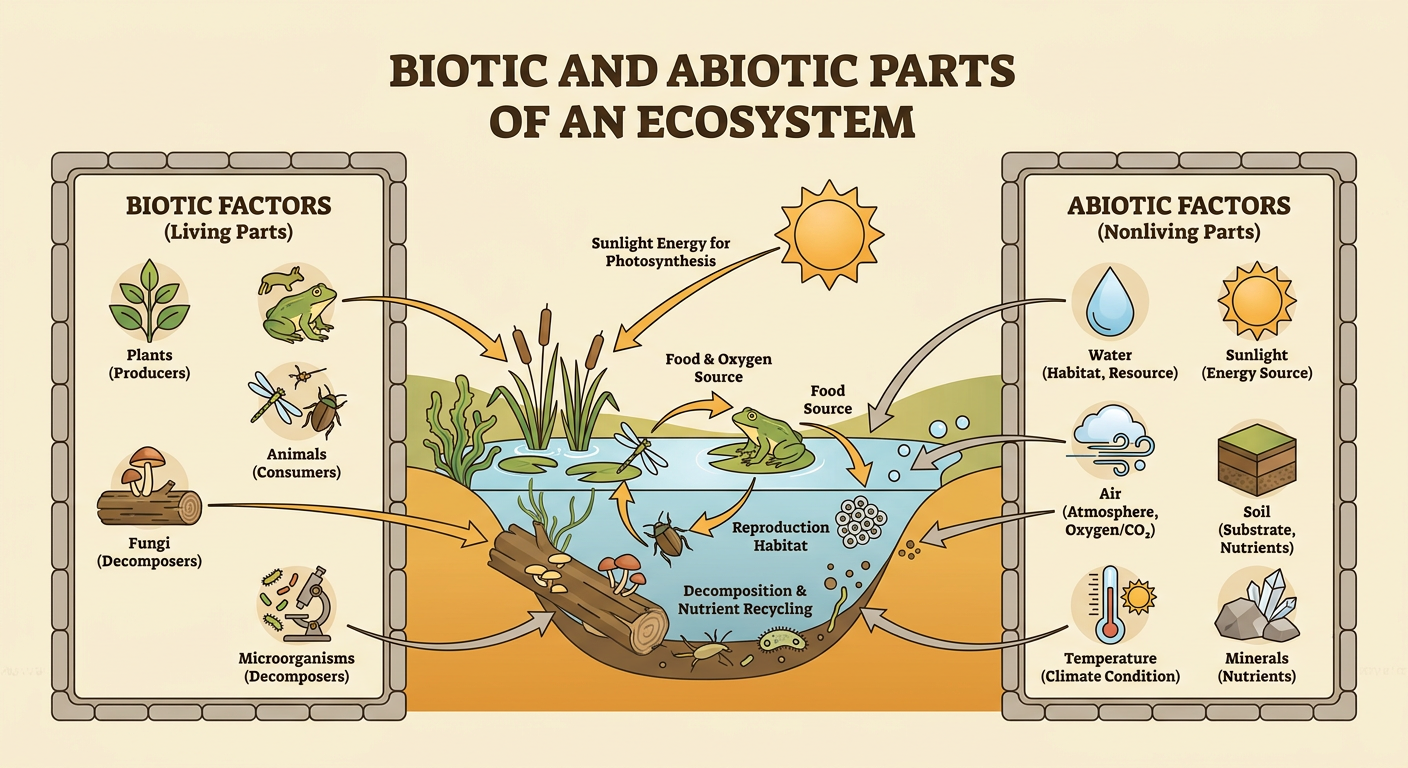
An ecosystem includes all the living and nonliving parts of an area and the interactions among them. Living, or biotic, factors include plants, animals, fungi, and microorganisms. Nonliving, or abiotic, factors include water, sunlight, air, soil, temperature, and minerals. Organisms depend on both kinds of factors. In an Indiana pond, frogs eat insects and use water as a place to reproduce. Pond plants need sunlight, carbon dioxide, water, and minerals from the mud. A change in one factor may affect many organisms. For example, a drought can lower the pond's water level, reduce plant growth, and leave fewer breeding places for frogs. Studying an ecosystem therefore requires looking at relationships rather than examining each organism by itself.
Producers, Consumers, and Decomposers
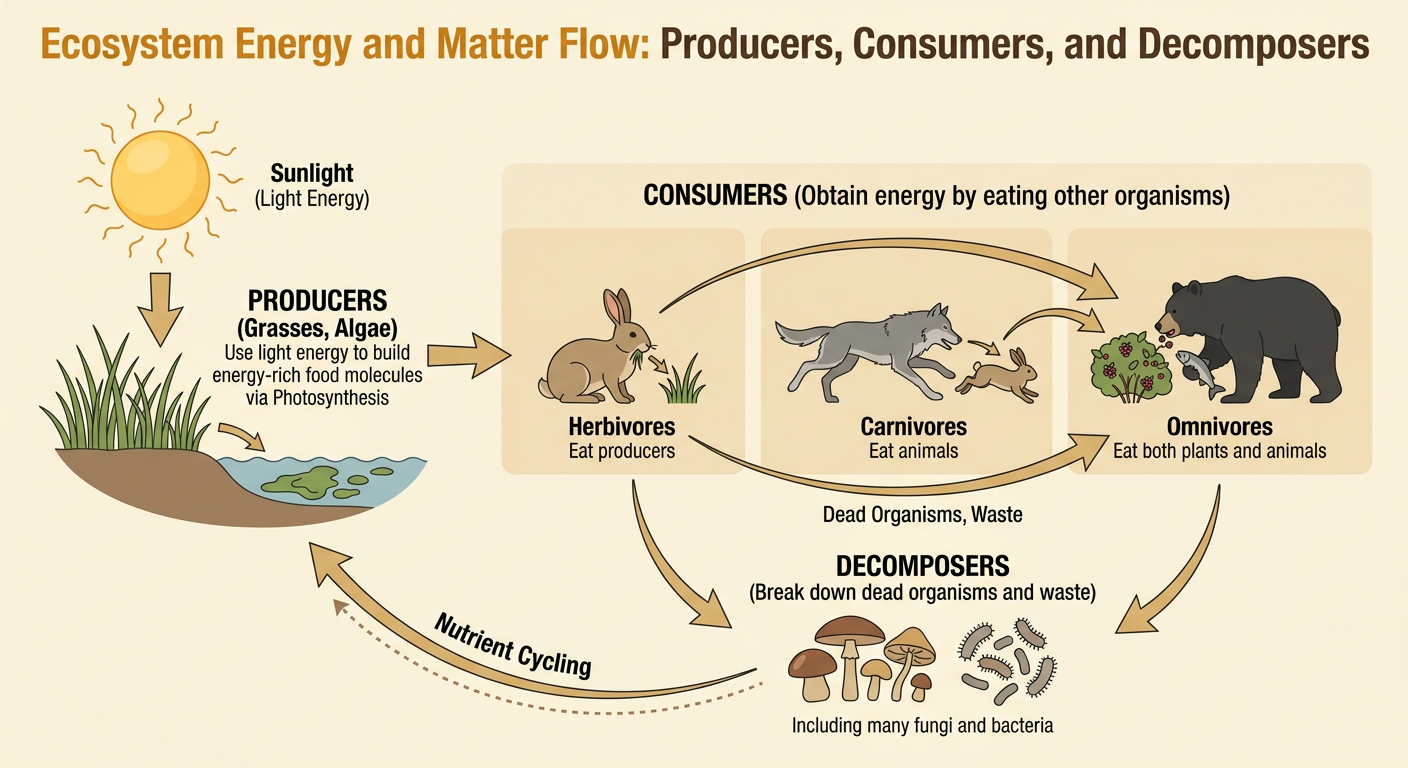
Organisms have different roles in moving energy and matter through an ecosystem. Producers, such as grasses and algae, use light energy to build energy-rich food molecules. Consumers obtain energy by eating other organisms. Herbivores eat producers, carnivores eat animals, and omnivores eat both plants and animals. Decomposers, including many fungi and bacteria, break down dead organisms and wastes. This returns nutrients to soil and water, where producers can use them again. In a forest, an oak tree is a producer, a caterpillar that eats its leaves is a consumer, and a fungus growing on a fallen branch is a decomposer. Energy flows through these roles, while matter such as carbon, water, and minerals is continually reused within the ecosystem.
Food Chains and Food Webs
A food chain shows one pathway through which energy moves in an ecosystem. Arrows point from the organism being eaten toward the organism that receives the energy. For example, grass to grasshopper to frog to hawk represents a possible food chain. Most organisms, however, have more than one food source or predator. A food web combines many connected food chains and gives a more realistic picture. A hawk might eat frogs, mice, and snakes, while a mouse might eat seeds and insects. If the grasshopper population decreases, frogs may have less food, but they might also eat other insects. Food webs help scientists predict effects throughout an ecosystem, although actual results depend on population sizes, available alternatives, and environmental conditions.

Competition and Resource Availability
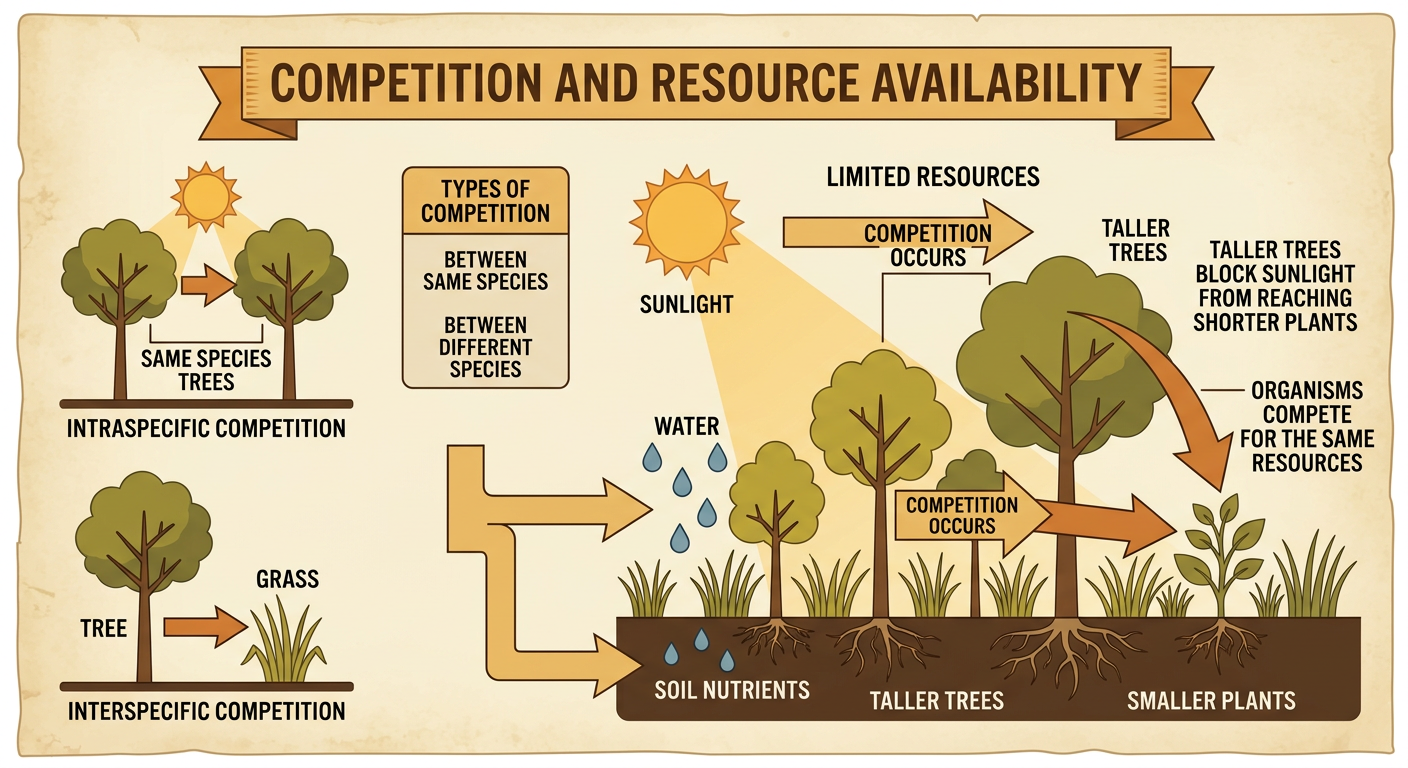
Organisms compete when they need the same limited resource. Resources may include food, water, light, shelter, mates, or space. Competition can occur between members of the same species or between different species. In a crowded field, young trees and grasses may compete for sunlight, water, and soil nutrients. Trees that grow taller can shade smaller plants, reducing their access to light. Resource availability can limit how large a population becomes. If a cold winter reduces the supply of seeds, fewer mice may survive, and predators that eat mice may also be affected. Scientists study population data before and after resource changes to identify patterns. A relationship between two changes is evidence, though additional investigation may be needed to determine the exact cause.
Symbiosis and Ecosystem Change
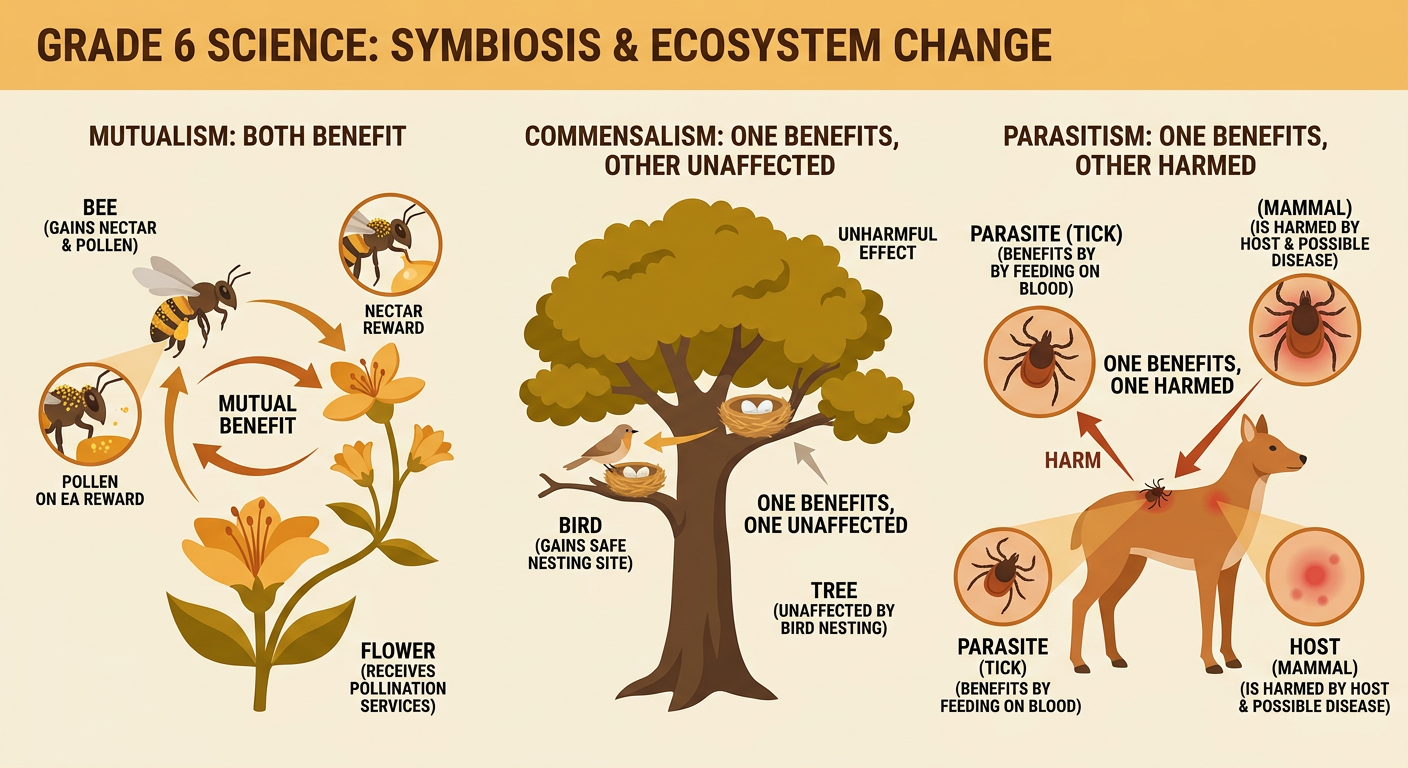
Symbiosis is a close relationship between organisms of different species. In mutualism, both organisms benefit. Bees gain food from flowers, while flowers receive help with pollination. In commensalism, one organism benefits and the other is not significantly helped or harmed, as when a bird nests in a tree. In parasitism, one benefits while the other is harmed; a tick feeding on a deer is an example. These interactions connect population changes. If disease greatly reduces flowering plants, pollinating insects may lose food and decline. Changes can also be caused by invasive species, pollution, habitat loss, or weather. A sound prediction identifies the affected relationship and follows its likely consequences through the food web rather than assuming that only one species will change.