Electric and Magnetic Forces at a Distance
Students investigate how distance, charge, and magnetic pole orientation affect noncontact electric and magnetic forces and use evidence to explain observed attraction and repulsion.
Illustrations are auto-generated and may be placeholders. They can be refreshed to match the narration.
Noncontact Forces in Everyday Life
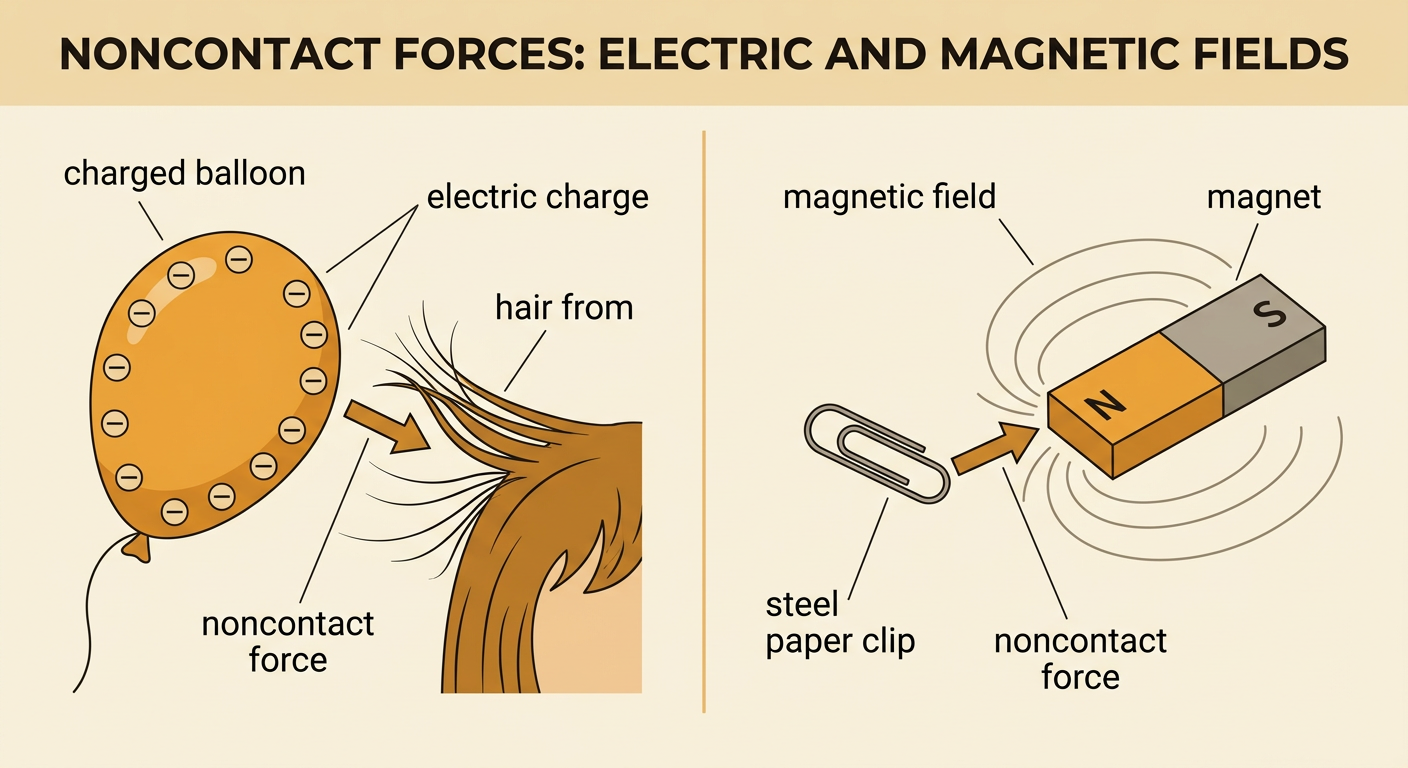
A noncontact force acts between objects that are not touching. Electric and magnetic forces are noncontact forces because charged objects and magnets produce fields in the space around them. When another suitable object enters the field, it experiences a push or pull. For example, rubbing a balloon on dry hair transfers electric charge. The charged balloon can attract hair or small paper pieces without touching them first. Similarly, a magnet can pull a steel paper clip across a small gap. The force becomes noticeable through the object’s motion, even though the field itself cannot be seen. Not every object responds equally: magnets strongly attract materials such as iron and steel, while electric forces act between charged particles and can also attract some neutral objects by rearranging their charges.
Attraction and Repulsion
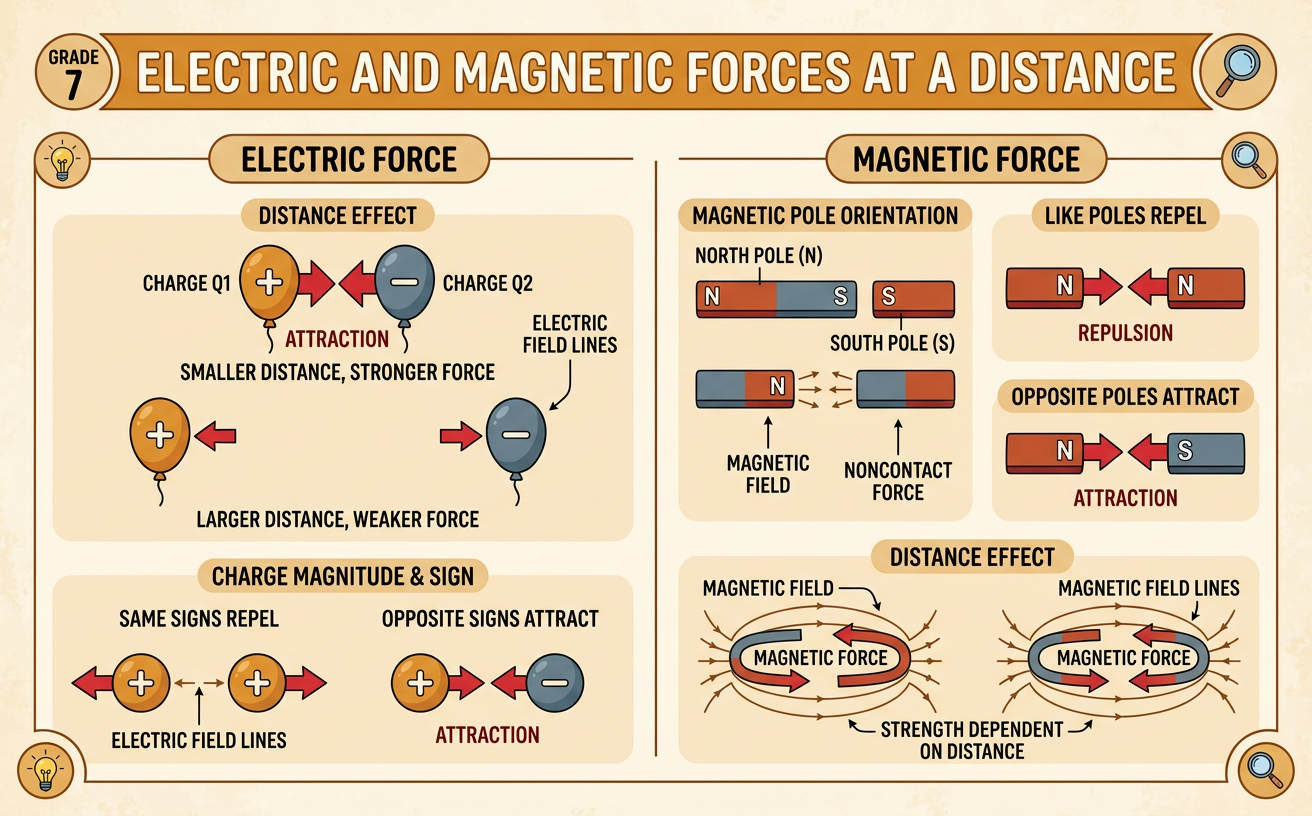
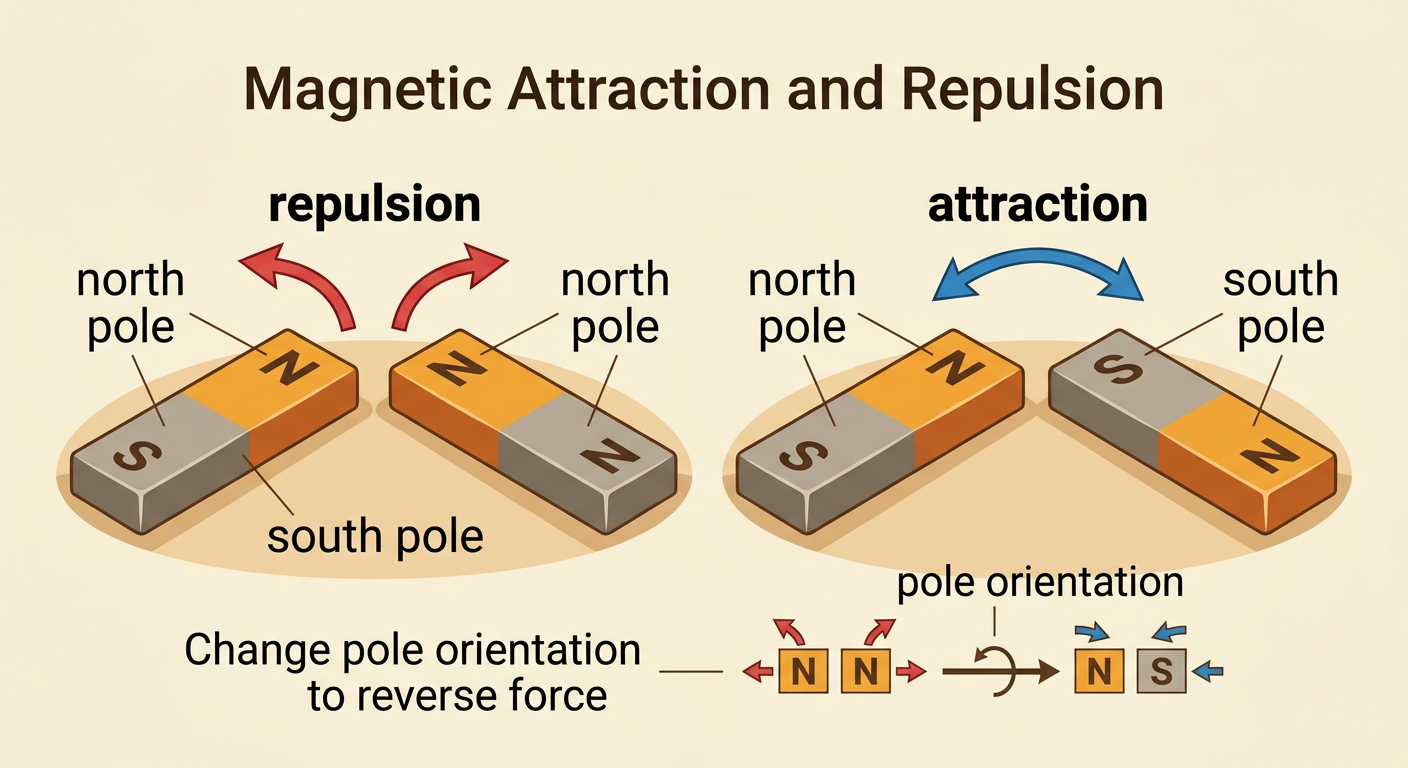
Electric and magnetic forces can cause either attraction or repulsion. Objects with opposite electric charges attract, while objects with like charges repel. A positive charge attracts a negative charge, but two positive charges or two negative charges push apart. Magnets have north and south poles. Opposite poles attract, so a north pole pulls toward a south pole. Like poles repel, so two north poles or two south poles push apart. For example, place two bar magnets on a smooth table with their north poles facing. When one magnet is moved close to the other, the second magnet may slide away. Turn one magnet around so that north faces south, and the magnets move together. Pole orientation changes the direction of the magnetic force without requiring contact.
Testing Distance and Force Strength
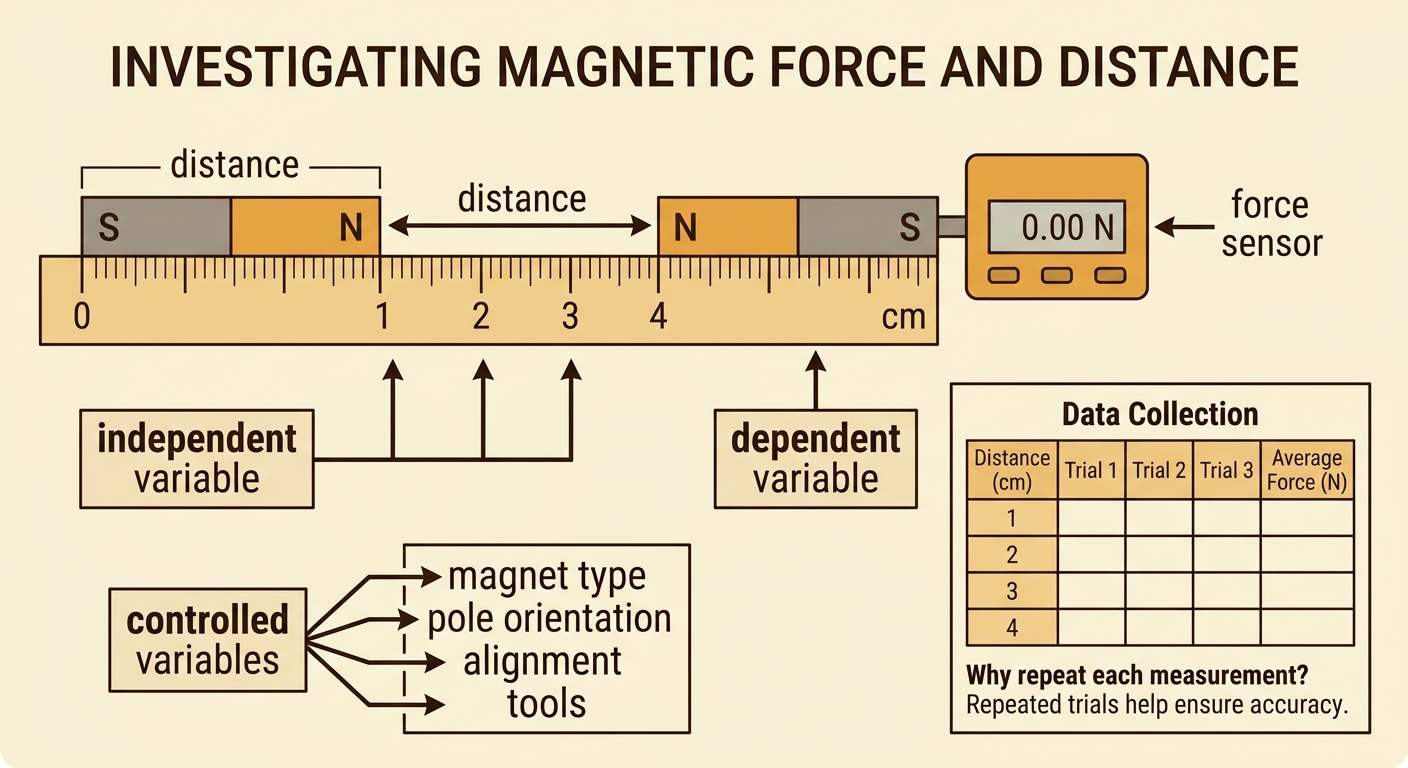
A fair investigation changes one factor at a time. To test distance, place one bar magnet at the zero mark of a ruler and connect a second magnet to a force sensor. Keep the same poles facing throughout the trial. Set the separation at 1 centimeter, wait for the reading to steady, and record the force. Repeat three times, then test 2, 3, and 4 centimeters using the same magnets and alignment. Average the repeated measurements. Keep pole orientation, magnet type, and measuring tools constant so distance is the independent variable. Force is the dependent variable. A separate electric investigation can compare equally spaced charged tape strips after changing the amount of charge in a consistent way. Safety matters: keep strong magnets away from electronics and never use wall electricity. Precise steps and controlled variables make the evidence more dependable.
Analyzing Investigation Data
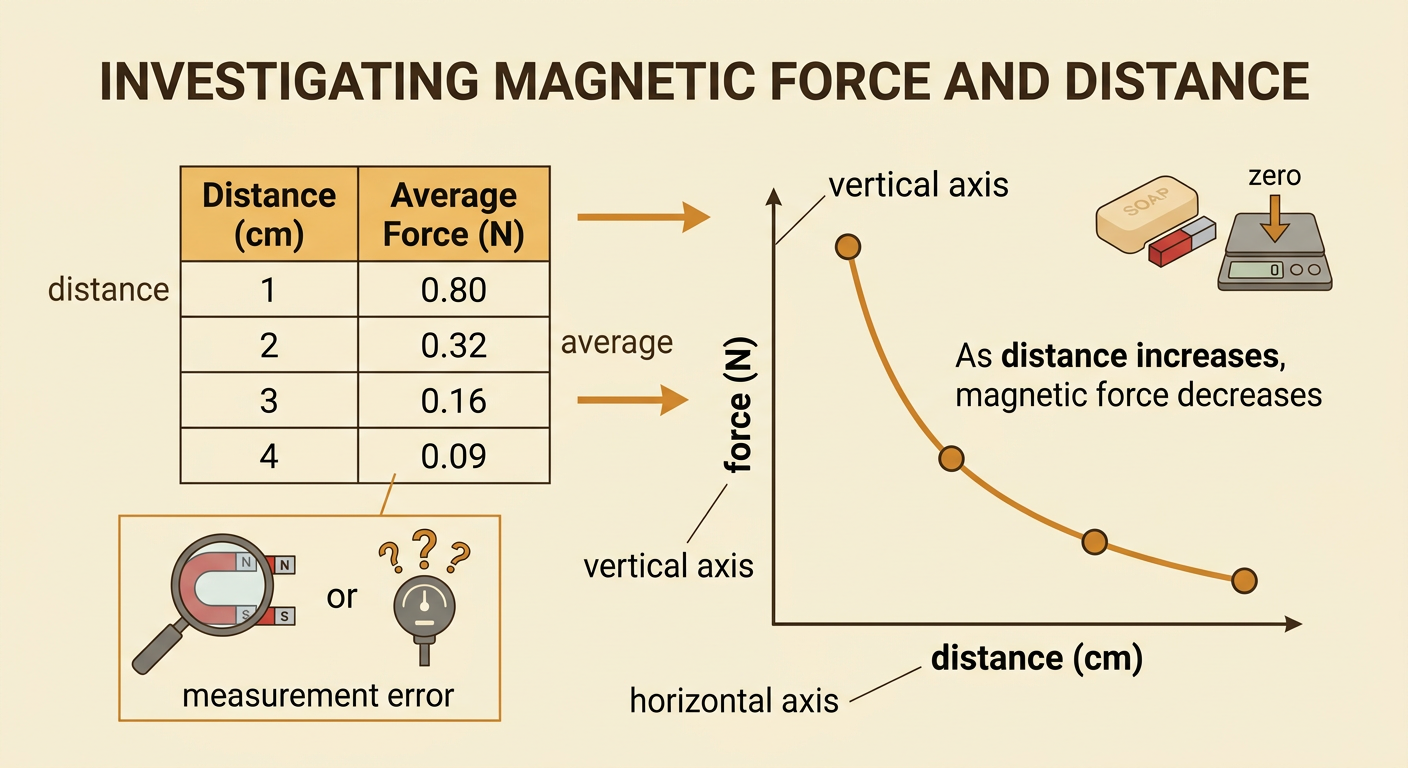
Organize measurements in a table and graph to look for a pattern. Suppose the average magnetic force is 0.80 newton at 1 centimeter, 0.32 newton at 2 centimeters, 0.16 newton at 3 centimeters, and 0.09 newton at 4 centimeters. A graph with distance on the horizontal axis and force on the vertical axis would curve downward. These data support the idea that magnetic force weakens as separation increases. They do not prove that every magnet follows one exact numerical rule, because magnet shape, strength, alignment, and measurement error can affect the results. Ask questions about unusual values: Was a magnet tilted? Did the sensor reach zero before each trial? Repeated trials and averages reduce the influence of random variation. Quantitative reasoning connects the measured numbers to the physical relationship between distance and force strength.
Evidence-Based Force Explanations
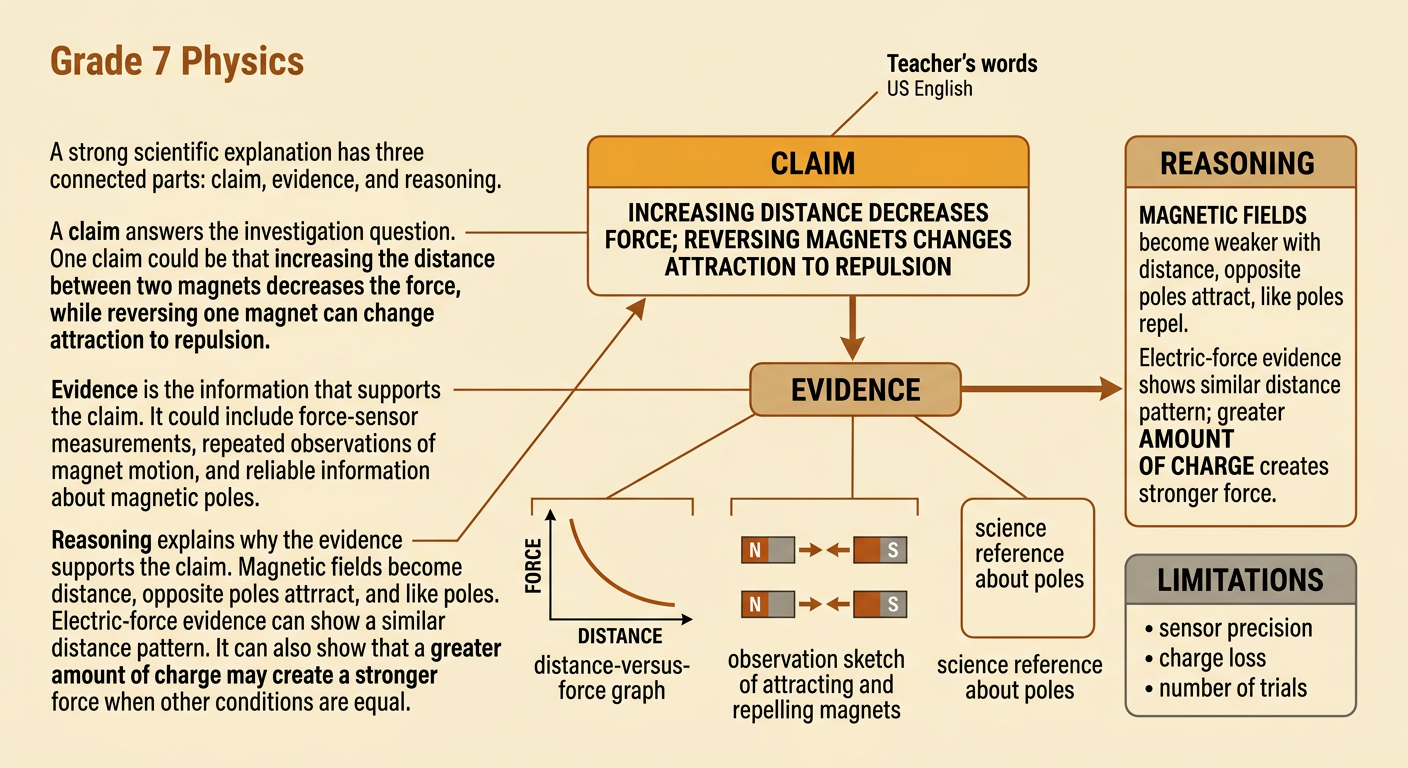
A strong scientific explanation includes a claim, evidence, and reasoning. One claim might be, “Increasing the distance between two magnets decreases the force between them, and reversing one magnet can change attraction to repulsion.” Evidence could include force-sensor measurements, repeated observations of magnet motion, and information from a reliable science text about magnetic poles. The reasoning connects them: magnetic fields become weaker with distance, opposite poles attract, and like poles repel. For electric forces, data can similarly show that greater separation weakens the force and a greater amount of charge can strengthen it under otherwise equal conditions. A complete argument also states limitations. A classroom force sensor may have limited precision, charged objects may lose charge to moist air, and a small number of trials may not represent every situation. Acknowledging these limits makes the conclusion more accurate, not less useful.