
Electric and Magnetic Forces at a Distance
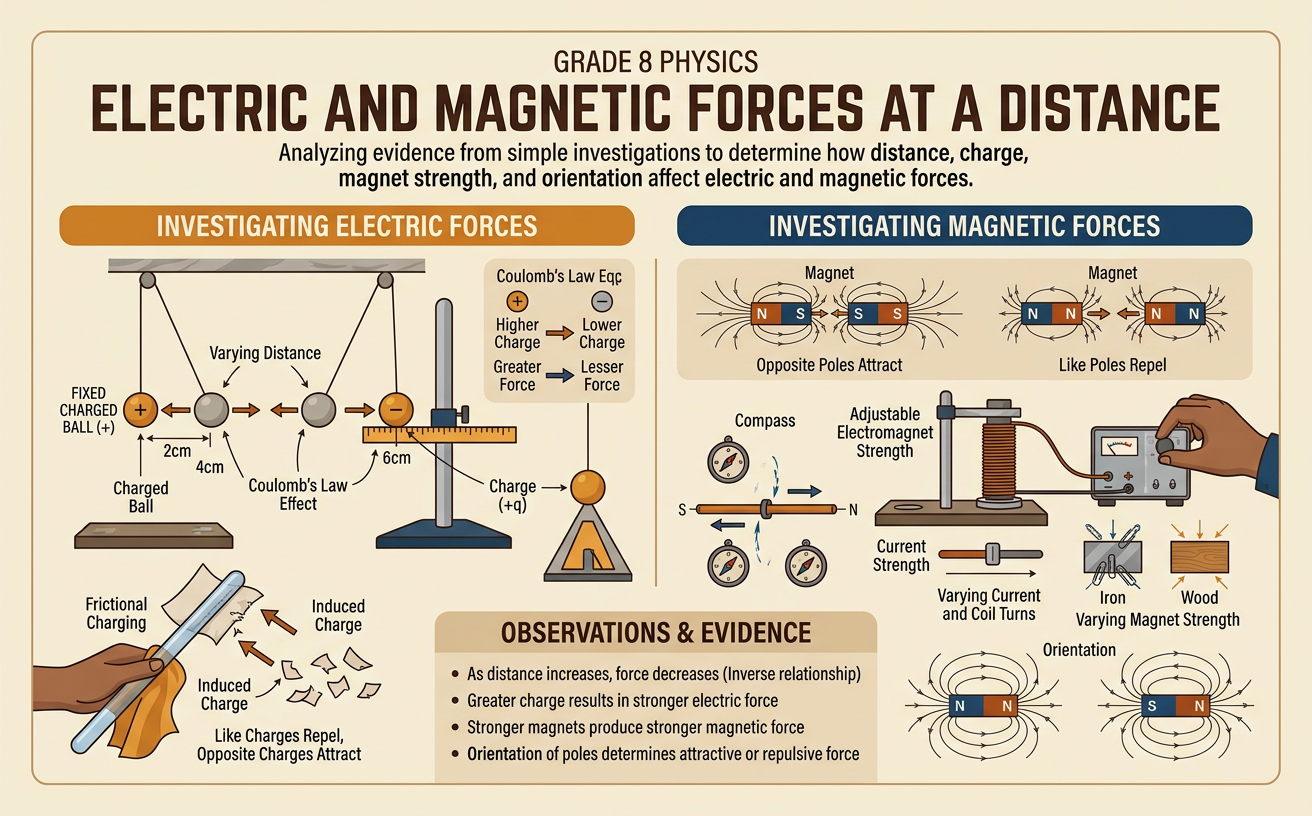
Students analyze evidence from simple investigations to determine how distance, charge, magnet strength, and orientation affect electric and magnetic forces.
Illustrations are auto-generated and may be placeholders. They can be refreshed to match the narration.
Forces Without Contact
Electric and magnetic forces can act across empty space, so objects do not need to touch to push or pull one another. A charged object creates an electric field around it. Unlike charges attract, while like charges repel. A magnet creates a magnetic field with north and south poles. Opposite poles attract, while matching poles repel. These forces become noticeable when objects respond without contact. For example, after a balloon is rubbed on hair, the balloon can attract small paper pieces from a short distance. Similarly, one bar magnet can push another away when their north poles face each other. Field models help scientists explain these interactions, even though the fields themselves cannot be seen directly. Arrows can show whether the force is attractive or repulsive.

Testing Magnets and Charged Objects
A fair investigation changes one factor at a time while keeping other conditions the same. To test magnetic force, place a bar magnet a measured distance from a steel paper clip and record whether the clip moves. Repeat at several distances, using the same magnet, paper clip, surface, and starting position. To test electric force, rub the same balloon with the same cloth for a set number of strokes, then hold it near identical paper pieces. Measure the greatest distance at which a piece moves. Follow each step in the same order and repeat every trial at least three times. Do not place magnets near electronic devices, and do not test static charge near outlets. Precise procedures and repeated trials make the evidence more reliable and allow other students to reproduce the investigation.

Distance, Strength, and Orientation
The strength of electric and magnetic forces depends on several factors. In general, the force becomes weaker as the distance between interacting objects increases. An object with a greater amount of net electric charge can produce a stronger electric interaction under the same conditions. Likewise, a stronger magnet usually exerts more force than a weaker magnet at the same distance. Orientation also matters for magnets. Opposite poles facing each other attract, while matching poles facing each other repel. For example, two strong magnets placed one centimeter apart may pull together firmly when a north pole faces a south pole. Turning one magnet around makes two north poles face, changing the pull into a push. Scientists must change only one factor at a time to determine which factor caused an observed difference.

Analyzing Investigation Data
Data reveal patterns that may not be obvious from one observation. Suppose a class measures the pull of the same magnet on a steel object. At one centimeter, the average force is 1.8 newtons; at two centimeters, it is 0.9 newton; and at three centimeters, it is 0.4 newton. The pattern supports the claim that magnetic force weakens as distance increases. Students should compare repeated trials, calculate an average, and look for unusual results. If one measurement at two centimeters is much larger than the others, the magnet or object may have moved, so that trial should be checked rather than ignored. Evidence can support a relationship without proving that every magnetic setup follows exactly the same numerical pattern. A conclusion should name the changed variable, describe the observed pattern, and cite specific measurements.

Electromagnetism in Technology
Electricity and magnetism work together in many technologies. When electric current flows through a wire, it produces a magnetic field. Wrapping the wire into a coil strengthens the field, and placing an iron core inside the coil can make a useful electromagnet. Early telegraphs used electromagnets to move metal parts and turn electrical signals into clicks. Modern relays use the same basic principle to open or close circuits, while motors use magnetic forces to produce motion. Speakers change electrical signals into vibrations that create sound. These examples show both continuity and change over time: the scientific principle remains the same, but materials, controls, speed, and applications have improved. For example, a recycling crane can switch its electromagnet on to lift steel and switch it off to release the load.
