Electric Charge and Coulomb’s Law
Students use Coulomb’s law to predict how charge, distance, and material interactions affect electrostatic forces and apply their reasoning to electrical safety practices.

Illustrations are auto-generated and may be placeholders. They can be refreshed to match the narration.
Observing Static Charge
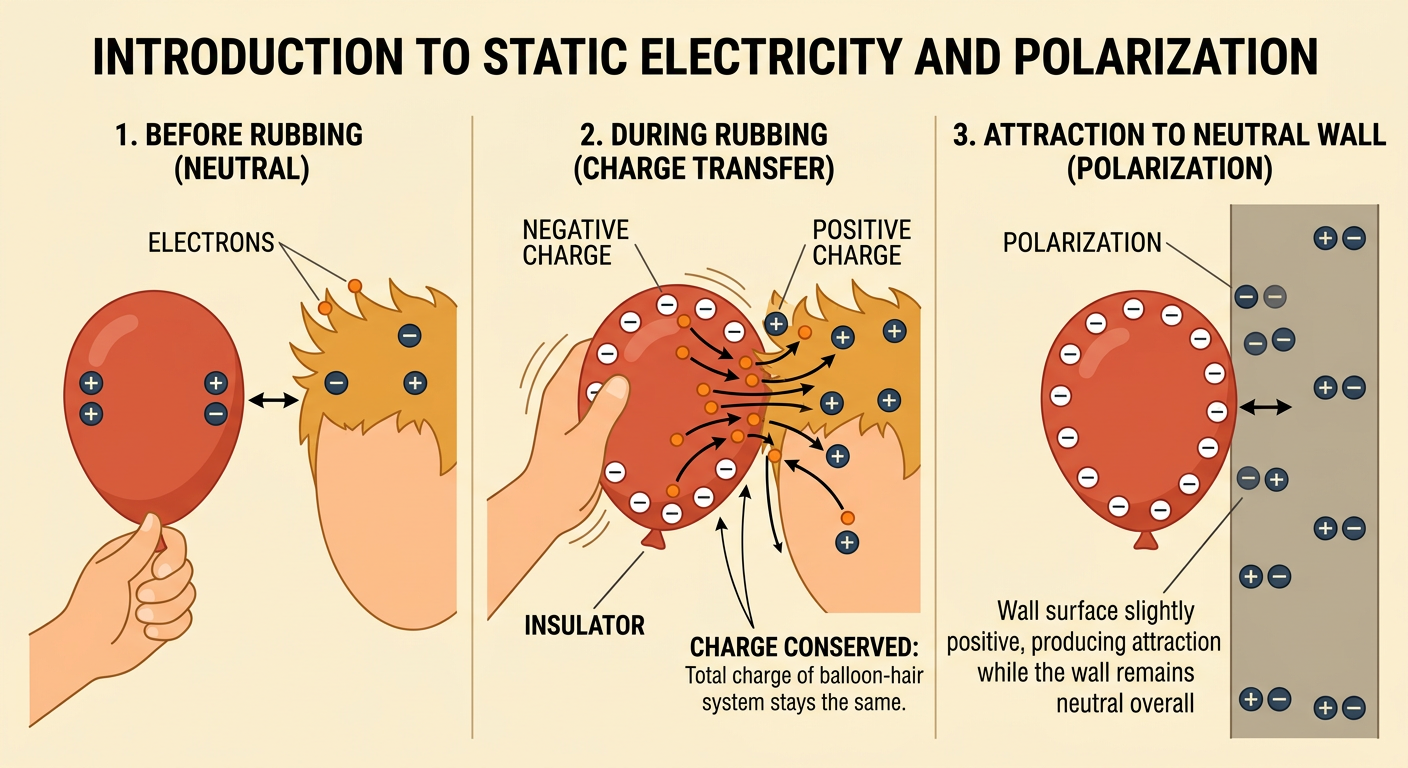
Static electricity begins when electrons move from one material to another. Rubbing a balloon on dry hair can transfer electrons from the hair to the balloon. The balloon gains a negative charge, while the hair is left with a positive charge. Because charge is conserved, the total charge of the balloon-hair system does not change. Materials affect what happens next. In an insulator, such as rubber, charge tends to remain where it was placed. In a conductor, such as metal, electrons can move easily across the material. A charged balloon can also stick to a neutral wall because its negative charge slightly shifts electrons in the wall away from the surface. This separation of charge, called polarization, creates attraction even though the wall remains neutral overall.
Attraction and Repulsion
Electric charges exert forces without touching. Like charges repel, so two positive charges push apart and two negative charges also push apart. Opposite charges attract, so a positive charge and a negative charge pull toward each other. According to Newton’s third law, each charge exerts a force of equal size and opposite direction on the other charge. For example, if two negatively charged balloons hang near one another, they swing apart because each balloon repels the other. If one balloon is positive and the other is negative, they swing together. A charged object may also attract a neutral object through polarization. Therefore, attraction does not always prove that two objects have opposite net charges, but repulsion does show that both objects are charged with the same sign.

Variables in Coulomb’s Law
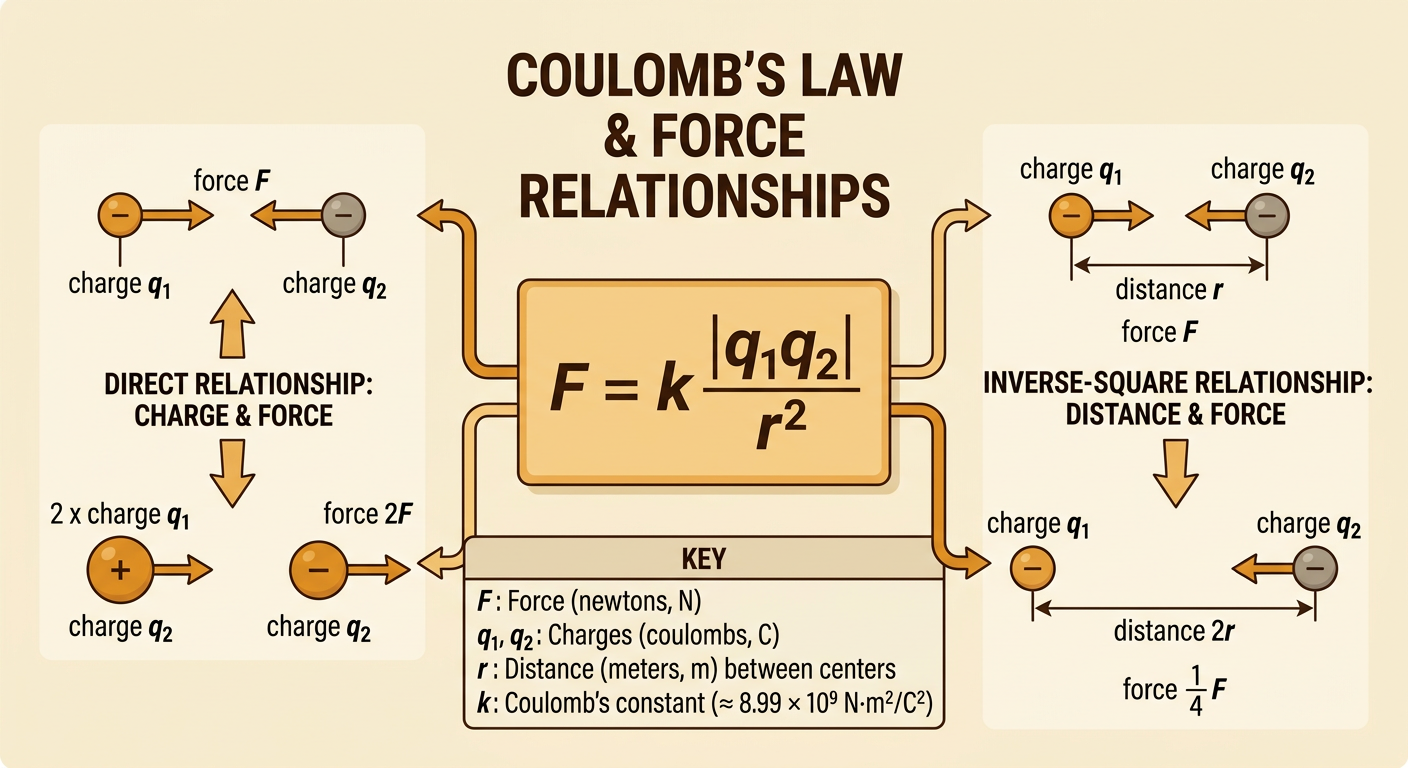
Coulomb’s law gives the magnitude of the electric force between two point charges: F = k|q1q2|/r². In this equation, F is force in newtons, q1 and q2 are charges in coulombs, r is the distance between their centers in meters, and k is approximately 8.99 × 10⁹ N·m²/C² in a vacuum or air. Increasing either charge increases the force in direct proportion. Doubling one charge doubles the force. Distance has an inverse-square relationship with force. Doubling the distance makes the force one-fourth as large, while tripling it makes the force one-ninth as large. The equation gives force magnitude; the signs of the charges determine whether the force is attractive or repulsive. In other materials, electric polarization can reduce the interaction compared with the interaction in a vacuum.
Calculating Electrostatic Force
To calculate electrostatic force, first convert every charge to coulombs and every distance to meters. Suppose q1 = +2.0 microcoulombs, q2 = −3.0 microcoulombs, and r = 0.20 meter. The charge magnitudes are 2.0 × 10⁻⁶ C and 3.0 × 10⁻⁶ C. Substitution gives F = (8.99 × 10⁹)(2.0 × 10⁻⁶)(3.0 × 10⁻⁶)/(0.20)², so F is about 1.35 N. Because the charges have opposite signs, the force is attractive. Coulomb’s law can also be rearranged to highlight an unknown quantity. For example, solving for distance gives r = √(k|q1q2|/F). Solving for the second charge magnitude gives |q2| = Fr²/(k|q1|). Always state the magnitude, direction or interaction type, and appropriate units.

Electric Force Diagrams
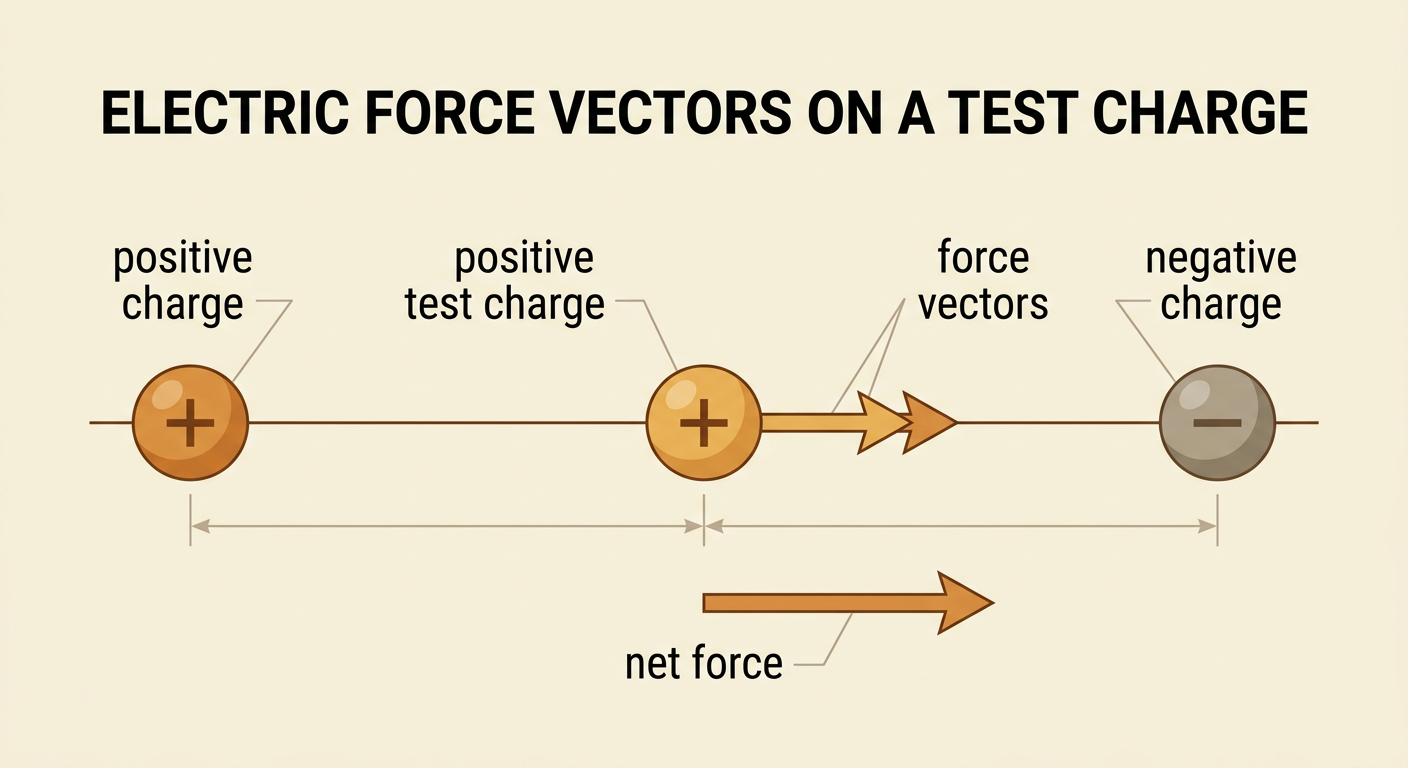
An electric force diagram represents forces with arrows called vectors. Draw each arrow on the object experiencing the force. The arrow points in the force direction, and its length represents the force magnitude. Consider three charges in a straight line: a positive charge on the left, a positive test charge in the center, and a negative charge on the right. The left positive charge repels the center charge toward the right. The right negative charge also attracts the center charge toward the right. Because both forces point right, their magnitudes are added to find the net force. If the arrows pointed in opposite directions, their magnitudes would be subtracted, and the net force would point in the direction of the larger force. Diagrams translate charge signs, positions, and equations into a visual prediction.
Applying Electrostatics to Safety
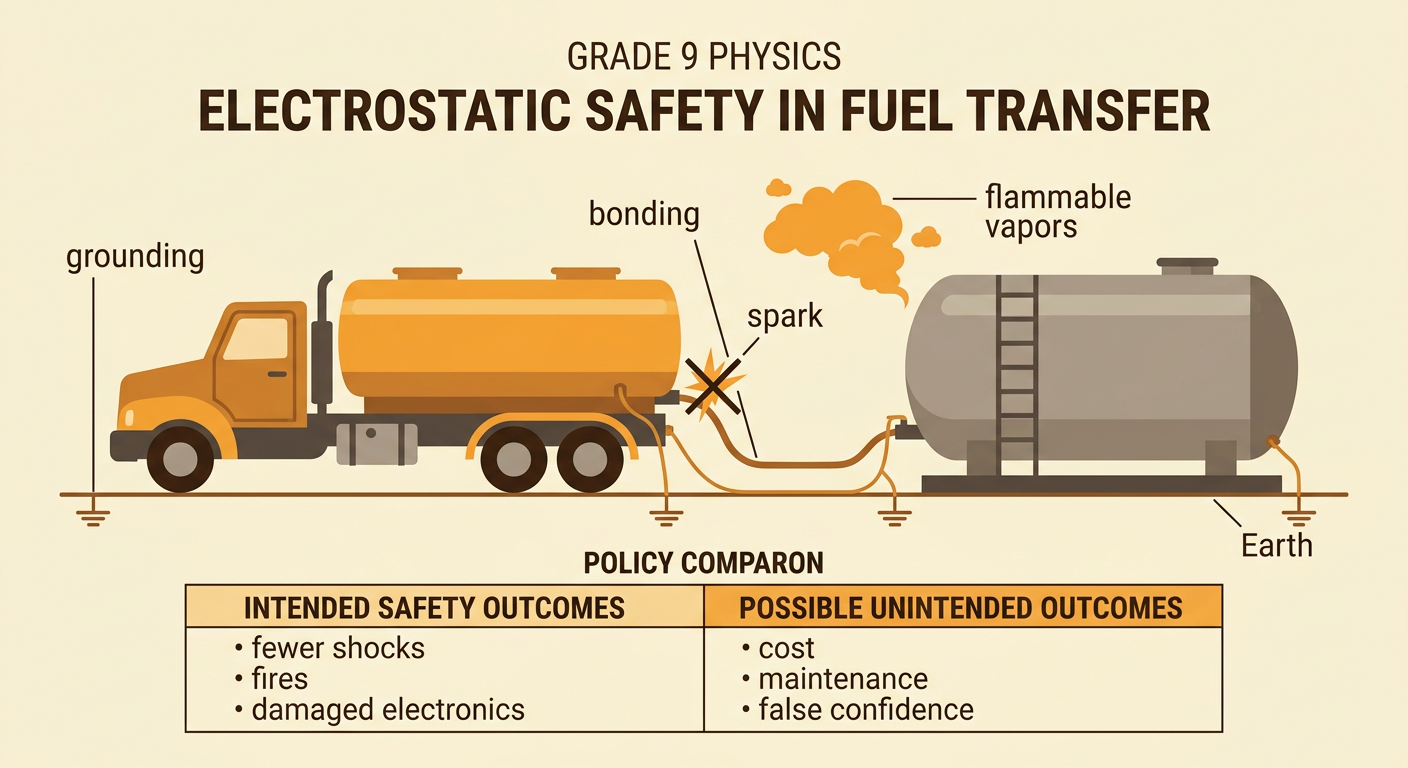
Electrostatic charge can build up on people, vehicles, fuel hoses, and equipment. A spark occurs when a strong electric force moves charge suddenly through air or another material. Near flammable vapors, that spark can start a fire. Grounding provides a conducting path for excess charge to move safely into Earth, while bonding connects conductive objects so a dangerous voltage difference is less likely to develop. Safety requirements may mandate grounded fuel pumps, lightning rods, antistatic flooring, or protective equipment for workers. Their intended outcomes are fewer shocks, fires, and damaged electronic devices. Possible unintended outcomes include added costs, maintenance demands, or false confidence when equipment is installed incorrectly. Evaluating a policy requires comparing evidence about risk reduction with its costs and practical effects. Coulomb’s law supports these decisions because greater charge and smaller separation can produce stronger forces and easier discharge.