
Electric Charge, Fields, and Circuits
Students model electric interactions and analyze series and parallel circuits using conservation principles, Ohm's law, and electrical power.
Illustrations are auto-generated and may be placeholders. They can be refreshed to match the narration.
Charge and Coulomb's Law
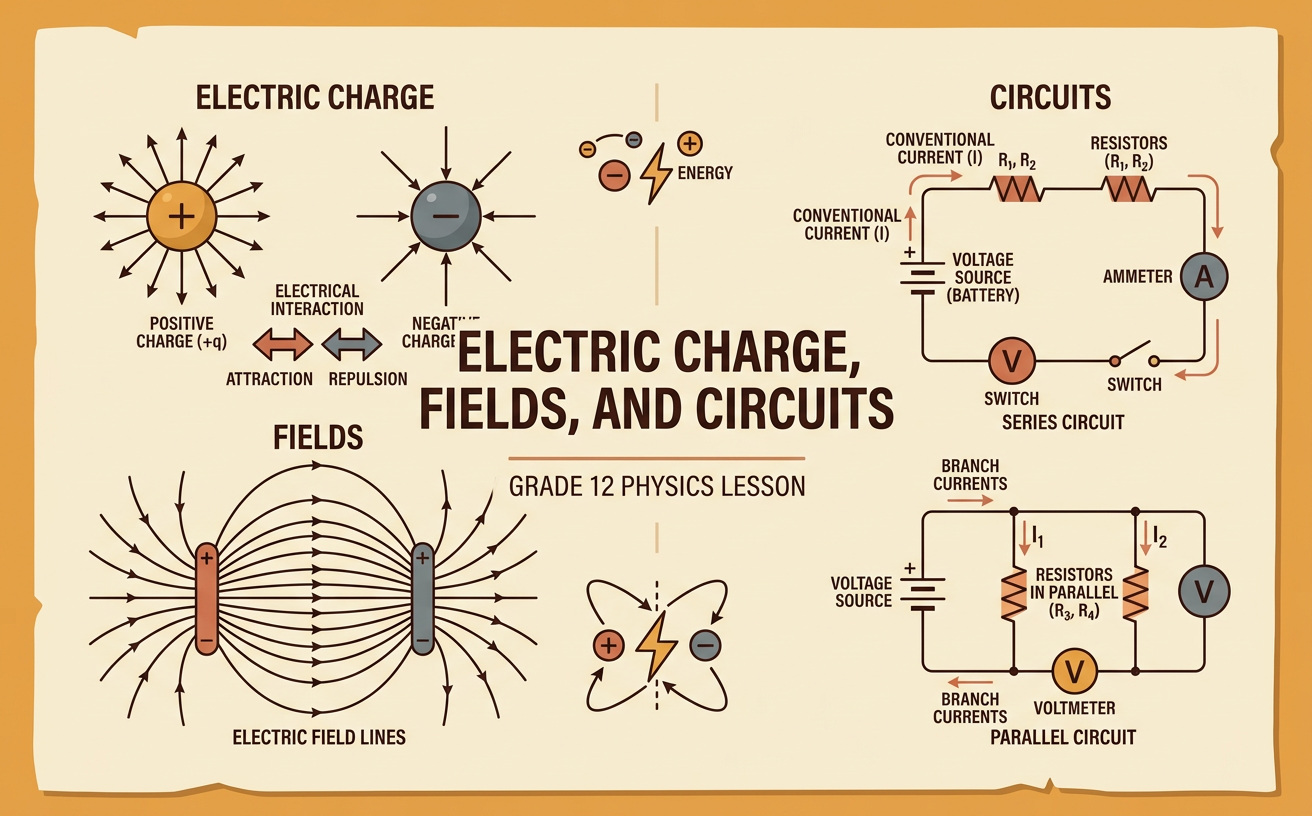
Electric charge is a conserved property of matter measured in coulombs. Protons have positive charge, electrons have negative charge, and like charges repel while opposite charges attract. Charge can move between objects, but the total charge of an isolated system remains constant. Coulomb's law gives the magnitude of the force between two point charges: F = k|q₁q₂|/r², where k = 8.99 × 10⁹ N·m²/C² and r is the distance between the charges. The force acts along the line connecting them. For example, two charges of +2.0 μC separated by 0.30 m repel with a force of about 0.40 N. Doubling their separation would reduce the force to one-fourth of that value. For several charges, determine each force separately and add the force vectors to find the net force.
Electric Fields and Potential
An electric field describes how a source charge changes the space around it. The field at a point is defined as force per unit positive test charge: E = F/q. Field direction is the direction a positive test charge would accelerate, so field lines point away from positive charges and toward negative charges. Electric potential is electric potential energy per unit charge and is measured in volts, where 1 V = 1 J/C. A potential difference can transfer energy to charges and produce current in a conducting path. In a uniform field, the magnitude of the potential difference is ΔV = Ed when displacement is parallel to the field. For example, between plates separated by 0.020 m with a potential difference of 120 V, the field magnitude is 6,000 V/m. An electron in this field accelerates opposite the field direction because its charge is negative.
Current, Resistance, and Ohm's Law
Electric current is the rate at which charge passes a location: I = ΔQ/Δt, measured in amperes. One ampere equals one coulomb per second. In a metal, electrons drift opposite the conventional current direction. A source such as a battery maintains a potential difference that drives charge through a closed circuit. Resistance measures opposition to current and depends on material, length, cross-sectional area, and temperature. For an ohmic component, Ohm's law is V = IR. For example, a 12 V battery connected across a 6.0 Ω resistor produces a current of I = V/R = 2.0 A. If the resistor must remain below 18 W, the constraint I²R ≤ 18 W requires I ≤ 1.7 A, so the original circuit would exceed the safe power limit. Equations and inequalities help engineers select components that meet operating constraints.
Series and Parallel Circuits
In a series circuit, components share one path, so the same current passes through every component. The source voltage equals the sum of the voltage drops, and equivalent resistance is Rₑq = R₁ + R₂ + …. In a parallel circuit, components connect across the same two nodes, so each branch has the same voltage. Current is conserved at every junction: the current entering equals the total current leaving. Parallel resistance follows 1/Rₑq = 1/R₁ + 1/R₂ + …. For example, 4 Ω and 8 Ω resistors in series have an equivalent resistance of 12 Ω. Connected in parallel, they have an equivalent resistance of 2.67 Ω. Across a 12 V source, the parallel branches carry 3.0 A and 1.5 A, giving a total current of 4.5 A. Household circuits use parallel connections so devices receive the full supply voltage and operate independently.
Electrical Energy and Power
Electrical power is the rate at which electrical energy is transferred: P = IV. Using Ohm's law, resistor power can also be written as P = I²R or P = V²/R. Electrical energy is E = Pt and is often billed in kilowatt-hours. For example, a 1.5 kW space heater used for 4.0 hours consumes 6.0 kWh. At $0.16 per kWh, the energy costs $0.96. Energy is conserved, but devices transform electrical energy into thermal energy, light, motion, or sound, with some transfer usually becoming unwanted heat. To evaluate energy choices, students should compare utility data, government reports, and scientific studies about cost, emissions, reliability, and efficiency. Markets influence which generating technologies are profitable, while institutions shape use through rates, efficiency standards, subsidies, and pollution rules. These factors affect how electricity is produced and which households or businesses can afford it.