
Electric Currents, Magnetic Fields, and Electromagnetic Induction
Students analyze evidence that electric currents create magnetic fields and that changing magnetic fields can induce electric currents.
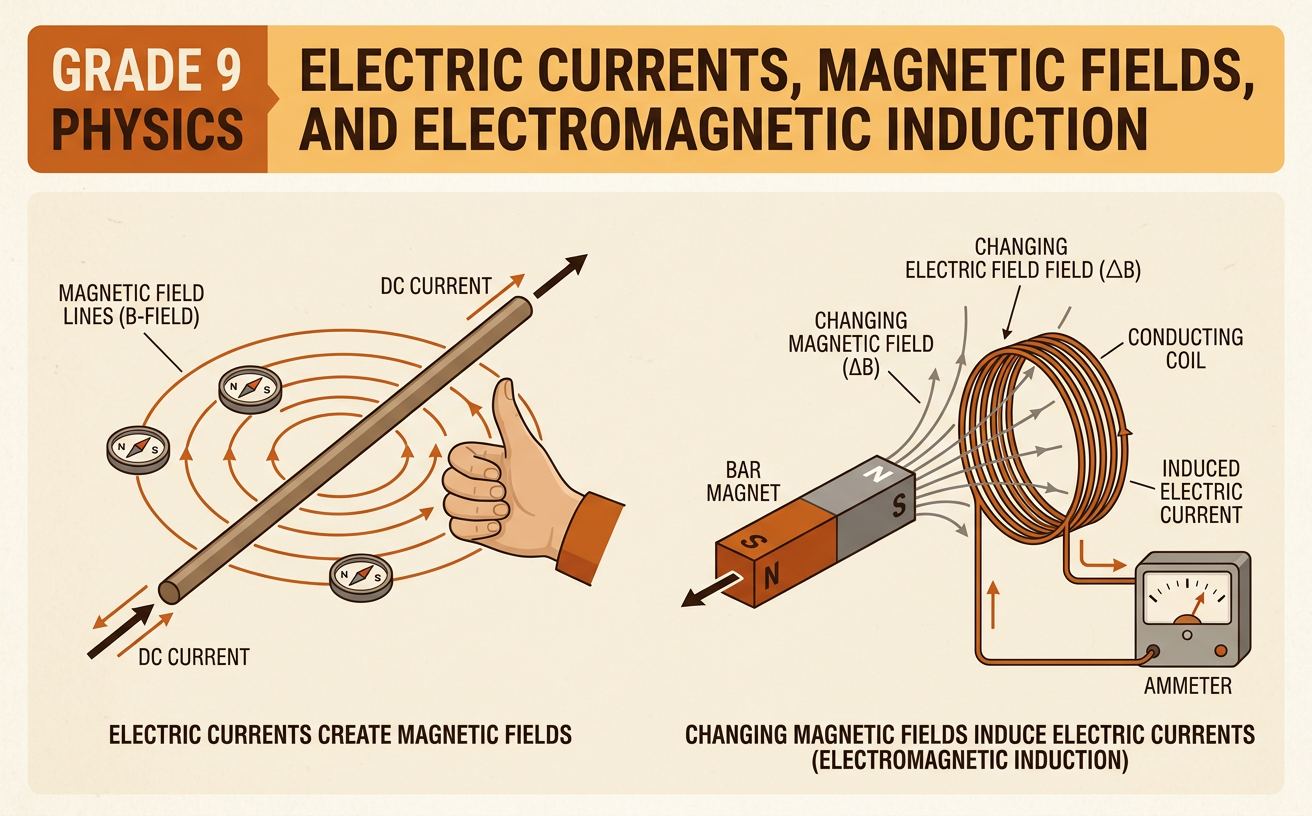
Illustrations are auto-generated and may be placeholders. They can be refreshed to match the narration.
Current and Magnetic Fields
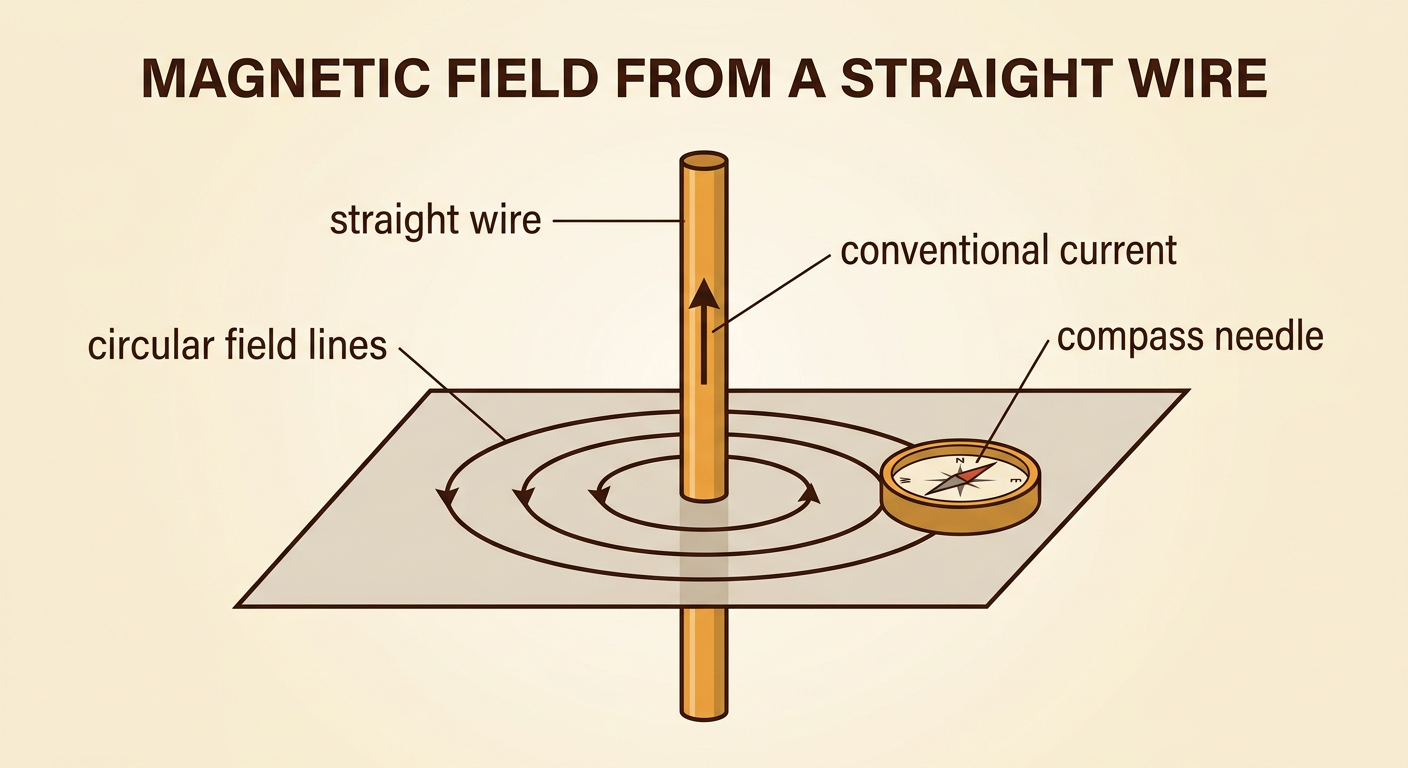
An electric current is a flow of electric charge. When current moves through a wire, it creates a magnetic field around the wire. For a straight wire, the field forms circles centered on the wire. The field becomes stronger when the current increases and weaker farther from the wire. Its direction can be predicted with the right-hand rule: point your right thumb in the direction of conventional current, and your curled fingers show the magnetic field direction. For example, place a compass near a wire connected to a battery. When the circuit is open, the compass points toward magnetic north. When the circuit is closed, current flows and the compass needle turns. Reversing the battery connections reverses the current and makes the needle turn in the opposite direction. These observations provide evidence that current produces a magnetic field.
Mapping a Coil’s Magnetic Field
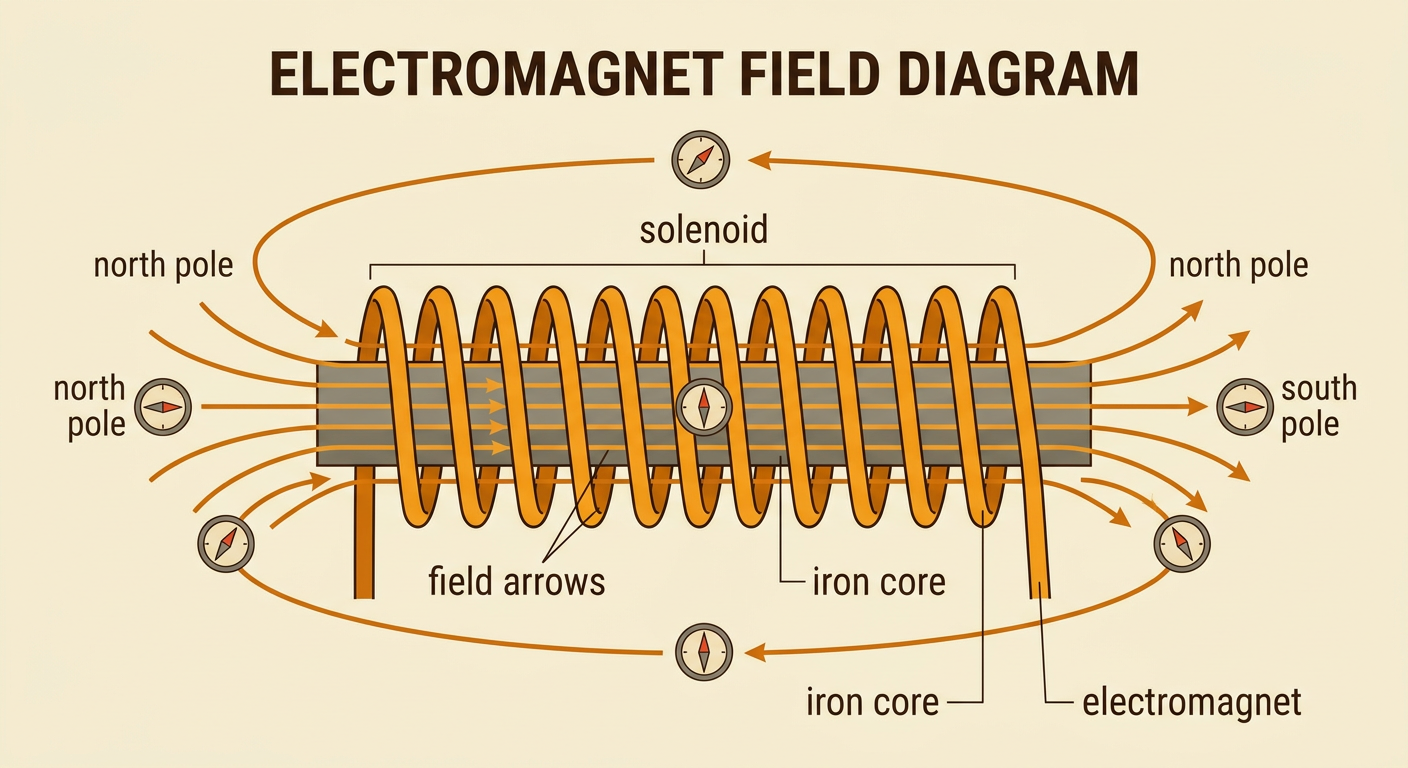
Bending a current-carrying wire into a loop concentrates its magnetic field through the loop’s center. Wrapping many loops into a coil, or solenoid, makes the combined field stronger and more uniform inside the coil. The coil then behaves like a bar magnet, with a north pole and a south pole. Students can map this field by placing small compasses at several locations around the coil and recording the direction of each needle. They can draw field arrows that follow the compass directions. For example, connect a coil to a low-voltage power source, test points inside and outside it, and compare the results. Increasing the number of turns or the current usually increases the field strength. Adding an iron core can strengthen the electromagnet because magnetic regions in the iron align with the coil’s field.
Changing Fields and Induced Current
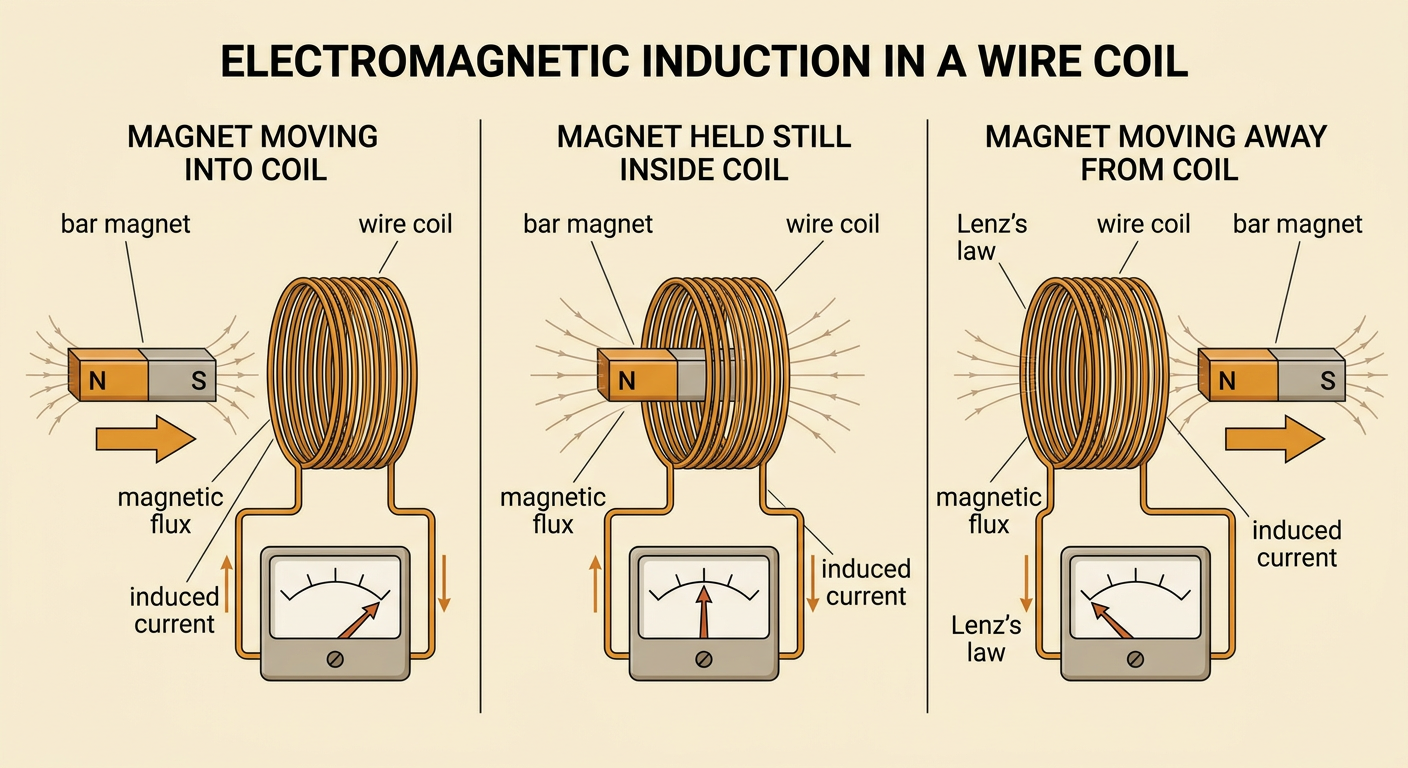
A magnetic field can produce electric current only when the magnetic field through a conductor changes. This process is electromagnetic induction. For example, pushing a bar magnet into a wire coil changes the magnetic flux through the coil, causing a meter connected to the coil to show a brief current. Holding the magnet still produces no sustained induced current, even though the magnet’s field is present. Pulling the magnet out reverses the change and reverses the induced current. Moving the magnet faster creates a larger meter reading because the magnetic flux changes more quickly. The induced current creates its own magnetic field that opposes the change that produced it, a pattern called Lenz’s law. Similar results occur if the coil moves while the magnet stays still, because the important factor is a change in magnetic flux through the coil.
Evidence from a Simple Investigation
A controlled investigation can test both parts of the relationship. First, place a compass a fixed distance from a straight insulated wire. Record the compass direction with the circuit open, close the circuit briefly, and record the deflection. Reverse the battery connections and repeat while keeping the wire position and distance constant. Second, connect a coil to a center-zero meter. Push the same magnet into the coil at a steady speed, hold it still, and then pull it out. Record the direction and size of each meter reading. Repeat each trial several times and follow safety directions by using a low-voltage source and disconnecting hot wires. A consistent compass deflection supports the claim that current creates a magnetic field. Meter deflections during motion, but not while the magnet is still, support the claim that a changing magnetic field induces current.

Applications in Generators and Technology
Electric generators apply electromagnetic induction to convert mechanical energy into electrical energy. In a simple generator, a coil rotates between magnetic poles, continually changing the magnetic flux through the coil. This changing flux induces a current that reverses direction every half-turn, producing alternating current. A turbine may rotate the generator using moving water, wind, steam, or another energy source. For example, in a wind turbine, moving air turns the blades, the shaft rotates coils or magnets, and the generator supplies electric current to the power grid. Electromagnetic principles also operate in transformers, induction cooktops, bicycle generators, microphones, and wireless chargers. When evaluating these technologies, explanations should identify the energy source, trace the sequence of energy transfers, and use evidence about costs and benefits. Wind generators produce electricity without burning fuel during operation, but their output depends on weather and location.
