
Electric, Magnetic, and Noncontact Forces
Students investigate how electric and magnetic fields allow objects to exert forces without touching.
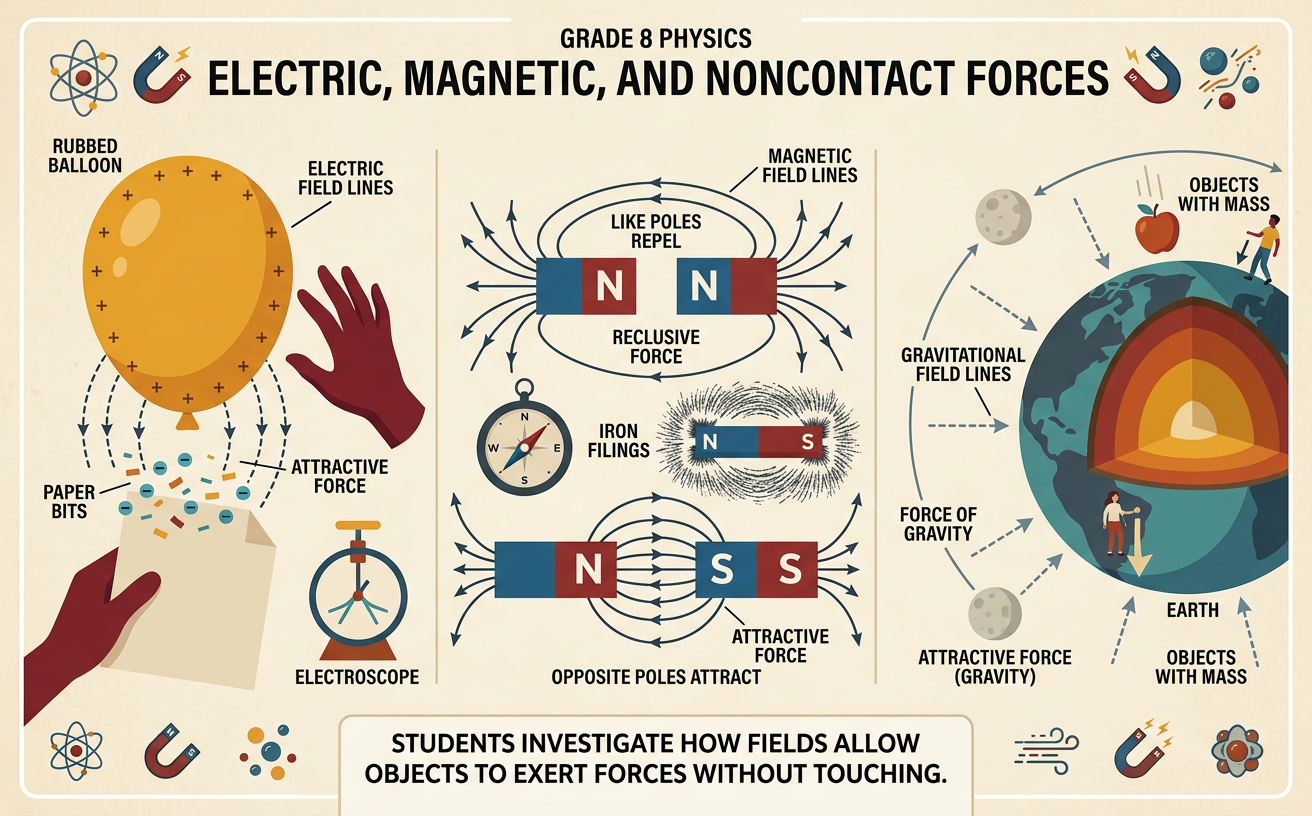
Illustrations are auto-generated and may be placeholders. They can be refreshed to match the narration.
Contact and Noncontact Forces
A force is a push or pull that can change an object’s motion. Contact forces act only when objects touch. For example, a hand pushes a cart through direct contact, and friction between the wheels and floor slows the cart. Noncontact forces act across a distance. Gravity pulls a dropped ball toward Earth, a magnet attracts an iron paper clip, and electrically charged objects can attract or repel one another without touching. In each case, the objects interact even though empty space may appear to separate them. Scientists identify a force by observing its effects, such as a change in speed, direction, or shape. Comparing contact and noncontact interactions helps scientists determine whether touching is necessary for a particular force to act.
Electric Charges
Electric force occurs between objects with electric charge. Charge can be positive or negative. Like charges repel, while opposite charges attract. An object may become charged when electrons move from one material to another, such as when a balloon is rubbed on dry hair. The balloon gains extra electrons and becomes negatively charged, while the hair loses electrons and becomes positively charged. When the balloon is brought near the hair, the opposite charges attract even before the objects touch. A charged balloon can also attract a neutral wall because charges within the wall shift slightly, leaving more positive charge near the balloon. The strength of electric force generally increases when the amount of charge increases or the distance between objects decreases.
Magnetic Poles
Every magnet has two poles: a north pole and a south pole. Like magnetic poles repel, and opposite magnetic poles attract. If the north pole of one bar magnet faces the south pole of another, the magnets pull toward each other across the gap. If two north poles face, the magnets push apart without touching. Magnetic forces are strongest near the poles. Cutting a magnet does not produce a separate north pole and south pole; instead, each piece becomes a smaller magnet with both poles. Magnets strongly attract certain materials, including iron, nickel, and cobalt, but they do not attract every metal. For example, a bar magnet can lift an iron paper clip, while an aluminum object usually shows no strong attraction.
Fields as Force Models
A field is a model scientists use to describe how an object can exert a force throughout the space around it. Electric charges create electric fields, magnets create magnetic fields, and Earth creates a gravitational field. A second object placed in a field may experience a force even without contact. Field diagrams use lines to show the direction and relative strength of an interaction. Electric field arrows point in the direction a positive test charge would move. Around a bar magnet, magnetic field lines form closed loops, traveling outside the magnet from the north pole toward the south pole. Closely spaced lines represent a stronger field; widely spaced lines represent a weaker field. Field lines are models, not physical strings or paths that can be seen directly.
Testing Forces at a Distance
An investigation can provide evidence for fields by measuring force effects while objects remain separated. Place a bar magnet at one end of a ruler and a paper clip at measured distances, such as 1, 2, 3, and 4 centimeters. At each distance, release the paper clip and record whether it moves toward the magnet. Repeat every trial at least three times. Keep the same magnet, paper clip, surface, orientation, and release method so distance is the only changed variable. A pattern of stronger or more frequent motion at shorter distances supports the claim that a magnetic field exists between the objects. Evaluate the design by checking measurement precision, controlled variables, repeated trials, and possible sources of error, such as a tilted surface or nearby metal. Evidence is stronger when results are consistent and reproducible.