
Electricity, Circuits, and Magnetism
Students model electric interactions, analyze simple circuits, and explain how electric currents produce magnetic fields.

Illustrations are auto-generated and may be placeholders. They can be refreshed to match the narration.
Electric Charge and Fields
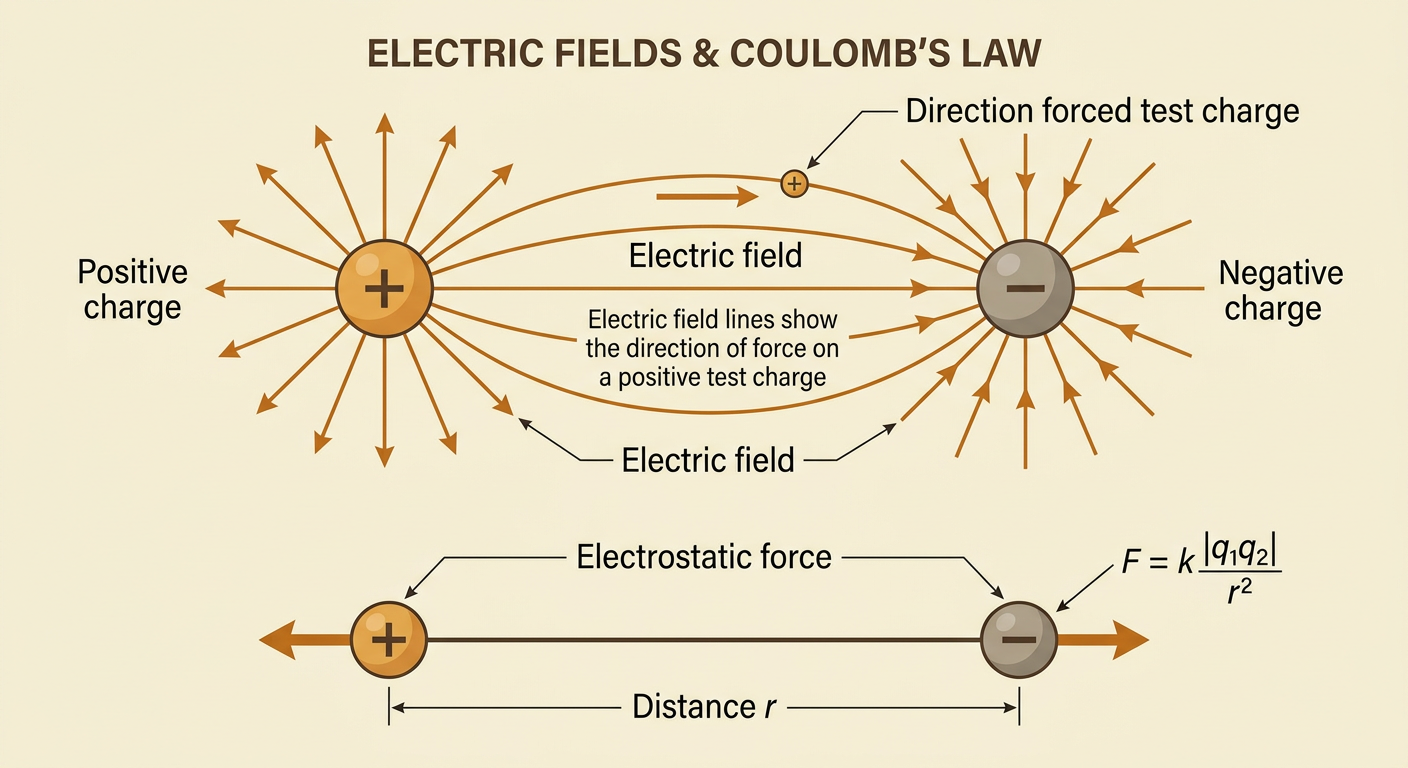
Matter contains positive protons and negative electrons. Objects become charged when electrons transfer from one object to another; protons usually remain bound inside atomic nuclei. Like charges repel, while opposite charges attract. An electric field describes how a charged object would push or pull a small positive test charge at each location. Field arrows point away from positive charges and toward negative charges. Coulomb’s law, F = k|q₁q₂|/r², models the force between two point charges. Increasing either charge increases the force, while doubling their separation reduces the force to one-fourth. For example, rubbing a balloon on hair transfers electrons to the balloon. The negatively charged balloon can then attract a neutral wall by slightly shifting charges within the wall. Charge is conserved during every transfer.
Voltage, Current, and Resistance
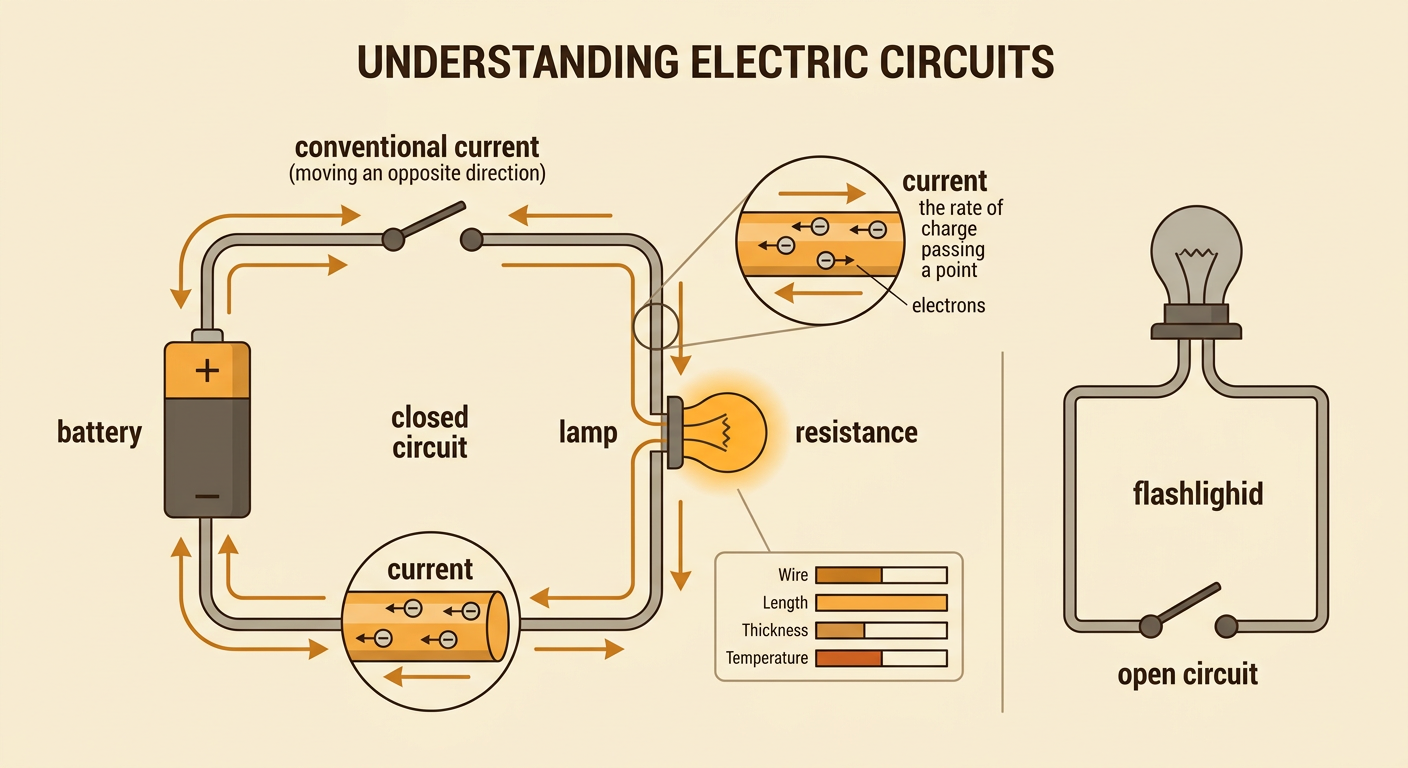
Voltage is electric potential difference: the energy transferred per unit charge between two points. A battery supplies voltage by using chemical reactions to separate charge. Current, measured in amperes, is the rate at which charge passes a point. Conventional current is drawn from the battery’s positive terminal toward its negative terminal, although electrons in metal wires drift in the opposite direction. Resistance, measured in ohms, opposes current and converts electrical energy into other forms, such as heat or light. In a flashlight, the battery provides voltage, current moves through a closed circuit, and the lamp resists the current while producing light. Wire material, length, thickness, and temperature affect resistance. Because copper and generating resources are limited, communities and utilities compare cost, efficiency, reliability, and availability when planning electrical generation and distribution.
Ohm's Law
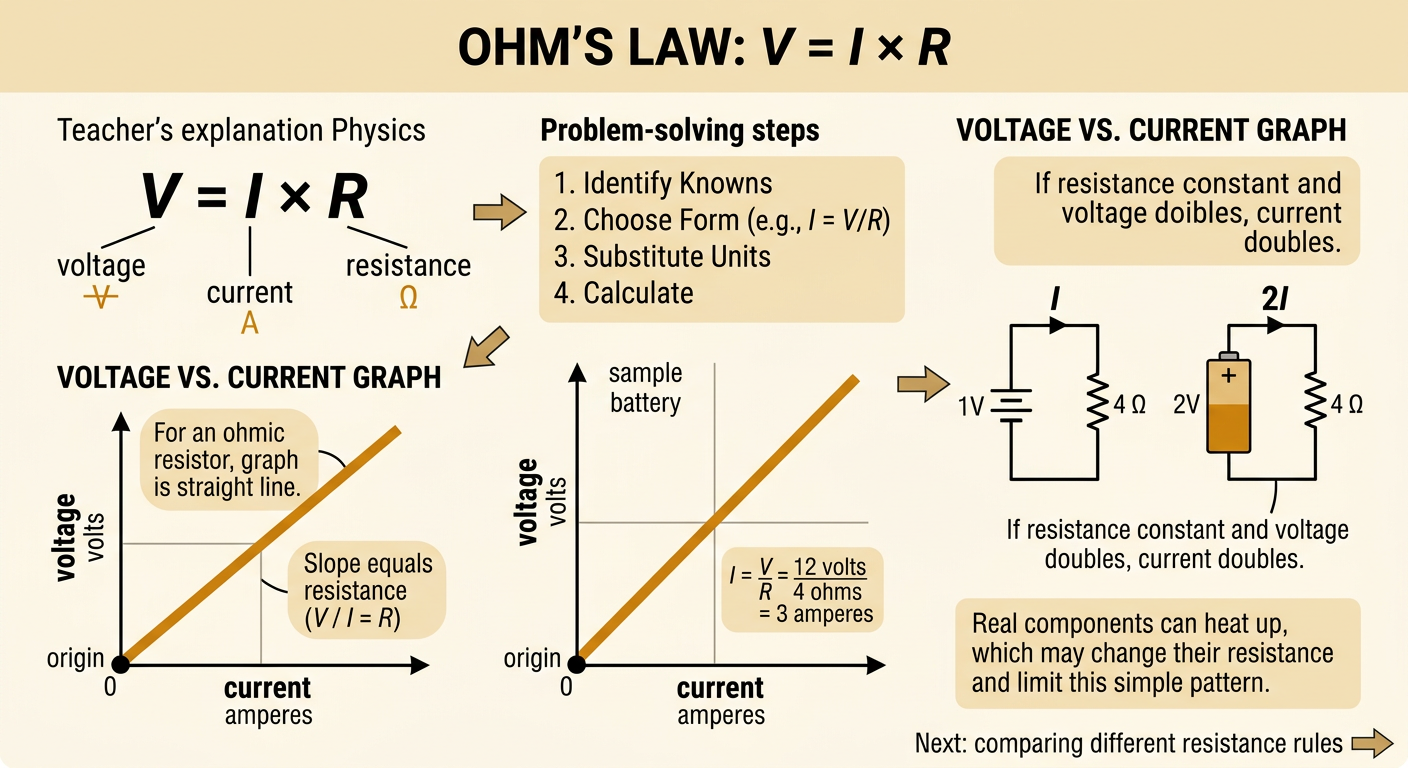
Ohm’s law relates voltage, current, and resistance in many conductors: V = IR. Voltage V is measured in volts, current I in amperes, and resistance R in ohms. The equation can be rearranged to solve for any variable: I = V/R or R = V/I. First identify the known values, select the correct form, substitute units, and calculate. For example, a 12-volt battery connected across a 4-ohm resistor produces I = 12 V ÷ 4 Ω = 3 A. If resistance stays constant, doubling the voltage doubles the current. A graph of voltage versus current for an ohmic resistor is a straight line through the origin, and its slope equals resistance because V/I = R. Real components may heat up, causing their resistance to change, so Ohm’s law must be applied under appropriate conditions.
Series and Parallel Circuits
In a series circuit, components share one path. The same current passes through every component, and the source voltage is divided among them. Series resistances add: Rtotal = R₁ + R₂. If one lamp opens the circuit, all lamps turn off. In a parallel circuit, components connect across the same two nodes and form separate branches. Each branch has the same voltage, while the total current equals the sum of the branch currents. For two resistors, 1/Rtotal = 1/R₁ + 1/R₂, so adding a parallel branch lowers total resistance. For example, two 6-ohm resistors in series have a total resistance of 12 ohms, but the same resistors in parallel have a total resistance of 3 ohms. Household devices use parallel connections so each device receives the full supply voltage and can operate independently.

Magnetic Fields
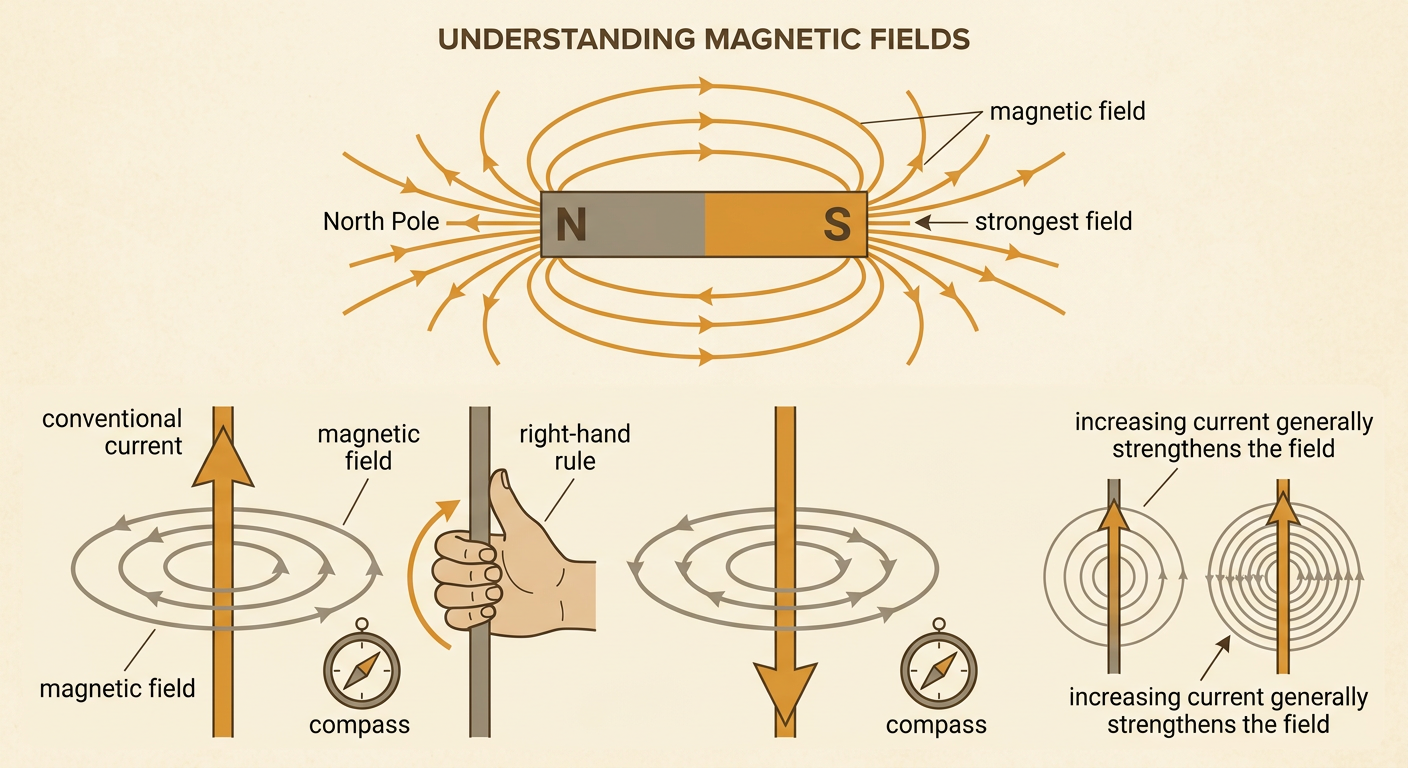
A magnetic field is a region where magnetic materials, moving charges, or electric currents experience magnetic forces. Outside a bar magnet, field lines point from the north pole toward the south pole. The lines form closed loops and are closest together where the field is strongest. An electric current also produces a magnetic field. Around a straight wire, the field forms concentric circles centered on the wire. Use the right-hand rule: point your right thumb in the direction of conventional current, and your curled fingers show the magnetic field direction. For example, when a current-carrying wire is placed above a compass, the compass needle deflects. Reversing the current reverses the needle’s deflection. This repeatable observation provides evidence that current creates a magnetic field. Increasing the current generally strengthens the field around the wire.
Electromagnetic Induction
Electromagnetic induction occurs when a changing magnetic flux through a loop produces an induced voltage. Magnetic flux depends on field strength, loop area, and the angle between the field and the loop. A current flows only if the conducting path is closed. For example, pushing a bar magnet into a wire coil changes the magnetic field through the coil and makes a connected galvanometer needle move. Holding the magnet still produces no sustained induced voltage, while pulling it out reverses the needle’s direction. Moving the magnet faster produces a larger voltage because the flux changes more rapidly. According to Lenz’s law, the induced current creates a magnetic field that opposes the change that produced it. Generators apply this principle by rotating coils or magnets, converting mechanical energy into electrical energy. Transformers also use changing magnetic fields to raise or lower alternating voltage for efficient distribution.
