Electrochemical Cells: How Batteries Convert Chemical Energy
Students model electron and ion movement in a galvanic cell, interpret battery-discharge data, and use evidence to evaluate battery technologies for a practical application.

Illustrations are auto-generated and may be placeholders. They can be refreshed to match the narration.
Battery Components and Energy Conversion
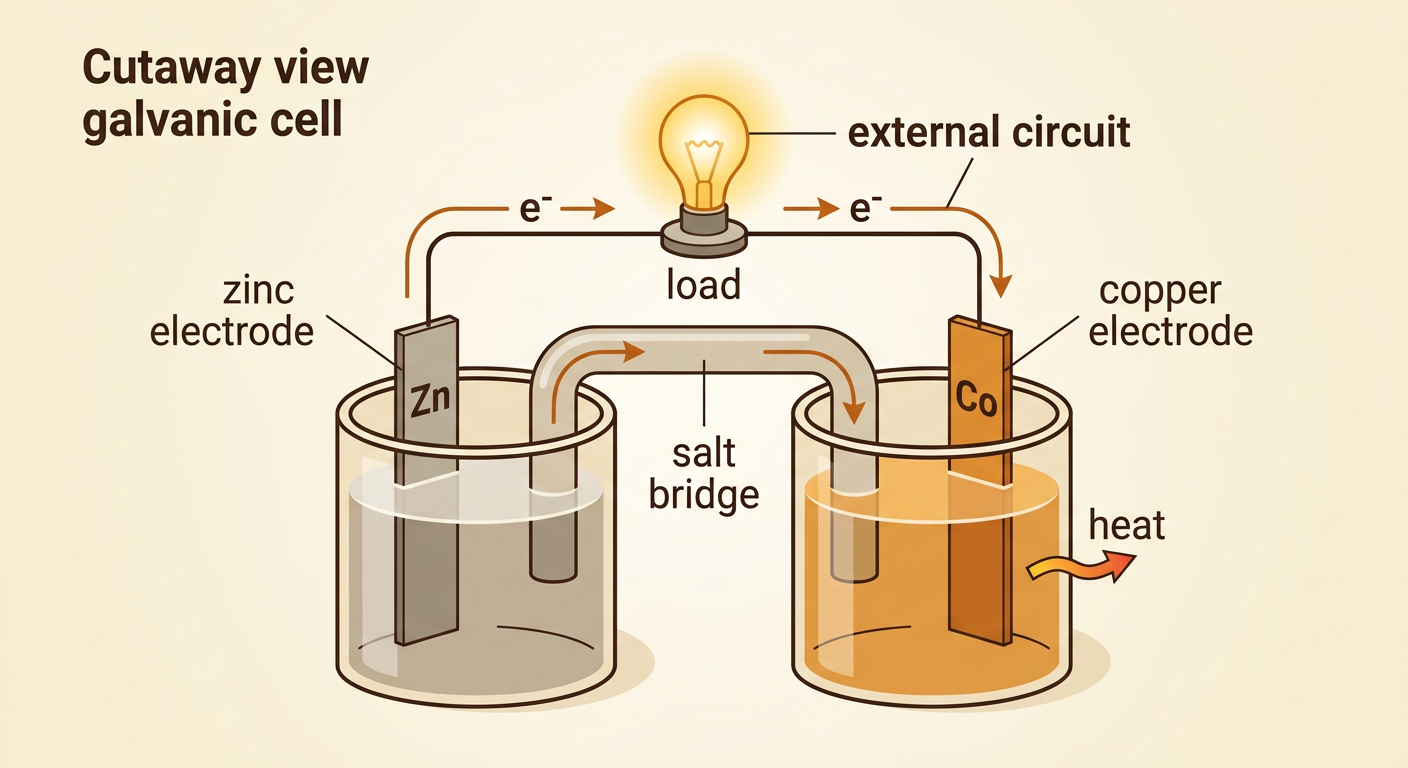
A galvanic cell converts stored chemical energy into electrical energy through a spontaneous redox reaction. It contains two electrodes, electrolytes that conduct ions, and an external circuit that conducts electrons. A separator or salt bridge permits ion movement while limiting direct mixing of reactants. In a zinc-copper cell, zinc metal and a zinc-ion solution form one half-cell, while copper metal and a copper-ion solution form the other. When the circuit closes, chemical reactions push electrons from the zinc electrode through a wire and load to the copper electrode. The moving electrons can power a small light or motor. Some energy also becomes thermal energy because the cell has internal resistance. A useful battery design must produce the needed voltage and current while controlling heat, leakage, mass, cost, and material use.
Oxidation, Reduction, and Electron Flow
Oxidation is the loss of electrons, and reduction is the gain of electrons. In a zinc-copper galvanic cell, zinc atoms are oxidized at the anode: Zn becomes Zn²⁺ plus two electrons. The released electrons enter the external circuit. At the copper cathode, copper ions are reduced: Cu²⁺ plus two electrons becomes Cu metal. Combining the half-reactions gives the overall reaction Zn plus Cu²⁺ becomes Zn²⁺ plus Cu. During discharge, the zinc electrode gradually loses mass, while copper can plate onto the copper electrode. Electrons always move through the wire from the anode to the cathode in a galvanic cell. Conventional current is defined in the opposite direction. Tracking electrons and identifying which species loses or gains them allows students to predict electrode changes and explain the cell’s voltage.

Modeling Ion Movement in the Cell
Electron flow would quickly stop without ion movement inside the cell. As zinc is oxidized, positive Zn²⁺ ions accumulate in the anode half-cell. Anions from the salt bridge move toward that half-cell to maintain electrical neutrality. At the cathode, Cu²⁺ ions leave the solution as they become copper metal, so cations from the salt bridge move toward the cathode half-cell. For example, a potassium nitrate salt bridge sends nitrate ions toward the zinc anode and potassium ions toward the copper cathode. The ions do not carry electrons through the salt bridge; they carry charge by physically moving through the electrolyte. A particle model should show electron movement only in the wire, ion movement in the solutions and bridge, and no buildup of large net charge in either half-cell.

Interpreting a Battery-Discharge Graph
A discharge graph often shows battery voltage as a function of time at a fixed current. Suppose a battery begins at 1.60 volts, quickly settles near 1.50 volts, remains between 1.45 and 1.50 volts for six hours, and then drops steeply to 1.00 volt by hour seven. The starting value is the initial voltage, the nearly horizontal region is the operating plateau, and the steep decline is the end-of-discharge region. If a device requires at least 1.20 volts, the battery’s useful runtime is about 6.7 hours, not the full time until voltage reaches zero. Students should also examine test conditions because higher current, low temperature, or an older battery can shorten runtime. When comparing curves, cite specific coordinates, slopes, and thresholds rather than stating only that one battery “lasts longer.”

Evaluating Battery Technology Tradeoffs
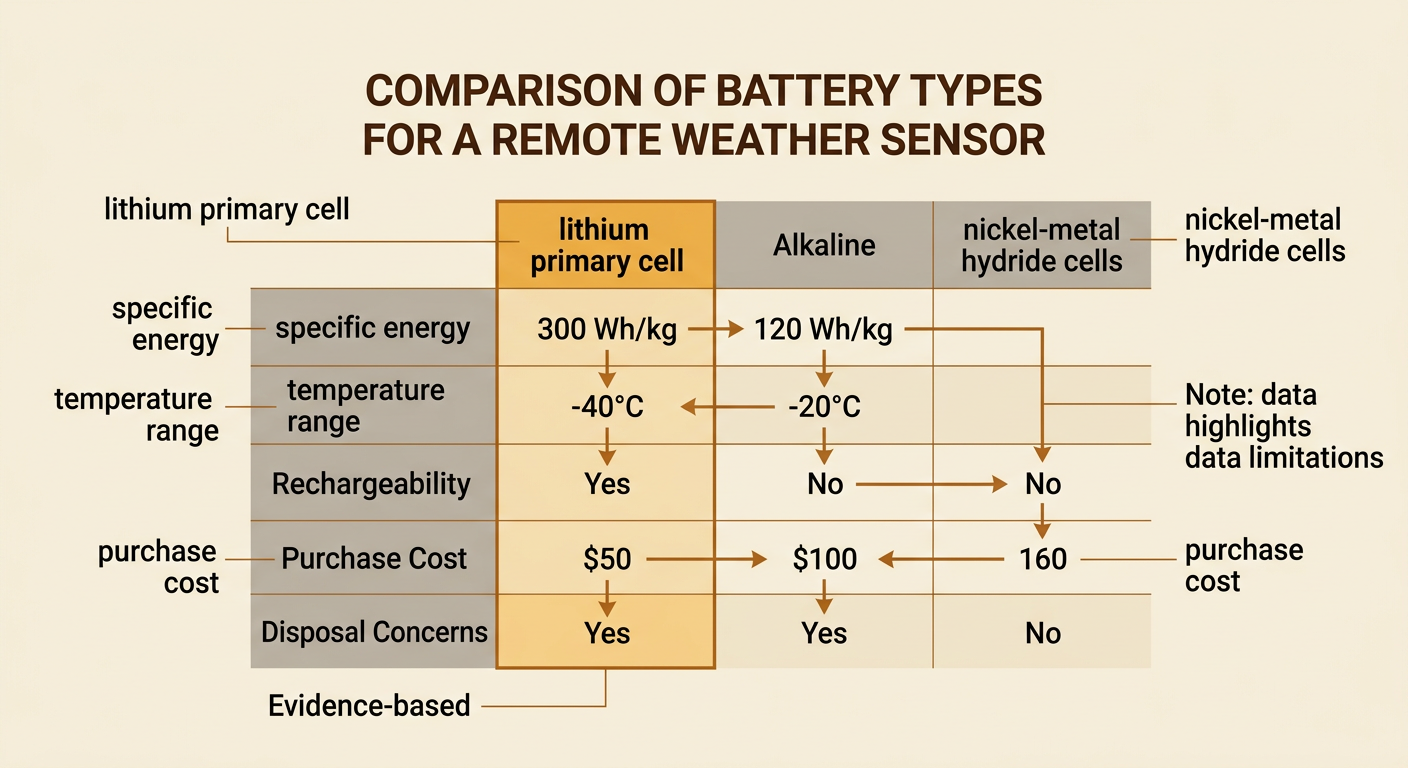
Selecting a battery requires evidence tied to a specific application. Consider a remote weather sensor that needs low mass, reliable cold-weather operation, and one year of service. A comparison table might report that lithium primary cells provide 300 watt-hours per kilogram and operate to −40 degrees Celsius, while alkaline cells provide 120 watt-hours per kilogram and operate reliably only to about −20 degrees Celsius. These data support lithium for the sensor, despite its higher purchase cost. A counterclaim is that rechargeable nickel-metal hydride cells reduce disposal and can cost less over many cycles. However, limited winter performance and the need for on-site recharging may weaken that option. The argument should cite exact values from technical sources, identify uncertainties such as different manufacturer test methods, and explain safety and environmental tradeoffs. Students can then refine a prototype by changing cell number, wiring, insulation, or power-management settings and retesting performance.