Electromagnetic Induction: From Motion to Electric Power
Students use models and evidence to explain how changing magnetic fields induce electric current and apply this principle to generators and electric-power systems.

Illustrations are auto-generated and may be placeholders. They can be refreshed to match the narration.
Magnetic Fields and Moving Charges
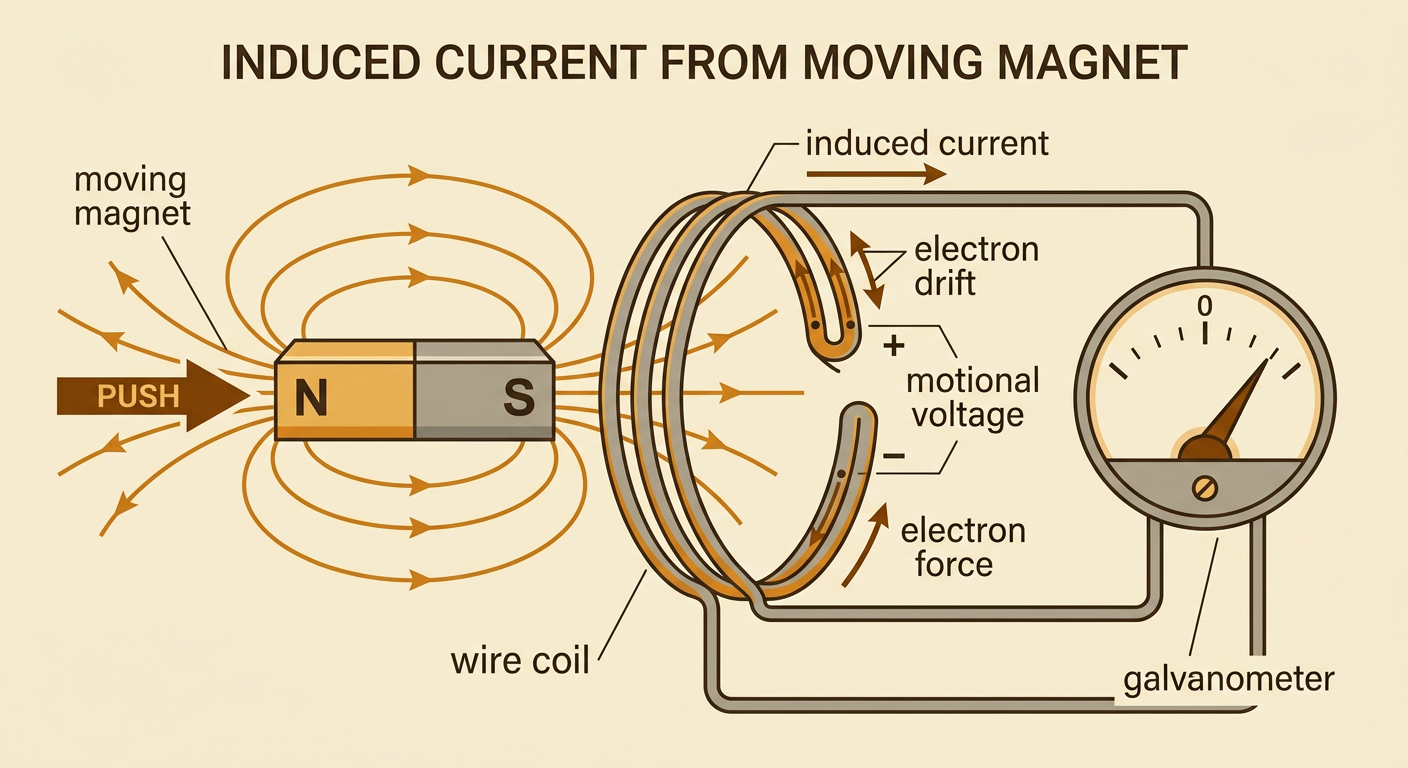
Magnetic fields exert forces on moving electric charges. The force is perpendicular to both the charge’s velocity and the magnetic field, so it can redirect charges or separate them within a conductor. When a wire moves across magnetic field lines, electrons shift toward one end, producing a potential difference called motional voltage. If the wire is part of a closed circuit, this voltage can drive a current. A similar effect occurs when a magnet moves relative to a stationary coil because the magnetic field through the coil changes. For example, pushing a bar magnet into a wire coil makes a connected galvanometer needle deflect. Pulling the magnet out reverses the deflection. The external push or pull supplies the energy that is transferred to the circuit.
Faraday’s Law of Induction
Magnetic flux measures how much magnetic field passes through a surface. For a uniform field, flux can be modeled as Φ = BA cos θ, where B is field strength, A is loop area, and θ is the angle between the field and a line perpendicular to the loop. Faraday’s law states that the induced voltage is ε = −NΔΦ/Δt. A larger or faster change in flux produces a greater voltage, and N represents the number of coil turns. The negative sign expresses Lenz’s law: the induced current creates a magnetic field that opposes the change in flux. For example, when a magnet’s north pole approaches a coil, the near face of the coil acts like a north pole, resisting the approach. This opposition is evidence that energy is conserved.

Factors Affecting Induced Voltage
Induced voltage depends on the rate of change of magnetic flux, not simply on the presence of a magnetic field. Students can test this relationship by connecting coils to a voltage sensor and moving the same magnet through them at different speeds. The peak voltage should increase when the magnet moves faster because ΔΦ/Δt becomes larger. Voltage also increases with more coil turns, a stronger magnet, or a larger effective loop area. Rotating a coil changes its angle to the field and therefore changes its flux. A fair investigation varies one factor while holding the others constant and repeats each trial. A graph of peak voltage versus speed can reveal a mathematical pattern. Circuit resistance does not directly change the induced voltage, but it affects current according to I = ε/R, so greater resistance produces less current for the same voltage.

How Electric Generators Work
An electric generator converts mechanical energy into electrical energy through electromagnetic induction. A turbine rotates a coil within a magnetic field, or rotates magnets around stationary coils. As the angle between the coil and the field changes, magnetic flux rises, falls, and reverses. The resulting voltage alternates direction, producing alternating current. In a simplified generator, slip rings and brushes connect the rotating coil to an external circuit while allowing continuous rotation. For example, steam in a power plant can spin turbine blades connected to a generator shaft. The steam’s thermal energy becomes rotational mechanical energy and then electrical energy. The generator does not create energy; some input energy becomes heat and sound because of electrical resistance, friction, and turbulence. Transformers later adjust AC voltage for efficient transmission and safer local distribution.

Evidence-Based Energy System Decisions
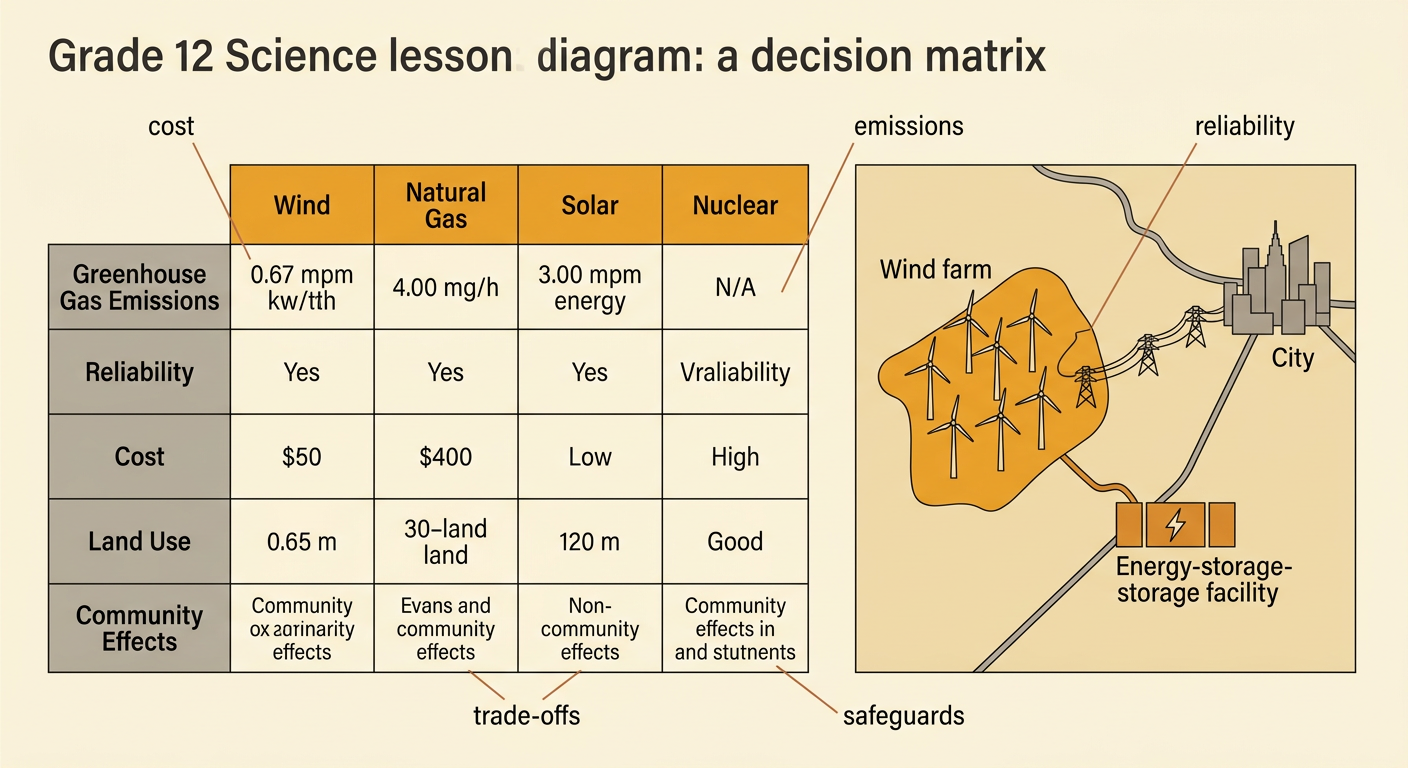
Energy policies should be evaluated using scientific evidence, quantitative models, and the experiences of affected communities. Decision makers can compare generating technologies by cost per kilowatt-hour, greenhouse gas emissions, reliability, land and water use, construction time, and effects on public health. Intended outcomes may include lower emissions, stable prices, or greater energy security. Unintended outcomes can include habitat loss, noise, mining impacts, unequal electricity costs, or reduced grid reliability. For example, a policy supporting a large wind farm may reduce fossil-fuel use but also require new transmission lines and plans for variable output. Students can examine maps, generation graphs, cost tables, and community testimony, then identify trade-offs and propose safeguards. A strong recommendation states its criteria, cites evidence, acknowledges uncertainty, and explains how benefits and burdens will be distributed among different groups.