
Electron Configuration and Periodic Trends
Students use atomic structure and electron configurations to explain recurring trends in atomic radius, ionization energy, electronegativity, and chemical behavior across the periodic table.

Illustrations are auto-generated and may be placeholders. They can be refreshed to match the narration.
Energy Levels and Valence Electrons
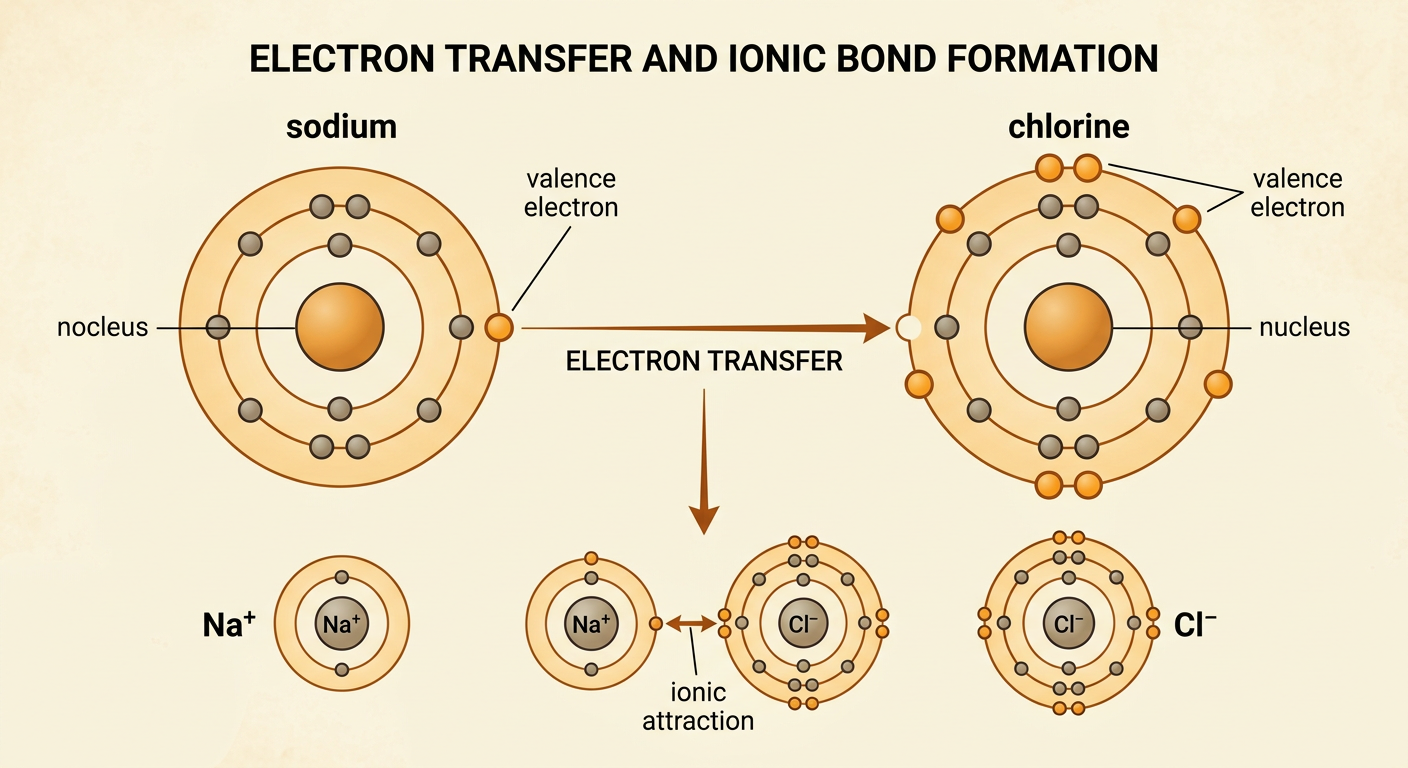
Electrons occupy regions around the nucleus called energy levels. Each main energy level contains sublevels and orbitals, which describe where electrons are most likely to be found. Electrons in the highest occupied energy level are called valence electrons. These electrons largely determine how an atom bonds and reacts because they are farthest from the nucleus and interact with other atoms. Elements in the same periodic table group usually have the same number of valence electrons and therefore show similar chemical behavior. For example, sodium has one valence electron, while chlorine has seven. Sodium tends to lose one electron, and chlorine tends to gain one. This transfer gives both ions stable outer energy levels and produces an ionic attraction in sodium chloride.
Writing Electron Configurations
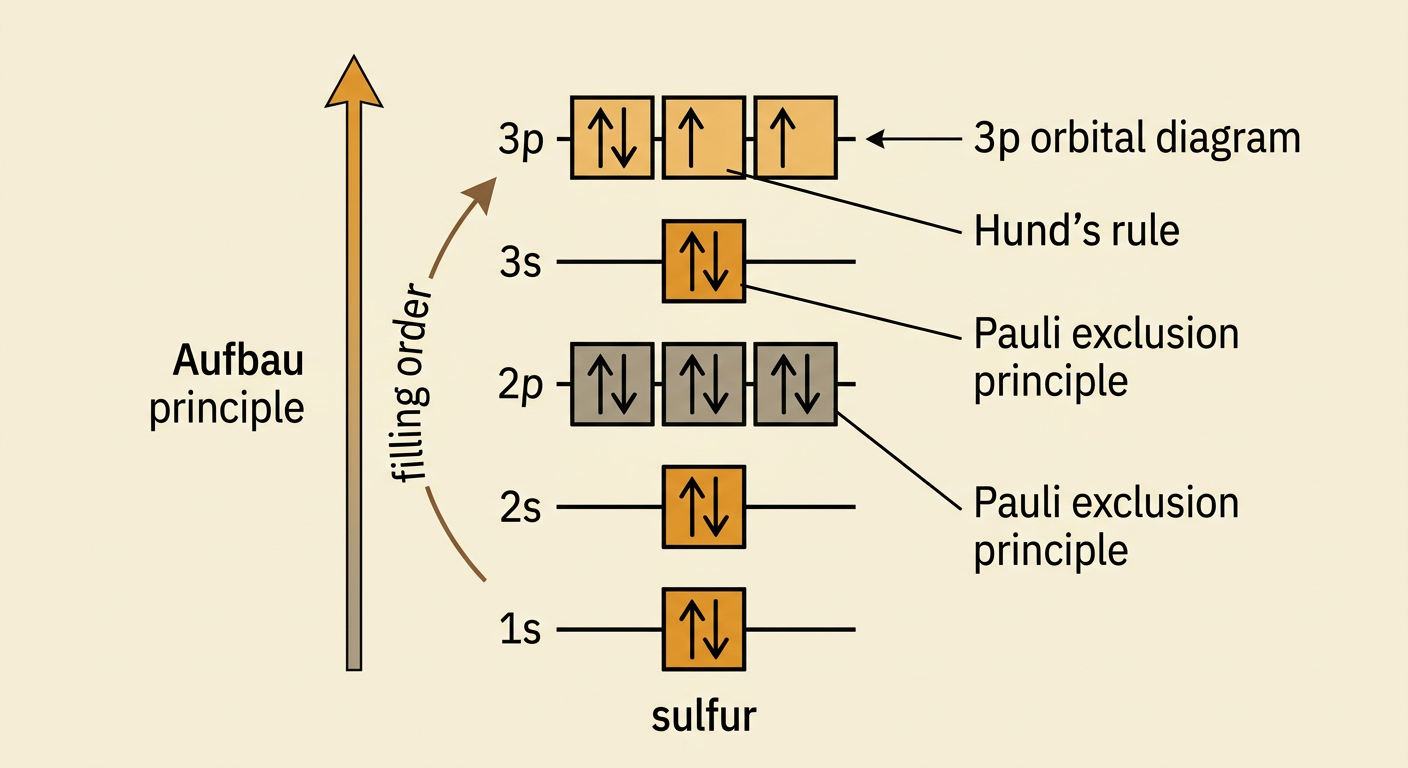
An electron configuration shows how an atom’s electrons are distributed among sublevels and orbitals. Electrons generally fill lower-energy sublevels before higher-energy ones, following the Aufbau principle. Each orbital can hold no more than two electrons with opposite spins, according to the Pauli exclusion principle. When equal-energy orbitals are available, electrons occupy them singly before pairing, following Hund’s rule. The usual filling order begins 1s, 2s, 2p, 3s, and 3p. Sulfur has 16 electrons, so its configuration is 1s² 2s² 2p⁶ 3s² 3p⁴. Its highest occupied energy level is level 3, which contains six valence electrons. An orbital diagram for 3p shows one paired orbital and two singly occupied orbitals.
Periodic Table Patterns
The periodic table organizes elements by increasing atomic number and recurring electron patterns. A period, or horizontal row, corresponds to the filling of a main energy level. A group, or vertical column, contains elements with related valence-electron configurations. The s, p, d, and f blocks identify the type of sublevel receiving the final electron. For main-group elements, the group position helps reveal the number of valence electrons. Magnesium and calcium are both in Group 2 and have outer configurations ending in s². Each commonly loses two electrons and forms a 2+ ion. Calcium has one more occupied main energy level than magnesium because it is in the next period. Thus, the table combines atomic number, electron configuration, and location into a model for predicting properties.

Atomic Radius and Shielding
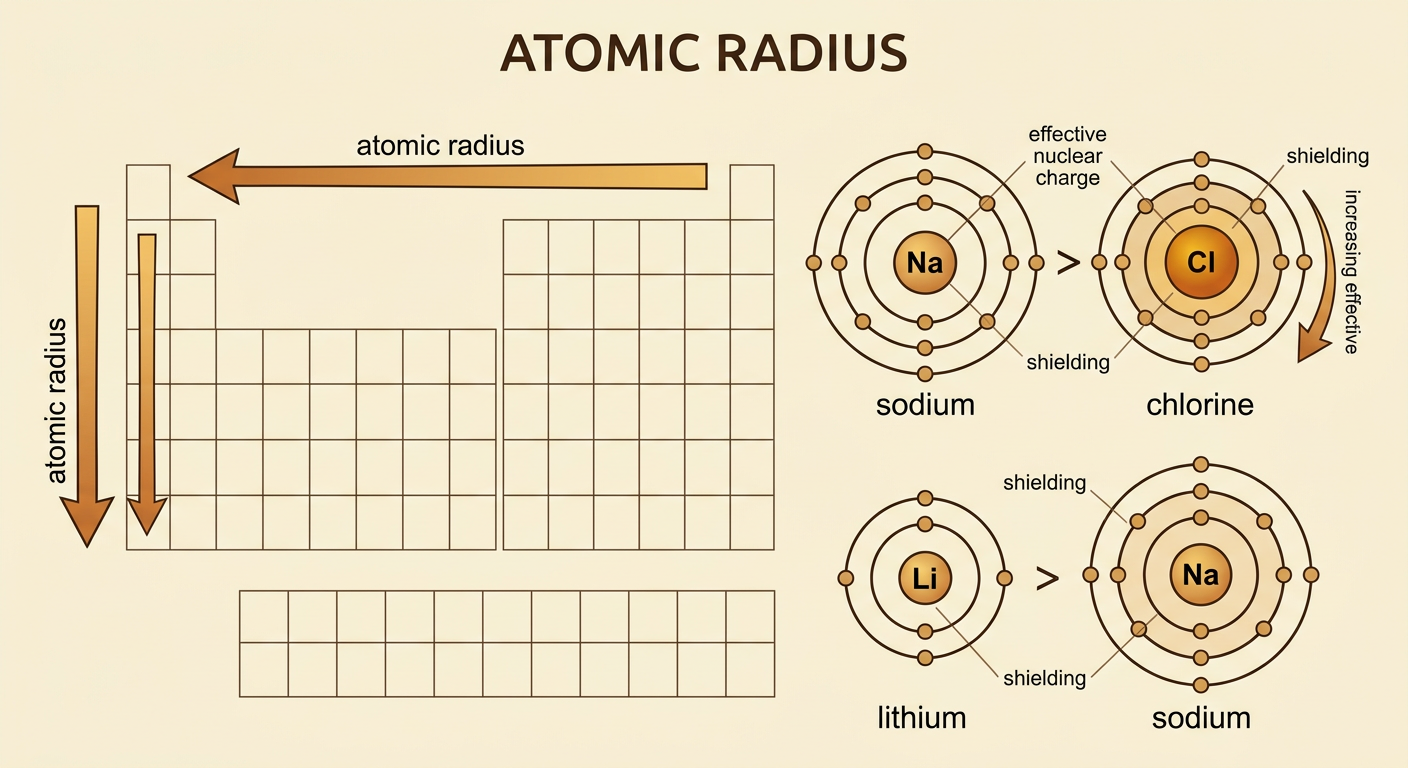
Atomic radius is a measure of an atom’s size. Across a period from left to right, atomic radius generally decreases. The number of protons increases, while added electrons enter the same main energy level. Because inner-electron shielding changes little, the stronger effective nuclear charge pulls the valence electrons closer to the nucleus. For example, chlorine is smaller than sodium even though chlorine has more electrons. Down a group, atomic radius generally increases because each new period adds another occupied energy level. Inner electrons also shield outer electrons from some nuclear attraction. Therefore, sodium is larger than lithium because sodium has an additional occupied energy level. Atomic size reflects a balance among nuclear charge, electron-electron repulsion, shielding, and the distance of valence electrons from the nucleus.
Ionization Energy and Electronegativity
Ionization energy is the energy required to remove an electron from a gaseous atom. It generally increases from left to right across a period because effective nuclear charge increases and valence electrons are held more tightly. It generally decreases down a group because valence electrons are farther from the nucleus and experience more shielding. Electronegativity measures an atom’s ability to attract shared electrons in a chemical bond. It follows a similar pattern, increasing across a period and decreasing down a group; fluorine has the highest electronegativity. Noble gases are often excluded because they rarely form bonds. For example, sodium has low ionization energy and readily loses an electron, while chlorine strongly attracts an electron in a bond. These differences help explain the formation and polarity of sodium chloride.

Predicting Element Properties
An element’s position and electron configuration can be used together to predict size, bonding, ion formation, and reactivity. First identify the element’s group, period, and valence electrons. Then apply periodic trends and compare it with nearby elements. Potassium, for example, is a Group 1 metal with the outer configuration 4s¹. It has a relatively large radius and low ionization energy, so it readily loses one electron to form K⁺. Bromine is a Group 17 nonmetal with seven valence electrons and tends to gain one electron to form Br⁻. Their opposite charges predict the ionic compound KBr. Such predictions can be checked by integrating periodic table trends, electron configurations, and experimental data. This knowledge also supports evidence-based choices about reactive materials in batteries, fertilizers, manufacturing, and safe chemical storage.
