Electron Transfer and Voltage in Galvanic Cells
Students model oxidation and reduction in a galvanic cell, trace electron and ion movement, and connect cell voltage to the chemical energy used by batteries.
Illustrations are auto-generated and may be placeholders. They can be refreshed to match the narration.
Oxidation and Reduction Review
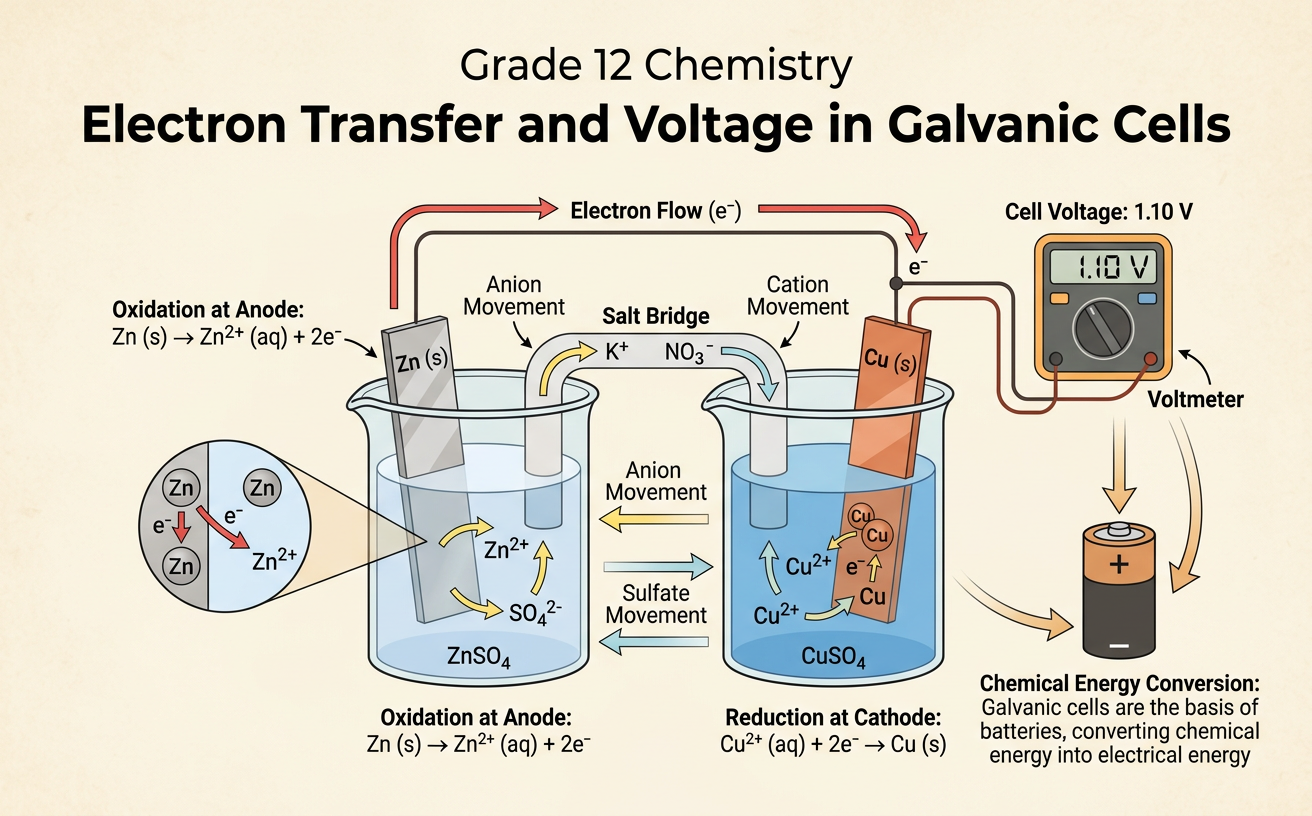
Oxidation and reduction are paired processes involving electron transfer. Oxidation is the loss of electrons, while reduction is the gain of electrons. In a zinc-copper reaction, a zinc atom loses two electrons and becomes Zn²⁺. Its oxidation state increases from 0 to +2, so zinc is oxidized. A Cu²⁺ ion gains those two electrons and becomes solid copper. Its oxidation state decreases from +2 to 0, so copper is reduced. The substance that loses electrons is the reducing agent because its electrons reduce another substance. The substance that gains electrons is the oxidizing agent. Tracking oxidation states and electron configurations helps predict reaction outcomes: metals such as zinc tend to lose valence electrons more readily than copper does.

Anode, Cathode, and Salt Bridge
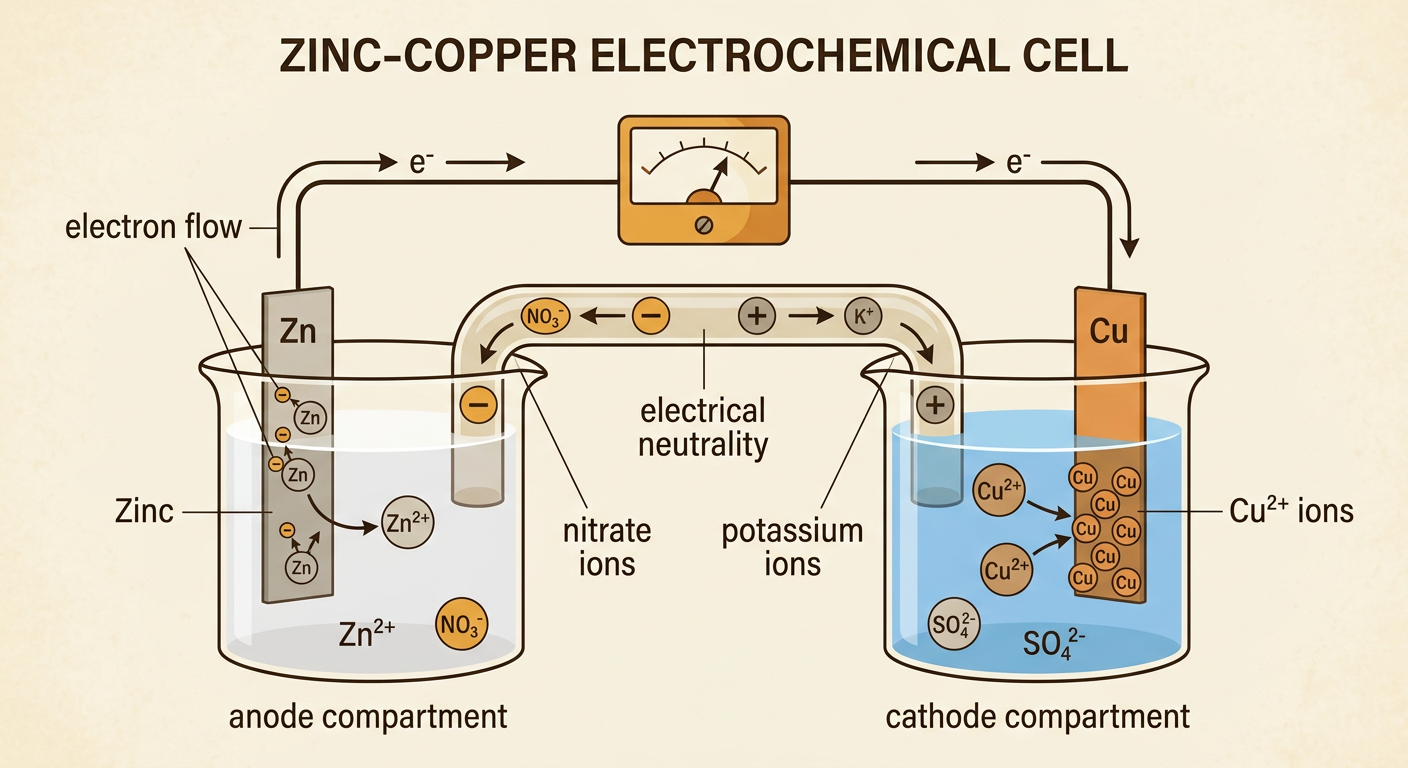
A galvanic cell separates a spontaneous redox reaction into two half-cells so that electrons must travel through an external circuit. In a zinc-copper cell, the zinc electrode is the anode, where oxidation occurs: Zn becomes Zn²⁺. The copper electrode is the cathode, where reduction occurs: Cu²⁺ becomes Cu. In a galvanic cell, the anode is negative because it supplies electrons, and the cathode is positive because it receives them. A wire connects the electrodes, while a salt bridge containing an inert electrolyte such as potassium nitrate connects the solutions. The salt bridge does not carry electrons. Instead, its mobile ions prevent charge buildup in each half-cell, completing the internal part of the circuit without directly mixing the solutions.

Tracing Electron and Ion Movement
To trace charge movement, begin at the anode. Zinc atoms enter solution as Zn²⁺ ions, leaving electrons on the zinc electrode. Those electrons move through the wire from the zinc anode to the copper cathode. At the cathode, Cu²⁺ ions in solution accept electrons and plate onto the electrode as copper metal. The salt bridge balances the changing charges. Nitrate ions move toward the anode compartment, where positive Zn²⁺ ions are accumulating. Potassium ions move toward the cathode compartment, where Cu²⁺ ions are being removed. Electrons never pass through the salt bridge, and salt bridge ions do not normally become part of the redox reaction. When analyzing a diagram or performing the experiment, trace electrons first and then verify that ion movement preserves electrical neutrality.
Writing Cell Reactions
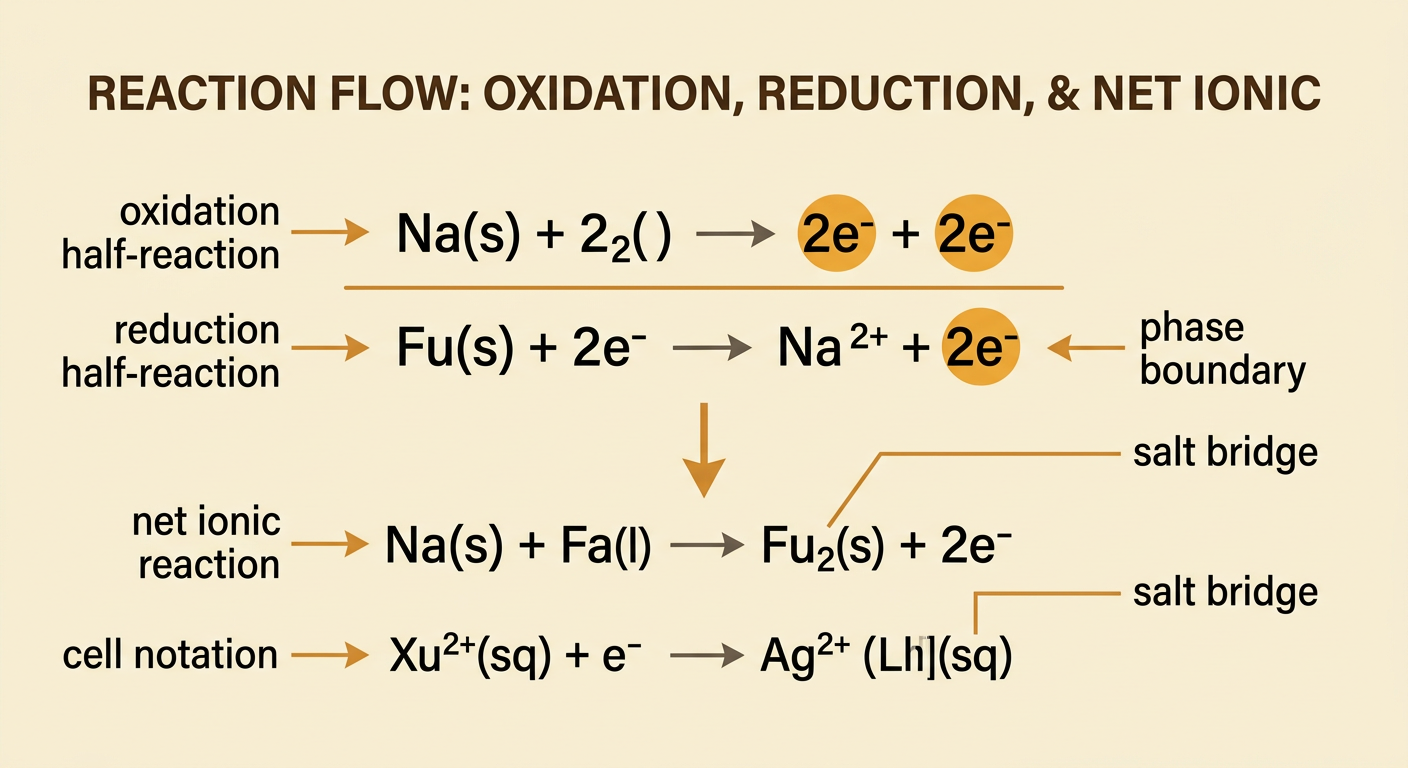
Write a galvanic cell reaction by separating oxidation and reduction into half-reactions. For the zinc-copper cell, the oxidation half-reaction is Zn(s) → Zn²⁺(aq) + 2e⁻. The reduction half-reaction is Cu²⁺(aq) + 2e⁻ → Cu(s). Because both half-reactions contain two electrons, they can be added directly. Cancel the electrons to obtain the net ionic reaction: Zn(s) + Cu²⁺(aq) → Zn²⁺(aq) + Cu(s). Confirm that both atoms and total charge are balanced. Cell notation summarizes the same arrangement as Zn(s) | Zn²⁺(aq) || Cu²⁺(aq) | Cu(s). The single lines represent phase boundaries, and the double line represents the salt bridge. By convention, oxidation is written on the left and reduction on the right.
Interpreting Cell Voltage
Cell voltage measures the electrical potential energy transferred per unit of charge. Under standard conditions, calculate standard cell voltage using E°cell = E°cathode − E°anode. The standard reduction potential for Cu²⁺/Cu is +0.34 volts, and that for Zn²⁺/Zn is −0.76 volts. Therefore, the zinc-copper cell has E°cell = 0.34 − (−0.76) = +1.10 volts. A positive voltage indicates that the written reaction is spontaneous under standard conditions. Voltage is not the number of electrons; it describes how strongly the reaction can push charge through a circuit. As reactant concentrations change, voltage changes according to a logarithmic relationship. Equal concentration changes by a constant factor produce equal voltage changes, so voltage is not linear in concentration. Conversely, concentration ratio changes exponentially with equal voltage intervals.

Battery Performance and Material Choices
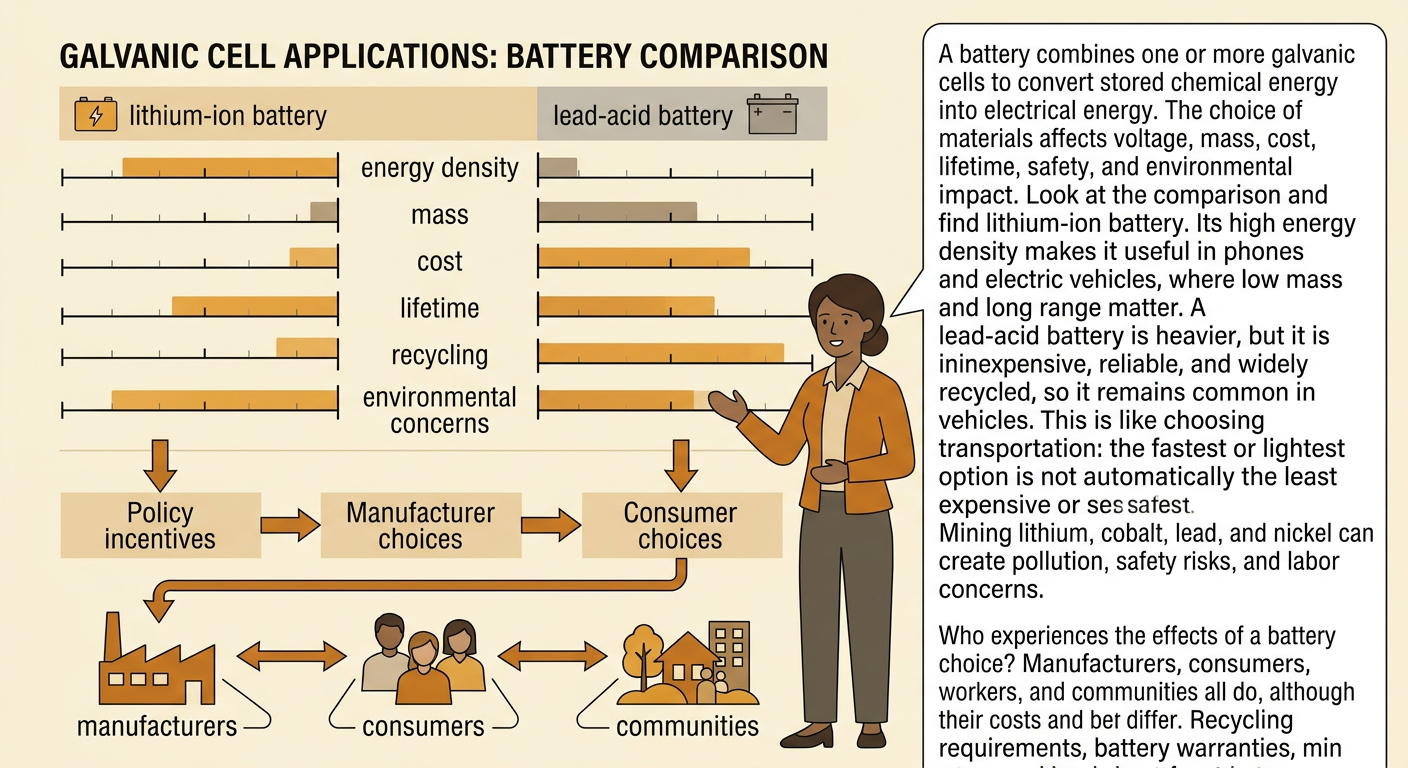
A battery uses one or more galvanic cells to convert stored chemical energy into electrical energy. Material choices affect voltage, mass, cost, lifetime, safety, and environmental impact. For example, lithium-ion batteries have high energy density, making them useful for phones and electric vehicles, while lead-acid batteries are heavier but inexpensive, reliable, and widely recycled. Manufacturers are encouraged to choose materials that improve performance and lower production costs, but mining lithium, cobalt, lead, or nickel can create environmental and labor concerns. Consumers may value low prices, long range, or rapid charging, while communities may prioritize safer mines, recycling, and reduced pollution. Policies such as recycling requirements, battery warranties, mining standards, and purchase incentives shift costs and benefits among manufacturers, consumers, workers, and communities. Evaluating a battery therefore requires both electrochemical evidence and economic tradeoffs.