
Elements, Compounds, and Mixtures: What Is Matter Made Of?
Students use particle diagrams and observable properties to distinguish elements, compounds, and mixtures.

Illustrations are auto-generated and may be placeholders. They can be refreshed to match the narration.
Classifying Matter
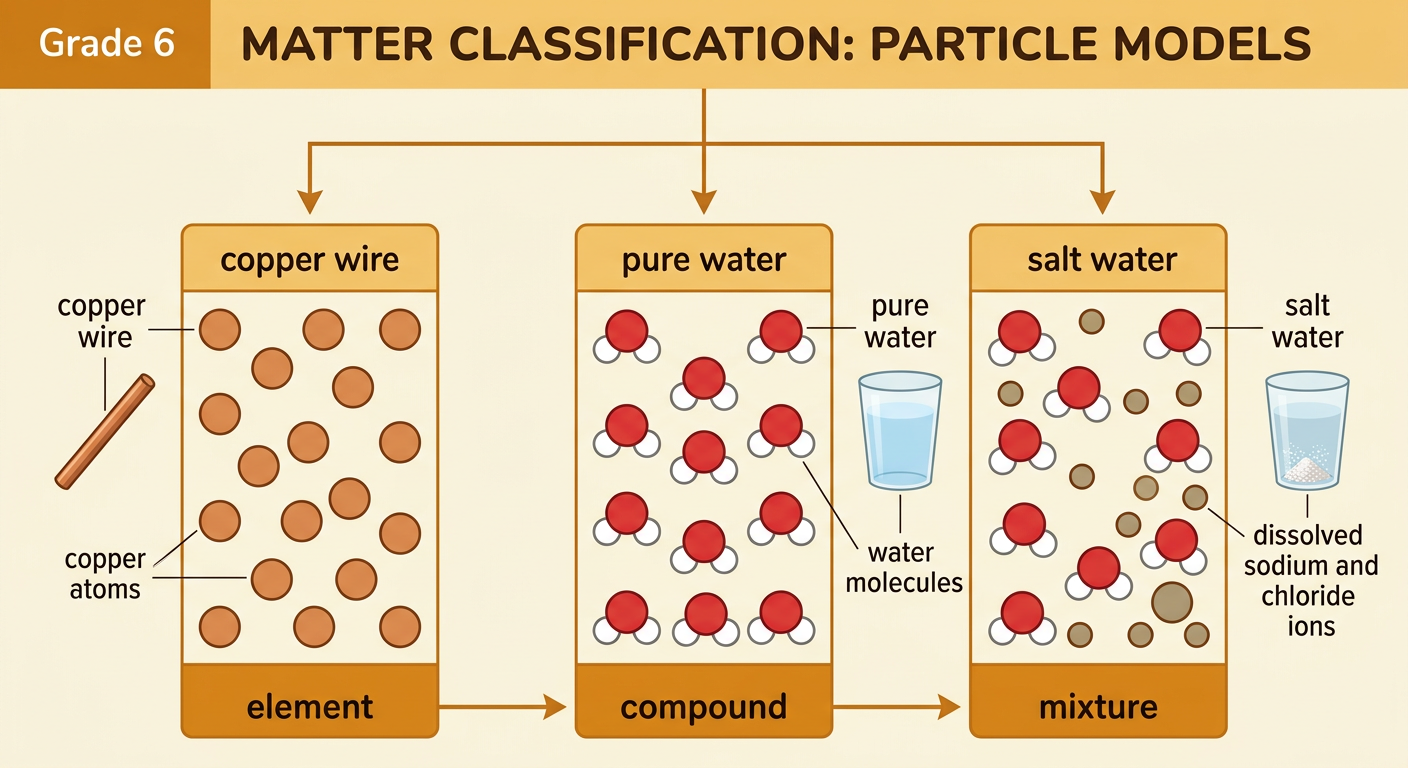
Matter is anything that has mass and takes up space. Scientists classify matter by asking what particles it contains and how those particles are connected. An element contains only one type of atom. A compound contains atoms of two or more elements chemically joined in a fixed ratio. A mixture contains two or more substances physically combined, so each substance keeps its own identity. For example, a copper wire is an element because it contains only copper atoms. Pure water is a compound because every water molecule has two hydrogen atoms joined to one oxygen atom. Salt water is a mixture because water molecules and dissolved salt particles are together without becoming one new substance. Observable properties, such as color, melting point, and whether a material can be separated physically, also help classify matter.
Elements: One Type of Atom
An element is a pure substance made of only one type of atom. Each element has a name and a chemical symbol, such as C for carbon, O for oxygen, and Cu for copper. All atoms of one element have the same number of protons, although models at this level often show them simply as matching circles. Some elements exist as individual atoms. Others form molecules made only of identical atoms. For example, oxygen gas consists mainly of O2 molecules, with two oxygen atoms chemically joined. It is still an element because both atoms are oxygen. A sample containing only O2 particles has a consistent composition and characteristic properties. It cannot be separated into simpler substances by ordinary physical methods such as filtering or evaporation.

Compounds: Atoms Chemically Joined
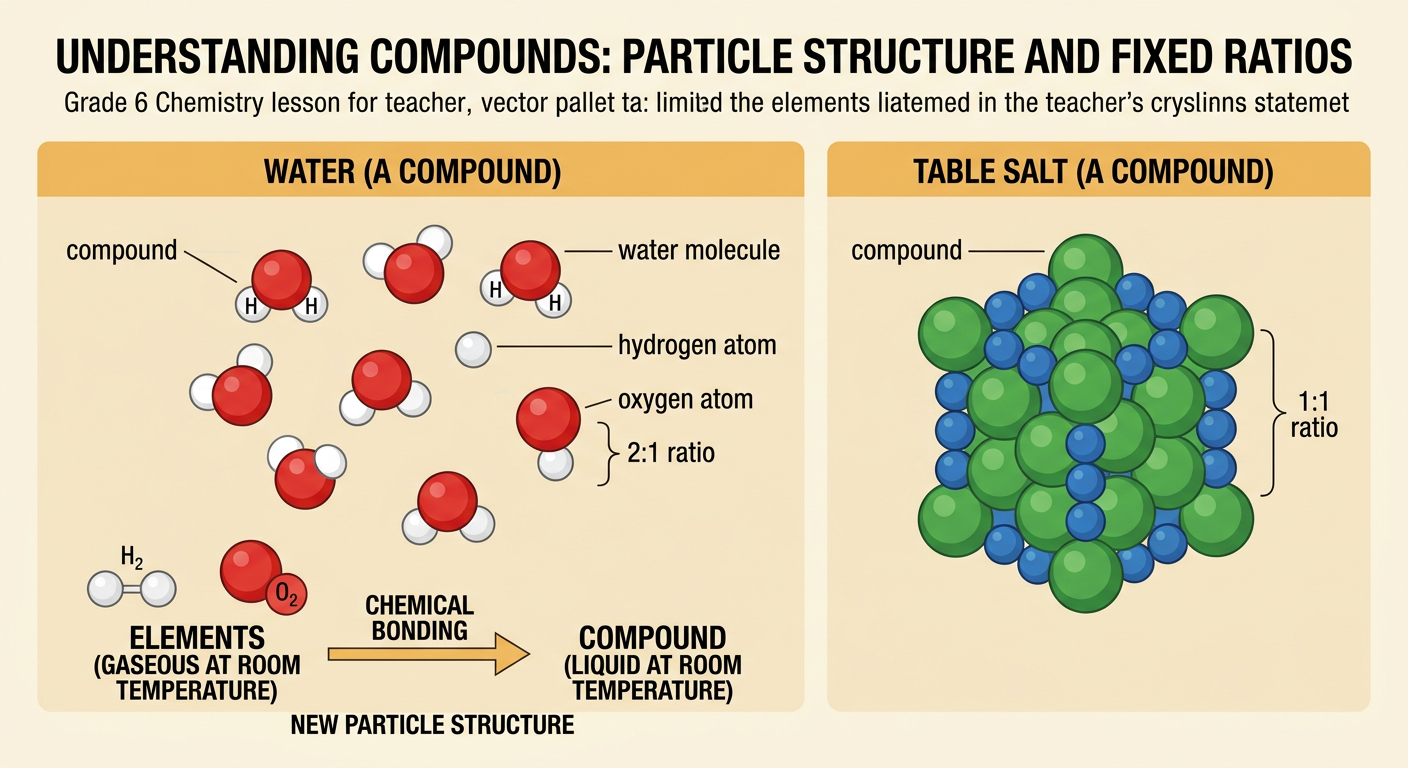
A compound is a pure substance made of atoms from two or more elements chemically joined in a fixed ratio. The properties of a compound can differ greatly from the properties of its elements. Water, H2O, is a compound. Every water molecule contains two hydrogen atoms bonded to one oxygen atom, giving a 2:1 ratio. Hydrogen and oxygen are gases at room temperature, but water is a liquid. Table salt, sodium chloride, is another compound. Its particles form an extended, repeating structure with sodium and chloride ions arranged in a 1:1 ratio rather than separate NaCl molecules. Compounds cannot be separated by simple physical methods such as sorting or filtering. Breaking a compound into simpler substances requires a chemical change that rearranges chemical bonds or particle connections.
Mixtures: Substances Physically Combined
A mixture forms when two or more substances are physically combined but are not chemically joined into one new substance. A mixture may contain elements, compounds, or both, and its composition can vary. Trail mix is a visible example: raisins, nuts, and cereal keep their own properties and can be sorted by hand. Salt water looks uniform, but it contains water molecules and dissolved sodium and chloride ions. The amount of salt can change, so salt water does not have one fixed particle ratio. Mixtures can often be separated by physical processes that use differences in properties. A filter can separate sand from water because the sand particles are too large to pass through. Evaporation can separate dissolved salt from water because the water changes to a gas while the salt remains behind.

Reading Particle Diagrams
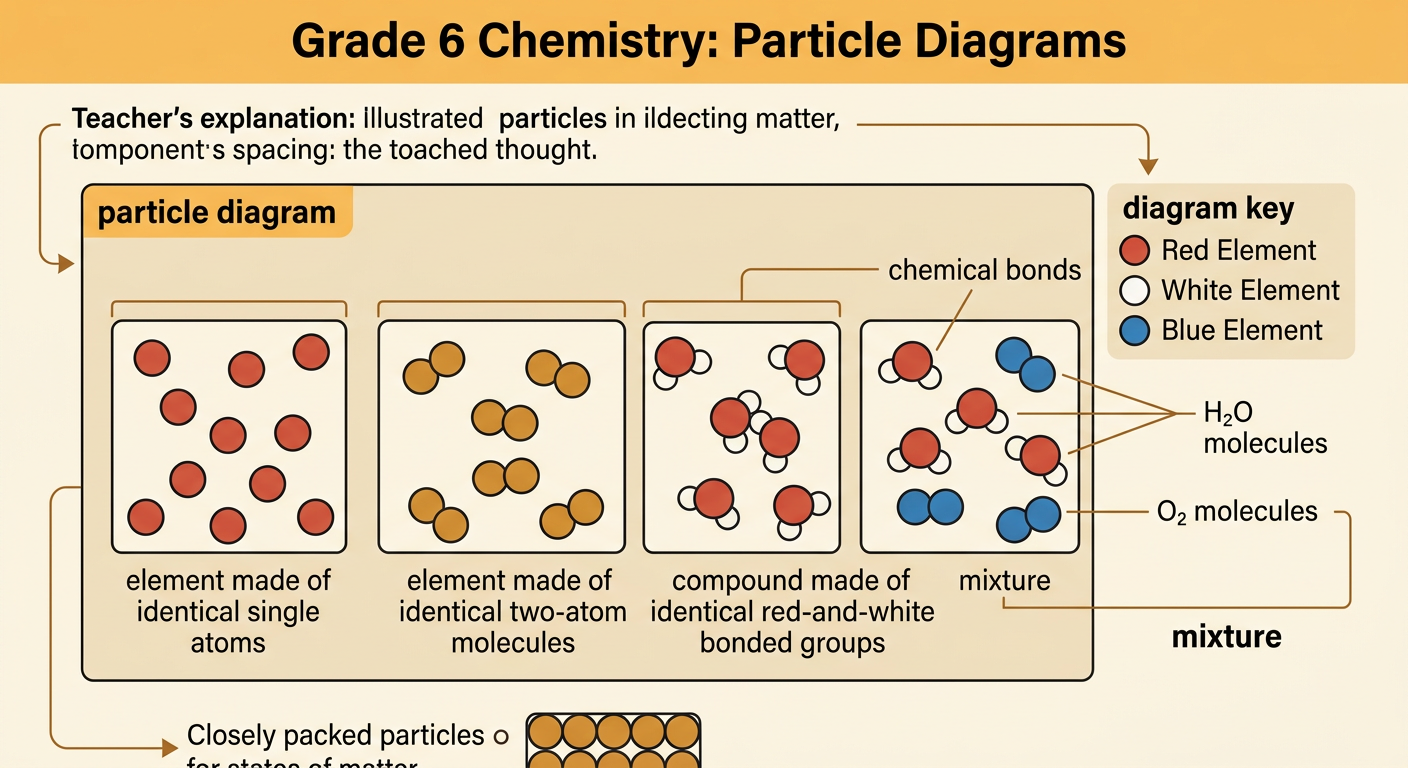
A particle diagram is a model that uses circles or spheres to represent atoms. Color, size, or letter labels distinguish different elements, while touching circles or connecting lines usually represent chemical bonds. First, use the diagram key instead of guessing what a color means. Next, count the types of atoms in each particle. If every atom is the same type, the sample is an element, even if identical atoms are bonded in pairs. If all particles are identical and each contains different atom types bonded in the same ratio, the sample is a compound. If more than one kind of particle appears, the sample is a mixture. For example, a box containing four H2O molecules and two O2 molecules is a mixture because it contains two distinct substances. Particle spacing may also show whether matter is solid, liquid, or gas.
Classification Check
Test a classification by making a claim, citing evidence, and explaining your reasoning. Sample A contains only separate iron atoms, so it is an element. The evidence is that every particle is the same type of atom. Sample B contains identical carbon dioxide molecules, each with one carbon atom bonded to two oxygen atoms. It is a compound because two elements are chemically joined in a fixed 1:2 ratio. Sample C contains carbon dioxide molecules mixed with oxygen molecules. It is a mixture because two different kinds of particles share the container without forming one new particle. Observable evidence can support the model. Iron can be identified by properties such as magnetism, while the gases in Sample C would require a suitable separation method. A strong explanation connects the classification rule directly to evidence from both the particle diagram and the material’s properties.
