Energy Around Us: Forms and Transformations
Students identify common forms of energy and trace how energy is converted from one form to another in everyday systems such as a flashlight, toaster, bicycle, and solar-powered device.
Illustrations are auto-generated and may be placeholders. They can be refreshed to match the narration.
What Is Energy?
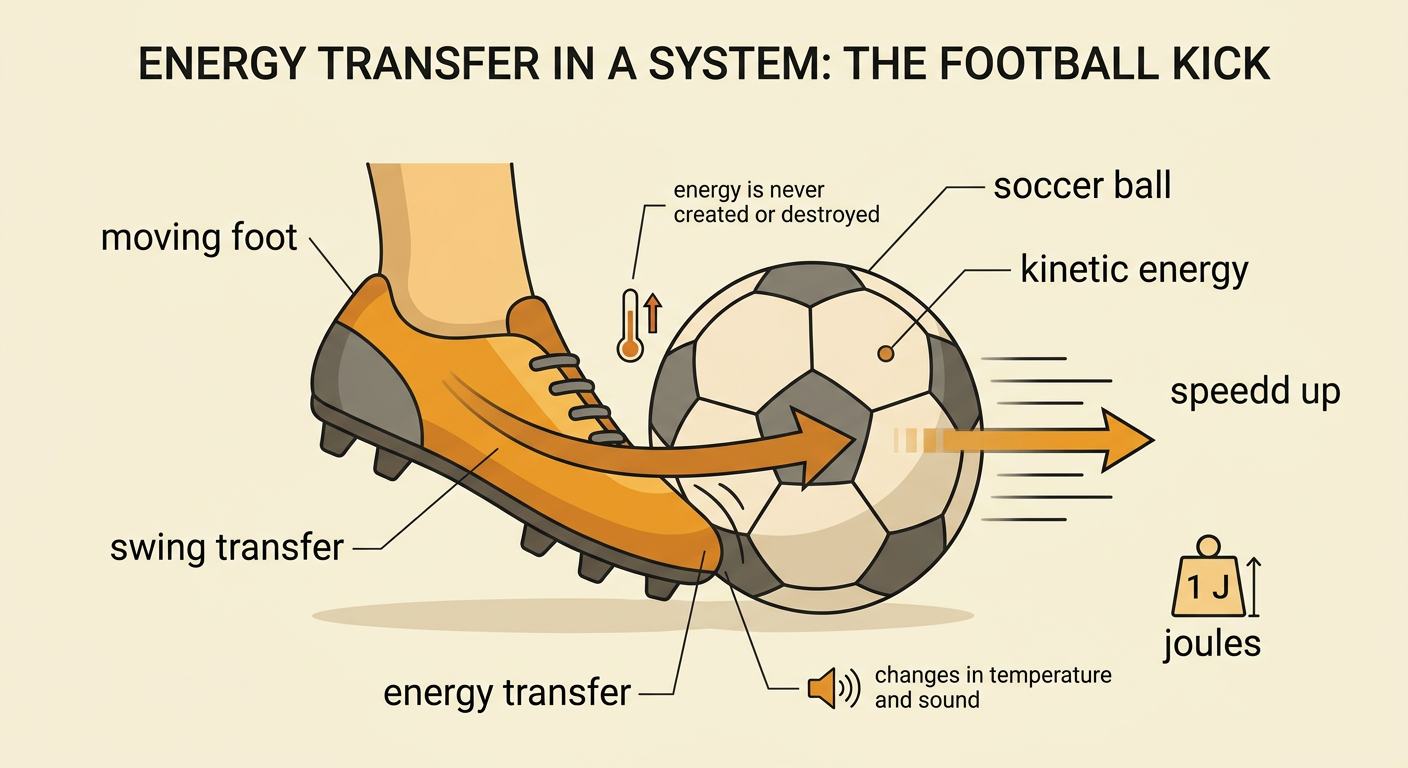
Energy is the ability to cause change. It can make an object move, warm up, produce light, or make sound. Scientists often study a system, which is an object or group of objects being examined. Energy can enter a system, leave it, or move among its parts. For example, when you kick a stationary soccer ball, energy is transferred from your moving foot to the ball. The ball gains kinetic energy, the energy of motion, and speeds up. Your foot slows because it transfers some energy away. Evidence of energy transfer includes changes in motion, temperature, light, or sound. Energy is measured in joules (J). Energy is not created or destroyed; instead, it is transferred between objects or converted from one form to another.
Forms of Energy
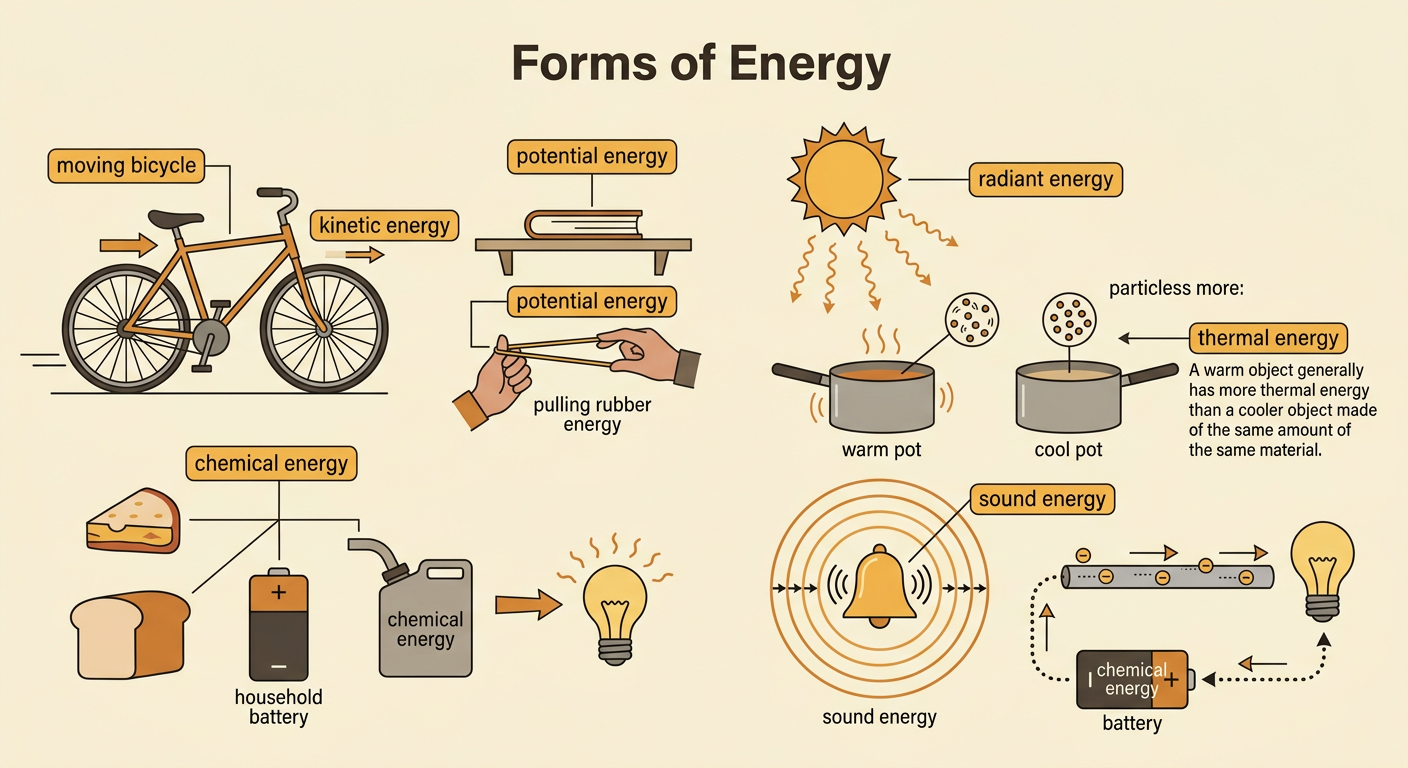
Energy appears in several forms. Kinetic energy is associated with motion, so a moving bicycle has kinetic energy. Potential energy is stored because of position or condition. A book on a high shelf has gravitational potential energy, while a stretched rubber band has elastic potential energy. Chemical energy is stored in substances such as food, batteries, and fuel. Electrical energy is carried by moving electric charges. Radiant energy travels as electromagnetic waves, including visible light. Thermal energy is related to the motion and arrangement of particles; warmer objects generally have more thermal energy than cooler objects of the same material and mass. Sound energy travels through vibrations in matter. One object or system can contain several forms of energy at the same time.
Energy Transfer and Conversion
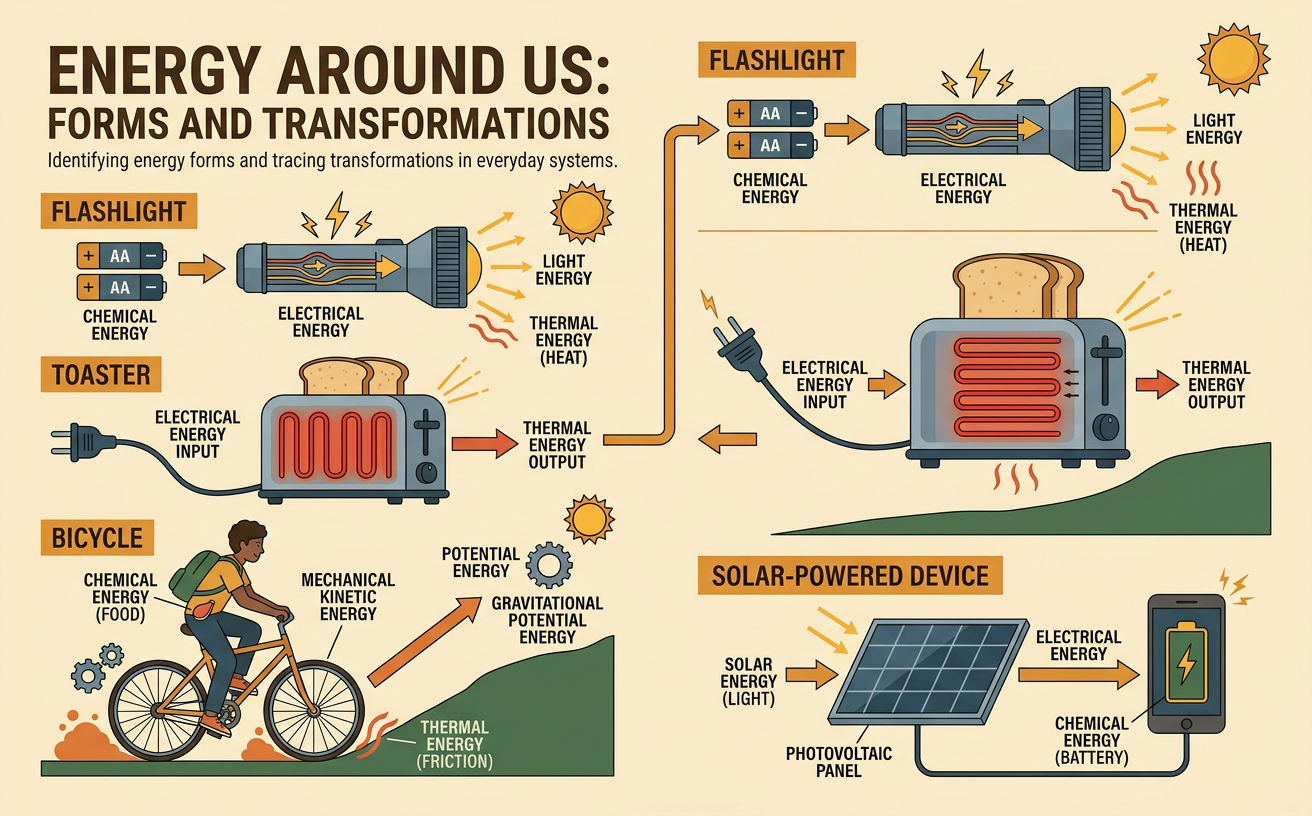
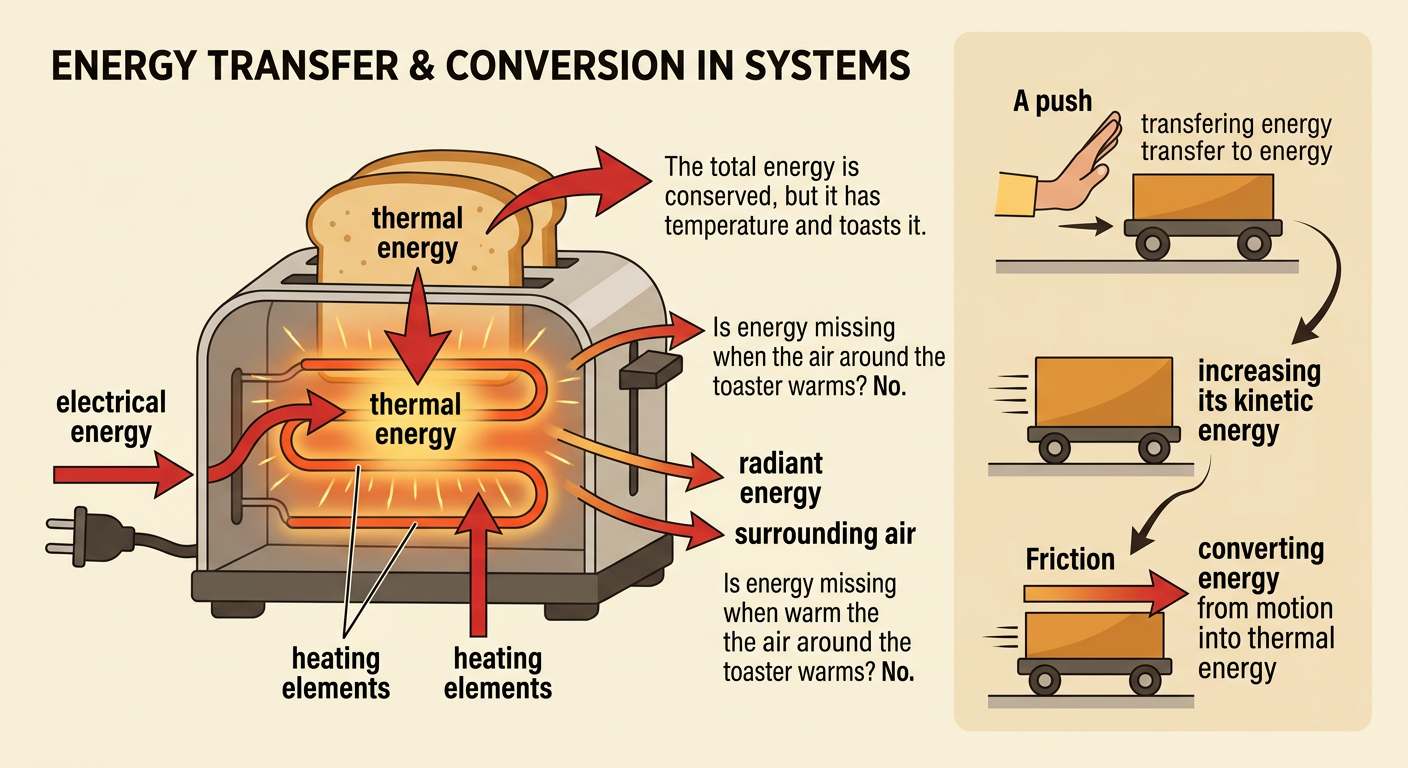
Energy transfer occurs when energy moves from one object or place to another. Energy conversion, also called energy transformation, occurs when energy changes form. In a toaster, electrical energy enters through the cord and is converted mainly into thermal energy in the heating elements. Thermal energy then transfers to the bread, raising its temperature and causing it to toast. Some energy also becomes radiant energy as the elements glow and thermal energy that warms the surrounding air. The total amount of energy is conserved, even though it spreads into different forms and locations. Changes in kinetic energy also show transfer. If a rolling cart speeds up after being pushed, its kinetic energy increases because energy was transferred to it. If friction slows the cart, energy transfers from its motion into thermal energy.
Tracing Energy Through Everyday Systems
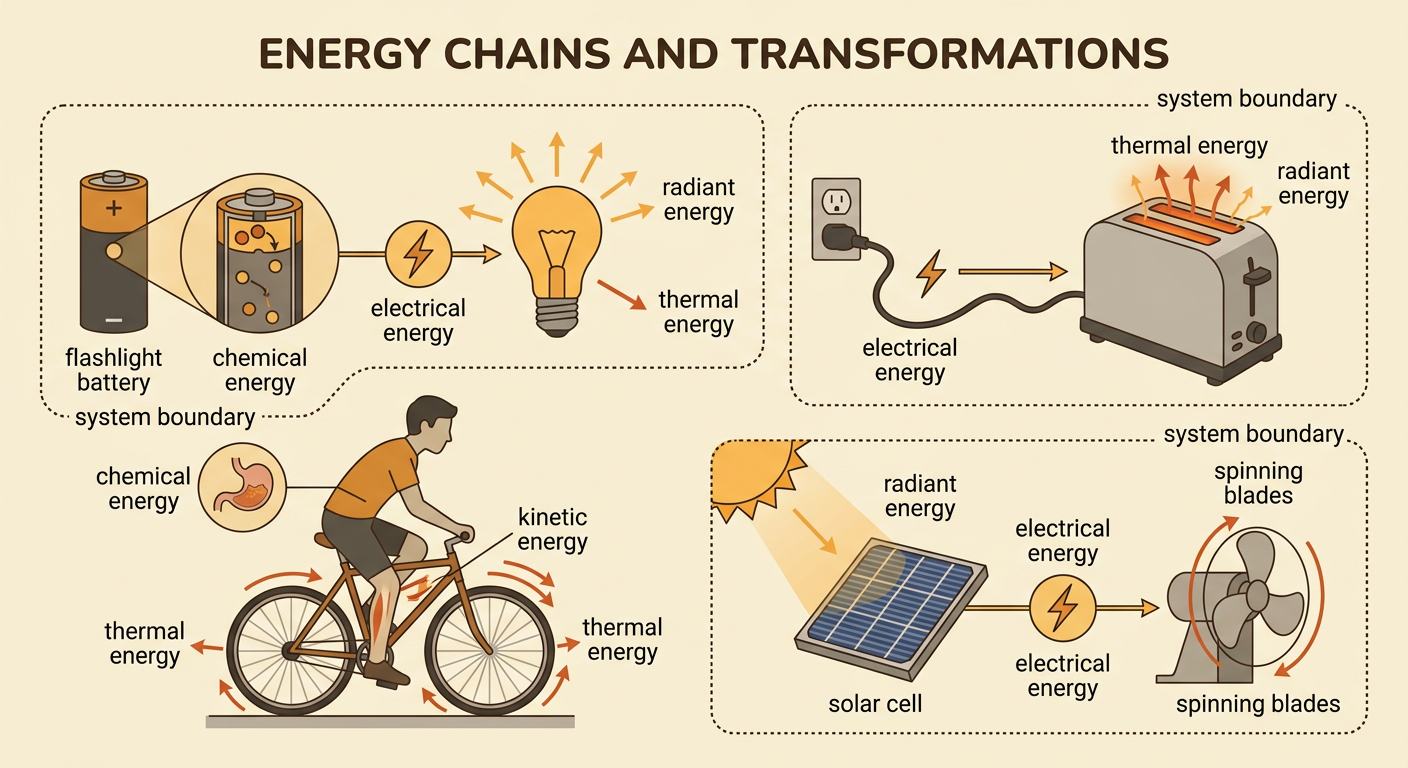
An energy chain traces where energy begins, how it changes form, and where it goes. In a flashlight, chemical energy in the battery becomes electrical energy and then radiant and thermal energy in the bulb. In a toaster, electrical energy becomes thermal and radiant energy. When a rider pedals a bicycle, chemical energy from food is converted into kinetic energy of the rider and bicycle, along with thermal energy from muscles and friction. In a solar-powered fan, radiant energy from sunlight is converted into electrical energy by a solar cell. The motor then converts electrical energy into the kinetic energy of the spinning blades. In every chain, some energy spreads to the surroundings as heat or sound. Identifying the system boundary helps students account for energy entering and leaving each device.
Real-Life Energy Conversion Examples
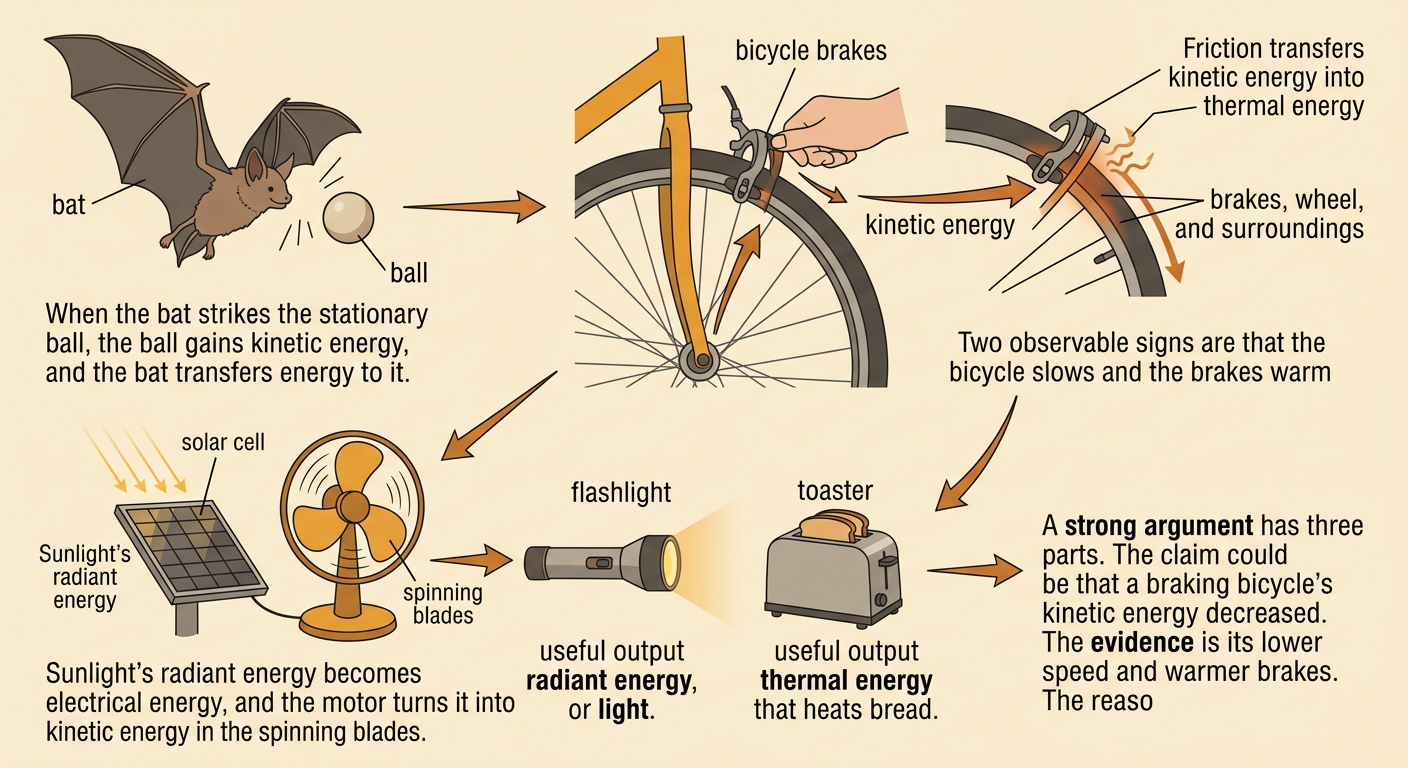
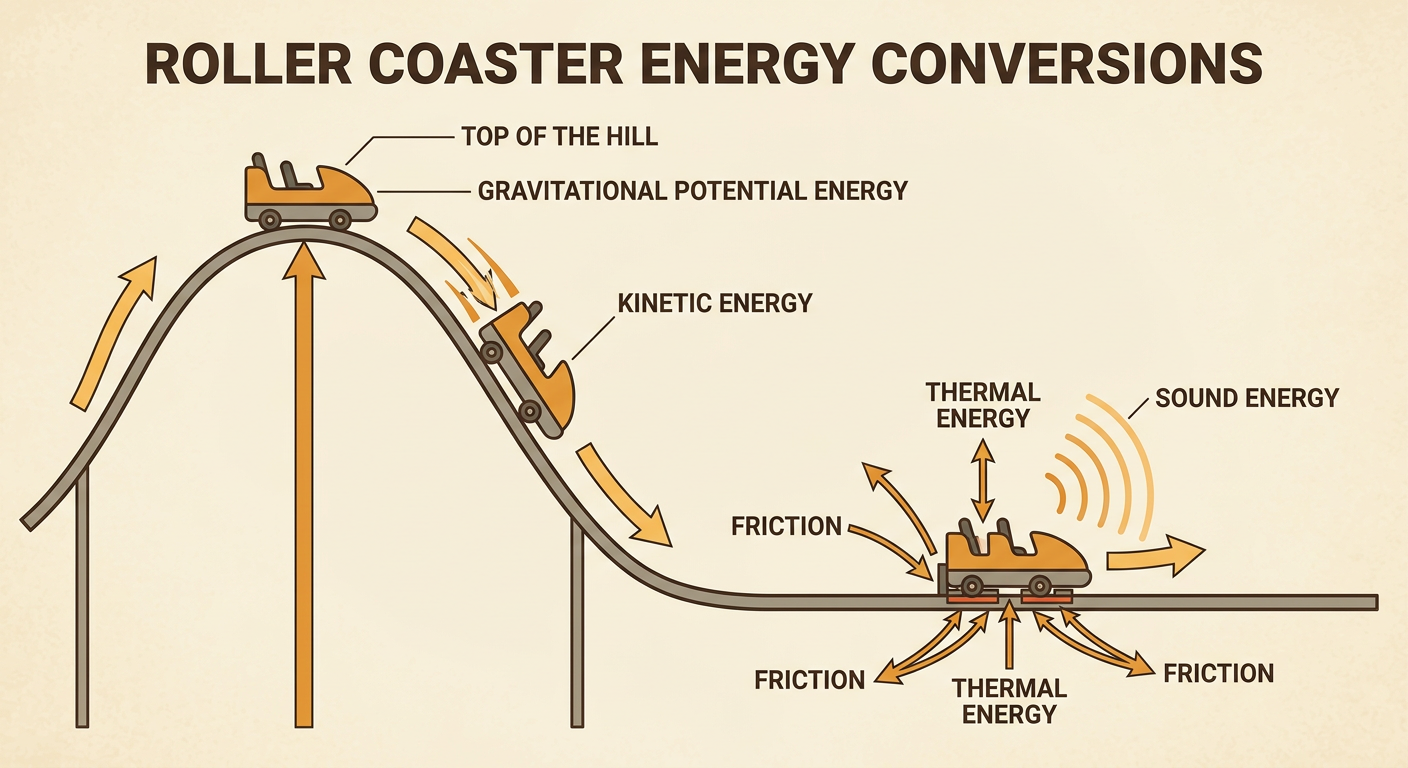
Energy conversions occur whenever devices operate or objects change motion. At the top of a hill, a roller coaster has gravitational potential energy. As it moves downhill, that energy is converted into kinetic energy, and the coaster speeds up. When the brakes are applied, friction transfers energy from the coaster’s motion to the wheels, brake pads, track, air, and surroundings as thermal and sound energy. The coaster slows, so its kinetic energy decreases. This change is evidence that energy left the coaster’s motion and was transferred elsewhere. A similar process occurs when bicycle brakes press against a wheel rim or disc. The bicycle loses kinetic energy while the brakes become warmer. To support an energy-transfer claim, students can cite evidence such as decreased speed, increased temperature, and produced sound.
Check Your Understanding
Use energy evidence to explain each situation. First, a stationary ball begins moving after a bat strikes it. Identify the object that gains kinetic energy and the object that transfers energy. Second, a bicycle slows when its brakes are squeezed. Explain where the bicycle’s kinetic energy goes and name two observable signs of the transfer. Third, trace the energy conversions in a solar-powered fan, beginning with sunlight and ending with the spinning blades. Finally, compare a flashlight and a toaster: both use electrical energy, but what useful output does each produce? For one situation, construct an argument with three parts: a claim about whether kinetic energy increased or decreased, evidence such as a change in speed or temperature, and reasoning that connects the evidence to an energy transfer. Remember that energy is conserved even when it spreads into the surroundings.