
Energy Changes Form in Devices
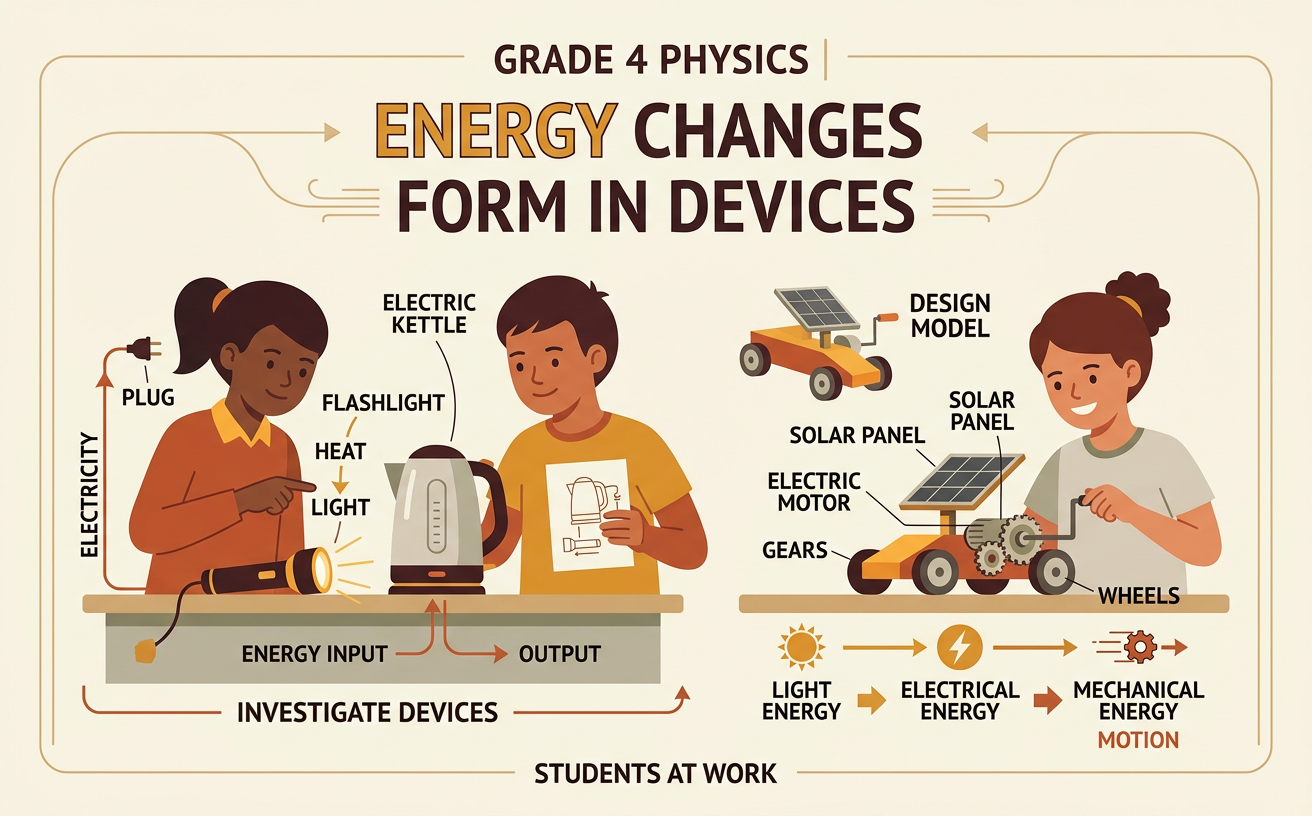
Students investigate everyday devices and design a simple model that converts energy from one form into another.
Illustrations are auto-generated and may be placeholders. They can be refreshed to match the narration.
Forms of Energy Review
Energy makes movement and change possible. Moving objects have motion energy. A warm object has thermal energy, and vibrating materials can produce sound energy. Light and electrical energy can also travel from one place to another. Energy may be stored in food, fuel, batteries, stretched rubber bands, and raised objects. When energy changes form, it is called an energy conversion. For example, a battery-powered lamp changes stored chemical energy in the battery into electrical energy. The lamp then changes electrical energy into light and thermal energy. Energy is not created or destroyed during this process. It is transferred between objects or converted into different forms. Often, some energy spreads into the surroundings as sound or thermal energy.

Energy Changes in Everyday Devices
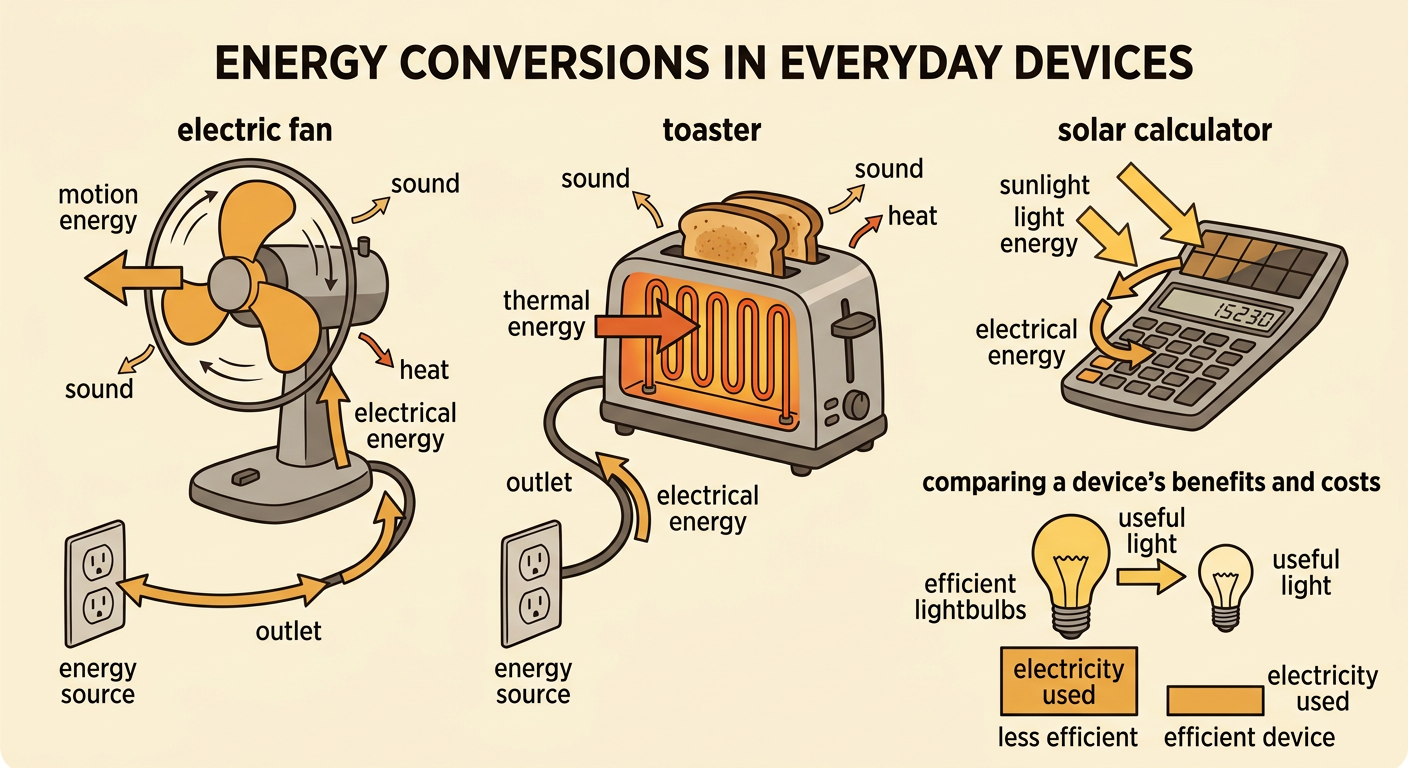
Everyday devices convert energy to perform useful tasks. A fan changes electrical energy into the motion energy of its spinning blades. It also produces sound and thermal energy. A toaster changes electrical energy mostly into thermal energy, which browns bread. A solar calculator changes light energy into electrical energy. People choose devices by comparing their benefits and costs. An efficient lightbulb can provide the same useful light as another bulb while using less electrical energy. It may cost more to buy, but it can cost less to operate. Rechargeable batteries can be used many times, which reduces waste, but they require a charger and electricity. When comparing devices, consider their purpose, energy source, price, safety, useful output, and effects on people and the environment.
Trace the Energy Path
An energy path shows where energy begins, how it is transferred, and which forms it takes. Consider a hand-crank flashlight. Energy from a person's body moves the hand and crank. The moving crank powers a small generator, which converts motion energy into electrical energy. The bulb converts that electrical energy into light and thermal energy. A mathematical model can represent the path with energy units. Suppose 10 energy units enter the flashlight. A simple model might show 6 units becoming light, 3 units becoming thermal energy, and 1 unit becoming sound. The outputs total 10 units, matching the input. These example numbers are not measurements, but they help show that all the input energy must be accounted for. Arrows can show each transfer and conversion.

Design an Energy-Conversion Device
You can design a rubber-band car that converts stored energy into motion. Build a light car body from cardboard, add two straight axles and four wheels, and connect a rubber band to an axle. Turning the axle winds and stretches the rubber band. When released, the rubber band unwinds and turns the axle, moving the car. Some energy also becomes sound and thermal energy because of friction. Begin with a goal, such as making the car travel at least 3 feet. Set limits, such as using one rubber band and only classroom materials. Draw a labeled model with arrows from stored elastic energy to motion energy. Consider costs and benefits when choosing materials. Large wheels may travel over bumps, but they may be heavier. Reused cardboard costs little and reduces waste, but it may bend.

Test, Explain, and Improve
Test the device with a clear procedure. Place the rubber-band car at the same starting line, wind the axle the same number of turns, release it without pushing, and measure the distance traveled. Complete three trials. Record the distances in a table, add them, and divide by three to find the average. If the distances are 3, 4, and 5 feet, the average is 4 feet. Compare the result with the design goal. Explain the test in order and describe how stored elastic energy changed into motion, sound, and thermal energy. Then improve one feature at a time. You might straighten an axle, reduce wheel rubbing, or strengthen the body. Test again under the same conditions. Compare the new results, material cost, safety, durability, and waste before deciding whether the change is an improvement.
