
Energy Changes in Chemical Reactions
Students use bond-energy models and reaction diagrams to explain energy absorption and release, distinguish endothermic from exothermic reactions, and consider the costs and benefits of chemical energy sources.
Illustrations are auto-generated and may be placeholders. They can be refreshed to match the narration.
Chemical Bonds and Energy
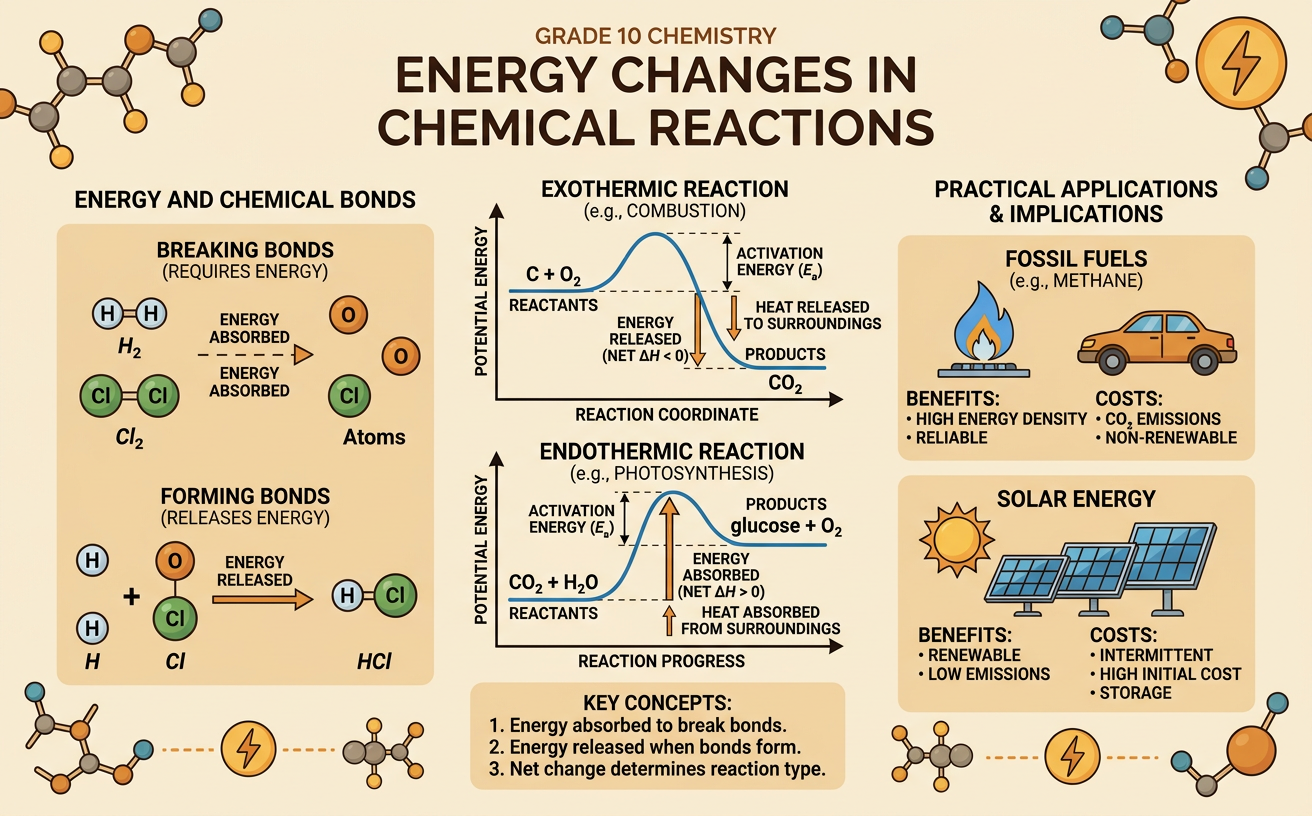
Chemical bonds store potential energy because bonded atoms interact through attractive and repulsive forces. Energy must be absorbed to break a bond. When a new bond forms, energy is released to the surroundings. A chemical reaction usually includes both processes, so its overall energy change depends on the total energy absorbed during bond breaking compared with the total energy released during bond formation. For example, separating the two hydrogen atoms in an H2 molecule requires energy because the H–H bond must be broken. If two hydrogen atoms later form an H–H bond, approximately the same amount of energy is released. Bonds do not simply contain energy that appears when they break; breaking bonds always requires an energy input.

Endothermic and Exothermic Reactions
An endothermic reaction absorbs more energy than it releases, transferring energy from the surroundings into the reacting system. Its enthalpy change, ΔH, is positive, and the surroundings may become cooler. An exothermic reaction releases more energy than it absorbs, so energy moves from the system to the surroundings. Its ΔH is negative, and the surroundings may become warmer. Photosynthesis is endothermic because plants use light energy to convert carbon dioxide and water into glucose and oxygen. Methane combustion is exothermic because forming strong bonds in carbon dioxide and water releases more energy than is needed to break bonds in methane and oxygen. Temperature change can provide evidence of energy transfer, but measurements must account for heat lost to or gained from the environment.

Reading Reaction Energy Diagrams
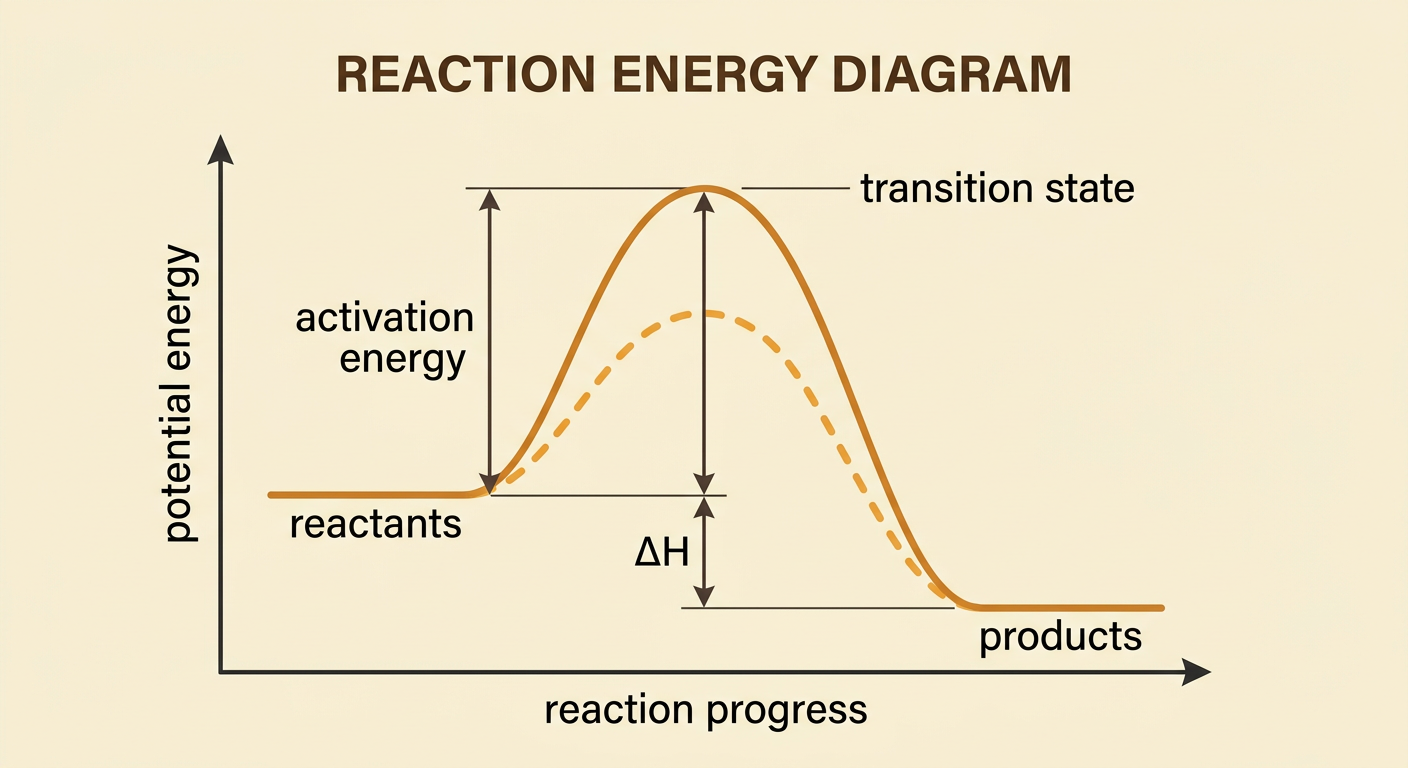
A reaction energy diagram plots potential energy on the vertical axis and reaction progress on the horizontal axis. Reactants begin at one energy level, and products end at another. The curve rises to a peak representing the transition state. The energy difference from the reactants to this peak is the activation energy, the minimum energy needed to begin the reaction. In an exothermic reaction, such as methane combustion, the products are lower in energy than the reactants, so ΔH is negative. In an endothermic reaction, the products are higher, so ΔH is positive. A catalyst lowers the activation energy by providing a different reaction pathway, but it does not change the energy levels of the reactants or products or the value of ΔH.
Modeling Bond-Energy Changes
Average bond energies can be used to estimate a reaction’s enthalpy change. First, add the energy required to break all reactant bonds. Next, add the energy released when all product bonds form. Then calculate ΔH ≈ energy of bonds broken minus energy of bonds formed. Consider H2 + Cl2 → 2HCl. Breaking one H–H bond requires about 436 kilojoules per mole, and breaking one Cl–Cl bond requires about 243 kilojoules per mole, for 679 kilojoules absorbed. Forming two H–Cl bonds releases about 862 kilojoules because each bond has an average energy of 431 kilojoules per mole. Therefore, ΔH ≈ 679 − 862 = −183 kilojoules per mole of reaction. The negative result predicts an exothermic reaction.

Comparing Chemical Energy Sources
Choosing a chemical energy source requires comparing benefits and costs, not only the energy released by its reactions. Gasoline has high energy density, is easy to transport, and uses existing engines and fuel stations. However, its combustion releases carbon dioxide and air pollutants, creating environmental and health costs. Hydrogen fuel cells produce electricity and water at the point of use, but hydrogen must first be produced, compressed or liquefied, transported, and stored. If hydrogen is made using renewable electricity, its climate impact can be lower, although equipment and infrastructure may cost more. A marginal analysis asks what additional benefit and additional cost result from one more unit of a choice. For example, a city comparing one additional gasoline bus with one hydrogen bus should consider purchase price, fueling, range, emissions, and health effects.

Exit Check
Use the model to show what you understand. A reaction energy diagram has reactants at 150 kilojoules per mole, a peak at 230 kilojoules per mole, and products at 90 kilojoules per mole. State whether the reaction is endothermic or exothermic, calculate its forward activation energy, and calculate ΔH. Then explain each answer in words by referring to the diagram. Next, suppose breaking the reactant bonds absorbs 500 kilojoules per mole while forming the product bonds releases 560 kilojoules per mole. Show how this bond-energy evidence supports the diagram. Finally, name one benefit and one cost of using an exothermic fuel reaction for transportation. Your response should connect energy calculations, visual evidence, and a practical decision.
