Energy Flow and Matter Cycling in Food Webs
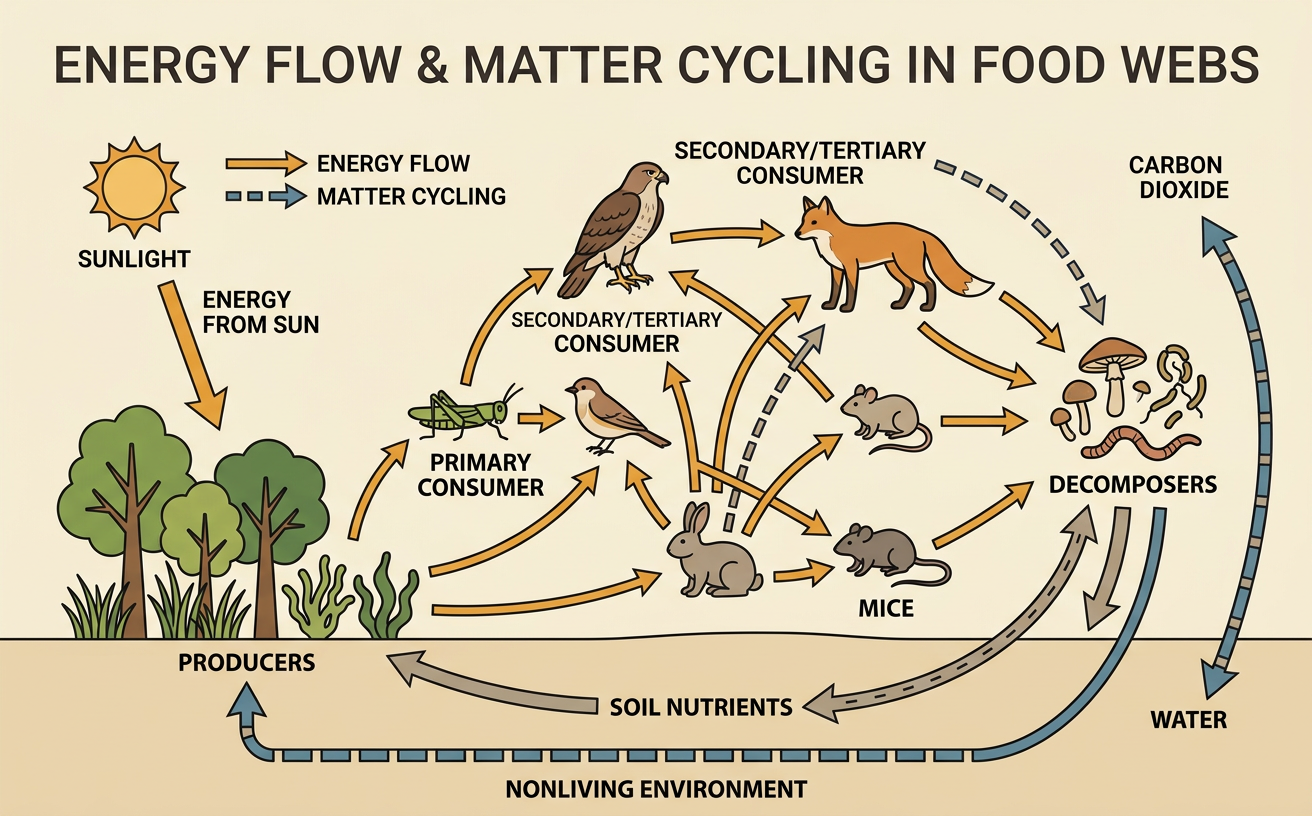
Students analyze and construct a food web model to explain how energy flows and matter cycles among producers, consumers, decomposers, and the nonliving environment.
Illustrations are auto-generated and may be placeholders. They can be refreshed to match the narration.
Ecosystem Roles
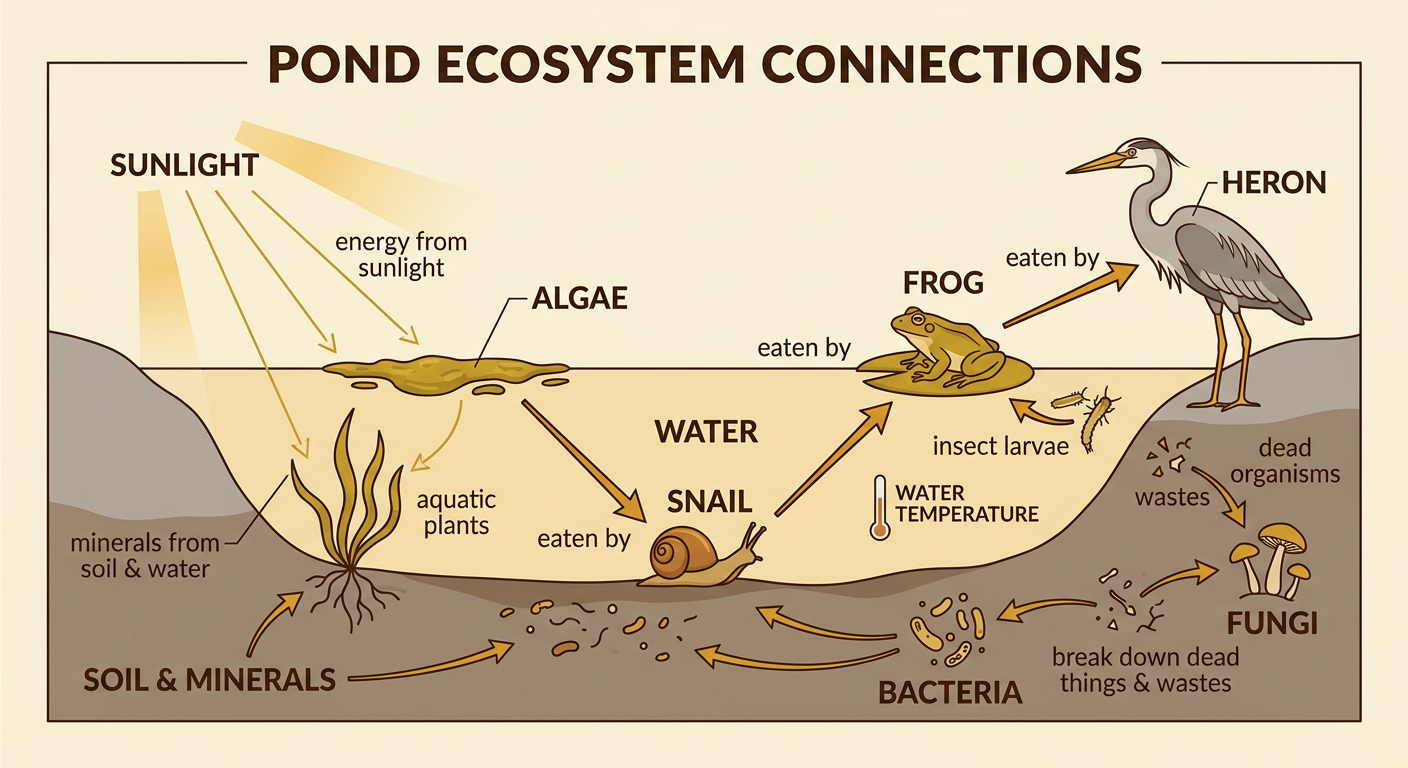
An ecosystem includes living organisms and nonliving parts of the environment. Producers, such as grasses and algae, make sugars using sunlight. Consumers obtain energy and matter by eating producers or other consumers. Decomposers, including fungi and many bacteria, break down dead organisms and wastes. Nonliving parts include sunlight, water, air, soil, and minerals. In a pond ecosystem, algae are producers, snails that eat algae are consumers, and bacteria in the mud are decomposers. Water temperature and available sunlight influence which organisms can survive there. Every organism may also have more than one connection. For example, a frog can eat insects and be eaten by a heron. These connected roles form a food web rather than one simple food chain.
From Sunlight to Producers
Most ecosystem energy begins as sunlight. During photosynthesis, producers use light energy, carbon dioxide, and water to make energy-rich sugars. They also release oxygen. A prairie grass plant uses sunlight to build leaves, roots, and seeds. The atoms in its new tissues come mainly from carbon dioxide and water, not from sunlight. This distinction is important: energy flows into the ecosystem as sunlight, while matter moves between living organisms and the nonliving environment. The plant uses some stored chemical energy for growth and life processes. When a grasshopper eats the grass, some of that chemical energy and matter move into the grasshopper. Sunlight is not recycled after organisms use its energy; much of the energy eventually leaves the ecosystem as heat.

Consumers and Energy Transfer
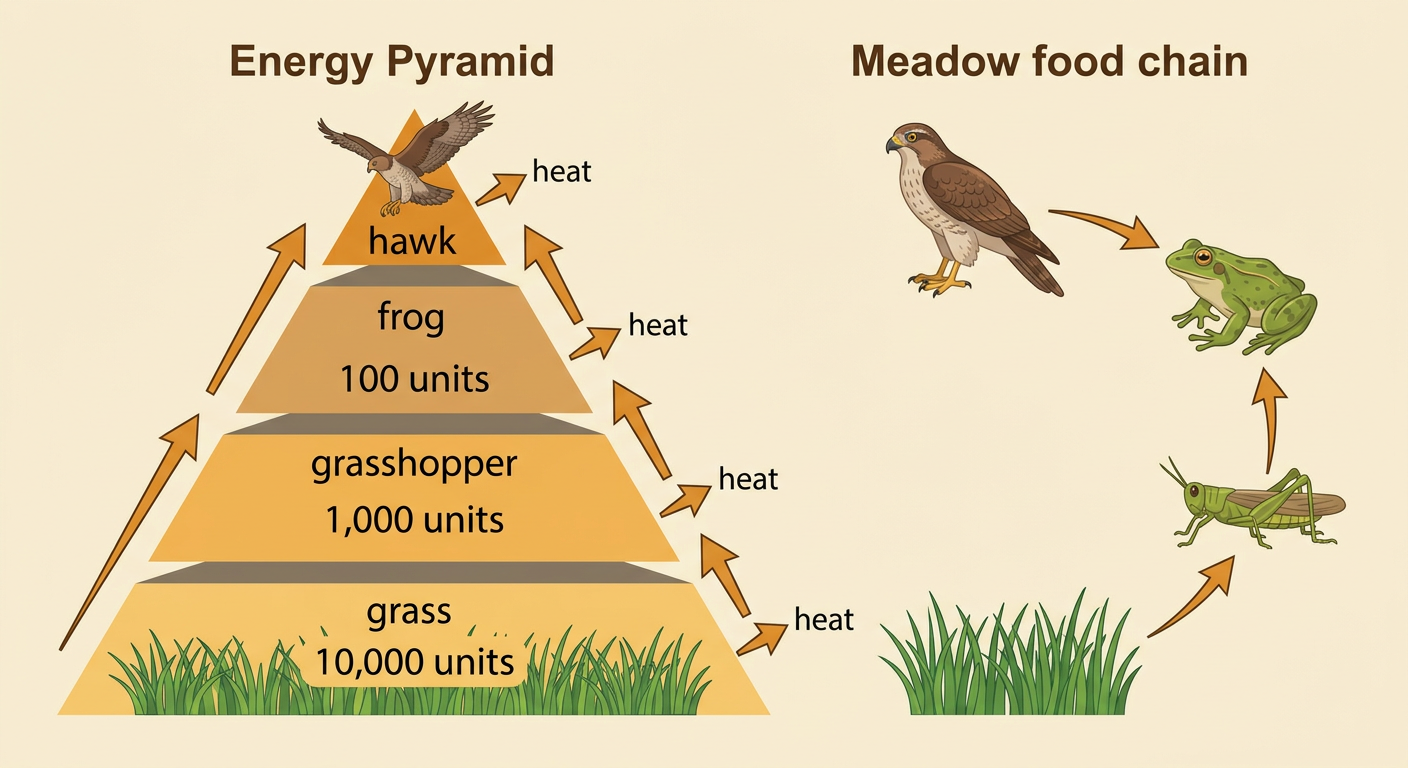
Consumers transfer energy and matter through feeding relationships. Herbivores eat producers, carnivores eat other animals, and omnivores eat both plants and animals. In a meadow, grass may be eaten by a grasshopper, the grasshopper by a frog, and the frog by a hawk. Food-web arrows point from the food to the eater because they show the direction of energy and matter transfer. Only a fraction of the energy stored at one level becomes biomass at the next level. For a simplified model, suppose grass stores 10,000 energy units and about 10 percent transfers to grasshoppers. The grasshoppers receive about 1,000 units. If about 10 percent transfers again, frogs receive about 100 units. Organisms use most energy for life processes, and much eventually leaves as heat.
Decomposers and Matter Cycling
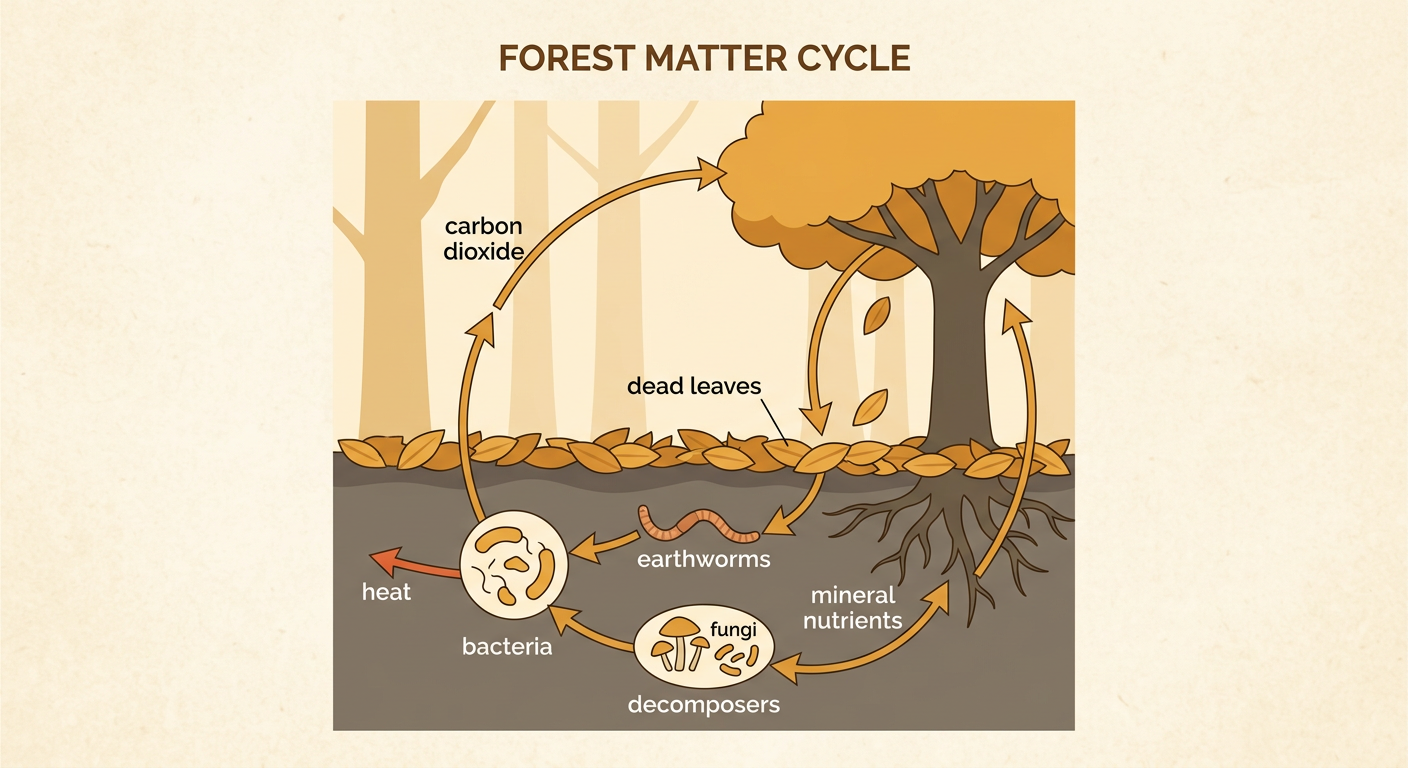
Decomposers return matter from dead organisms and wastes to the nonliving environment. Fungi and bacteria break complex materials into simpler substances. Earthworms and other detritivores first shred or eat dead material, making it easier for decomposers to act. For example, when fallen forest leaves decay, their carbon may enter the air as carbon dioxide, while mineral nutrients enter the soil. Tree roots can absorb those nutrients, and the tree can use carbon dioxide during photosynthesis. The same atoms can move repeatedly among soil, air, water, and organisms, so matter cycles. Energy behaves differently. Decomposers obtain chemical energy from dead material, use much of it for life processes, and release heat. Decomposers recycle matter, but they do not recycle energy back into sunlight.
Build and Explain a Food Web
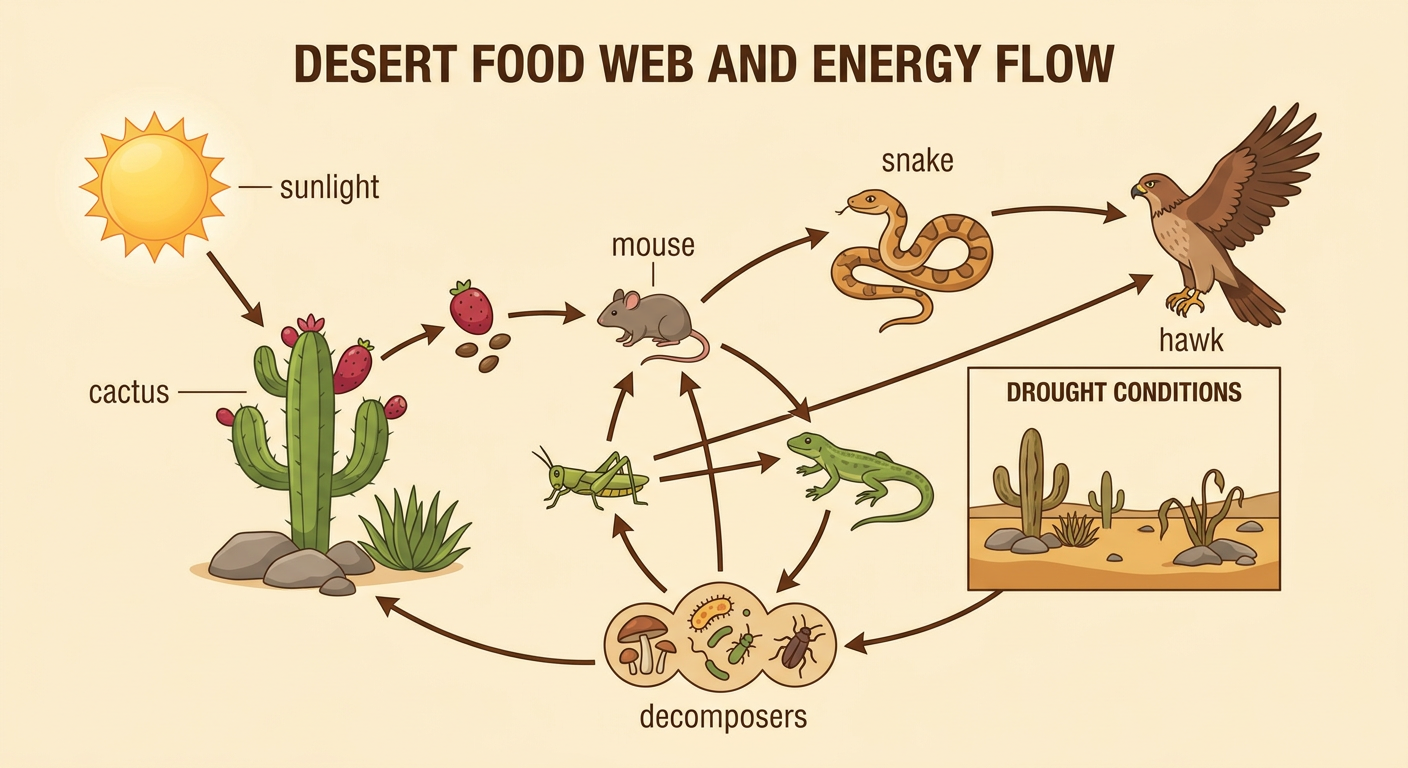
To build a food web, first list the living and nonliving parts of one ecosystem. Classify organisms as producers, consumers, or decomposers. Next, draw arrows from each food source to the organism that eats it. A desert web might include sunlight, cactus, seeds, grasshoppers, mice, lizards, snakes, hawks, and decomposers. A mouse may receive arrows from seeds and cactus fruit, while arrows from the mouse may point to snakes and hawks. Add arrows for matter returning through wastes and dead organisms to decomposers, soil, air, and plants. Then explain that energy enters as sunlight, moves through feeding relationships, and leaves as heat, while matter cycles. Test the model by changing an environmental condition. During a long drought, reduced plant growth may support fewer insects and mice, which can reduce food for their predators.