Energy on the Move in Everyday Devices
Students observe, measure, and model how electrical energy is transferred into light, sound, motion, and heat in everyday devices.

Illustrations are auto-generated and may be placeholders. They can be refreshed to match the narration.
Where Does a Device's Energy Go?
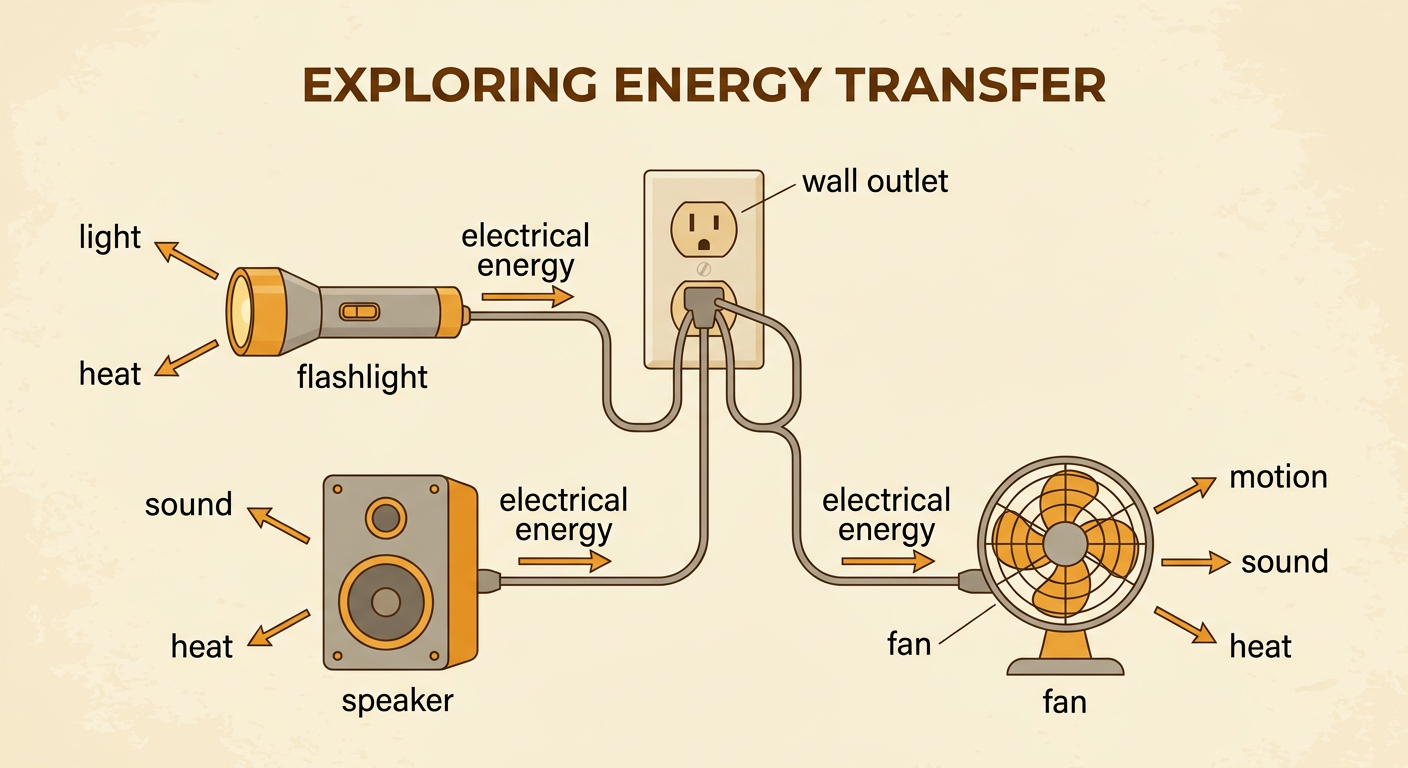
Every device needs an energy input to work. Many household devices receive electrical energy from a battery or wall outlet. Inside the device, that energy is transferred and changed into forms we can observe. In a flashlight, electrical energy is transferred into light and heat. In a speaker, electrical energy makes a part vibrate, producing sound and some heat. In a fan, a motor transfers electrical energy into the motion of the blades, as well as sound and heat. Energy does not disappear when a device operates. It moves into the device and then into the surroundings in different forms. Observations such as glowing light, moving parts, sounds, and rising temperatures provide evidence of these energy transfers.
Tracing Energy Transfer Pathways
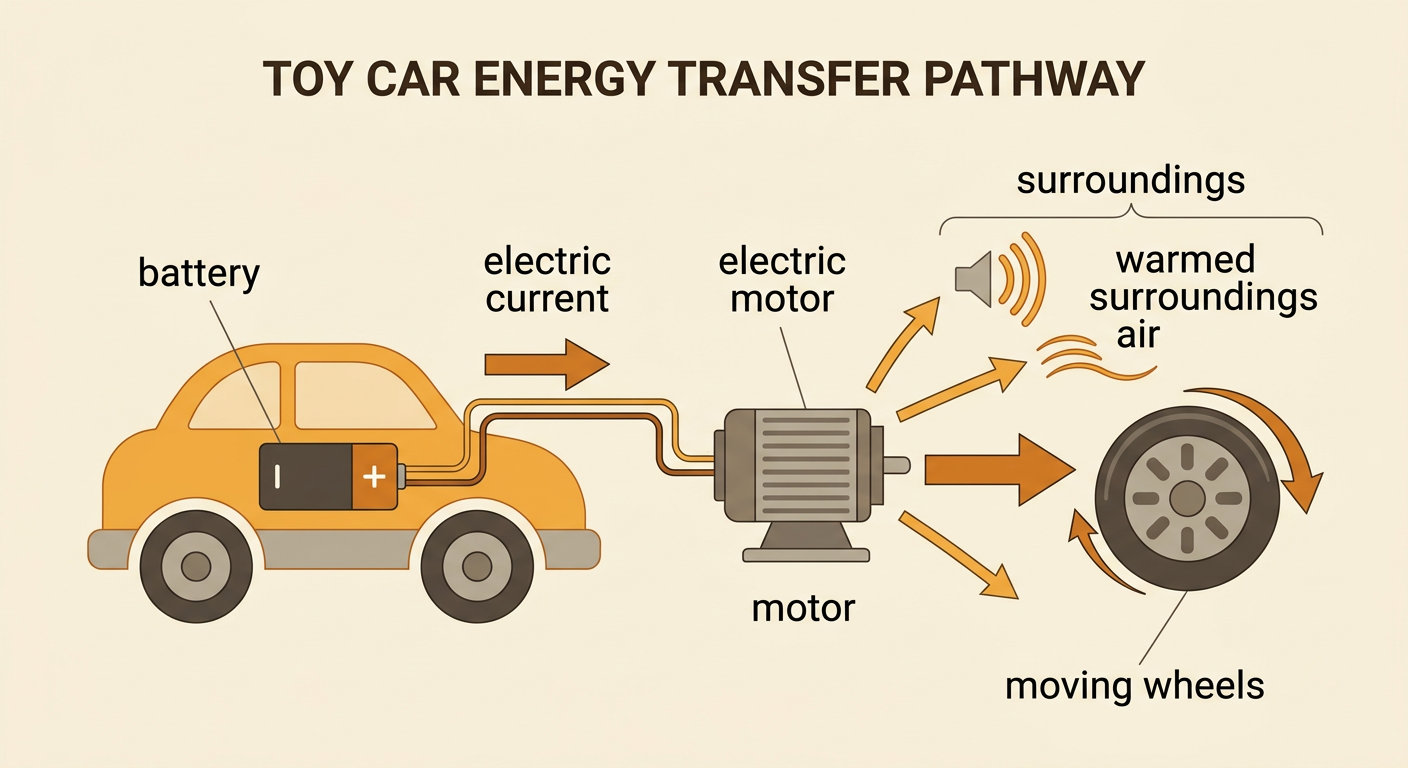
An energy transfer pathway is a model showing where energy starts, where it travels, and what happens next. Use arrows to show the direction of transfer. For example, chemical energy stored in a battery is transferred by an electric current through wires to a toy car’s motor. The motor transfers energy to the wheels, causing motion. Some energy also transfers to the surroundings as sound and heat. A complete pathway might read: battery, electric current, motor, moving wheels, surroundings. The current is not energy stored inside the wire; it is the movement of electric charges that transfers energy through the circuit. Models simplify real systems, but they help us explain evidence and compare devices.
Investigation: Measuring Heat Transfer
Investigate how much heat two lamps transfer to their surroundings. Use an LED lamp and an incandescent lamp that produce similar amounts of light. Place each lamp the same distance from a separate thermometer, and record both starting temperatures. Turn on the lamps for the same amount of time, such as five minutes. Record the final temperatures to the nearest one-half degree Fahrenheit, then subtract to find each temperature increase. Repeat the test several times while keeping distance, time, room conditions, and thermometer type the same. A larger temperature increase is evidence that more energy was transferred as heat near that lamp. Do not touch either bulb, because bulbs can become hot. An adult should set up and unplug the lamps.

Graphing the Measurement Data
A line plot can display repeated temperature increases and reveal patterns. Suppose the LED lamp trials increased by 1/2, 1/2, 1, 1, and 1 1/2 degrees Fahrenheit. Draw a number line labeled Temperature Increase and mark equal intervals of one-half degree. Place one X above the matching value for each trial. Two Xs belong above 1/2 degree, two above 1 degree, and one above 1 1/2 degrees. Make a second line plot for the incandescent lamp using the same scale so the results can be compared fairly. Look for clusters, repeated values, and the overall range. If most incandescent results are farther to the right, the data support the claim that it transferred more energy as heat near the thermometer.

Comparing Device Costs and Benefits
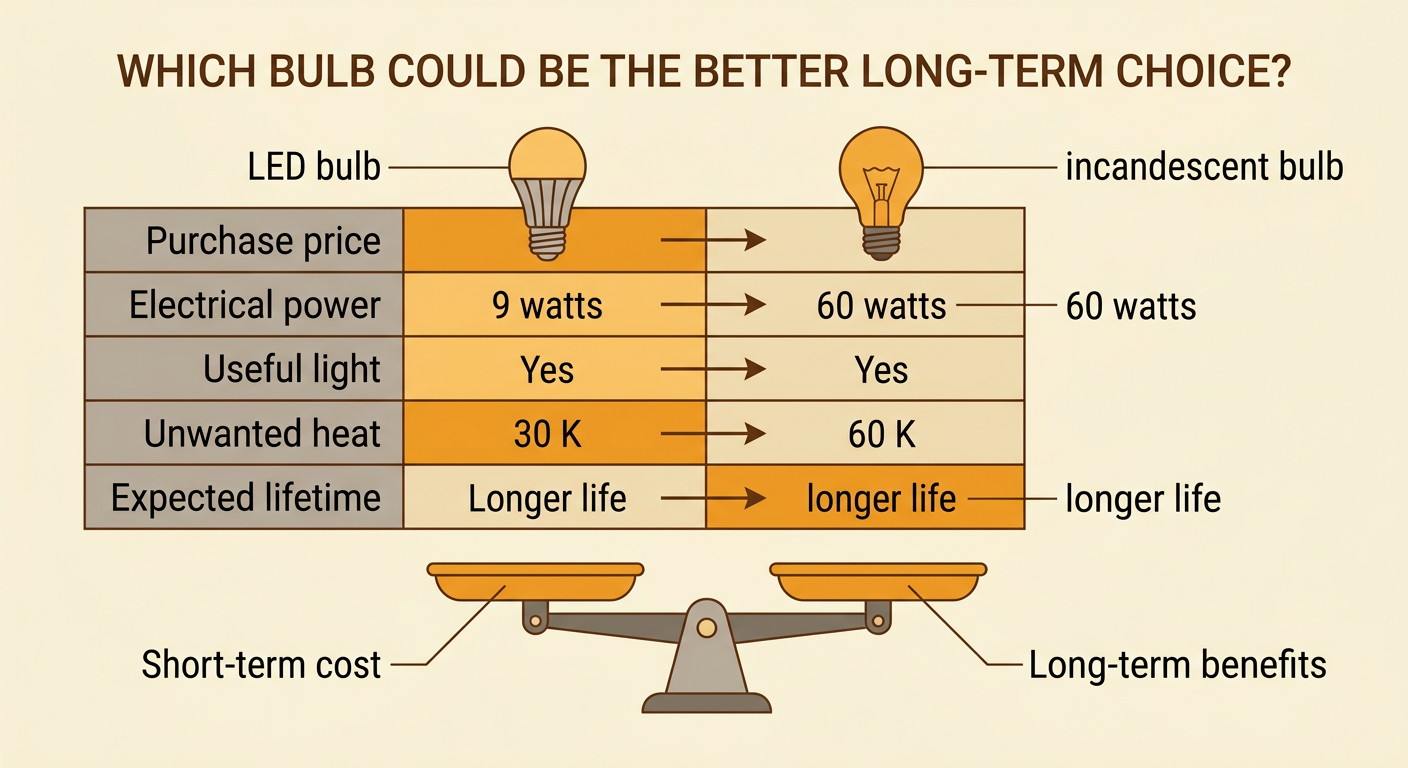
Energy choices involve both benefits and costs. An LED bulb may cost more to buy than an incandescent bulb, but it usually uses less electrical power to produce a similar amount of light. For example, an LED might use 9 watts while a similar incandescent bulb uses 60 watts. The LED also lasts longer and transfers less energy as unwanted heat, which can reduce electricity use and replacement costs. However, price, brightness, color, availability, and safe disposal may also affect a buyer’s choice. Evidence should support a recommendation. A student might recommend the LED because its lower energy use and longer life provide benefits over time, even if its purchase price is higher. Individual choices can affect household spending and the demand for electricity in a community.
Exit Model: Energy on the Move
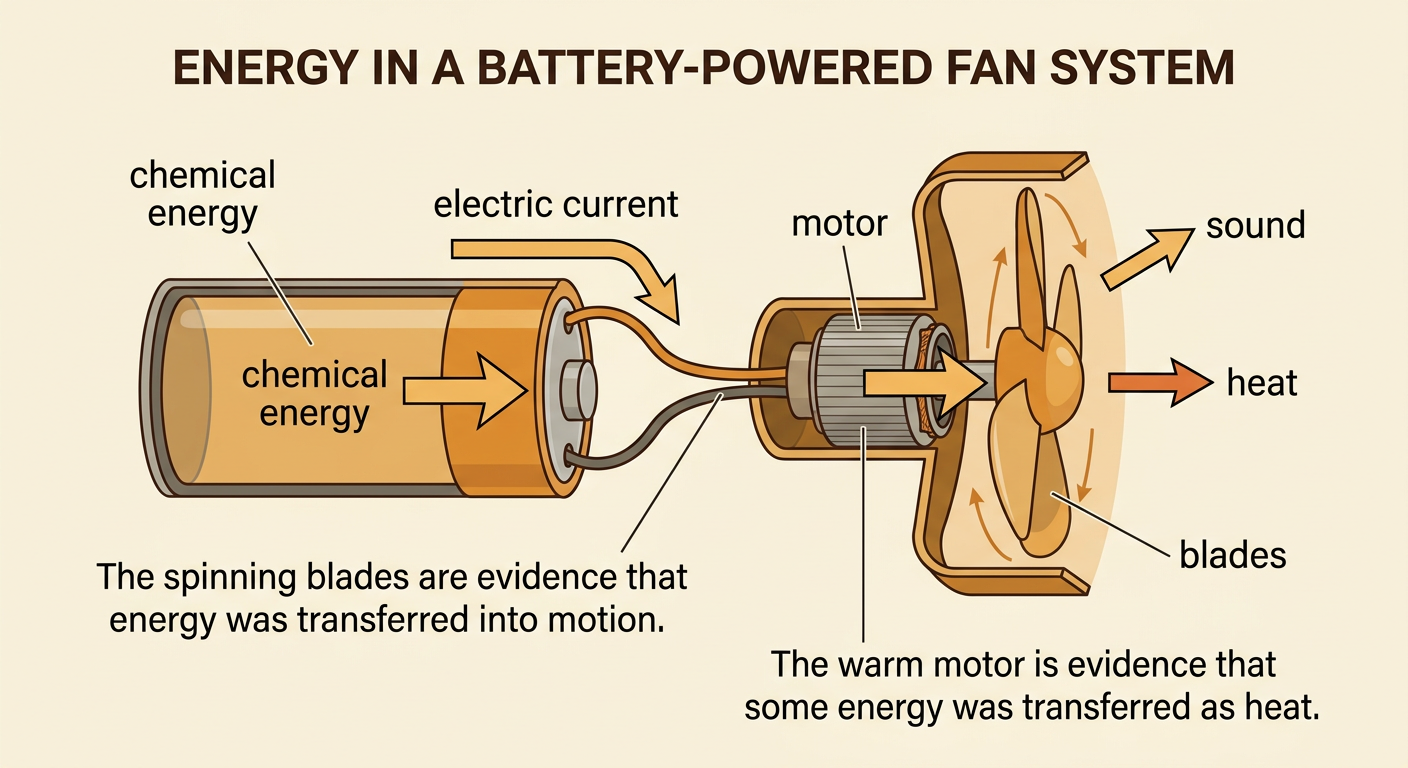
Create a final model for one everyday device, such as a battery-powered fan. Draw the battery, wires, motor, blades, and nearby surroundings. Add arrows to show the energy pathway. Label chemical energy in the battery, energy transferred by electric current, motion of the motor and blades, and transfers of sound and heat to the surroundings. Then write two evidence statements based on observations. For example, “The spinning blades are evidence that energy was transferred into motion” and “The warm motor is evidence that some energy was transferred as heat.” Check that every arrow has a clear direction and every output is connected to the device. Your model should show that energy moves through a system and can produce several effects at the same time.