
Energy Transfer Through Collisions
Students investigate how moving objects transfer energy during collisions and use observations as evidence to explain changes in motion.

Illustrations are auto-generated and may be placeholders. They can be refreshed to match the narration.
What Happens During a Collision?
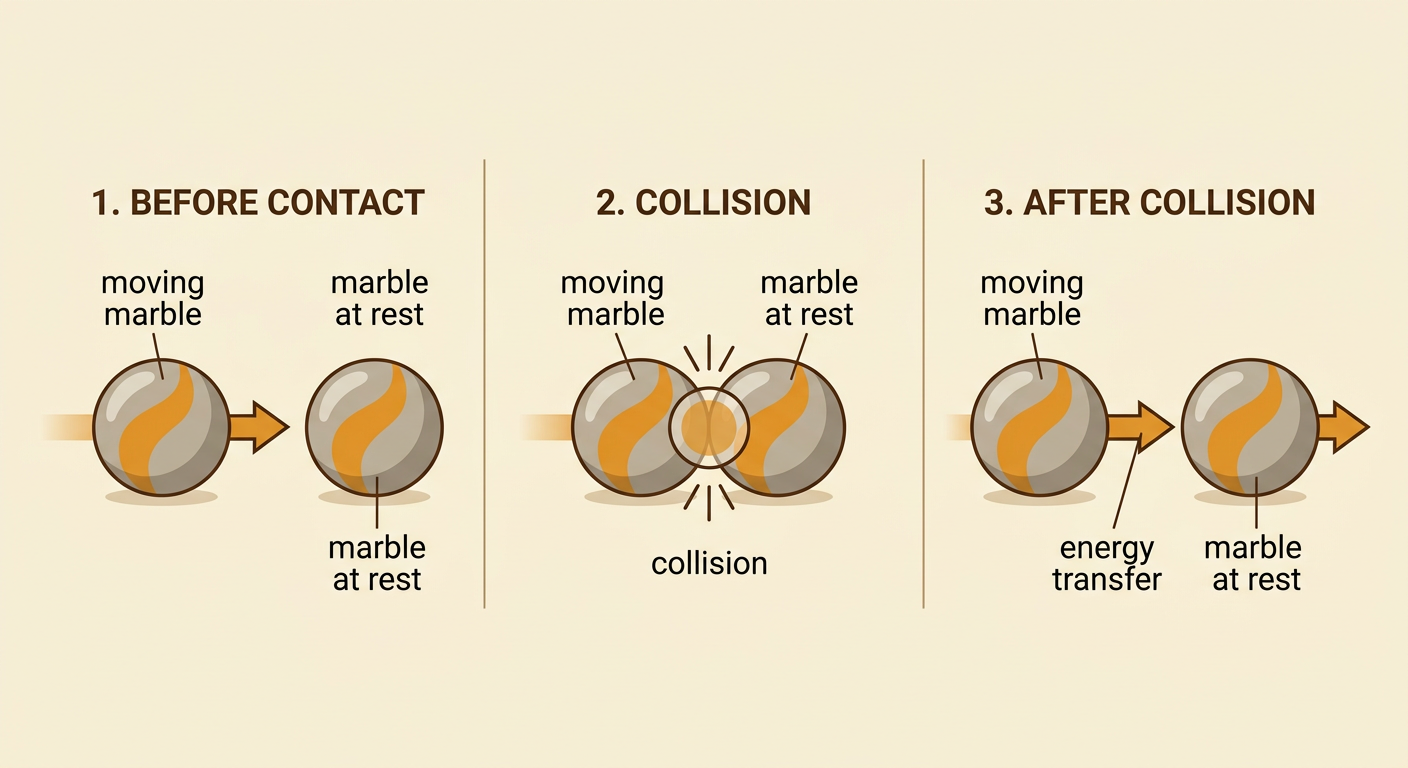
A collision happens when two objects make contact and push on each other. If one object is moving, it has energy of motion. During the collision, some of this energy can transfer to the other object. As a result, either object may speed up, slow down, stop, bounce, or change direction. For example, imagine a rolling marble striking a marble that is at rest. The first marble may slow down, while the second marble begins moving. This change is evidence that energy transferred between the marbles. A collision can also produce sound and a small amount of heat. Scientists observe what happens before, during, and after contact to understand how energy moves through a system.
Predicting Changes in Motion
A prediction states what you think will happen and gives a reason based on what you know. Before studying a collision, ask questions such as: Will the object at rest move? Will the moving object slow down? Will either object change direction? The starting speed and mass of each object can affect the outcome. For example, suppose the same toy car rolls down a low ramp and then a higher ramp before striking a block. The car from the higher ramp will usually be moving faster at the bottom. You might predict that it will make the block travel farther because the faster car has more energy of motion to transfer. A useful prediction names the changed condition, the expected result, and the scientific reason.

Testing Collisions with Rolling Objects
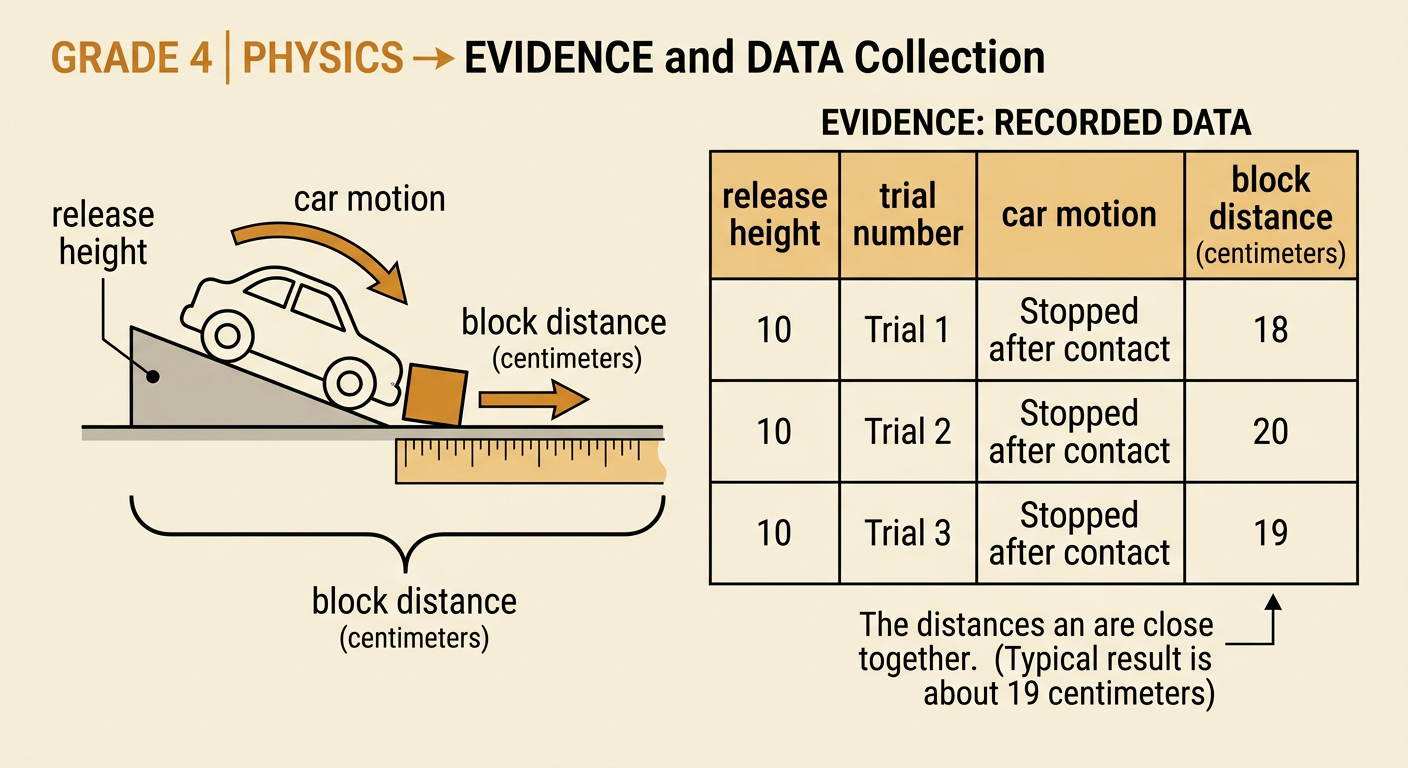
A fair test changes one condition while keeping other conditions the same. Place a toy car at a marked point on a ramp and set a lightweight block at the bottom. Release the car without pushing it. Observe the collision and measure how far the block moves. Repeat the test three times. Then raise the starting point of the same car and test again. Keep the car, block, ramp, floor surface, and measuring method unchanged. For example, compare a car released from 10 centimeters above the floor with the same car released from 20 centimeters. Use a ruler or measuring tape to find the block's travel distance. Keep hands and faces away from the car's path. Repeated trials help show whether the result is consistent rather than accidental.

Recording Evidence
Evidence is information collected through careful observation or measurement. Create a table with columns for release height, trial number, the car's motion after contact, and the distance the block travels. Record measurements with units, such as centimeters. Do not replace an observation with what you expected to happen. For example, if the block travels 18 centimeters, 20 centimeters, and 19 centimeters in three trials, record all three results. You can describe the pattern by saying the distances were close and were about 19 centimeters. Notes, measurements, drawings, and repeated trials are different sources of evidence. Compare them to check whether they tell the same story. Clear records allow other students to understand the test, evaluate the evidence, and decide whether it supports the prediction.
Explaining Energy Transfer
A strong scientific explanation includes a claim, evidence, and reasoning. The claim answers the investigation question. The evidence gives relevant observations and measurements. The reasoning explains how the evidence supports the claim using science ideas. For example, a student might claim that a faster toy car transferred more energy to the block. The student could cite evidence that the block moved an average of 8 centimeters after low-ramp collisions and 21 centimeters after high-ramp collisions. The reasoning could state that the same car moved faster from the higher release point and caused a greater change in the block's motion. Use precise terms such as collision, energy transfer, speed, direction, and distance. Also mention evidence that does not fit the pattern. A complete explanation helps readers follow the argument and judge whether the claim is supported.
