
Energy Transfer Through Interactions
Students analyze collisions and other interactions to explain how energy moves between objects while the total energy of a system is conserved.
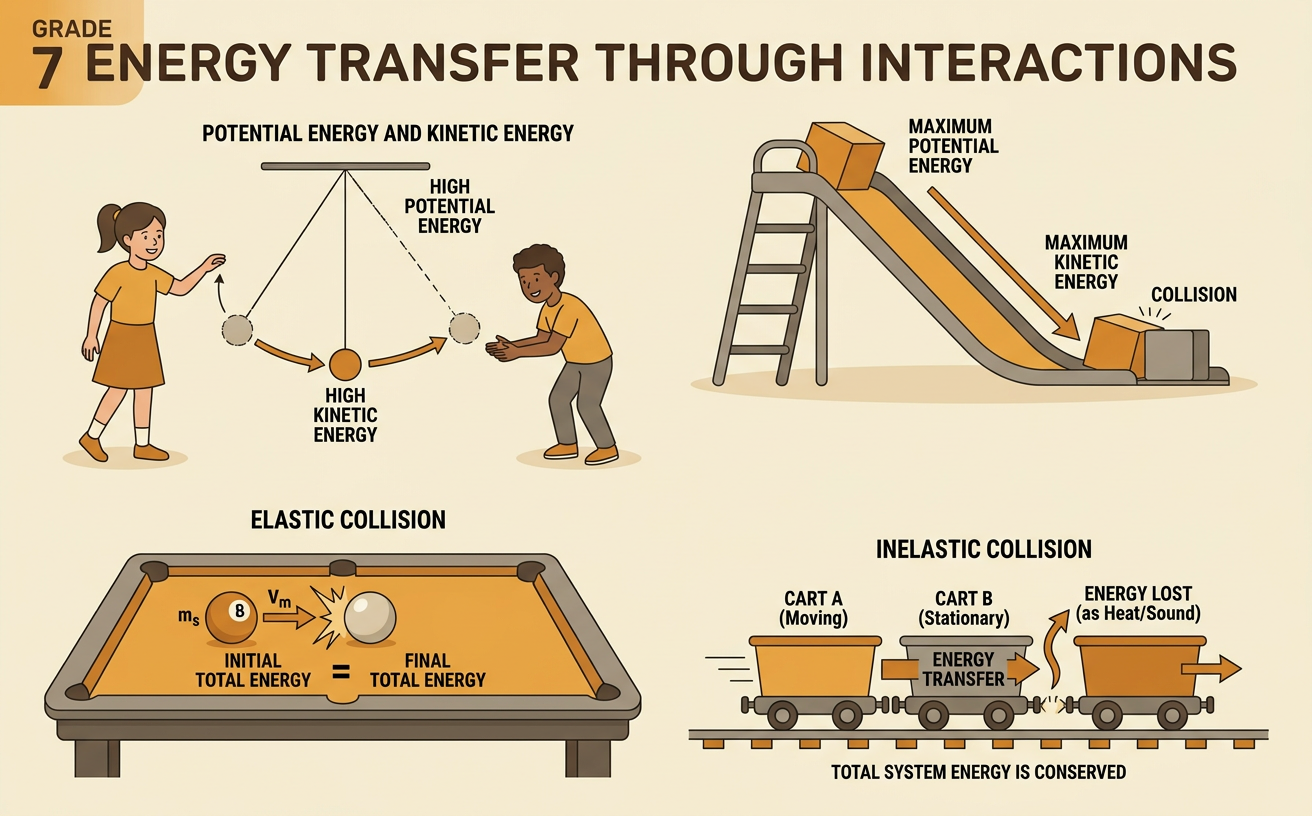
Illustrations are auto-generated and may be placeholders. They can be refreshed to match the narration.
Defining a System
A system is the object or group of objects chosen for study. Everything else is called the surroundings. Scientists draw a system boundary to show what is included. The boundary may be imaginary, and energy can sometimes cross it. For example, consider a child pushing a toy car. If the system includes only the car, energy enters the system through the child’s push. If the system includes the child and the car, energy is transferred between objects inside the system. Choosing a clear system helps you track where energy comes from and where it goes. A system can be small, such as one rolling ball, or larger, such as two balls, a ramp, and the floor. The system must be identified before making a claim about whether its total energy changes.
Objects and Interactions
An interaction occurs when objects affect one another. During an interaction, energy can move from one object to another even though energy is not a material substance. Contact interactions include pushes, pulls, friction, and collisions. Some interactions act at a distance, including gravitational and magnetic interactions. For example, hold a ball above the floor and release it. Earth’s gravitational interaction with the ball transfers energy within the Earth-ball system as the ball falls. The ball gains kinetic energy, the energy of motion, while the system’s gravitational potential energy decreases. Objects can also transfer energy through friction. When a book slides across a table, its motion slows, and energy is transferred to the book and table as thermal energy. Identifying the interacting objects helps explain each energy transfer.
Collisions and Energy Transfer
A collision is a brief, strong interaction between objects. During a collision, one object can transfer some or most of its kinetic energy to another object. Imagine a moving marble striking an identical marble that is initially at rest. After a nearly straight, centered collision, the first marble may slow greatly while the second marble rolls forward. The second marble gained kinetic energy through its interaction with the first. Real collisions also transfer some energy into sound and thermal energy, and objects may bend or change shape briefly. Therefore, the total kinetic energy after a collision may be less than it was before, even though total energy is conserved. To analyze a collision, compare each object’s motion before and after contact and include other forms of energy produced during the interaction.
Energy Transfer Models
An energy transfer model is a simplified representation that shows where energy is stored and how it moves or changes form. A useful model may include labeled objects, arrows, and energy bars. Arrows should point from the object losing energy toward the object gaining energy. Wider arrows or taller bars can represent greater amounts of energy, but the model should include a key. For example, when a swinging pendulum ball hits a block, the model can show kinetic energy transferring from the ball to the block. The block begins moving, while some energy becomes thermal energy and sound energy during the collision. A before-and-after bar chart can compare energy forms in the whole system. A strong model identifies the system boundary, the interacting objects, the direction of transfer, and all important forms of energy.
Conservation of Energy
The law of conservation of energy states that energy cannot be created or destroyed. Energy can be transferred between objects or changed from one form to another, but the total energy of a closed system remains constant. A closed system is one in which no energy enters or leaves. Consider a bouncing ball and Earth as a system. Before the ball falls, much of the energy is gravitational potential energy. As it falls, that energy changes to kinetic energy. When the ball hits the floor, energy is temporarily stored as elastic energy as the ball changes shape. Some energy then returns to kinetic energy as the ball rebounds, while some becomes thermal energy and sound. The ball does not rise to its original height, but energy has not disappeared; it has spread into less visible forms.