
Energy Transfers and Efficiency
Students use energy diagrams and calculations to analyze how devices transform input energy into useful and dissipated forms of energy.
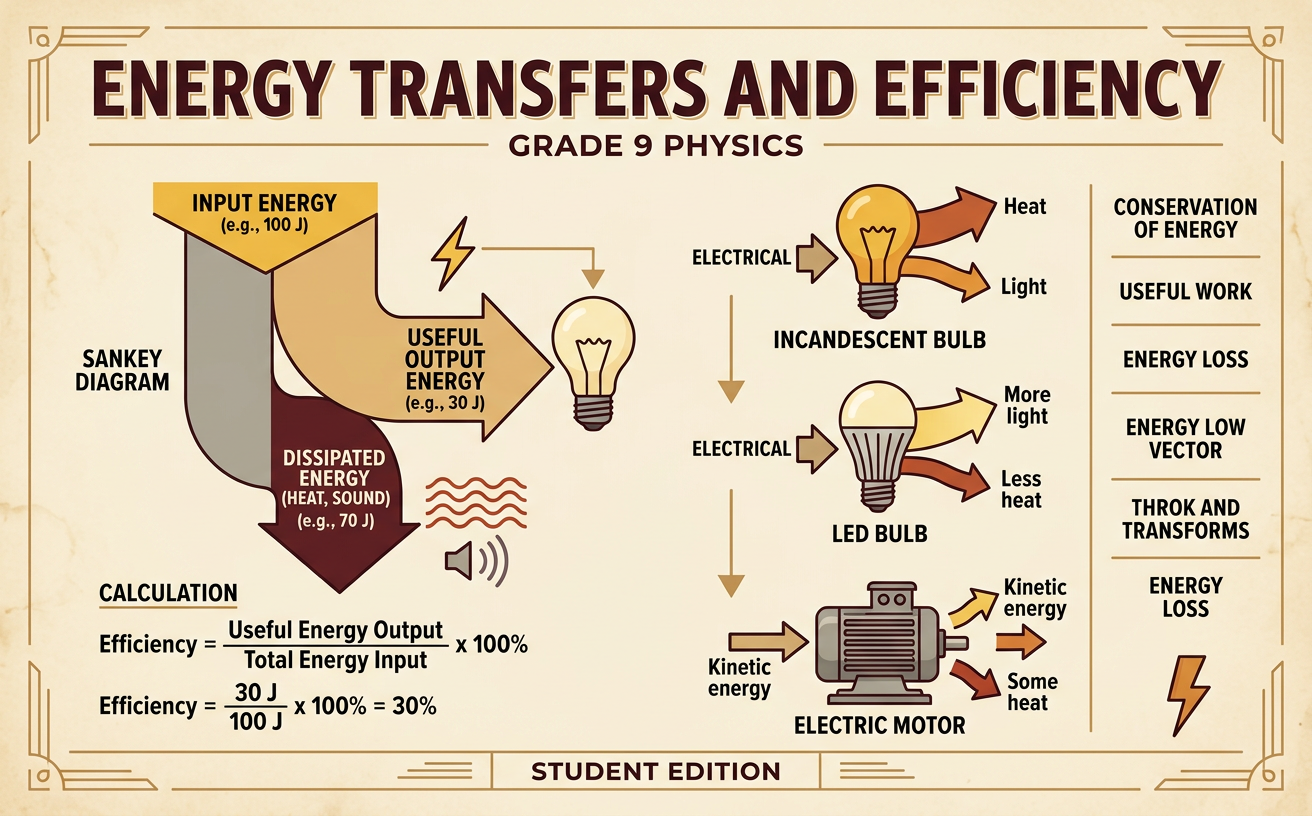
Illustrations are auto-generated and may be placeholders. They can be refreshed to match the narration.
Forms of Energy Review
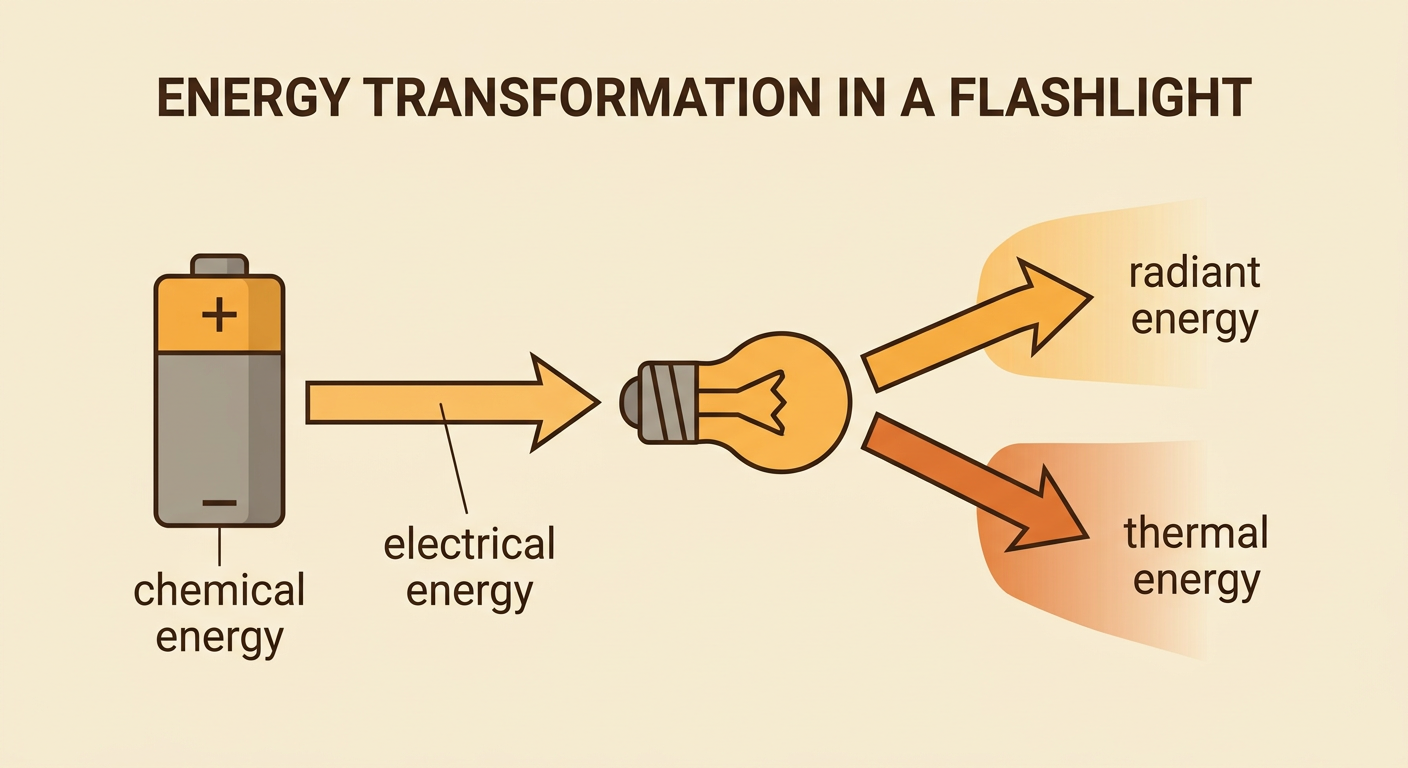
Energy is the ability of a system to cause change. Common forms include kinetic, gravitational potential, elastic potential, chemical, electrical, thermal, radiant, and sound energy. Devices often transform energy from one form into several others. In a flashlight, chemical energy stored in the battery becomes electrical energy in the circuit. The bulb then transforms electrical energy into useful radiant energy and thermal energy. Energy is conserved during these transformations: it is not created or destroyed. Instead, it moves between objects or changes form. To analyze a device, identify the system, the initial energy source, and every important output. Tracking all forms helps confirm that the total energy entering a system equals the energy leaving it or remaining stored within it.
Tracing Energy Through a System
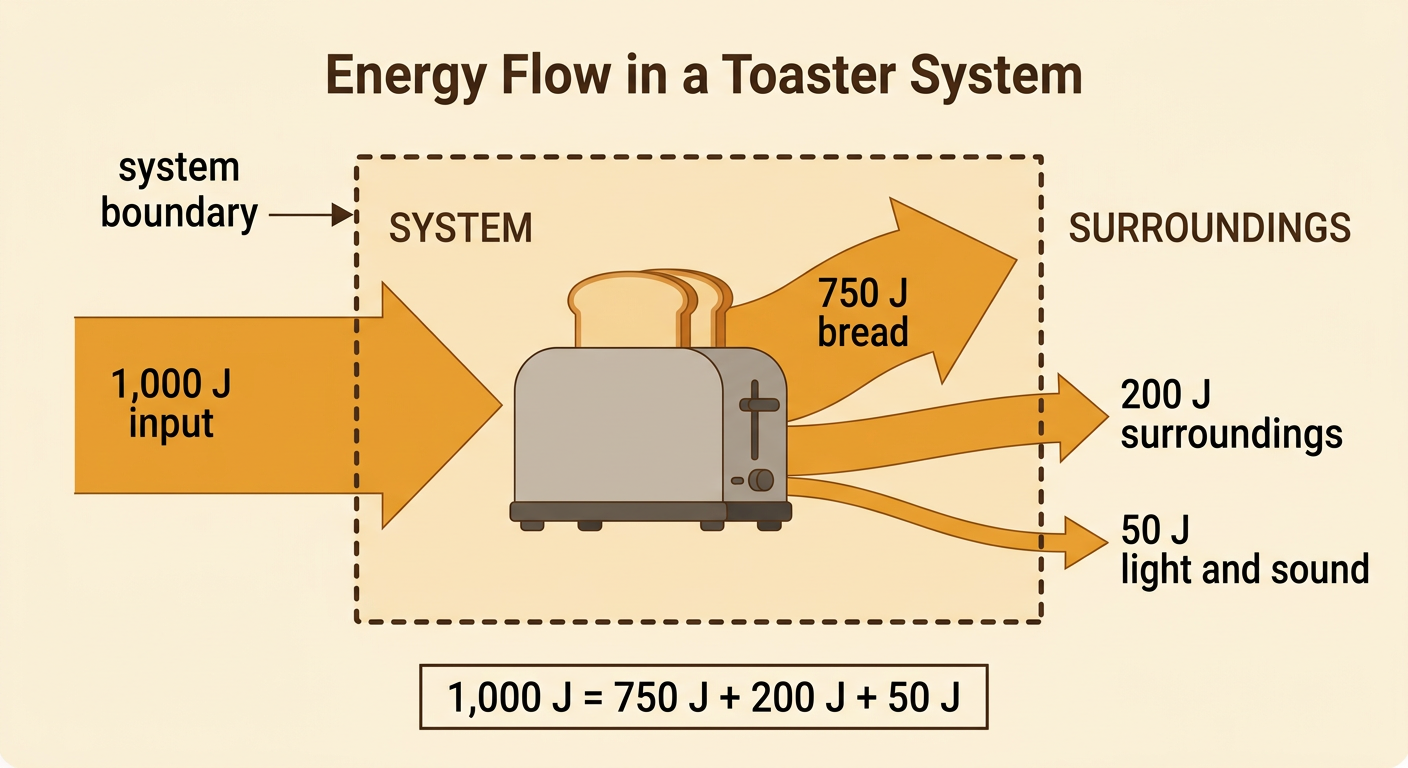
To trace energy, first draw a boundary around the system being studied. Then show energy entering, leaving, or changing the system’s stored energy. Suppose a toaster and a slice of bread receive 1,000 joules of electrical energy. During the measured interval, 750 joules increase the bread’s thermal energy, 200 joules transfer to the surrounding air and counter, and 50 joules leave as light and sound. The energy model balances because 1,000 J = 750 J + 200 J + 50 J. In an energy-flow diagram, wider arrows can represent larger energy amounts. Translating the written description into arrows and values makes the conservation relationship visible and provides a computational model of the system.
Useful and Dissipated Energy
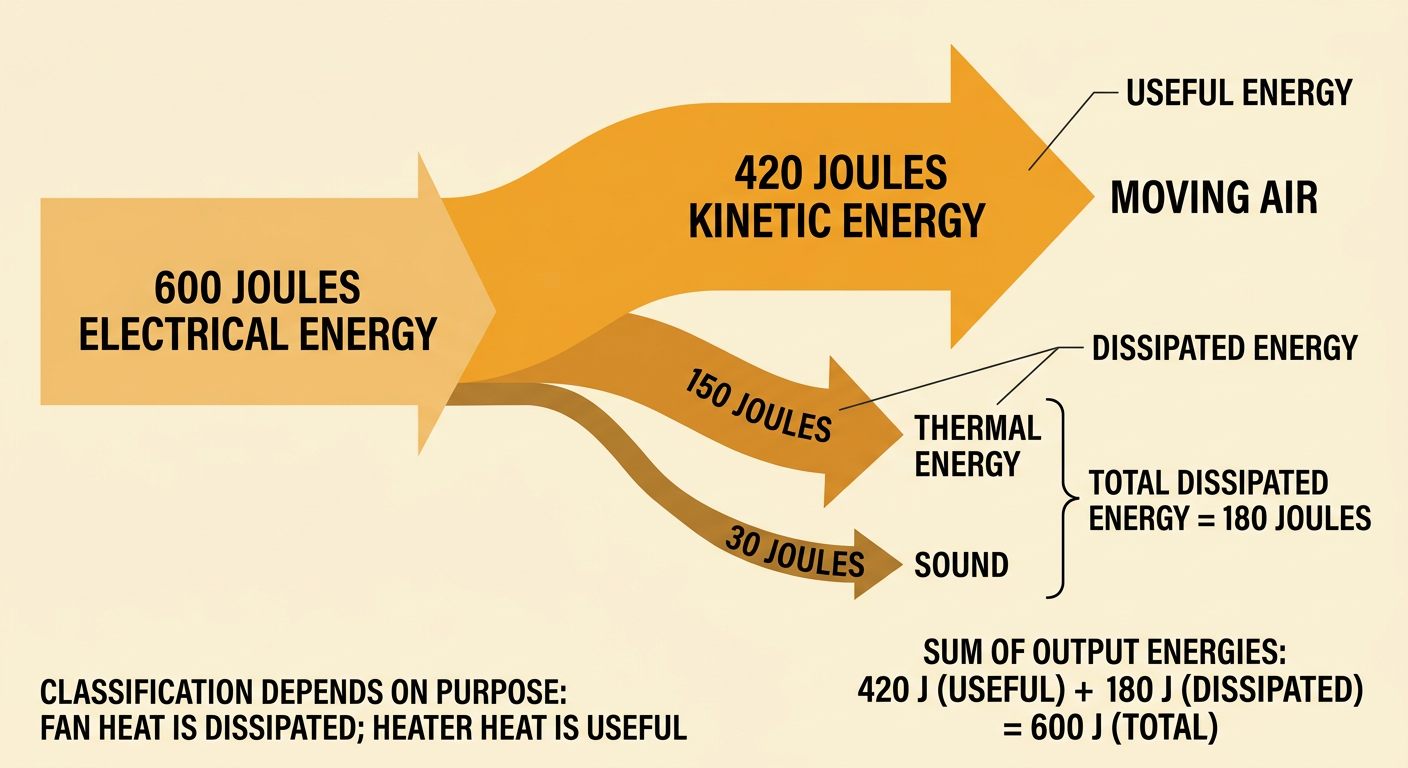
Useful energy is the part of an energy output that accomplishes the device’s intended purpose. Dissipated energy spreads into the surroundings in forms that are less useful for that purpose, commonly thermal energy and sound. Dissipated energy is not destroyed; it still follows conservation of energy. Consider a fan that receives 600 J of electrical energy. If 420 J becomes kinetic energy of moving air, that amount is useful. If 150 J becomes thermal energy in the motor and room and 30 J becomes sound, 180 J is dissipated. The classification depends on the goal. Thermal energy from a fan is generally unwanted, but thermal energy from an electric heater is useful because heating the room is the intended task.
Calculating Percent Efficiency
Percent efficiency compares a device’s useful energy output with its total energy input. Use the equation percent efficiency = useful energy output ÷ total energy input × 100. For example, a motor receives 500 J of electrical energy and provides 350 J of useful kinetic energy. Its efficiency is 350 J ÷ 500 J × 100 = 70 percent. The remaining 150 J is dissipated, mainly as thermal energy and sound. The formula can be rearranged to find another quantity. Useful output equals efficiency written as a decimal multiplied by input. Input equals useful output divided by efficiency written as a decimal. Always use energy values in matching units, and convert a percentage such as 70 percent to 0.70 before multiplying or dividing.

Comparing Device Efficiency
Device efficiencies should be compared while holding the intended task constant. Suppose two motors must each provide 360 kJ of useful mechanical energy. Motor A is 80 percent efficient, so its required input is 360 kJ ÷ 0.80 = 450 kJ. Motor B is 90 percent efficient, so its required input is 360 kJ ÷ 0.90 = 400 kJ. Motor B saves 50 kJ per job and releases less dissipated energy. However, efficiency is only one part of a purchasing decision. If Motor B costs more, a buyer should compare the marginal benefit of lower energy use with the marginal cost of the higher price. Frequency of use, electricity price, reliability, maintenance, and environmental effects can all support an argument for or against buying the more efficient device.
