Engineering Safer Collisions
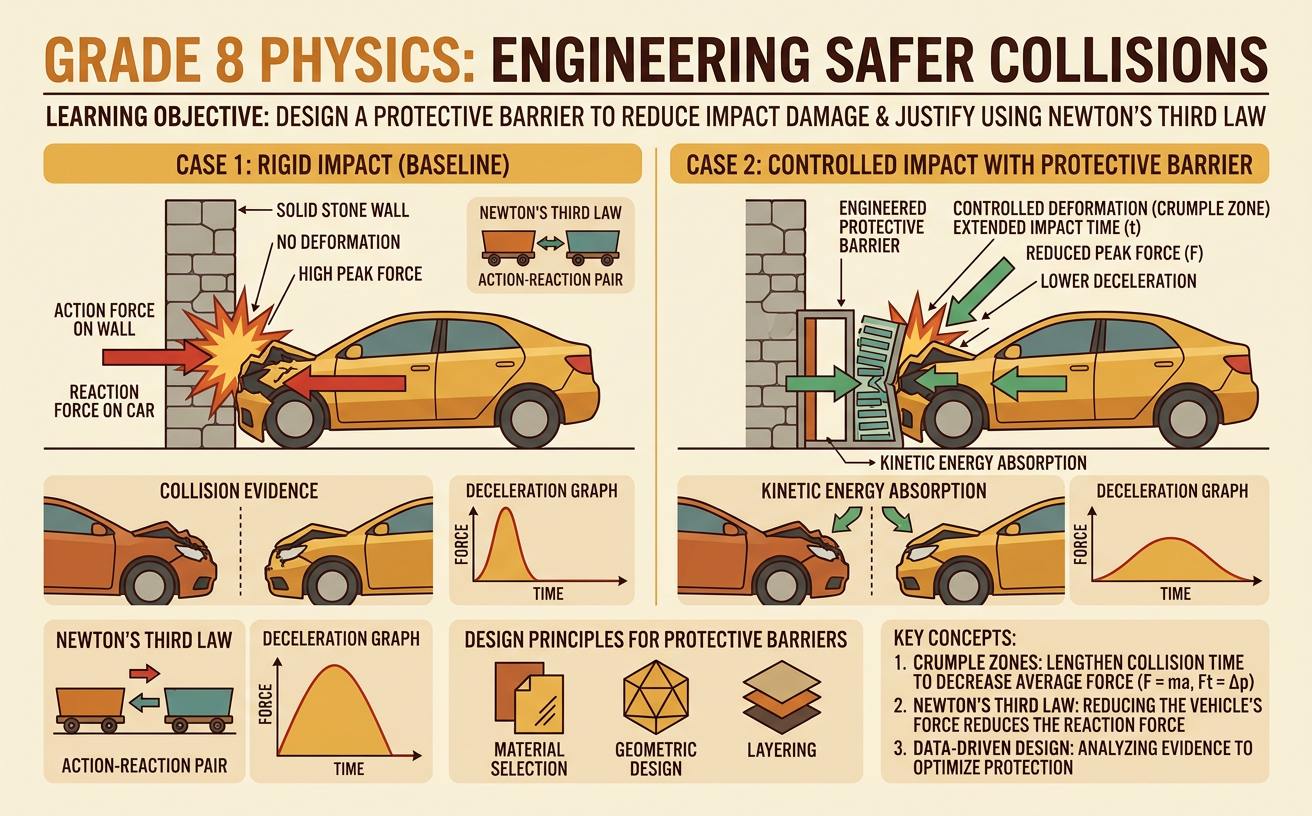
Students apply Newton’s Third Law and collision evidence to design and justify a protective barrier that reduces damage during an impact.
Illustrations are auto-generated and may be placeholders. They can be refreshed to match the narration.
Observing Forces in a Collision
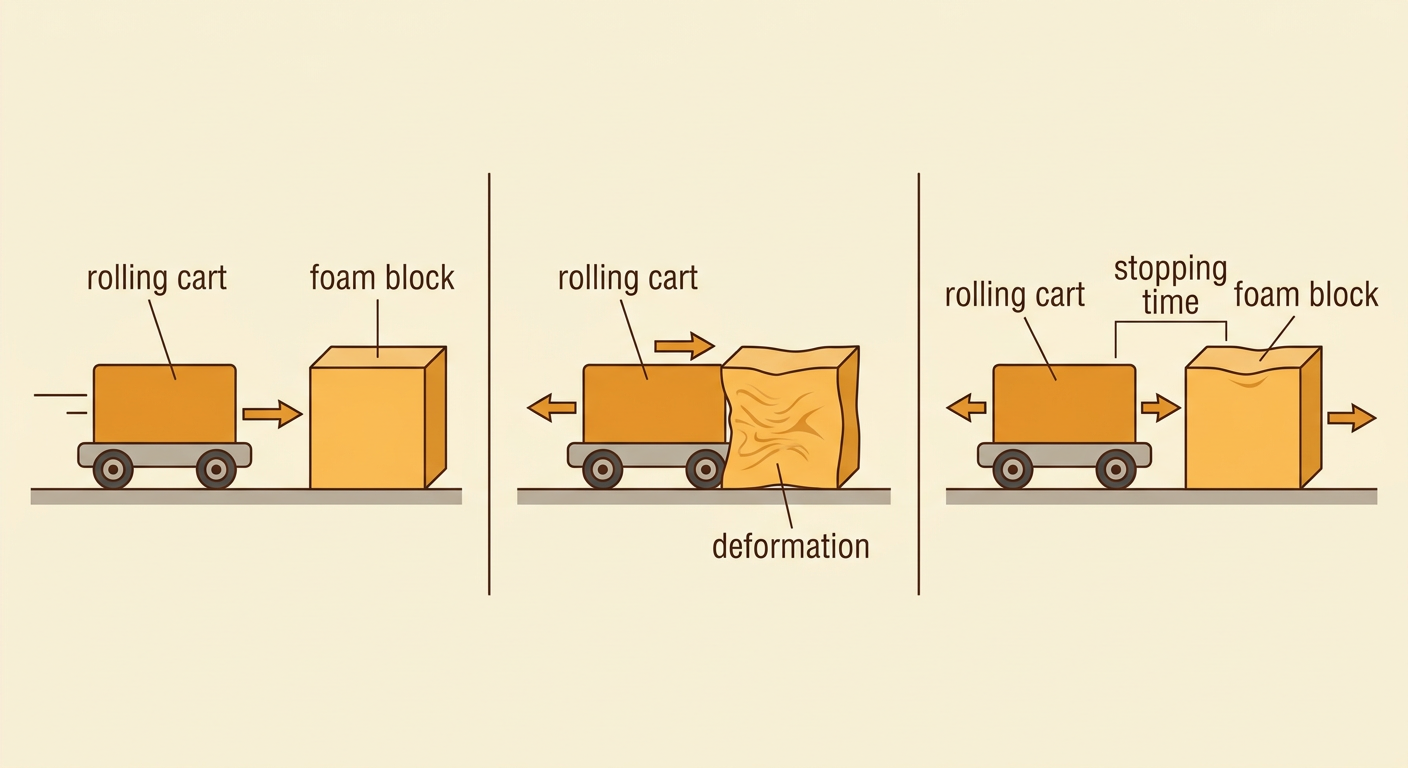
A collision occurs when two objects contact each other and affect one another’s motion. Scientists study what happens before, during, and after contact. Useful evidence includes changes in speed, direction, shape, sound, and temperature. Imagine a rolling cart striking a foam block. Before contact, the cart moves while the block is still. During contact, the cart slows and the foam compresses. Afterward, the cart may stop or bounce back, and the block may move forward. These observations show that forces acted during the collision. Damage, such as a dent or crack, is also evidence of an impact, but damage alone does not give an exact force measurement. Measurements of mass, speed, stopping time, and deformation provide stronger evidence for comparing collisions and evaluating safety designs.
Newton’s Third Law Force Pairs
Newton’s Third Law states that when object A pushes on object B, object B pushes on object A with an equal force in the opposite direction. These forces begin and end together and act on different objects. For example, when a cart hits a wall, the cart pushes the wall forward while the wall pushes the cart backward with equal force. The forces do not cancel because one acts on the wall and the other acts on the cart. The cart’s motion changes noticeably because it has much less mass than the wall and the connected Earth. The wall’s acceleration is too small to notice. A correct force-pair statement names both objects: force of the cart on the wall and force of the wall on the cart.

Testing Collision Barriers
Engineers test barriers to learn which designs reduce damage. A fair test changes one design feature while keeping other conditions the same. Students might roll the same cart down the same ramp into barriers made from folded cardboard, foam, or stacked paper tubes. They should keep the cart’s mass, release point, track, and target object constant. Each barrier should also have the same allowed thickness if thickness is a design constraint. Students can measure stopping time, maximum compression, rebound distance, target movement, or damage to a clay passenger model. Repeating each test at least three times helps reveal whether a result is consistent or accidental. A barrier is not automatically best because it survives; it must also protect the object behind it while meeting the stated criteria and constraints.

Analyzing Impact Evidence
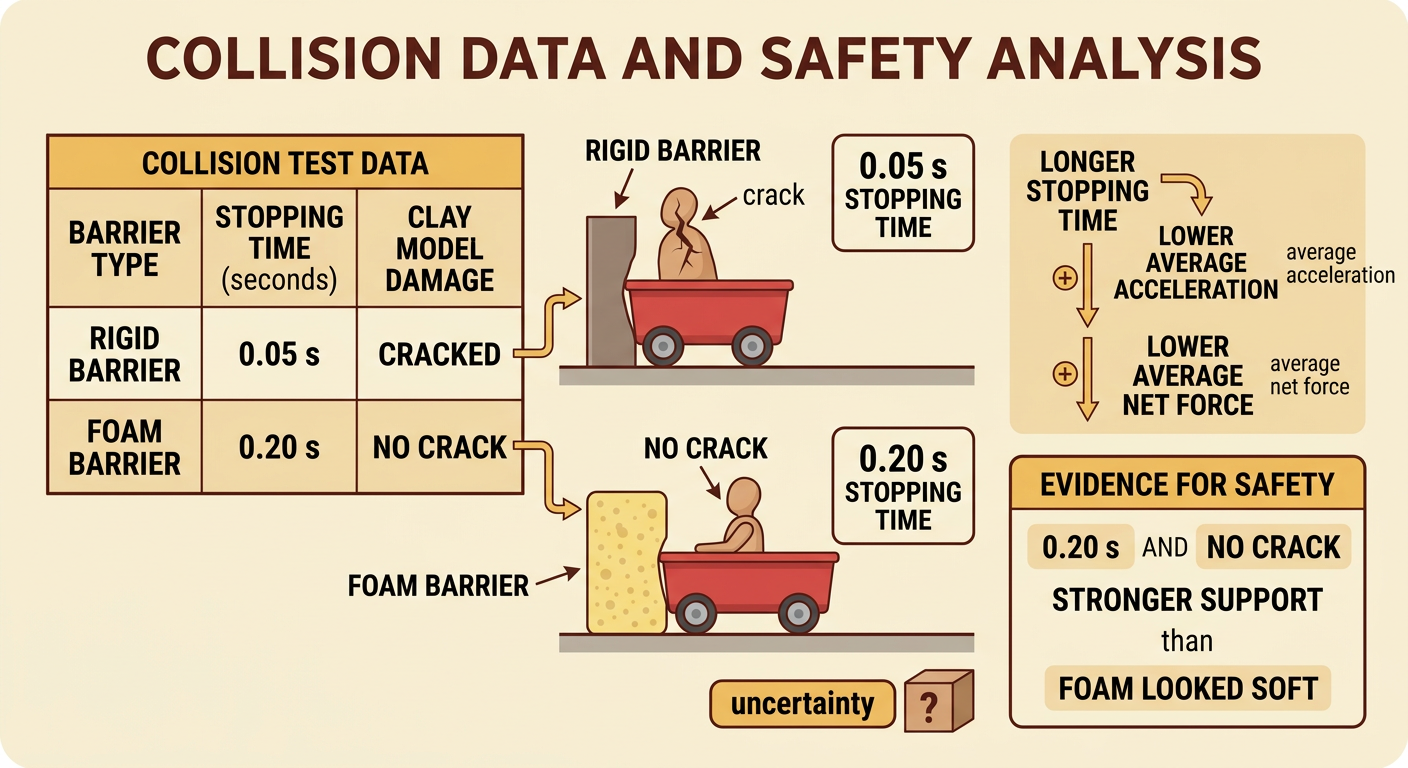
Collision evidence should be organized and compared rather than judged by appearance alone. Suppose a data table shows that a rigid barrier stops a cart in 0.05 second and cracks the clay passenger model, while a foam barrier stops the same cart in 0.20 second with no crack. Both barriers cause the same overall change from moving to stopped, but the foam spreads that change over more time. A longer stopping time generally reduces the cart’s average acceleration and average net force. Newton’s Third Law still applies: the cart and barrier exert equal and opposite interaction forces on each other at every moment. Students should cite exact evidence, such as measured times, deformation, or damage scores. They should also note uncertainty caused by inconsistent releases, measurement limits, or too few trials.
Designing a Safer Barrier
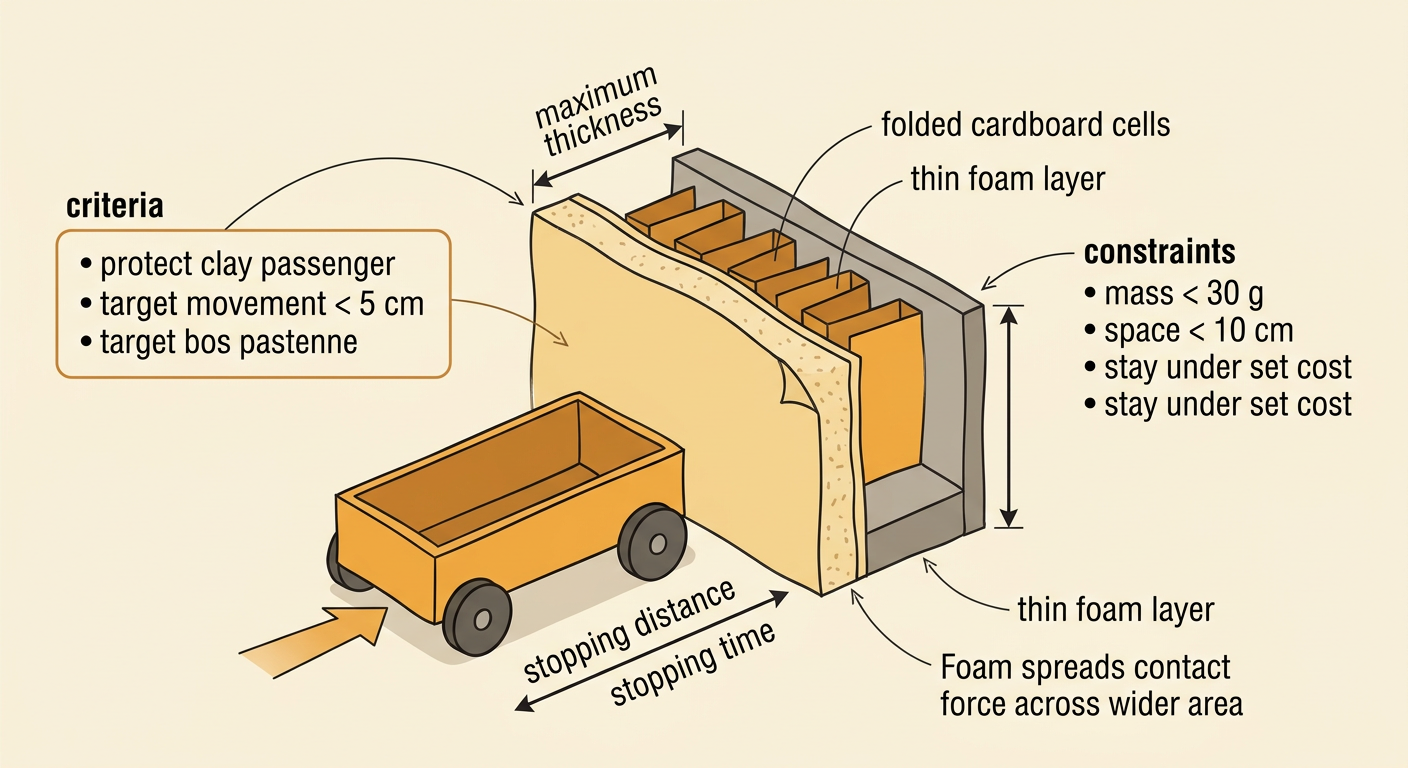
A safer barrier should reduce damage while satisfying criteria and constraints. Criteria describe what the design must do, such as protect a clay passenger model or keep target movement below five centimeters. Constraints set limits, such as using only 30 grams of material, fitting within a 10-centimeter space, or costing less than a set amount. One possible design uses folded cardboard cells with a thin foam layer. The cells crush gradually, increasing the stopping distance and time, while the foam spreads contact across a wider area. Students should sketch the design, label its materials and dimensions, and explain how each feature addresses the evidence. They should then build, test, and revise it. Adding unlimited padding is not a valid solution when size, mass, material, and cost constraints are part of the engineering problem.
Defending the Design
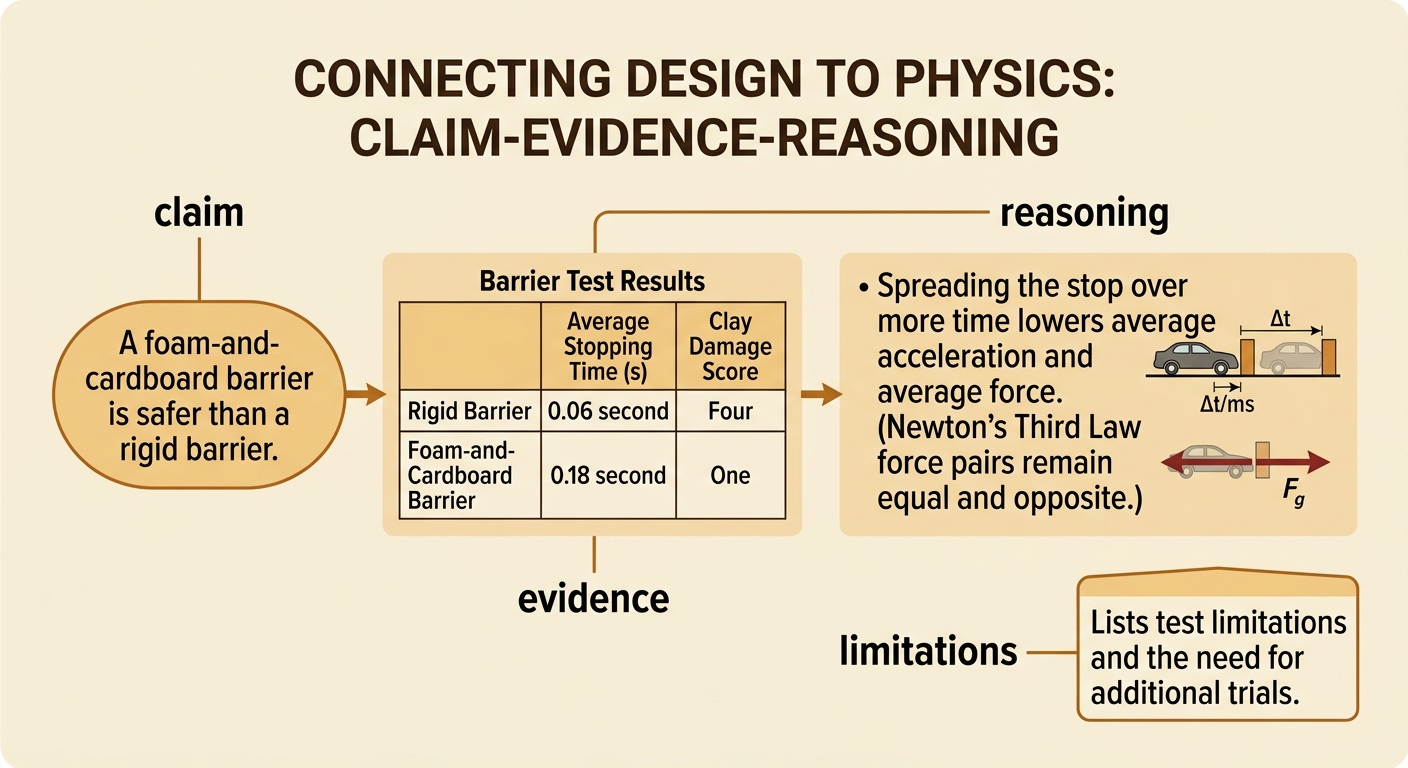
Engineers defend a design with a clear claim, relevant evidence, and scientific reasoning. A student might claim that the foam-and-cardboard barrier is safer than a rigid barrier. Evidence could state that, across three trials, it increased average stopping time from 0.06 second to 0.18 second and reduced the clay damage score from four to one. The reasoning should connect the longer stopping time to lower average acceleration and force while explaining that the cart and barrier still exert equal and opposite forces on each other. A strong argument also acknowledges limitations. For example, three trials are a small sample, clay does not perfectly represent a passenger, and the classroom cart is smaller than a real vehicle. These limitations do not erase the evidence, but they show why more testing is needed before making a broader safety claim.