
Engineering Thermal Energy Transfer
Students apply evidence about heat transfer to design and evaluate a device that either reduces or increases thermal energy transfer.
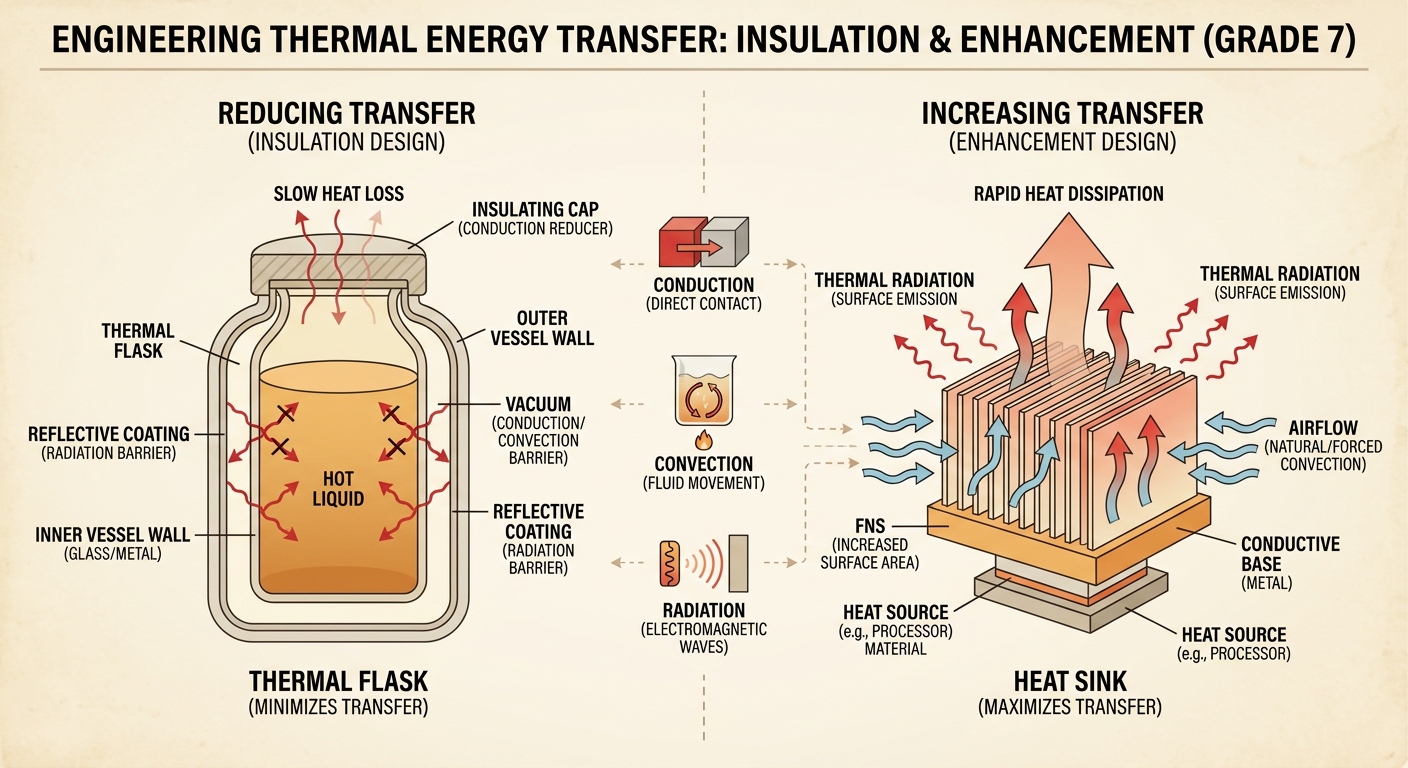
Illustrations are auto-generated and may be placeholders. They can be refreshed to match the narration.
Defining the Design Problem
An engineering design problem begins with a need, criteria for success, and constraints. First decide whether the device should minimize or maximize thermal energy transfer. A lunch container should minimize transfer so food stays near its starting temperature. A solar cooker should maximize transfer into the cooking chamber. Criteria are measurable goals, such as keeping 200 milliliters of water above 50 degrees Celsius for 20 minutes. Constraints are limits involving materials, size, cost, time, or safety. Identify the system being studied and its surroundings. Thermal energy naturally transfers from warmer matter to cooler matter through conduction, convection, and radiation. A useful design changes one or more of these pathways. Clear criteria and constraints make it possible to test designs fairly and decide whether they solve the problem.
Conductors and Insulators
A conductor allows thermal energy to transfer through it relatively quickly, while an insulator slows that transfer. Metals such as aluminum and copper are good thermal conductors because energy moves through them easily. Materials such as foam, wool, wood, and trapped air are usually better insulators. For example, a metal spoon placed in hot soup soon becomes warm by conduction, but a wooden spoon warms more slowly. Insulation does not stop thermal energy transfer completely. It reduces the transfer rate. Convection can also carry energy as liquids or gases move. A tight lid limits the circulation and escape of warm air. Thermal radiation transfers energy by electromagnetic waves and does not require matter. A shiny surface can reflect much of the incoming radiation, while a dark, dull surface generally absorbs more radiation.
Choosing Materials
Engineers choose materials by matching each material’s properties to the goal of the device. To minimize thermal energy transfer, they may use thick foam, felt, or layers that trap still air. A lid can reduce convection, and a reflective outer layer can reduce energy transfer by radiation. However, aluminum foil is also a conductor, so it works best as a reflective surface combined with an insulating layer rather than as the only protection. To maximize transfer, engineers might choose dark surfaces that absorb radiation, metal parts that conduct energy, and openings that allow warmed air to circulate. For example, a solar cooker can use a shiny reflector to direct sunlight toward a dark metal container. Material choices must also meet constraints such as cost, strength, availability, and safety. The best material is the one that supports the design goal and satisfies the constraints.
Building and Testing
A prototype is an early model built to test a design idea. Testing should be controlled so results from different prototypes can be compared. Change only one design variable at a time, such as insulation material or thickness. Keep other conditions constant, including the container size, water volume, starting temperature, room location, and testing time. For example, students might place 200 milliliters of warm water in two identical cups. One cup is wrapped in felt and the other in foam. They measure the water temperature at the start and every five minutes for 25 minutes. Thermometers should be placed at the same depth without touching the cup walls. Safety matters: use warm rather than boiling water, clean spills promptly, and handle tools correctly. Repeated trials make the evidence more reliable because one unusual measurement has less influence on the conclusion.
Using Data to Improve
Test data provide evidence for evaluating and improving a device. Organize each trial’s time and temperature measurements in a table, then graph temperature on the vertical axis and time on the horizontal axis. For a device meant to minimize transfer, a line that changes temperature more slowly usually shows better insulation. Suppose water in a foam-wrapped cup cools from 60 degrees Celsius to 52 degrees Celsius in 20 minutes, while water in a felt-wrapped cup cools to 47 degrees Celsius. The foam design has a smaller temperature change and better meets the goal. Engineers should also compare results with the original criteria and constraints. They can identify weaknesses, revise one feature, and test again. Adding a better-fitting lid might reduce convection. Increasing insulation thickness might reduce conduction. Each claim about improvement should be supported by measurements rather than appearance or opinion.