
Eutrophication: When Nutrients Disrupt Aquatic Ecosystems
Students analyze evidence from a nutrient-polluted lake, model how algal blooms reduce dissolved oxygen, and evaluate strategies for limiting ecosystem damage.
Illustrations are auto-generated and may be placeholders. They can be refreshed to match the narration.
Nutrients in Aquatic Ecosystems
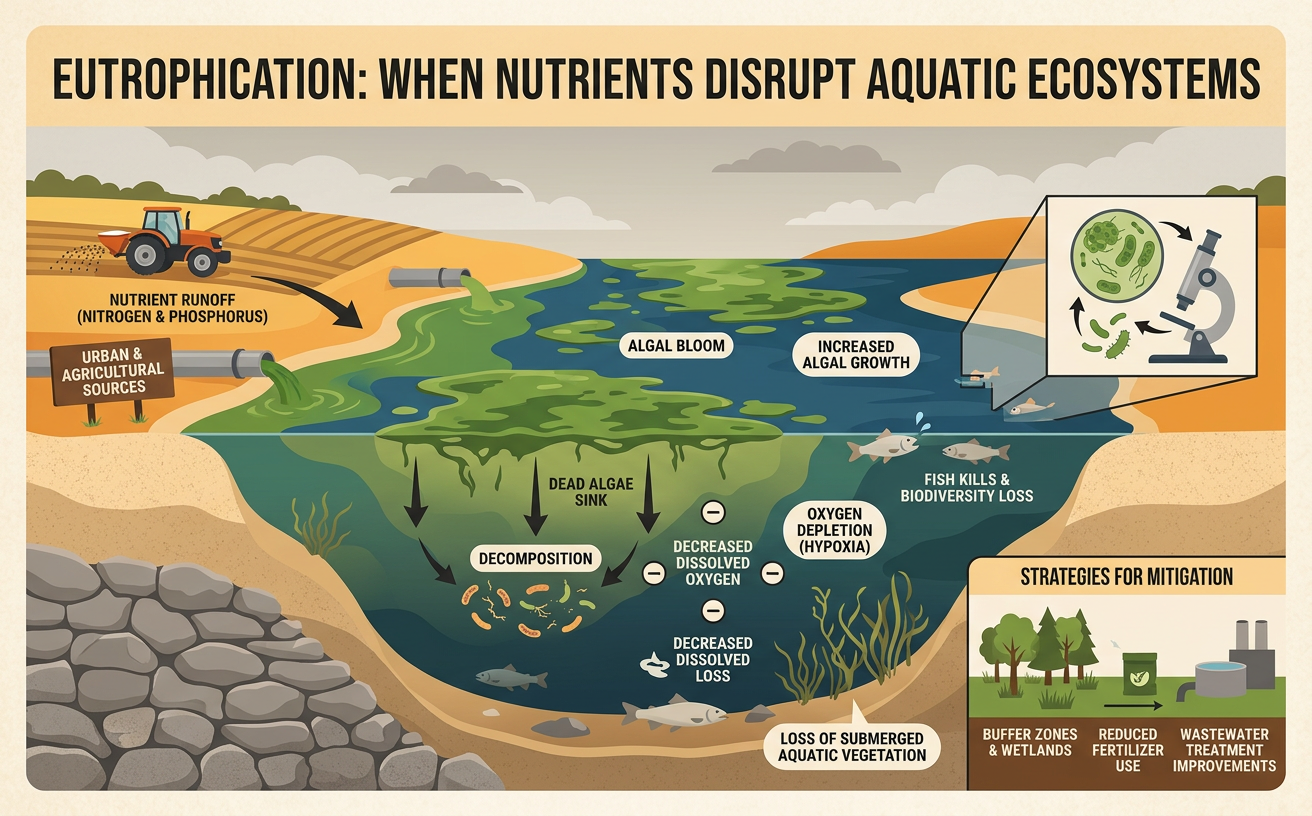
Nitrogen and phosphorus are essential nutrients that help algae, aquatic plants, and other organisms grow. In many lakes, one nutrient is naturally scarce and limits growth. When human activities add unusually large amounts of that nutrient, primary producers can grow too quickly and disrupt the ecosystem. Common sources include fertilizer, animal manure, leaking septic systems, wastewater, and soil erosion. Nutrient enrichment that causes excessive plant or algal growth is called eutrophication. Some eutrophication occurs naturally over centuries as sediments and nutrients accumulate, but human-caused eutrophication can happen within years or decades. For example, repeated phosphorus runoff from fertilized lawns around a lake may change clear water into cloudy, algae-rich water. The added phosphorus is not directly poisonous, but it can trigger changes that reduce habitat quality, oxygen availability, and biodiversity.
From Runoff to Algal Blooms
Runoff forms when rain or melting snow moves across land instead of soaking into the ground. As it flows, water can collect dissolved fertilizer, manure, and nutrient-rich soil before entering streams and lakes. In warm, sunny water, added nutrients may allow algae or cyanobacteria to reproduce rapidly, forming an algal bloom. Blooms can make water green or brown, block sunlight, and reduce the growth of submerged plants. Some cyanobacteria also produce toxins, although not every bloom is toxic. Consider a cornfield fertilized shortly before a heavy storm. Water carries phosphorus-rich soil into a nearby creek, which delivers it to a shallow reservoir. Several days later, satellite images and water samples show a large surface bloom near the creek’s outlet. This sequence connects a land-based human activity to a visible change in the aquatic ecosystem.
Decomposition and Oxygen Depletion
Algae produce oxygen during photosynthesis, but they and other organisms also use oxygen during cellular respiration. When a large bloom dies, bacteria and other decomposers break down the dead biomass. Their respiration can consume dissolved oxygen faster than photosynthesis and mixing replace it. Oxygen depletion is especially severe in warm, stratified lakes because the warmer surface water does not mix readily with cooler bottom water. Fish and mobile invertebrates may leave low-oxygen areas, while organisms that cannot escape may die. Water below about 2 milligrams of oxygen per liter is commonly described as hypoxic, although species differ in tolerance. For example, after a summer bloom sinks in a stratified lake, bottom-water oxygen may fall from 7 to 1.5 milligrams per liter. Decomposers continue using oxygen near the sediment, creating habitat unsuitable for many fish and bottom-dwelling animals.
Interpreting Lake Data
Scientists combine graphs, maps, photographs, and field measurements to identify eutrophication patterns. Suppose monthly data from a lake show phosphorus increasing from 0.02 milligrams per liter in April to 0.12 in July. Over the same period, chlorophyll a, an indicator of algal abundance, rises from 5 to 45 micrograms per liter. By August, bottom-water dissolved oxygen declines from 8.5 to 2.5 milligrams per liter, and observers report fewer fish in deep water. The timing supports a model in which nutrient enrichment promotes algal growth and later decomposition lowers oxygen. A watershed map showing the highest phosphorus concentrations near an agricultural inlet adds spatial evidence. However, correlation alone does not prove cause. Students should compare multiple years, check temperature and rainfall records, examine upstream reference sites, and consider other oxygen-reducing factors before drawing a conclusion.
Evaluating Runoff Solutions
An effective solution reduces nutrient inputs while remaining practical, affordable, and enforceable. Farmers can plant streamside buffer vegetation, grow winter cover crops, test soil before applying fertilizer, and avoid spreading manure before heavy rain. Communities can upgrade wastewater treatment, inspect septic systems, restore wetlands, and limit phosphorus in lawn fertilizer. Each strategy has tradeoffs. A buffer strip traps sediment and nutrients but removes some land from production; a treatment plant may remove more phosphorus but requires major public investment. For example, a county could combine cost-sharing for 10-meter stream buffers with stricter wastewater discharge limits. Students could evaluate the plan by comparing cost, expected phosphorus reduction, habitat benefits, and effects on farmers and taxpayers. Monitoring inlet phosphorus, bloom area, and dissolved oxygen would test performance. If targets are missed, officials could widen buffers or adjust fertilizer rules. Political priorities, funding decisions, and local industries influence which solutions are adopted and how environmental benefits and costs are distributed.