Evaluating an Author’s Argument and Evidence
Students identify an author’s central claim, distinguish relevant evidence from unsupported reasoning, and evaluate whether the argument is sound and convincing.

Illustrations are auto-generated and may be placeholders. They can be refreshed to match the narration.
Define Claims, Reasons, and Evidence
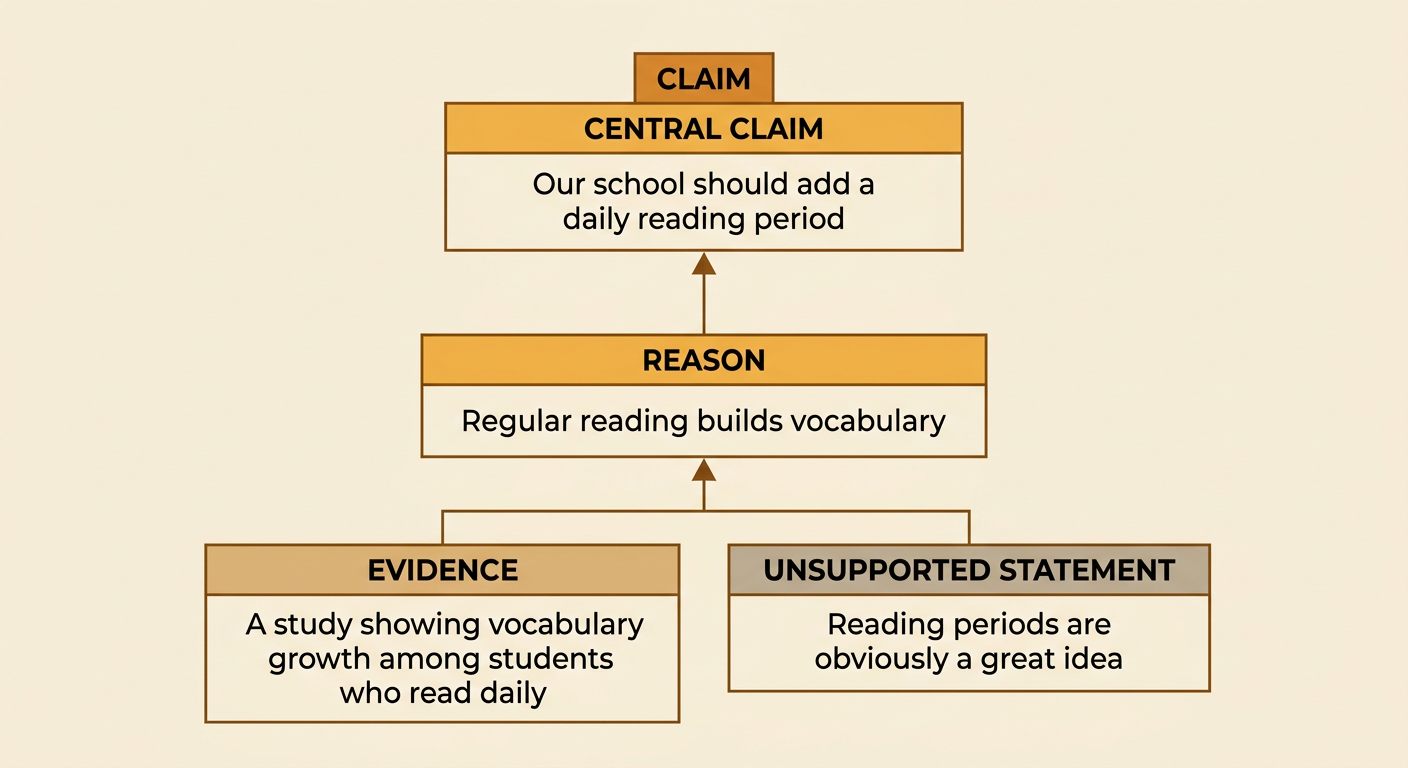
An argument begins with a claim, a statement the author wants readers to accept. The central claim is the author’s main position, while specific claims support or develop that position. A reason explains why a claim should be accepted. Evidence provides facts, examples, statistics, observations, or expert statements that support a reason. For example, an author might claim, “Our school should add a daily reading period.” One reason is that regular reading helps students build vocabulary. A study showing vocabulary growth among students who read daily would be evidence. The statement “Reading periods are obviously a great idea” is not evidence because it provides no verifiable support. When reading an argument, ask what the author believes, why the author believes it, and what information proves it.
Map the Author’s Argument
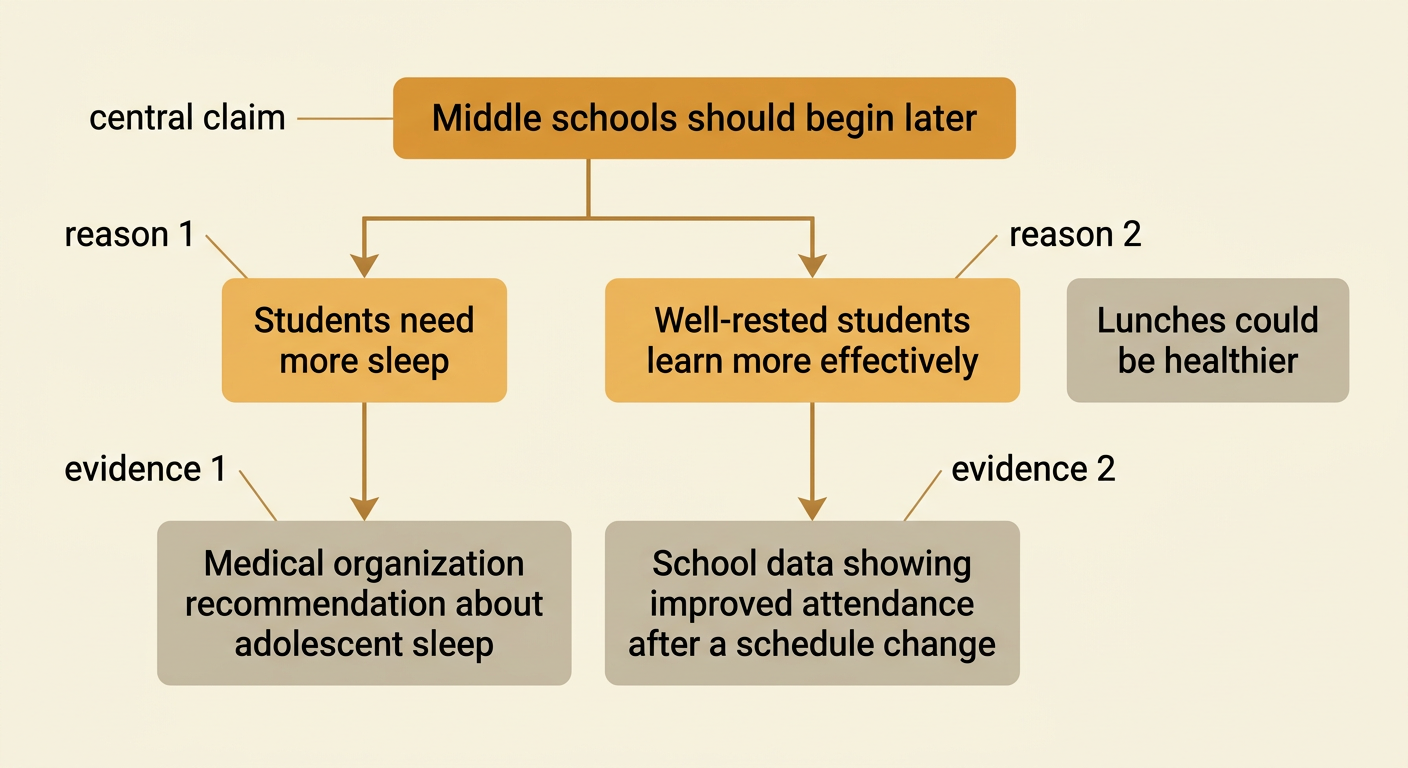
Mapping an argument helps you see how its parts connect. First, write the central claim in a box. Next, identify each reason or specific claim and place it below the central claim. Then connect each piece of evidence to the reason it supports. Suppose an author argues that middle schools should begin later. The author gives two reasons: students need more sleep, and well-rested students learn more effectively. A medical organization’s recommendation about adolescent sleep supports the first reason. School data showing improved attendance after a schedule change may support the second. If a statement does not connect to any claim, mark it as possibly irrelevant. A clear map also reveals gaps, such as a reason with no evidence or evidence that does not actually support the central claim.
Check the Reasoning
Reasoning is the logical connection between evidence, reasons, and claims. Sound reasoning explains how the evidence supports the conclusion without making an unsupported leap. Ask whether the author’s conclusion follows from the information presented and whether another explanation is possible. For example, an author states, “Our basketball team won after the school installed new water fountains, so the fountains caused the victory.” The timing is real, but the reasoning is weak because events that happen together do not necessarily have a cause-and-effect relationship. Better coaching, practice, or player performance could explain the win. Also watch for overgeneralizations, such as using one student’s experience to make a claim about every student. Strong reasoning considers limits, avoids unfair assumptions, and clearly explains why the evidence supports the claim.

Evaluate Evidence for Relevance and Sufficiency
Relevant evidence directly supports the claim or reason being discussed. Sufficient evidence provides enough strong support to make the claim convincing. Evidence can be relevant but insufficient. For example, one student’s report that a later school start improved concentration relates to the claim that later starts benefit learning, but one experience is not enough to represent all students. A larger study from several schools, supported by attendance records and academic data, would be more sufficient. Evidence about the color of school buses would be irrelevant because it does not address start times or learning. Consider quality as well as quantity. Ask whether sources are credible, current, and based on accurate methods. Several weak opinions do not equal strong evidence, while multiple reliable sources that agree can make an argument more convincing.

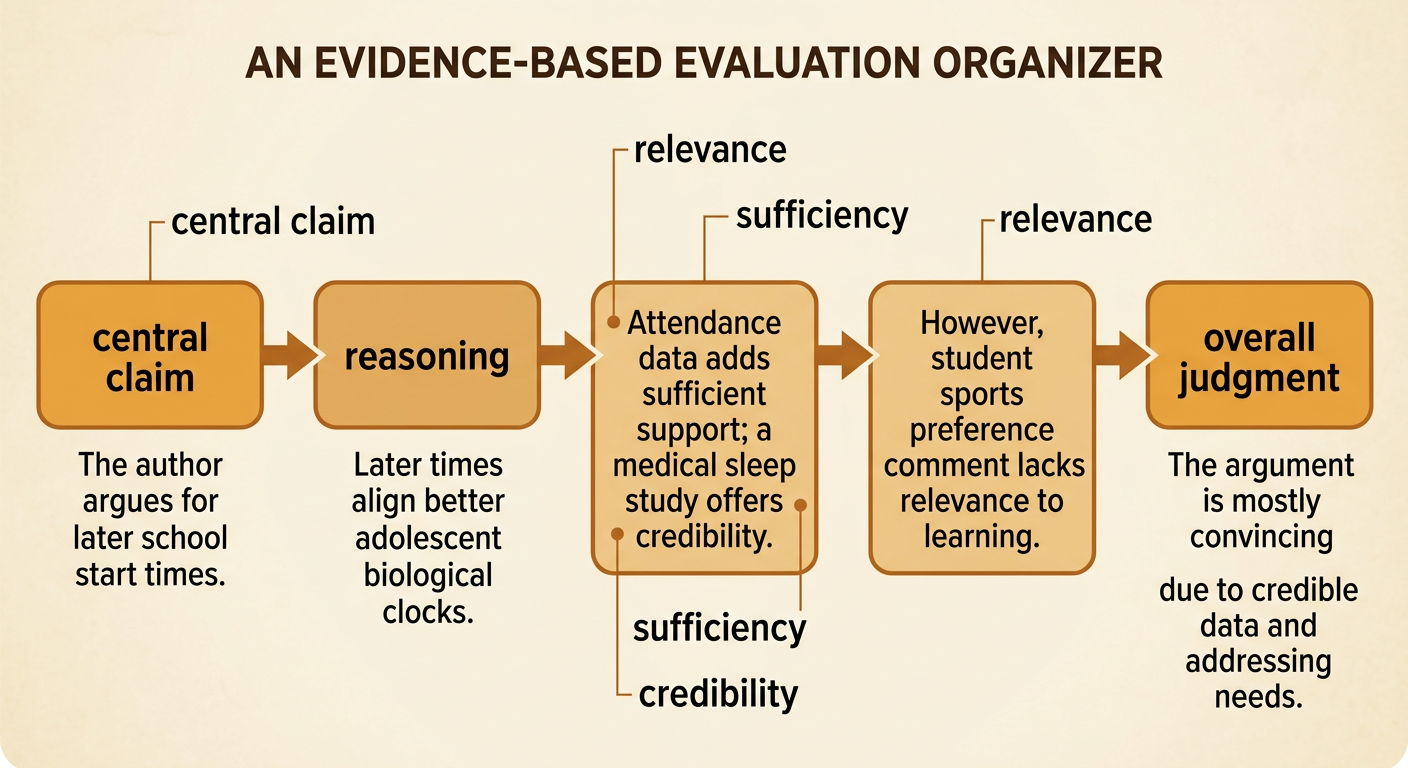
Write an Evidence-Based Evaluation
An evidence-based evaluation states whether an argument is convincing and explains why. Begin by identifying the central claim. Then judge the reasoning and discuss the relevance, sufficiency, and credibility of the evidence. Support your evaluation with specific quotations or accurate paraphrases from the text. For example: “The author’s claim that middle schools should start later is mostly convincing. The recommendation from a medical organization is relevant and credible because it addresses adolescent sleep needs. Attendance data from several schools also provides sufficient support. However, the author’s comment about students preferring afternoon sports is not relevant to the effect of start times on learning.” This evaluation does more than agree or disagree. It uses clear criteria and details from the argument. End with an overall judgment, such as convincing, partly convincing, or unconvincing.