Evaluating Arguments and Evidence
Students trace an author’s argument and determine whether each claim is supported by sound reasoning and relevant, sufficient evidence.
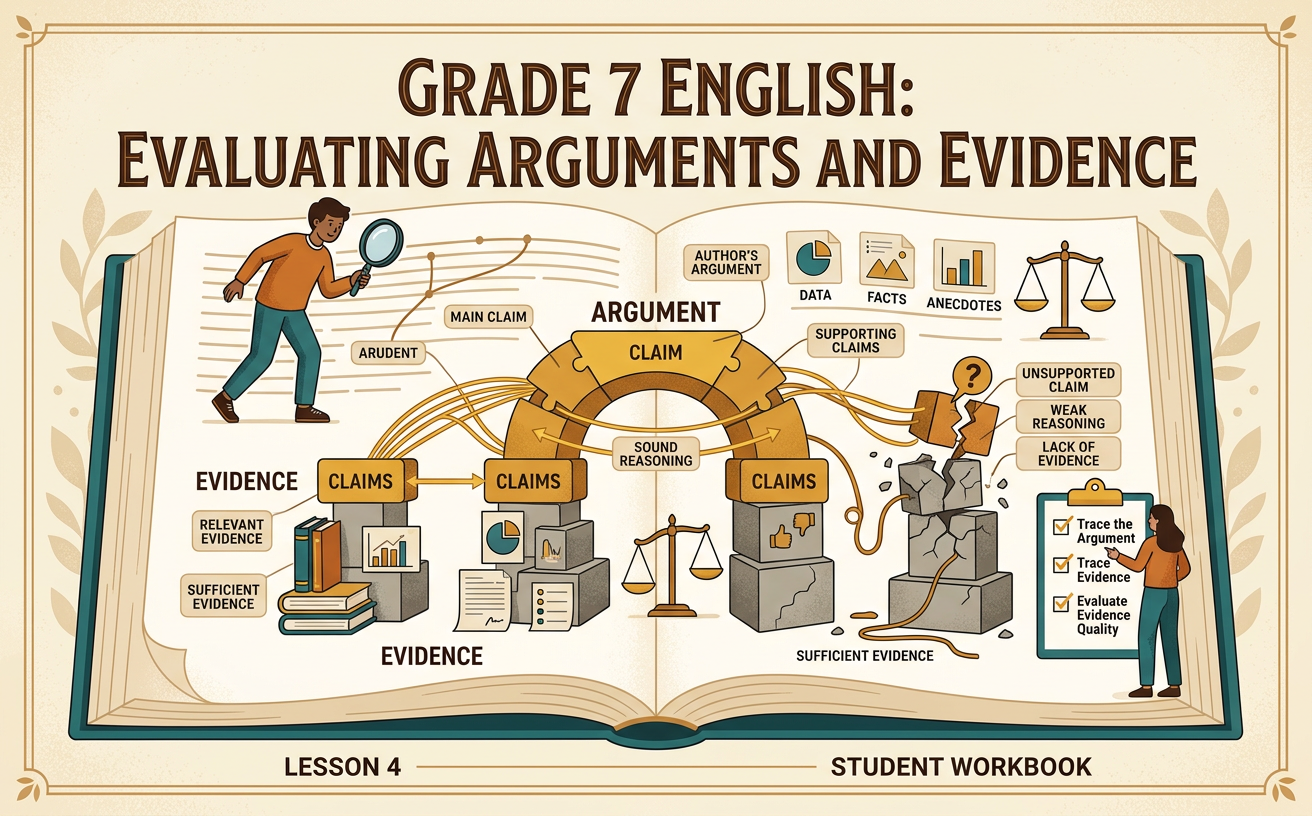
Illustrations are auto-generated and may be placeholders. They can be refreshed to match the narration.
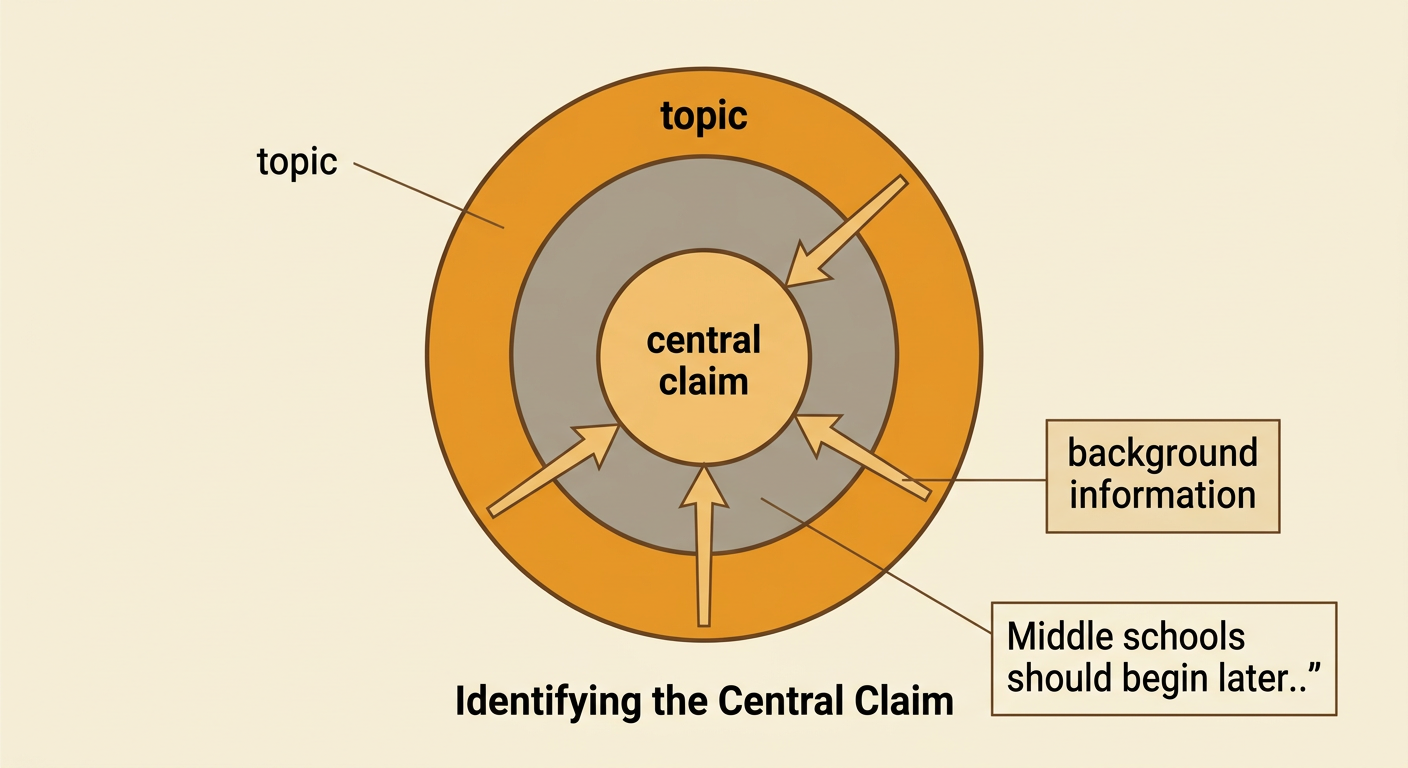
Identify the Central Claim
The central claim is the author’s main position about a topic. It is the idea the author wants readers to accept. To find it, ask: What is the author trying to prove? Look in the title, introduction, and conclusion, but remember that the claim may not appear in one exact sentence. Separate the central claim from the topic. “School schedules” is a topic, while “Middle schools should begin later in the morning” is a claim because someone could agree or disagree with it. Also separate the claim from background information. For example, an author might explain that many students feel tired before stating that later start times would improve learning. As you read, restate the central claim in your own words without changing its meaning. Then check that most of the text develops or supports that claim.
Trace Supporting Claims
Supporting claims are smaller points that help prove the central claim. Trace them by noting each claim in the order the author presents it and connecting it to the main argument. Ask how each point supports the central claim. For example, an author arguing that middle schools should begin later might make three supporting claims: students would be more alert, attendance could improve, and morning travel could be safer. Beside each supporting claim, record the evidence the author provides, such as research findings, attendance records, expert statements, or examples. Do not confuse evidence with a claim. “Students learn better when alert” is a supporting claim; a study comparing test performance at different start times could be evidence. An argument map or outline helps reveal missing links, repeated ideas, and claims that do not actually support the author’s main position.

Examine the Author’s Reasoning
Reasoning is the logical connection between a claim and its evidence. Sound reasoning clearly explains why the evidence supports the claim and avoids errors in logic. For example, suppose an author writes, “A later start improved attendance at one school, so every school in the country will have perfect attendance if it starts later.” The evidence may be real, but the reasoning is unsound because one school cannot represent every school, and improved attendance does not mean perfect attendance. Watch for overgeneralizations, false choices, unrelated conclusions, and claims that one event caused another without enough proof. Test the reasoning by asking: If the evidence is true, does the claim reasonably follow? What assumptions does the author make? A strong author explains the link and considers other possible causes, such as transportation changes or a new attendance policy.

Evaluate Relevance and Sufficiency
Relevant evidence directly relates to the claim. Sufficient evidence provides enough dependable support to justify accepting the claim. These qualities are different: evidence can be relevant but still insufficient. For the claim that later start times improve attendance, attendance records from several comparable middle schools before and after a schedule change would be relevant. A single student’s comment about enjoying extra sleep is related to later starts, but it is not enough to prove an attendance improvement. Check the source, amount, variety, and representativeness of the evidence. Strong support may combine reliable statistics, expert research, and examples from multiple schools. Evidence about cafeteria menus would be irrelevant unless the author clearly connects menus to attendance. Ask what information is missing and whether another explanation fits the facts. An argument needs enough high-quality evidence, not simply many facts or quotations.

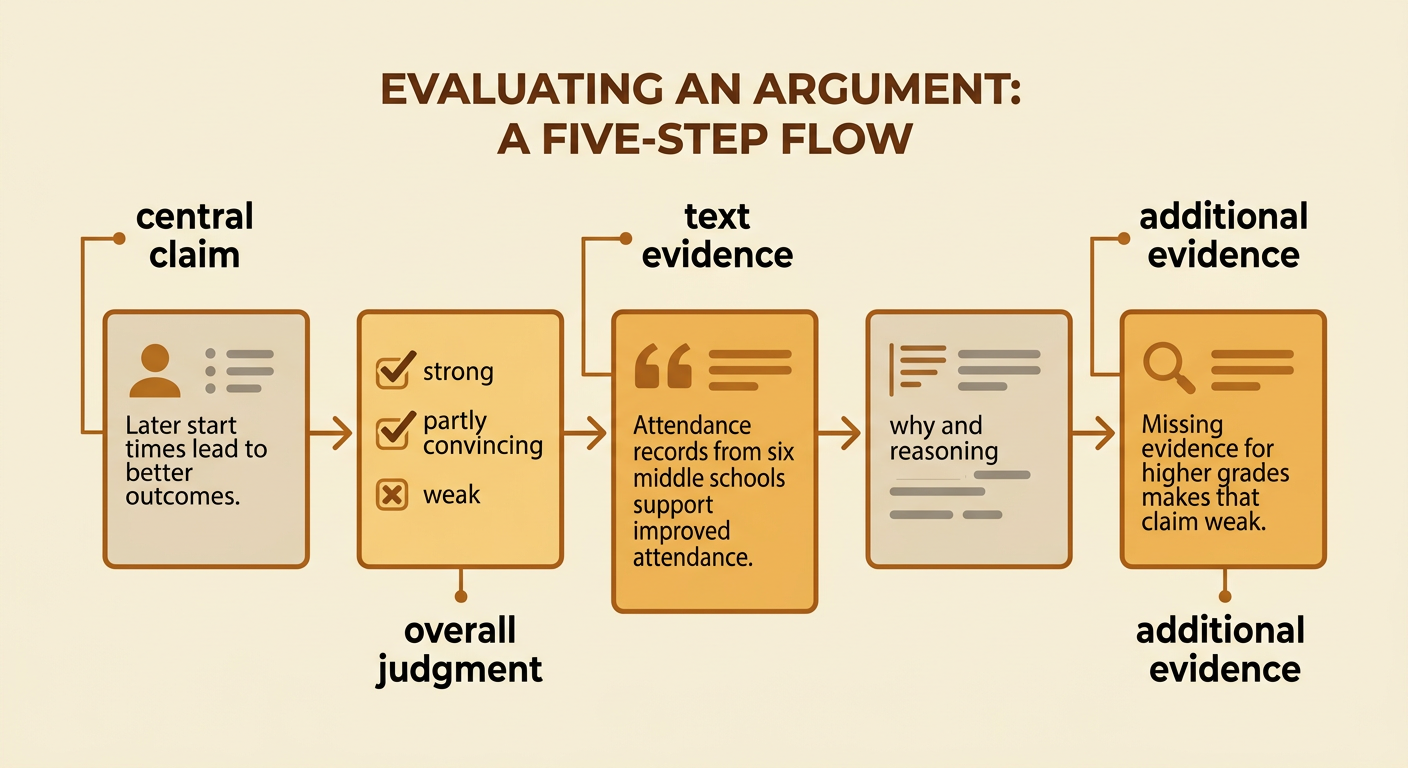
Write an Evidence-Based Evaluation
An evidence-based evaluation explains how well an author supports an argument. Begin by identifying the central claim and giving an overall judgment, such as strong, partly convincing, or weak. Then discuss specific claims, reasoning, and evidence from the text. Quote or paraphrase accurately and explain why each example matters. For instance: “The argument for later start times is partly convincing. Attendance records from six middle schools are relevant and sufficient to support the claim that attendance may improve. However, the author’s claim that all students will earn higher grades is weak because it relies on one student’s experience and does not consider other causes of grades.” This response does more than summarize; it applies clear criteria. End by stating what additional evidence would strengthen the argument, such as grade data from several schools or research that controls for other factors. Keep your tone fair and objective.