Evaluating Arguments and Evidence
Students identify an author's central claim, distinguish relevant evidence from unsupported reasoning, and evaluate whether the argument is sound and convincing.
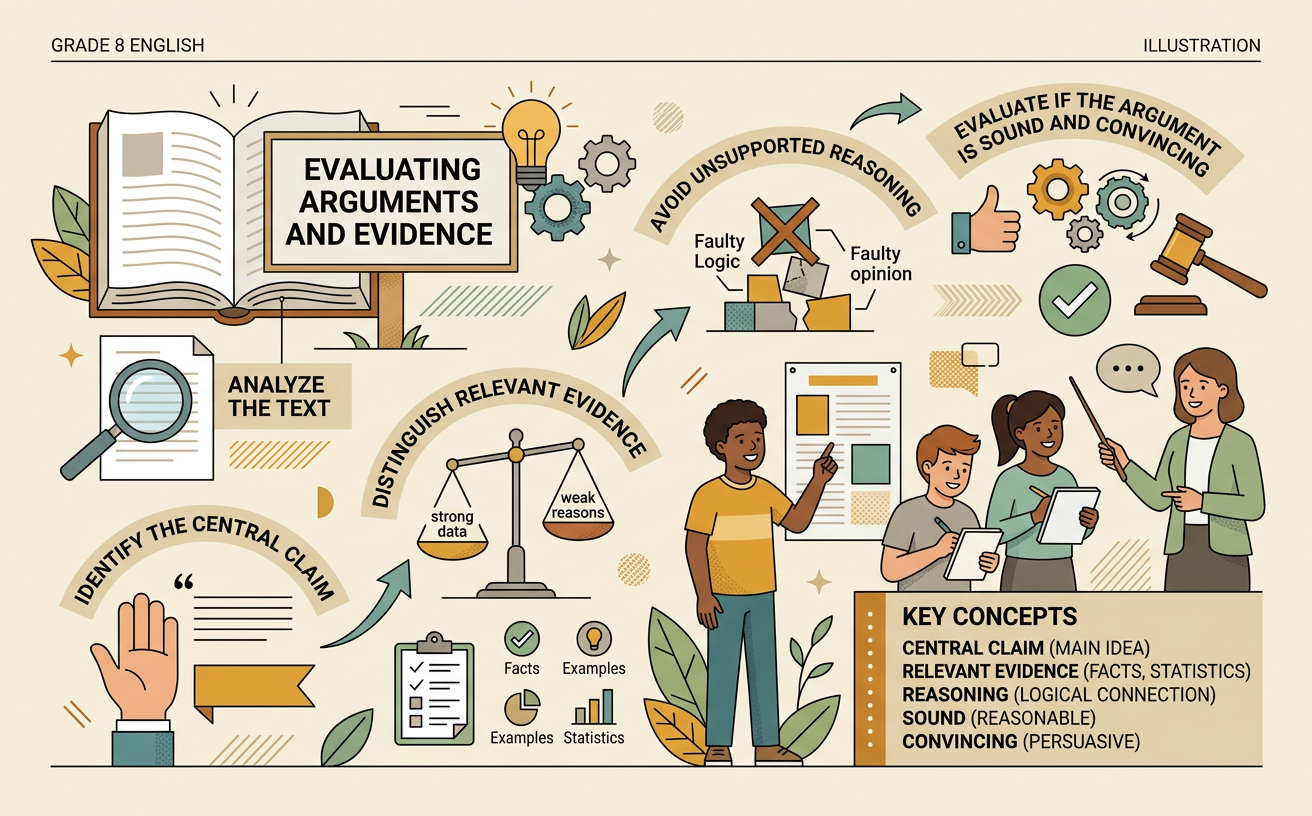
Illustrations are auto-generated and may be placeholders. They can be refreshed to match the narration.
Identify the Central Claim
A central claim is the main position an author wants readers to accept. It is more specific than the topic and usually can be debated. To identify it, ask: What does the author believe, and what action or conclusion does the author support? Look in the introduction and conclusion, but also consider the entire text. An author may state the claim directly or imply it through repeated ideas. For example, a text may discuss sleep, bus schedules, and attendance. Its central claim could be, “Middle schools should begin later in the morning.” “School schedules” is only the topic, while the sentence about starting later is a debatable position. Check your choice by asking whether most of the author’s reasons and evidence are intended to support it.

Trace Supporting Claims
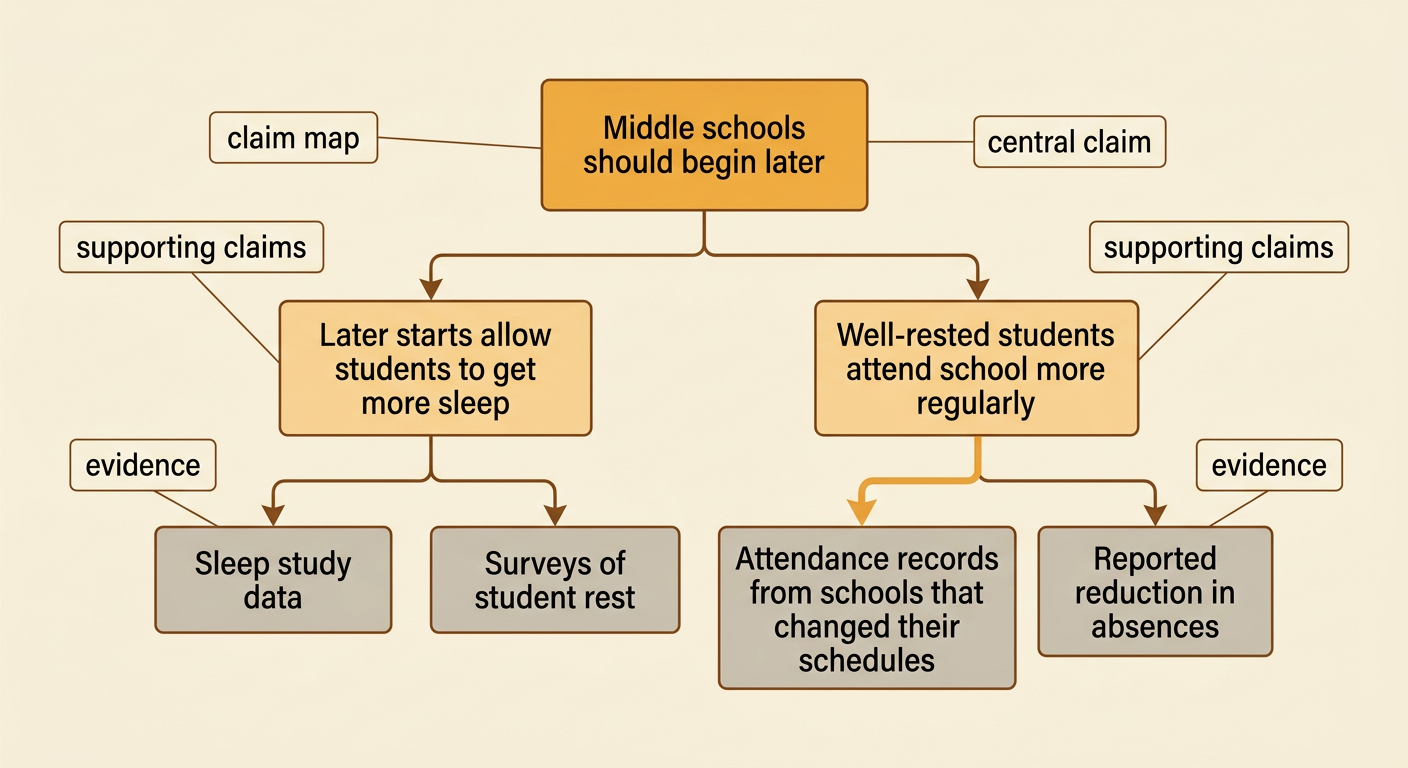
Supporting claims are smaller points that help prove the central claim. Trace them by showing how each one connects to the author’s main position. A supporting claim should answer the question, “Why should I accept the central claim?” For the central claim “Middle schools should begin later,” one supporting claim might be that later start times allow students to get more sleep. Another might be that well-rested students attend school more regularly. Authors may also include evidence beneath each supporting claim. For example, attendance records from schools that changed their schedules could support the attendance claim. Create a claim map as you read: place the central claim at the top, supporting claims below it, and evidence under the claim it directly supports. If a point does not connect to the central claim, it may be irrelevant.
Classify Evidence
Evidence is information used to support a claim. Common types include facts, statistics, examples, expert testimony, observations, and research findings. Classifying evidence helps you judge its strength. A statistic from a well-designed study is different from one person’s opinion. For example, the statement “A district reported a 7 percent decrease in tardiness after moving its start time” is statistical evidence. A quotation from a sleep researcher is expert testimony if the researcher has relevant qualifications. The statement “Later starts are obviously better because everyone knows mornings are terrible” is not evidence; it is an unsupported assertion. Personal stories can illustrate an idea, but one student’s experience may not represent all students. As you read, label each piece of support and check whether its source is trustworthy, current, and clearly identified.

Evaluate Reasoning
Reasoning is the logical bridge that explains how evidence supports a claim. Sound reasoning makes that connection clear and avoids faulty assumptions. Ask whether the evidence actually leads to the author’s conclusion and whether another reasonable explanation is possible. Suppose an author argues, “One student’s grades improved after the school began later, so later start times improve every student’s grades.” The reasoning is weak because one example is not enough to support a claim about all students. This is an overgeneralization. A stronger argument would compare grades from many students, consider other changes, and explain how additional sleep may improve attention and learning. Also watch for reasoning that attacks a person instead of addressing the claim or assumes that one event caused another simply because it happened first. Strong reasoning is logical, complete, and fair.

Judge Relevance and Sufficiency
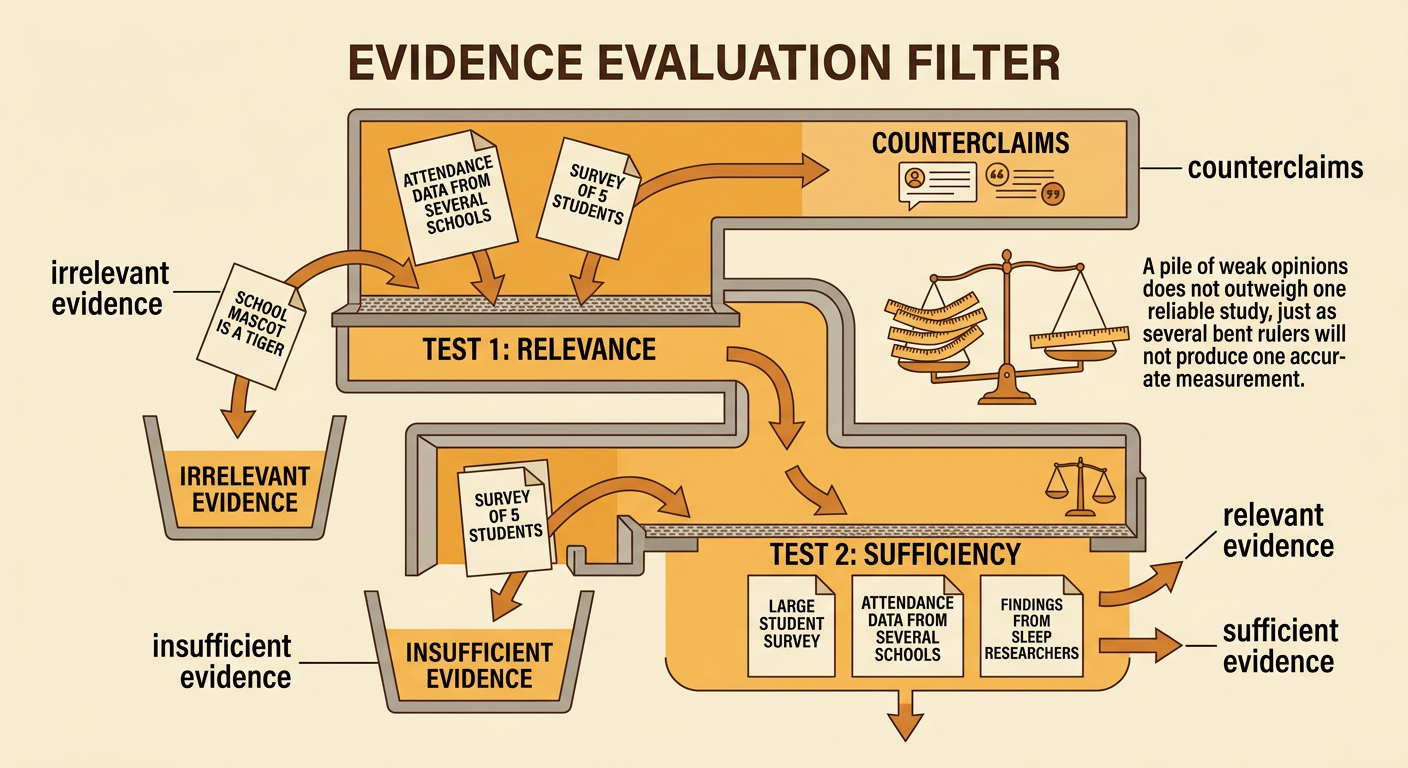
Relevant evidence directly supports the claim being discussed. Sufficient evidence provides enough strong support to make the claim convincing. Evidence can be true but still irrelevant. For example, the fact that a school’s mascot is a tiger does not help prove that the school should begin later. A survey of five students about start times may be relevant, but it is probably insufficient because the group is too small. A stronger case might include a large student survey, attendance data from several schools, and findings from sleep researchers. Consider quality as well as quantity: several weak opinions do not equal one reliable study. Ask whether the author presents enough varied, credible evidence and addresses important counterclaims. An argument is more convincing when its evidence is directly connected, dependable, representative, and adequate for the size of the claim.
Write an Evidence-Based Evaluation
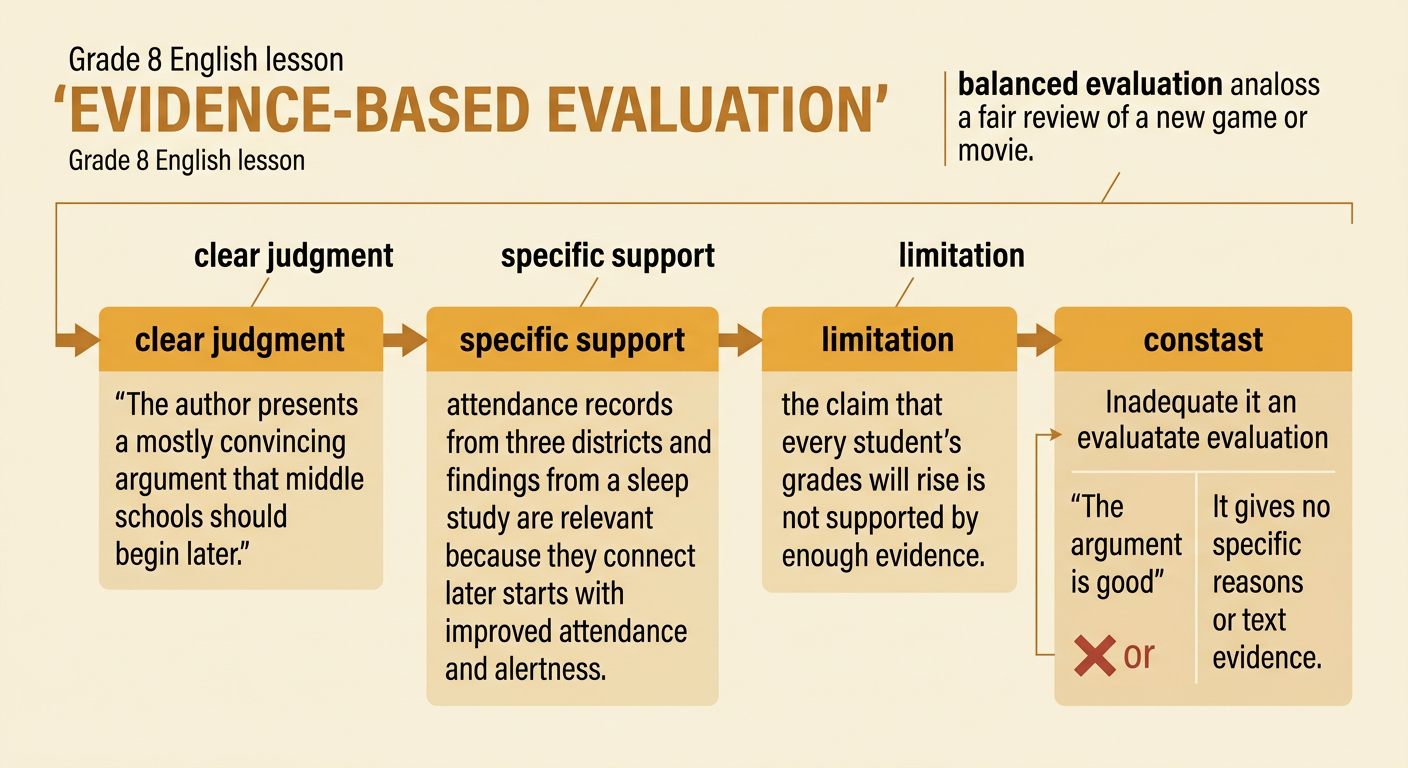
An evidence-based evaluation states how effective an argument is and supports that judgment with details from the text. Begin by naming the central claim. Then judge the reasoning and explain whether the evidence is relevant and sufficient. Use specific examples rather than simply saying the argument is “good” or “bad.” For example: “The author presents a mostly convincing argument that middle schools should begin later. Attendance records from three districts and findings from a sleep study are relevant because they connect later starts with improved attendance and alertness. However, the author’s claim that every student’s grades will rise is not sufficiently supported.” This evaluation gives a clear judgment, cites evidence, and identifies a limitation. End by explaining the overall effect of the strengths and weaknesses. A balanced evaluation may recognize strong support while noting unsupported claims, irrelevant details, or gaps in reasoning.