Evaluating Claims and Evidence
Students trace an author’s argument, identify specific claims, and evaluate whether each claim is supported by relevant reasons and evidence.

Illustrations are auto-generated and may be placeholders. They can be refreshed to match the narration.
What Makes a Claim?
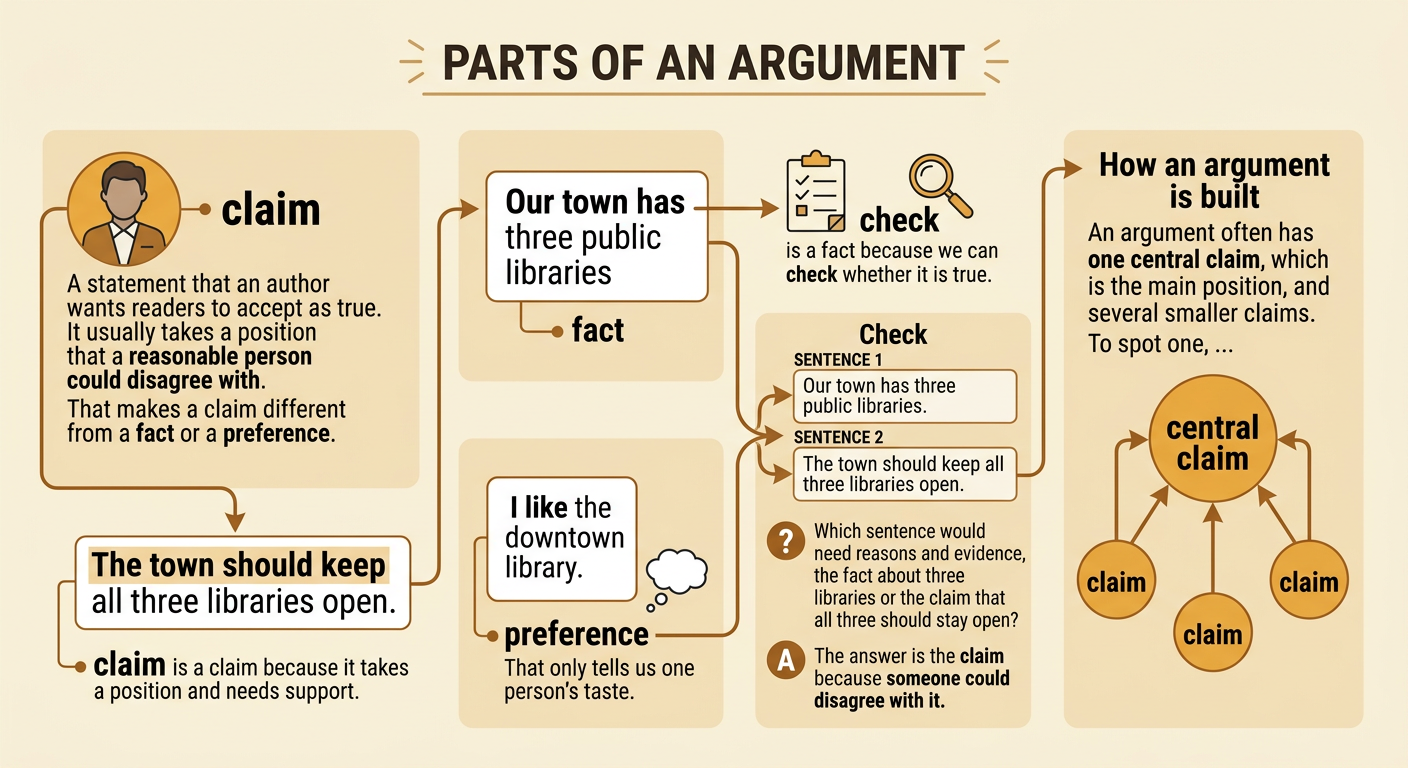
A claim is a statement that an author wants readers to accept as true. In an argument, a claim is usually debatable, which means a reasonable person could disagree with it. A claim is different from a simple fact or a personal preference. “Our town has three public libraries” is a fact that can be checked. “I like the downtown library” is a preference. “The town should keep all three libraries open” is a claim because it takes a position that needs support. An author may present one central claim and several smaller claims. To identify a claim, ask, “What does the author want me to believe or do?” Then look for reasons and evidence that the author uses to support that position.
Trace the Author’s Argument
To trace an argument, follow how the author connects ideas from beginning to end. First, identify the central claim. Next, find each reason the author gives for that claim. Then locate the facts, examples, quotations, or statistics used as evidence. Notice connecting words such as because, therefore, for example, and as a result. Suppose an author claims, “Our school should create a vegetable garden.” The author explains that a garden would provide science learning and fresh food. The author then reports that 80 students requested more outdoor science activities and describes a nearby school that grows vegetables for its cafeteria. Tracing these parts shows the argument’s structure. It also reveals gaps, such as a reason that has no evidence or evidence that does not connect to the central claim.

Match Reasons and Evidence to Claims
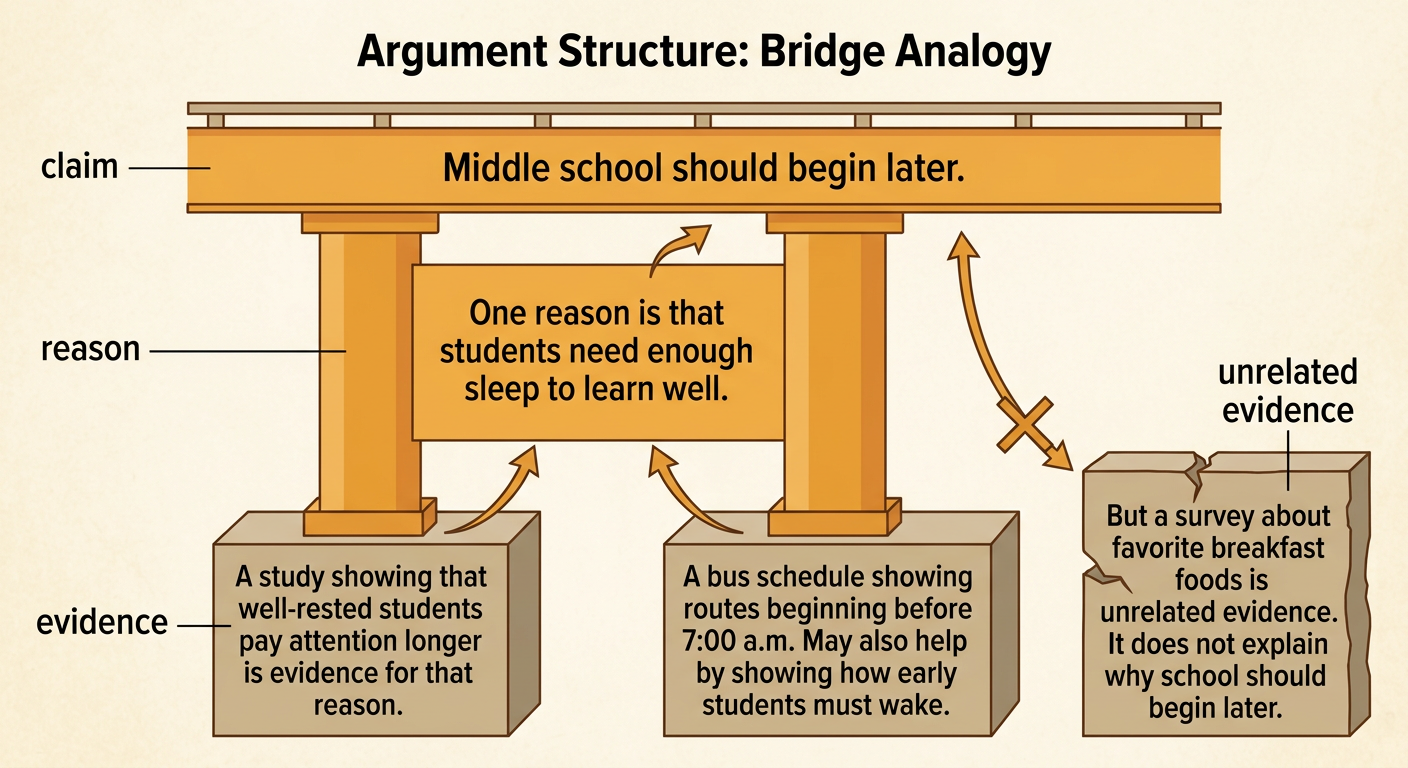
A reason explains why a claim should be accepted. Evidence is specific information that helps prove the reason. Strong readers match every reason and piece of evidence to the exact claim it supports. Consider the claim, “Middle school should begin later in the morning.” One reason is that students need enough sleep to learn well. A study showing that well-rested students pay attention longer is evidence for that reason. A bus schedule showing that some routes begin before 7:00 a.m. may also support the argument by showing how early students must wake. However, a survey about students’ favorite breakfast foods does not support the claim. When matching ideas, ask, “Does this reason explain the claim?” and “Does this evidence directly support the reason?” If the answer is no, the information may not belong in the argument.
Evaluate Relevance and Sufficiency
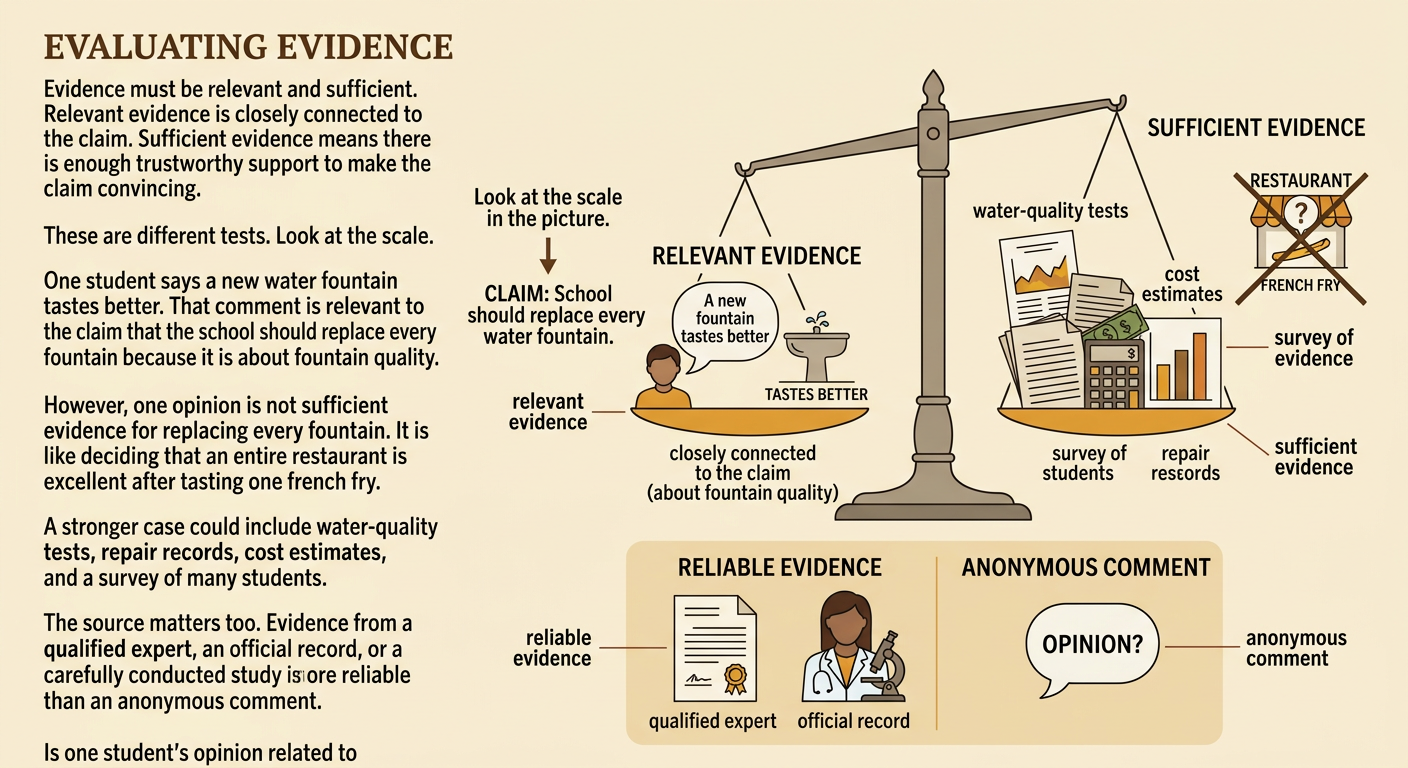
Relevant evidence is closely connected to the claim and helps support it. Sufficient evidence provides enough trustworthy support to make the claim convincing. Evidence can be relevant but not sufficient. For example, one student’s statement that a new water fountain tastes better is related to the claim that the school should replace every fountain, but one opinion is not enough support. A stronger argument might include water-quality test results, repair records, cost estimates, and a survey of many students. Readers should also consider the source. Evidence from a qualified expert, official record, or carefully conducted study is usually stronger than an anonymous comment. Ask two questions: “Does this evidence actually address the claim?” and “Is there enough reliable evidence?” A claim may be only partly supported if its evidence is relevant but too limited, outdated, or weak.
Explain Which Claims Are Supported
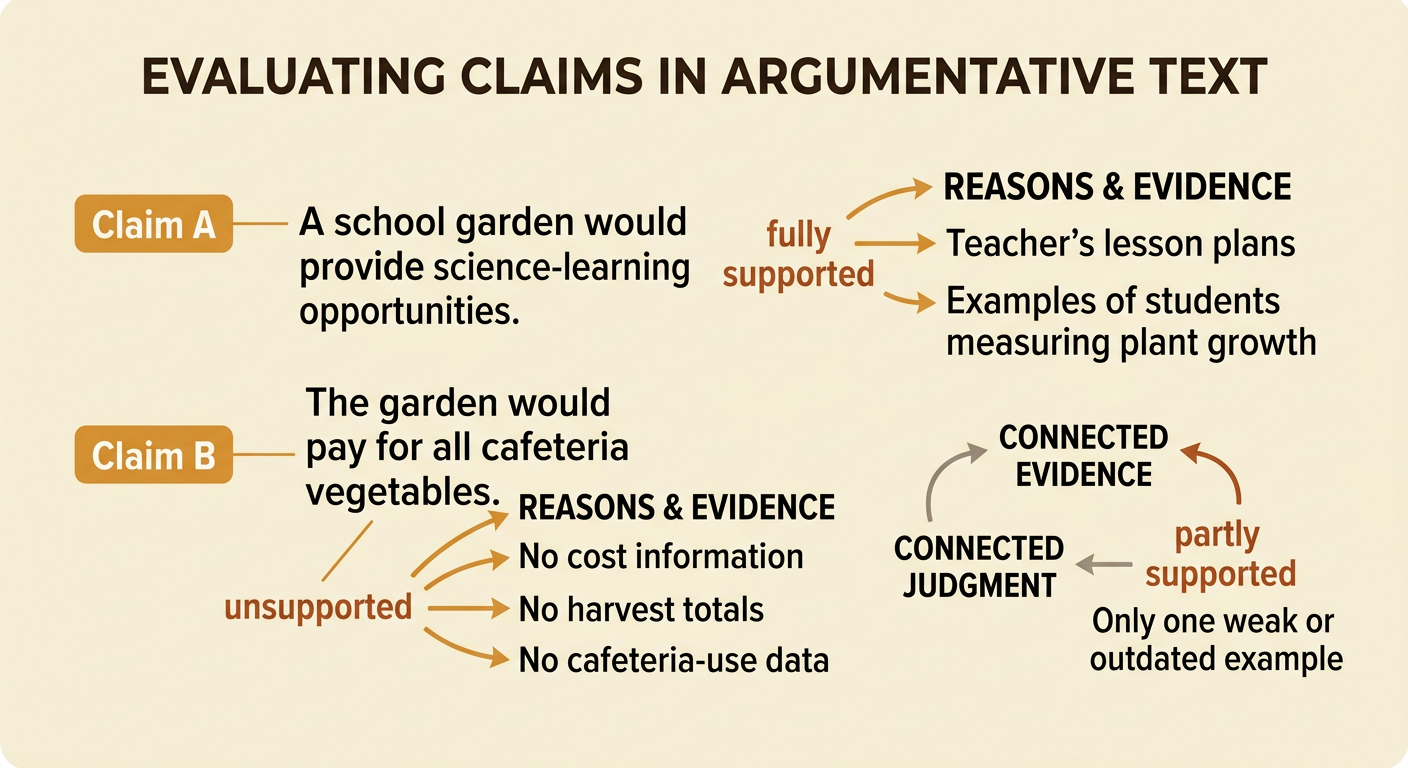
After tracing an argument, decide whether each claim is fully supported, partly supported, or unsupported. State the claim, identify its reasons and evidence, and explain how well they connect. For example, an author makes two claims about a school garden. Claim A says the garden would provide science-learning opportunities. The author includes a teacher’s lesson plans and examples of students measuring plant growth, so Claim A is well supported. Claim B says the garden would pay for all cafeteria vegetables. The author gives no cost, harvest, or cafeteria-use data, so Claim B is unsupported. A clear evaluation might say, “Claim A is supported because the lesson plans and activities directly show how the garden would be used for science. Claim B is not supported because the author provides no financial or production evidence.” Always explain your judgment instead of merely labeling a claim.