Evaluating Claims, Reasons, and Evidence
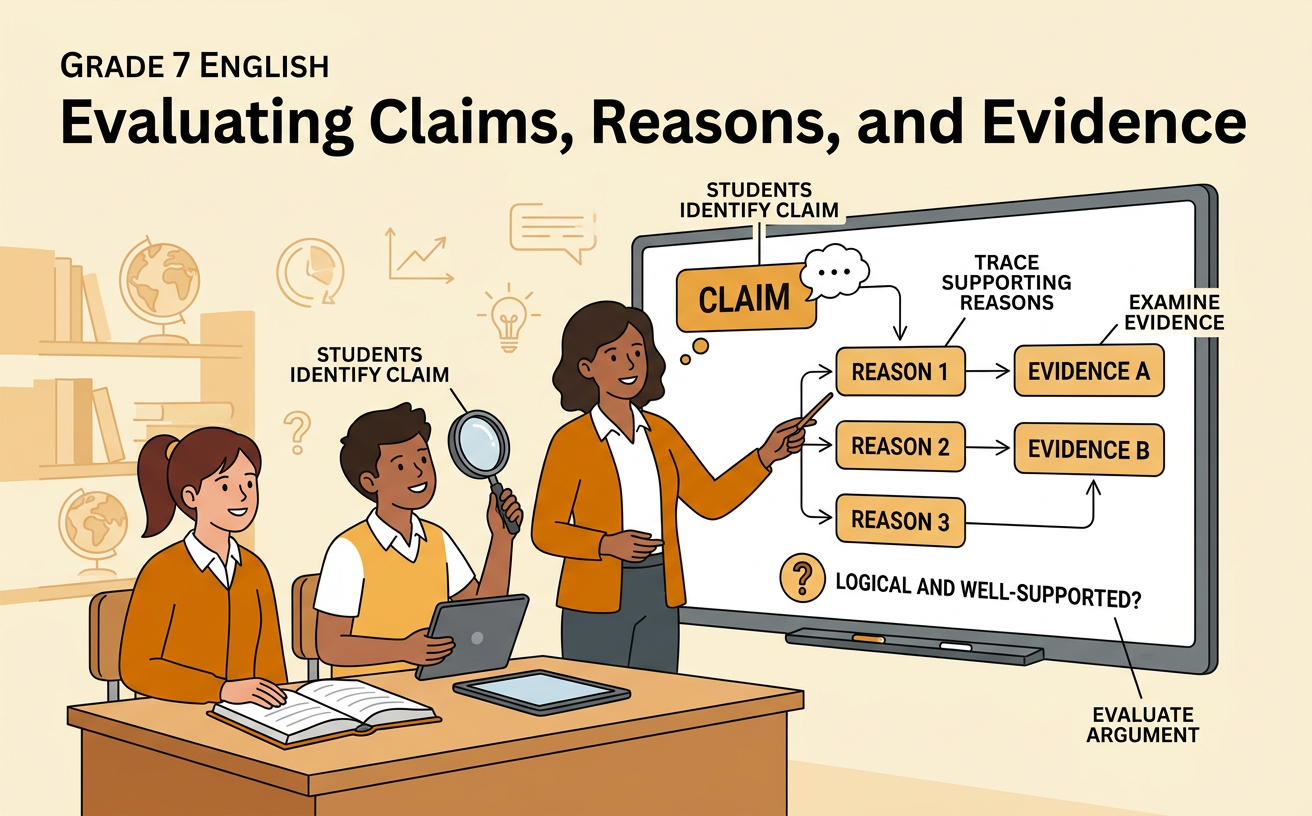
Students identify an author's claim, trace the supporting reasons and evidence, and evaluate whether the argument is logical and well supported.
Illustrations are auto-generated and may be placeholders. They can be refreshed to match the narration.
Identify the Central Claim
A central claim is the main point an author wants readers to accept. It is more than a topic because it takes a position that can be supported or challenged. To find it, ask, “What does the author want me to believe or do?” Look in the introduction and conclusion, but remember that a claim may be implied rather than directly stated. For example, an article about school schedules might state, “Middle schools should begin classes later in the morning.” That sentence is the central claim because the rest of the argument is meant to prove it. Details about bus times, sleep, or attendance are not central claims by themselves. As you read, restate the claim in your own words and check that it covers the author’s overall position without making it broader or narrower.

Trace the Author’s Reasons
Reasons explain why the author believes the central claim is true or worth accepting. To trace an argument, list each reason and connect it to the claim it supports. Signal words such as because, since, therefore, and one reason can help you locate the connections. Suppose the claim is, “Middle schools should begin classes later.” The author might give two reasons: students need more sleep, and well-rested students are more prepared to learn. Ask whether each statement truly explains why the claim should be accepted. A statement such as “Many students ride buses” is related to school schedules, but it does not automatically support a later start time. Tracing the reasons helps you see the argument’s structure and notice missing links, repeated ideas, or reasons that do not logically connect to the claim.

Examine Supporting Evidence
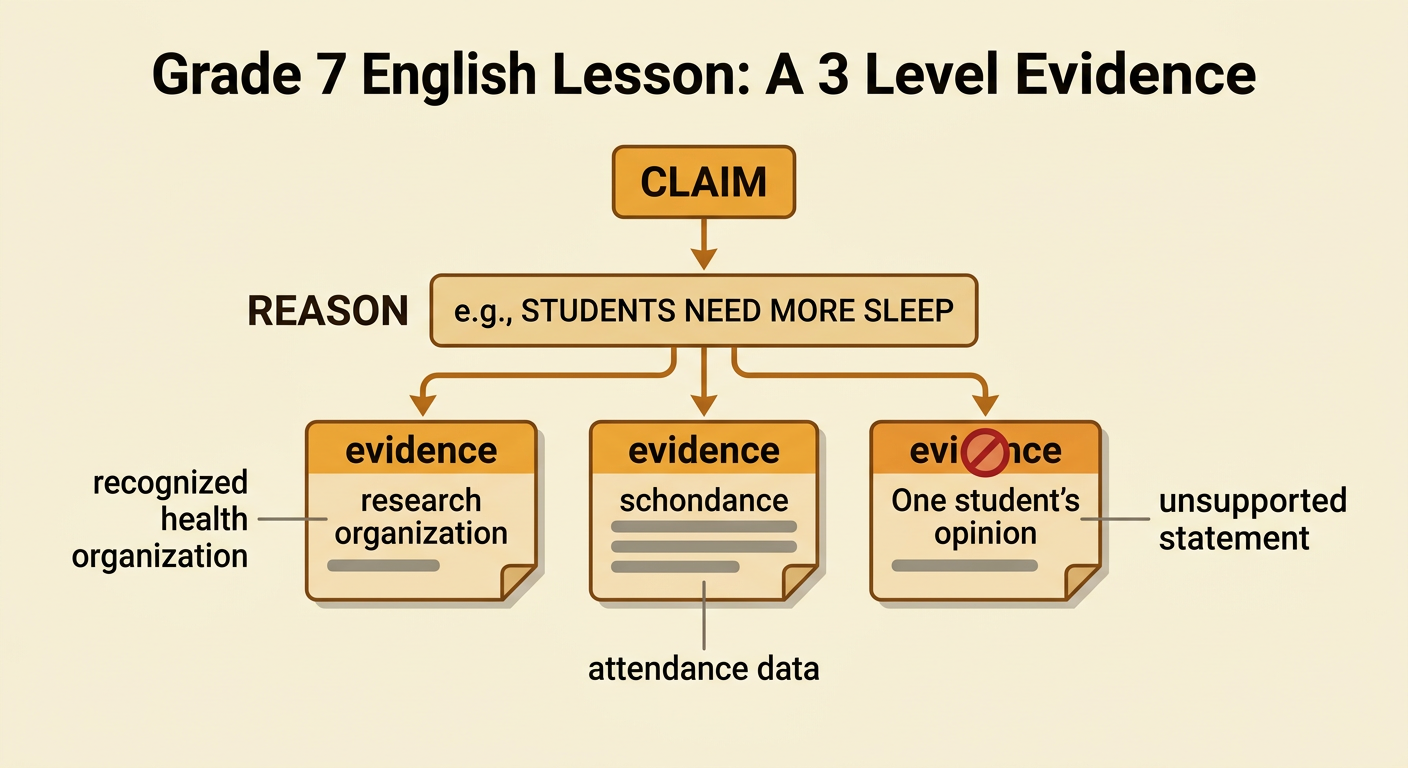
Evidence is the information an author uses to prove a reason or claim. Common forms include facts, statistics, examples, expert statements, observations, and research findings. Strong evidence should come from a trustworthy source and be presented accurately. For example, an author may support the reason that students need more sleep by citing a study from a recognized health organization about adolescents’ sleep needs. The author might also report attendance data from schools that changed their start times. When examining evidence, ask who collected the information, when it was collected, and whether the author provides enough context to understand it. A student’s comment that “everyone feels tired” may illustrate an experience, but it is not enough to prove what all students experience. Separate evidence from opinions, predictions, and unsupported statements so you can judge the argument fairly.
Evaluate Relevance and Sufficiency
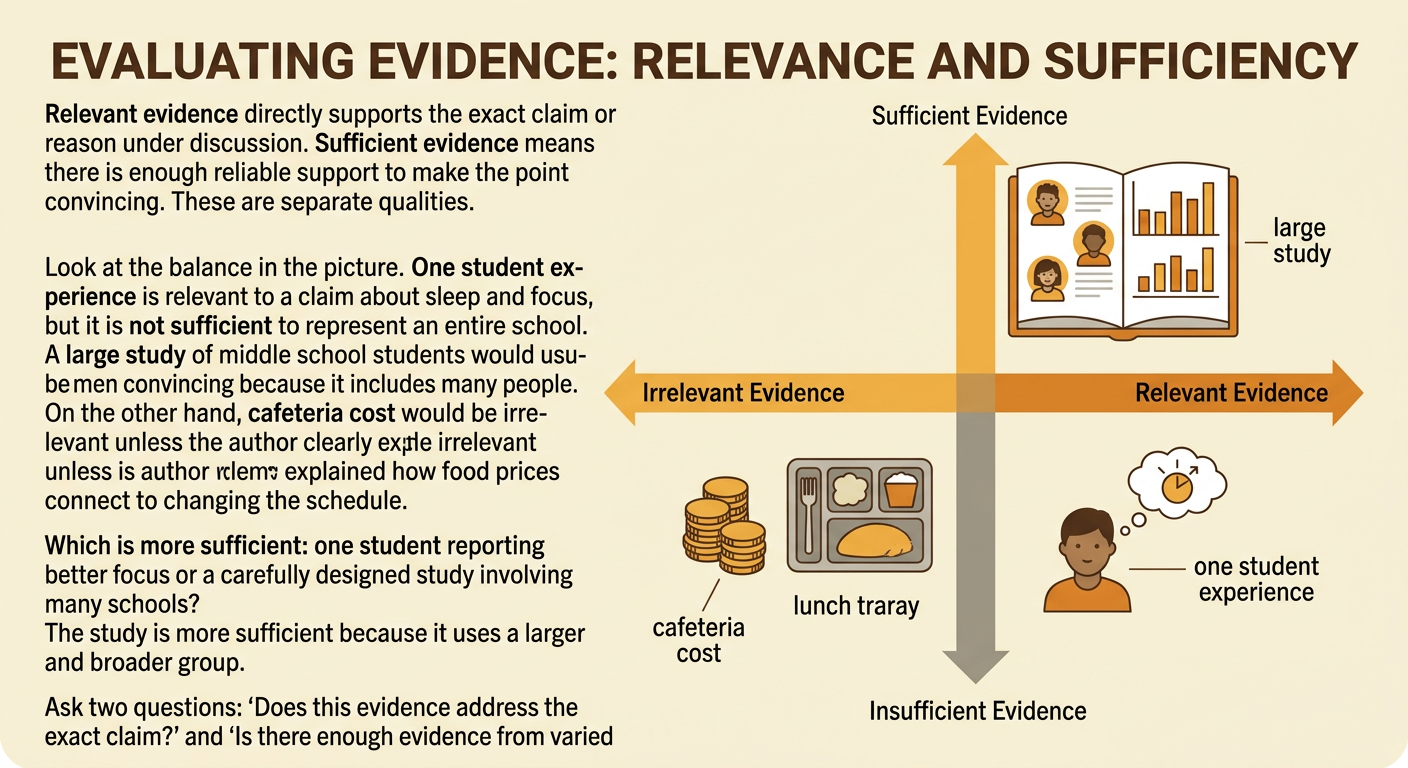
Relevant evidence directly supports the claim or reason being discussed. Sufficient evidence provides enough reliable support to make the point convincing. These qualities are different: evidence can be relevant but insufficient. For example, one student reporting better focus after sleeping longer is relevant to a claim about later school starts, but one experience is not enough to represent an entire school. A large, well-designed study of middle school students would usually provide stronger support. Evidence about the cost of cafeteria food would be irrelevant unless the author clearly connected it to changing the schedule. Ask, “Does this evidence address the exact claim?” and “Is there enough evidence from varied, credible sources?” Also watch for repeated examples that all come from one source. Several similar examples may sound impressive, but they may still leave important groups, conditions, or opposing information unexamined.
Judge the Overall Argument
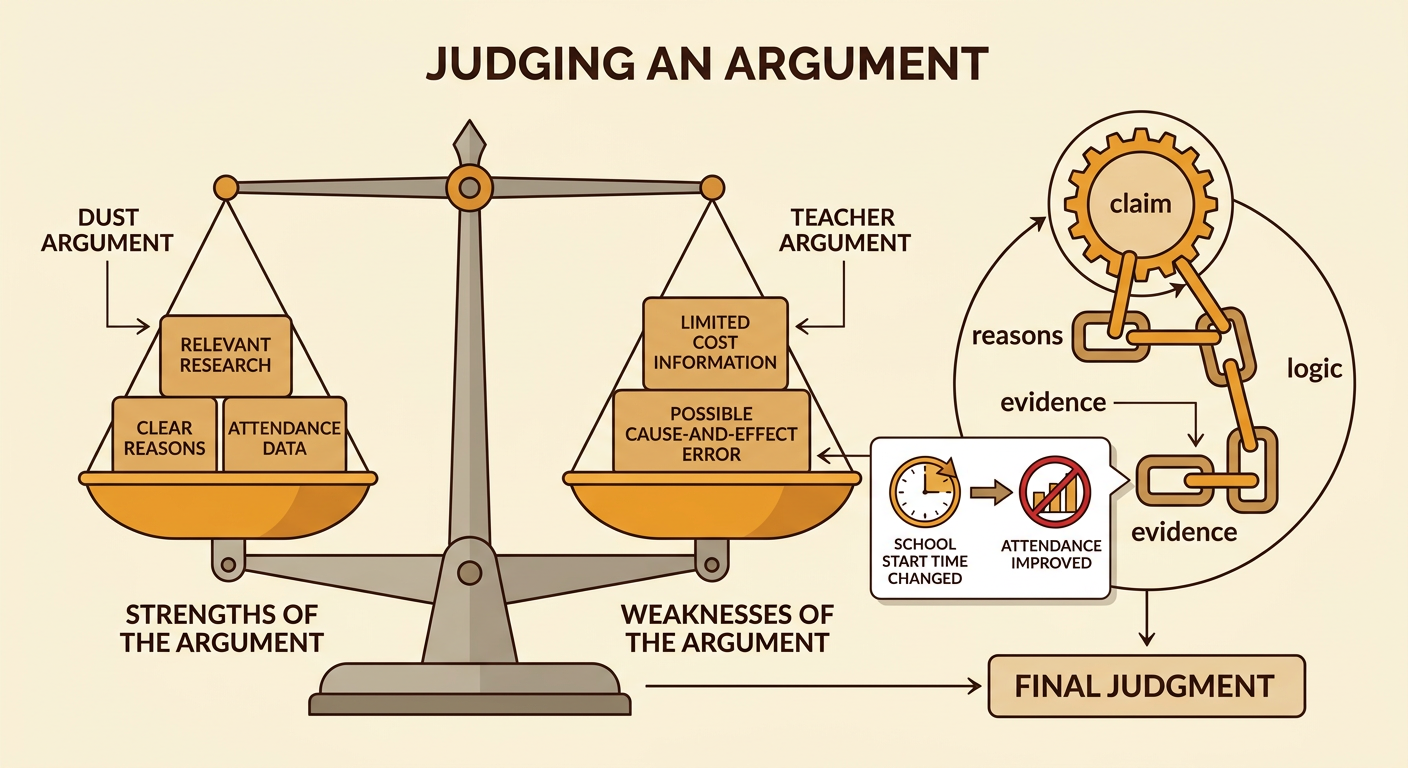
To judge an overall argument, consider the claim, reasons, evidence, and logic together. First, decide whether the claim is clear and arguable. Next, check that each reason supports the claim and that the evidence supports the reason. Look for sound reasoning, meaning that the conclusion follows logically from the information provided. Watch for flaws such as exaggeration, unfair assumptions, or the idea that one event caused another simply because they happened together. In the school-start example, improved attendance after a schedule change may support the argument, but it does not prove that every improvement was caused by the new schedule. A strong final judgment names both strengths and weaknesses. You might conclude, “The argument is mostly convincing because it uses relevant research and attendance data, but it needs more evidence about transportation costs.” This judgment is more useful than simply calling the argument good or bad.