
Evaluating Encryption and Digital Privacy Trade-Offs
Students model simple encryption, identify how keys protect data, and evaluate trade-offs among privacy, security, and public access.
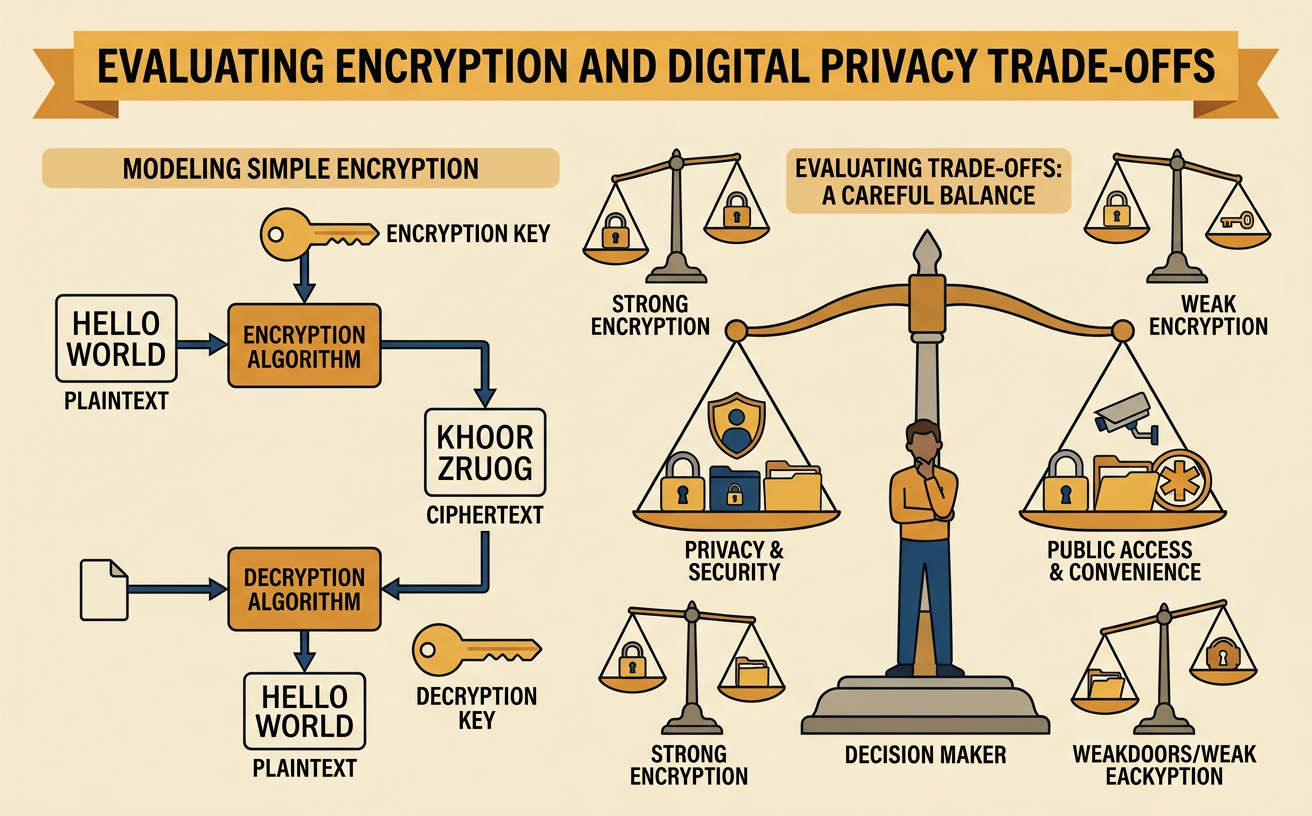
Illustrations are auto-generated and may be placeholders. They can be refreshed to match the narration.
Encryption and Keys
Encryption transforms readable plaintext into ciphertext that is difficult to understand without the correct key. A key is information used by an encryption algorithm to control the transformation. In symmetric encryption, the sender and receiver use the same secret key, so they must protect and share it safely. In public-key encryption, a public key can be shared widely for encryption, while a related private key is kept secret for decryption. For example, a shopping website can use a customer-facing public key system to establish protected communication for payment information. Encryption does not make data impossible to steal, and its strength depends on the algorithm, key length, implementation, and key protection. If an attacker obtains the private or secret key, protected information may become readable.

Encrypt-and-Decrypt Demonstration
A Caesar cipher provides a simple model of encryption by shifting each letter a fixed number of places in the alphabet. Suppose the plaintext is “MEET AT 3” and the key is a shift of three. M becomes P, E becomes H, and T becomes W, producing the ciphertext “PHHW DW 3.” To decrypt it, the receiver applies the inverse key and shifts each letter back three places. This demonstration shows that the algorithm and key work together: using the wrong shift produces an incorrect message. However, a Caesar cipher is not secure for real communication because an attacker can quickly test all 26 possible shifts. Modern encryption uses far larger key spaces and mathematical operations that make guessing a properly protected key impractical.

Identifying Security Goals
Digital security decisions often balance confidentiality, integrity, and availability. Confidentiality means that only authorized people can read information. Integrity means that information has not been changed without permission. Availability means that authorized users can reach information and services when needed. Authentication, which verifies identity, also supports these goals. Consider an online gradebook. Encryption helps keep grades confidential while they travel across a network. Digital signatures or message authentication tools can help reveal unauthorized changes, supporting integrity. Reliable servers, backups, and recovery plans support availability. One protection may not satisfy every goal: encrypting a file protects its contents, but losing the only key makes the file unavailable. Before choosing a solution, designers should identify which goals matter most and what risks are acceptable.

Privacy and Access Scenarios
Encryption can protect personal privacy, but demands for access may involve safety, law enforcement, transparency, or public records. Imagine that a city employee uses an encrypted phone containing both private family messages and work records requested under a lawful public-records process. The employee values personal privacy, journalists value government transparency, investigators may value access to relevant evidence, and cybersecurity experts may warn that a universal access method could be abused. Constitutional rights and democratic principles can be applied differently because people prioritize interests such as privacy, due process, public safety, and accountable government. A careful response should distinguish personal data from public records, follow legal procedures, and limit access to relevant information. Encryption alone does not decide whose claim is strongest; laws, evidence, technical limits, and affected perspectives all matter.

Evaluating Trade-Offs
Engineers evaluate encryption solutions by comparing prioritized criteria, constraints, and social impacts. Criteria are desired outcomes, such as strong confidentiality, quick emergency access, low cost, or ease of use. Constraints are limits, such as laws, budgets, available technology, and deadlines. Suppose a school is choosing between storing student files unencrypted, encrypting them with one shared key, or encrypting them with individual accounts and managed recovery keys. Unencrypted storage is easy to access but provides weak privacy. One shared key improves confidentiality but creates a single point of failure. Individual keys with controlled recovery offer stronger accountability, although they cost more to manage. A decision matrix can assign weights to criteria and scores to each option. Scores organize evidence, but decision makers must also examine assumptions, unequal impacts, and possible misuse.

Evidence-Based Recommendation
An evidence-based recommendation states a choice, explains the criteria used, cites relevant evidence, and addresses limitations and affected groups. For the school file system, a team might recommend individual account encryption with managed recovery keys because it best supports the prioritized goals of student confidentiality, accountability, and continued access. Evidence could include results from access tests, records of who can use each key, cost estimates, documented security practices, and credible research about common attacks. The recommendation should acknowledge that recovery keys create risk if too many people can use them. It could therefore require restricted administrator access, approval by two authorized staff members, audit logs, regular key rotation, and notice to users about data policies. A strong conclusion also identifies remaining uncertainty and explains why the expected benefits outweigh the costs and social risks.
