Evaluating Numerical and Algebraic Expressions
Students evaluate expressions by substituting values for variables and applying exponents and the order of operations.
Illustrations are auto-generated and may be placeholders. They can be refreshed to match the narration.
Identify Terms and Variables
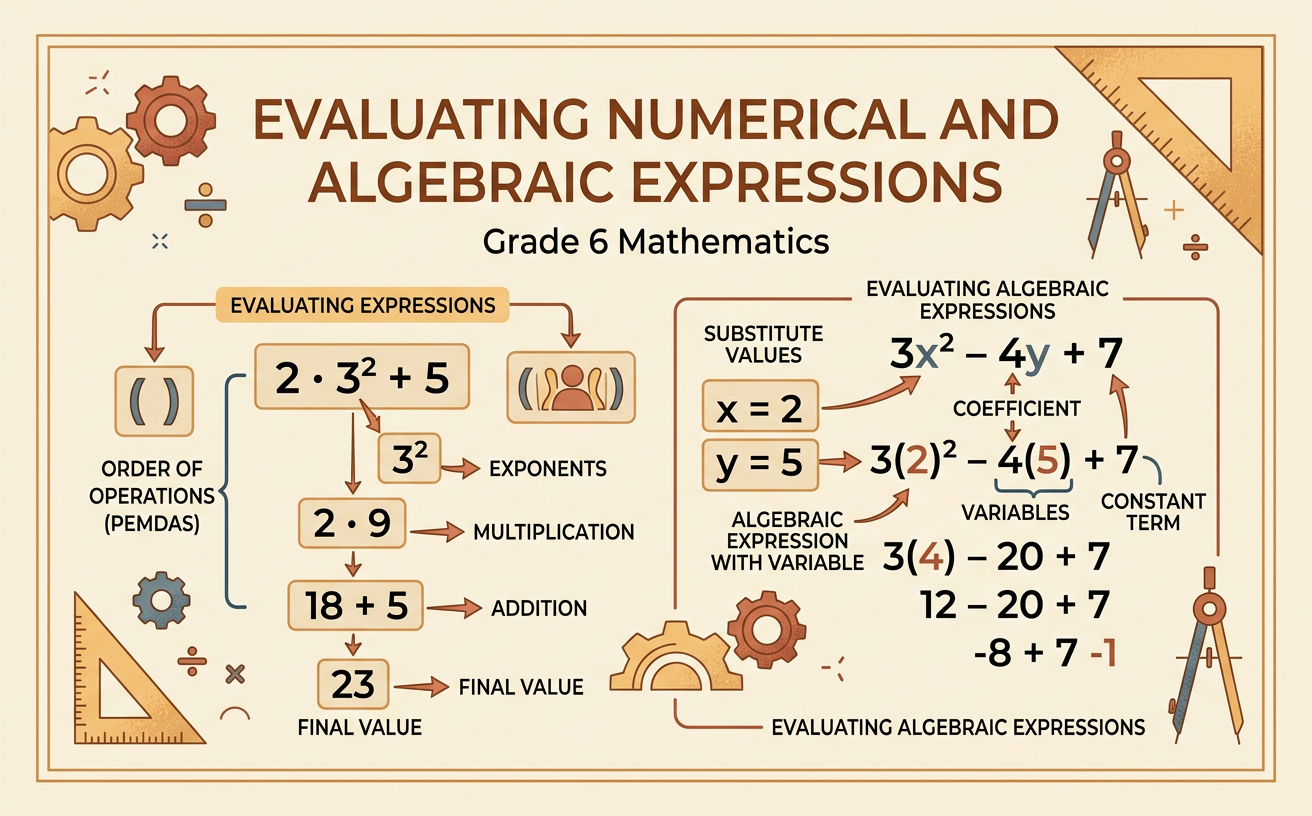
An expression is a mathematical phrase made of numbers, variables, and operation symbols. A variable is a letter that represents a number that may change. Terms are the parts of an expression separated by addition or subtraction signs. In the expression 4x + 3y - 7, the terms are 4x, 3y, and -7. The numbers 4 and 3 are coefficients because they multiply variables. The number -7 is a constant because it has no variable. In the term 4x, writing a number next to a variable means multiplication: 4x means 4 times x. An expression does not contain an equals sign. Identifying its terms, variables, coefficients, and constants helps you understand its structure before evaluating it.

Review Whole-Number Exponents
An exponent tells how many times a base is used as a factor. In 3 to the fourth power, written 3⁴, the base is 3 and the exponent is 4. This means 3 × 3 × 3 × 3, not 3 × 4. Multiply the repeated factors to evaluate the power: 3 × 3 = 9, 9 × 3 = 27, and 27 × 3 = 81. Therefore, 3⁴ = 81. A whole-number exponent can also appear on a variable. For example, x³ means x × x × x. If x = 2, then x³ = 2³ = 2 × 2 × 2 = 8. Always evaluate an exponent before performing ordinary multiplication, addition, or subtraction.

Substitute Given Values
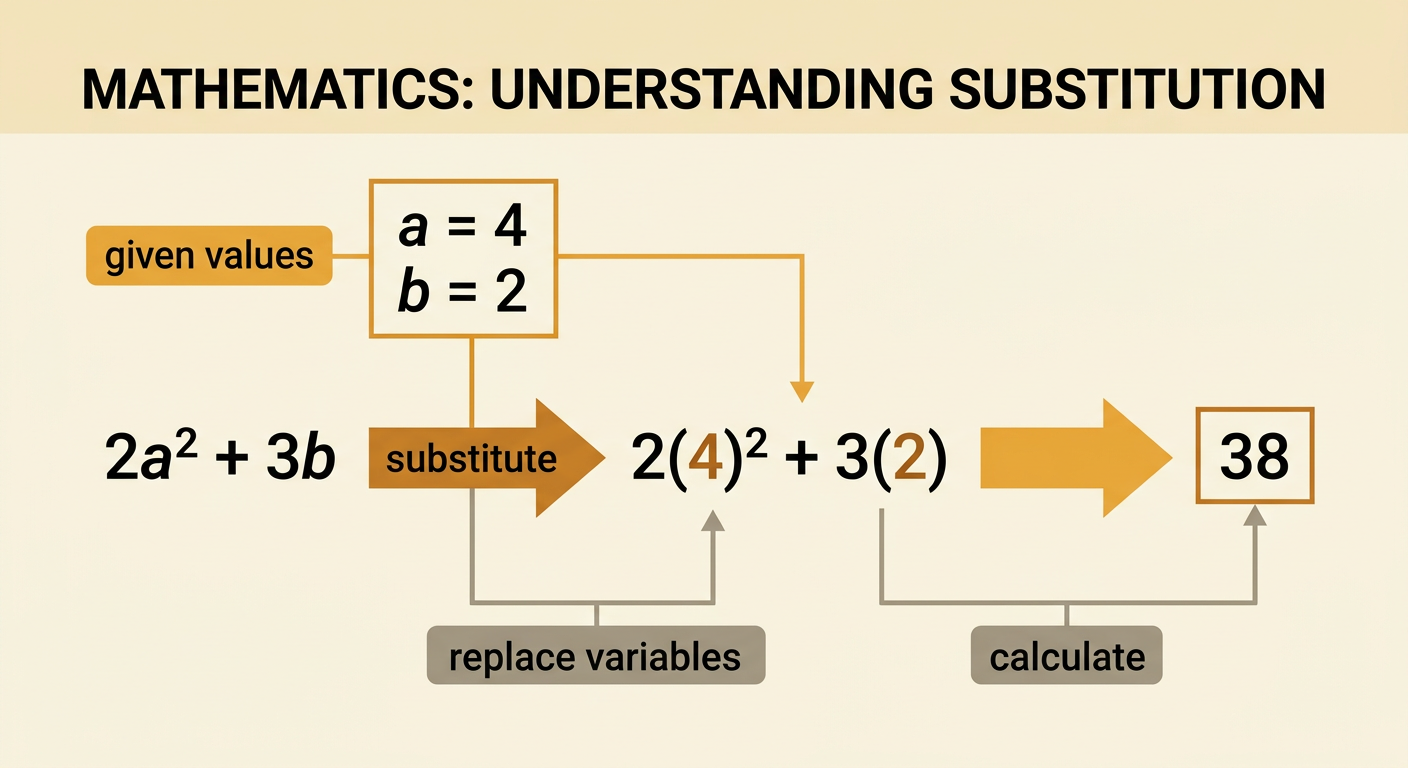
To evaluate an algebraic expression, replace each variable with its given value. This replacement is called substitution. Use parentheses around substituted values so the structure of the expression remains clear. Evaluate 2a² + 3b when a = 4 and b = 2. Substitute 4 for a and 2 for b: 2(4)² + 3(2). Next, evaluate the exponent: (4)² = 16. The expression becomes 2(16) + 3(2). Multiply to get 32 + 6, and then add to get 38. Be careful to replace every occurrence of a variable with the correct value. If a value is negative, parentheses are especially important. For example, if n = -3, then n² becomes (-3)², which equals 9.
Apply Order of Operations
After substituting values, use the order of operations to evaluate correctly. First simplify grouping symbols such as parentheses. Next evaluate exponents. Then multiply and divide from left to right. Finally, add and subtract from left to right. Consider 18 - 2(3 + 1)² ÷ 4. Begin inside the parentheses: 3 + 1 = 4, giving 18 - 2(4)² ÷ 4. Evaluate the exponent to get 18 - 2(16) ÷ 4. Multiply and divide from left to right: 2 × 16 = 32, and 32 ÷ 4 = 8. Finally, subtract: 18 - 8 = 10. Following the order prevents you from performing an addition or subtraction too early and getting an incorrect result.

Evaluate Real-World Formulas
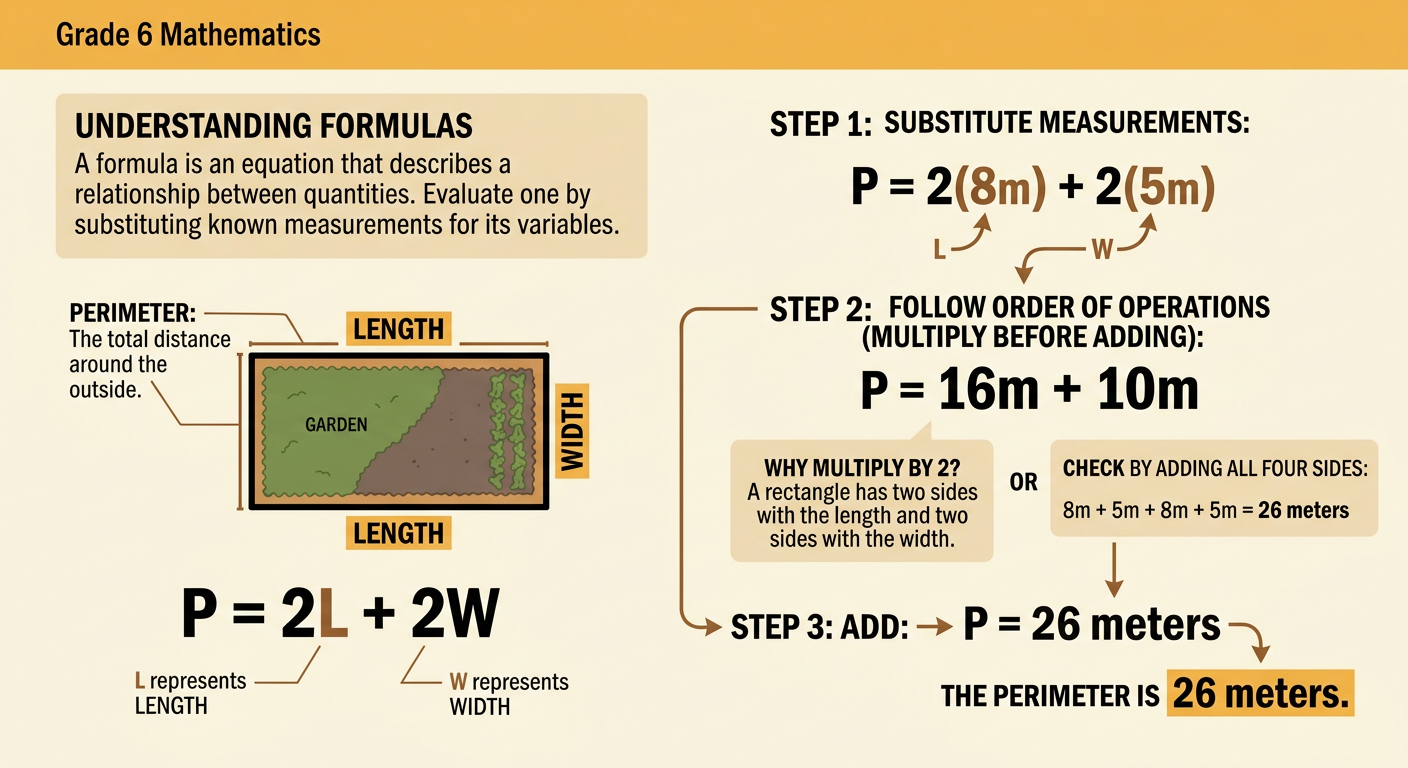
A formula is an equation that describes a relationship between quantities. You can evaluate a formula by substituting known measurements for its variables. The perimeter P of a rectangle is given by P = 2l + 2w, where l is the length and w is the width. Suppose a rectangular garden has a length of 8 meters and a width of 5 meters. Substitute l = 8 and w = 5: P = 2(8) + 2(5). Multiply before adding to get P = 16 + 10, so P = 26 meters. Include the correct unit because perimeter measures distance around a shape. Check that the answer is reasonable by adding all four sides: 8 + 5 + 8 + 5 also equals 26 meters.