Evaluating Rhetorical Arguments in a Seminal U.S. Text
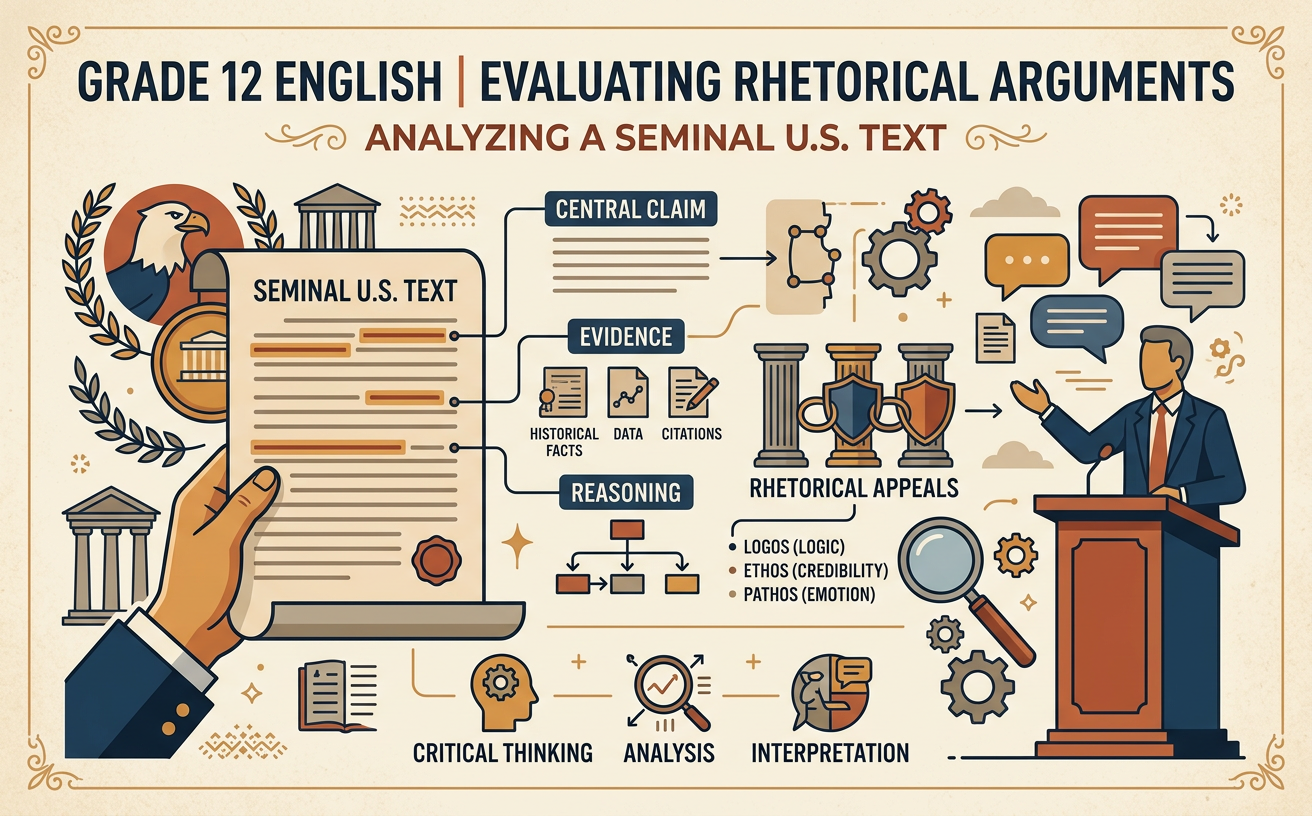
Students analyze how an author uses claims, evidence, reasoning, and rhetorical appeals to advance an argument in a seminal U.S. text.
Illustrations are auto-generated and may be placeholders. They can be refreshed to match the narration.
Introduce the Text and Context
Martin Luther King Jr. wrote “Letter from Birmingham Jail” in April 1963 after he was arrested during a campaign against racial segregation in Birmingham, Alabama. He addressed eight white Alabama clergymen who had called the demonstrations unwise and untimely. Understanding this situation clarifies King’s purpose: to defend nonviolent direct action and challenge moderate readers who preferred patience. The civil rights movement also provides essential context. Black Americans faced segregation, discriminatory laws, racial violence, and barriers to voting. King’s letter is therefore both a response to specific critics and a work of public advocacy about justice. For example, when King explains why he came to Birmingham, he counters the accusation that he was an outside agitator by describing his organizational ties and his moral responsibility to oppose injustice.

Identify the Central Claim
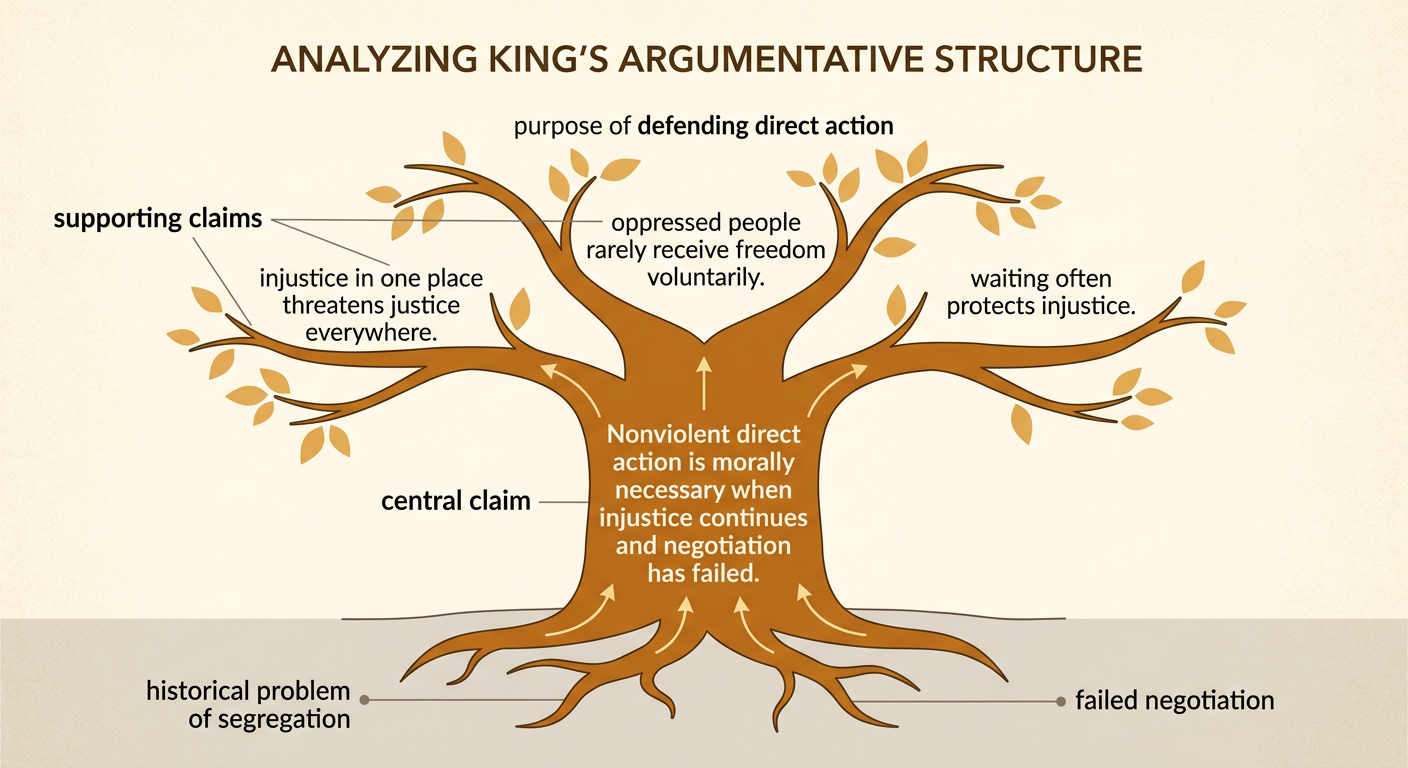
A central claim is the main position an author wants readers to accept. King’s central claim is that nonviolent direct action is morally necessary when unjust conditions persist and negotiation has failed. He rejects the clergymen’s suggestion that activists should wait for courts or local leaders to act. Several supporting claims develop this position: injustice in one place affects justice everywhere, oppressed people rarely gain freedom voluntarily, and waiting often preserves injustice rather than correcting it. King’s statement that “injustice anywhere is a threat to justice everywhere” supports his argument that people have a shared responsibility beyond local boundaries. To identify the central claim, ask which idea connects most of the author’s examples, explanations, and responses to opposing views. A topic such as segregation is not itself a claim; the claim states what King believes must be understood or done about it.
Trace Evidence and Reasoning
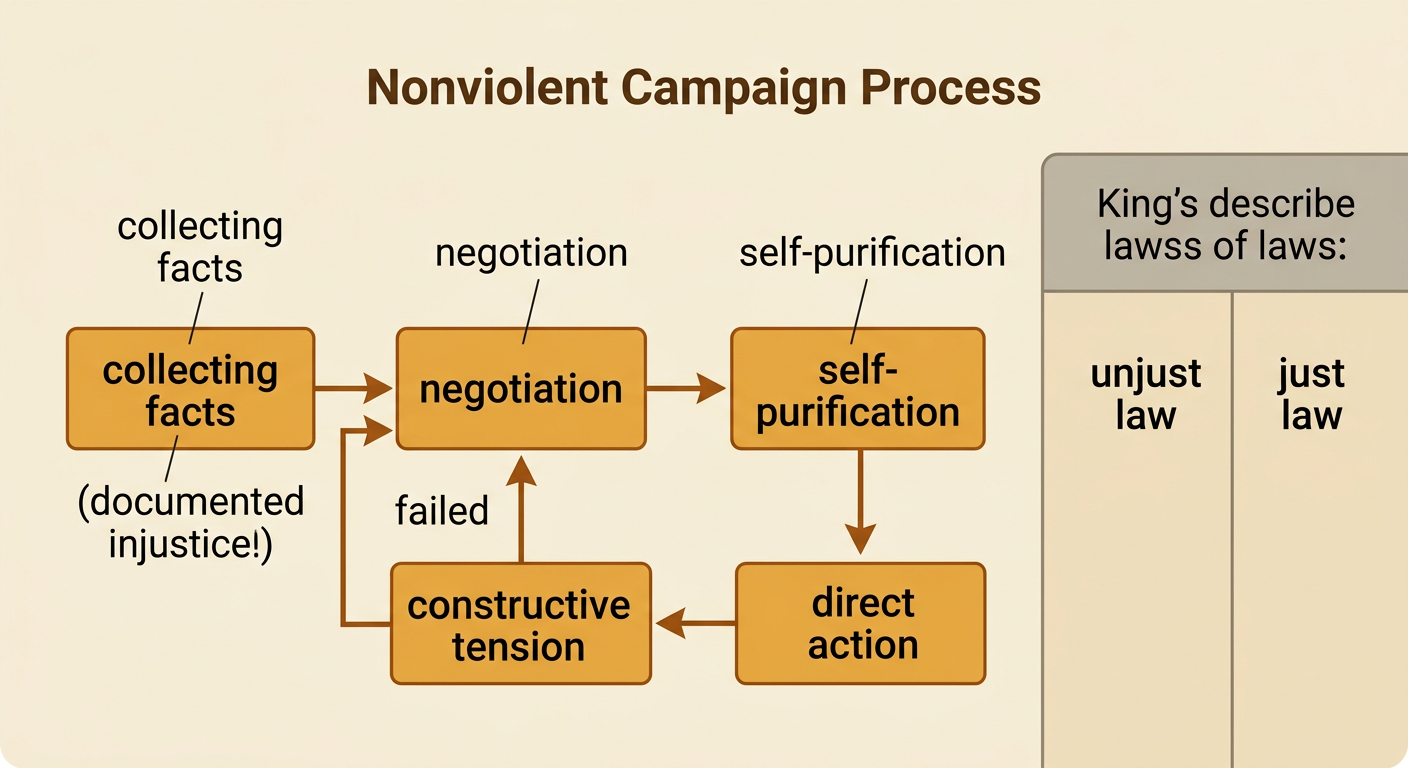
Tracing an argument means following how evidence supports claims through reasoning. King explains that a nonviolent campaign has four steps: collecting facts, negotiating, preparing participants through self-purification, and taking direct action. He then argues that Birmingham activists followed these steps before demonstrating. His evidence includes failed negotiations and the continuing realities of segregation and racial violence. His reasoning is causal: because negotiation did not produce change, direct action was needed to create constructive tension that would force the community to confront injustice. King also uses legal reasoning when he distinguishes just laws from unjust laws. A just law respects human dignity and applies equally; an unjust law degrades people or is imposed on a group denied a meaningful role in making it. This distinction supports civil disobedience while limiting it to laws that violate moral and democratic principles.
Analyze Rhetorical Appeals
Rhetorical appeals help an author influence an audience. King builds ethos, or credibility, by presenting himself as a religious leader, an experienced organizer, and a person willing to accept the consequences of nonviolent protest. He uses logos, or logical appeal, by explaining the stages of a campaign and defining just and unjust laws. He uses pathos, or emotional appeal, when he describes the humiliation and pain that segregation inflicts on Black families, including the difficulty of explaining discrimination to children. These appeals often work together. For example, King’s discussion of breaking unjust laws combines logical definitions, ethical responsibility, and the emotional urgency of oppression. The effect is not merely to make readers feel sympathy. It encourages the clergymen and the wider public to see delay as a moral choice with harmful consequences, not as a neutral or reasonable position.

Evaluate the Argument
To evaluate an argument, judge whether its claims are clear, its evidence is relevant and sufficient, and its reasoning is valid. King’s argument is strong because he addresses the clergymen’s objections directly, explains the disciplined process behind nonviolent action, and grounds his position in moral, legal, religious, and constitutional principles. His distinction between just and unjust laws also answers a likely counterargument: that protesters cannot support law while disobeying it. King argues that accepting punishment openly demonstrates respect for justice while exposing an unjust law. A careful evaluation should also note limits. Some evidence is based on King’s personal testimony and selected historical examples rather than statistical data. However, those forms of evidence fit a public letter focused on moral reasoning and lived experience. Overall, the argument is effective because its evidence, reasoning, audience awareness, and rhetorical choices consistently support its purpose.

Write an Evidence-Based Conclusion
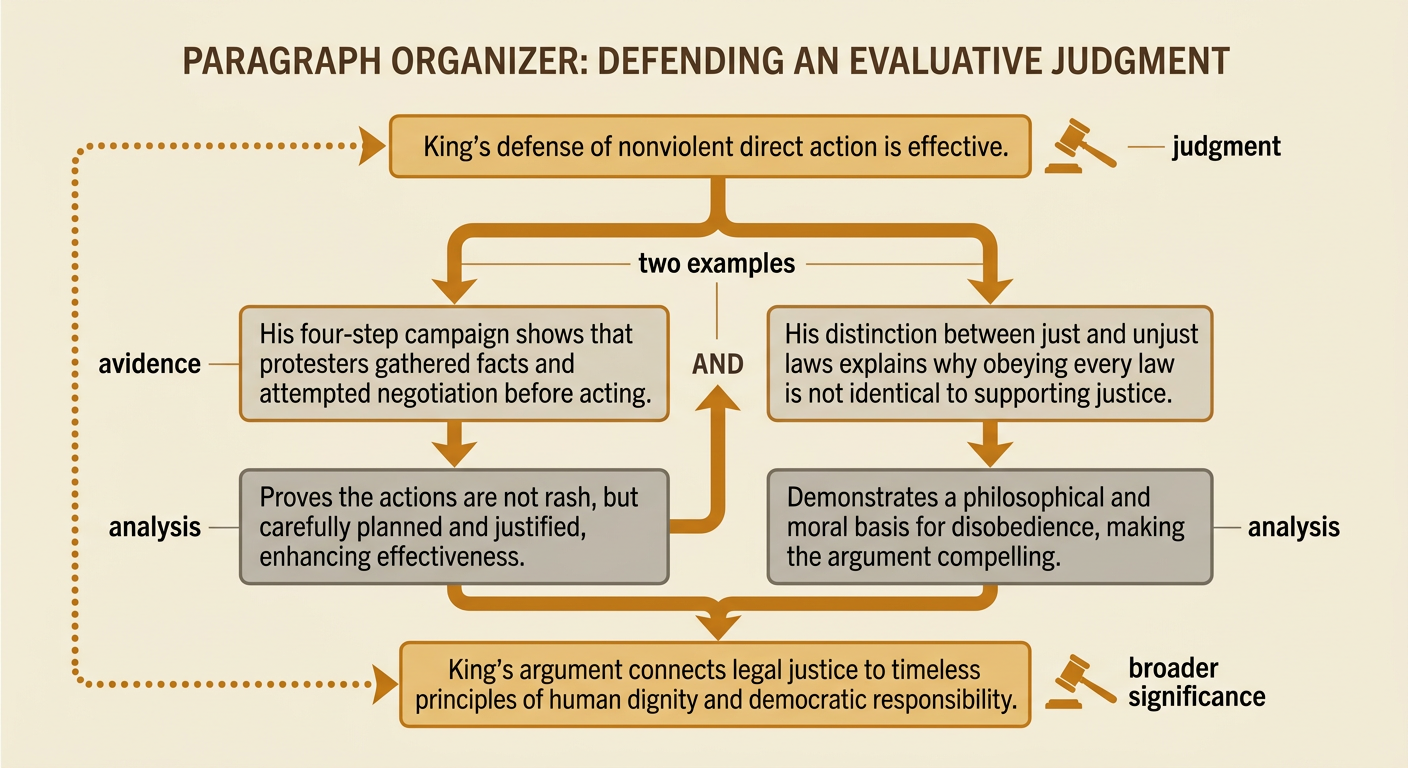
An evidence-based conclusion makes a defensible judgment and supports it with specific details from the text. Begin by answering the evaluation question clearly. Then cite or paraphrase two strong examples and explain how each one proves the judgment. For example: King presents an effective defense of nonviolent direct action because he combines a logical sequence of action with a principled distinction between just and unjust laws. His explanation of the campaign’s four steps shows that the protests were planned only after facts were gathered and negotiation was attempted. His definition of unjust laws shows why obeying every law cannot be the same as supporting justice. Together, these examples demonstrate that King responds to opposing claims rather than simply asserting his beliefs. End by explaining the argument’s broader significance, such as how it connects civic action to equality, human dignity, and responsibility under democratic government.