
Exploring the Structures of Poetry, Drama, and Prose
Students identify and compare the structural elements of poems, plays, and prose passages.

Illustrations are auto-generated and may be placeholders. They can be refreshed to match the narration.
Meet the Three Literary Forms
Literary texts can be organized as poetry, drama, or prose. A poem is arranged in lines and often in groups called stanzas. It may use rhythm, rhyme, or repeated sounds. A drama, or play, is written to be performed. It usually includes characters’ names, dialogue, and stage directions. Prose is ordinary written language arranged in sentences and paragraphs. Most short stories and novels use prose. Imagine a story about a sudden rainstorm. A poem might describe raindrops in short, rhythmic lines. A play might show two characters speaking while a stage direction tells them to open umbrellas. A prose passage might describe the storm in a paragraph. Each form can explore the same topic, but its structure helps readers experience the topic differently.

Notice Poetry Elements
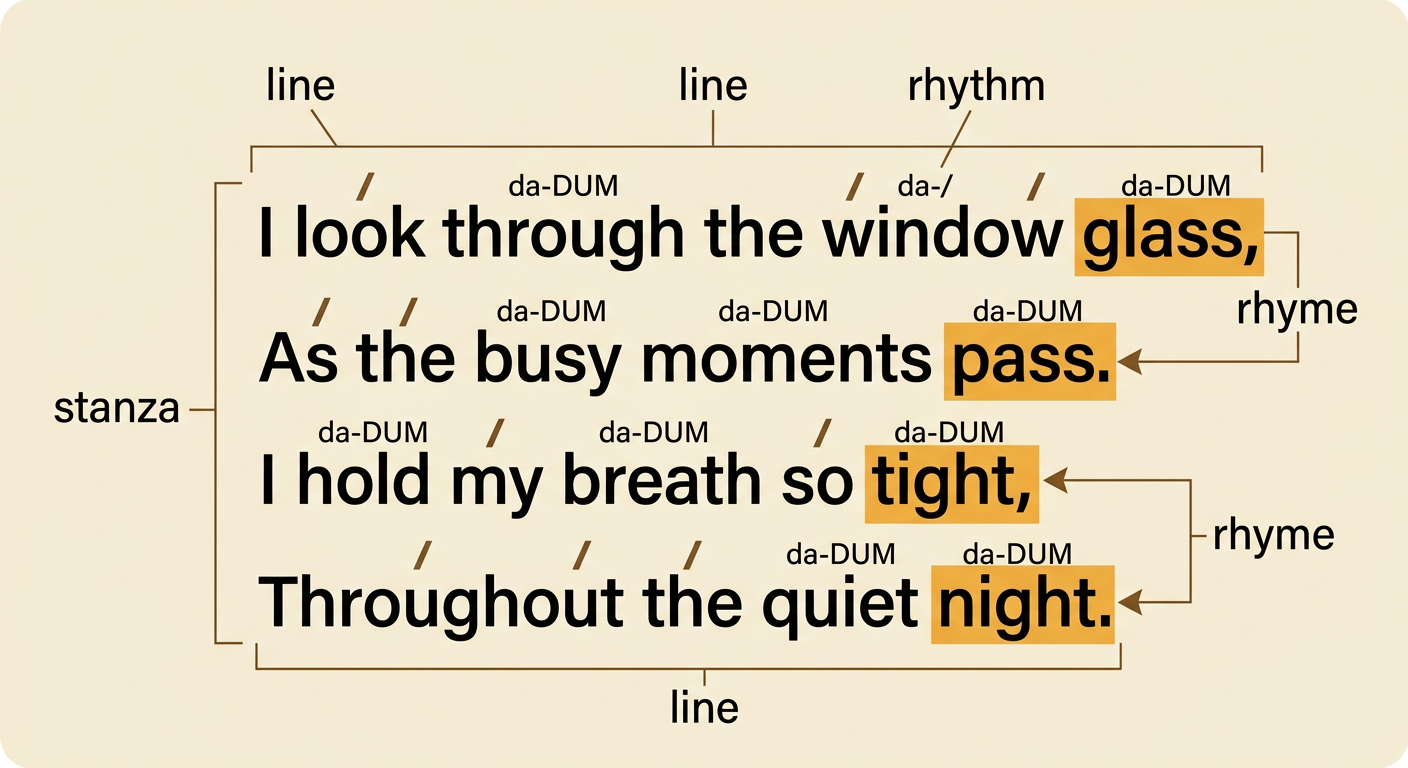
A poem’s structure begins with its lines. A line may end before the sentence or idea is complete. Lines are often grouped into stanzas, which are separated by blank spaces. A stanza works somewhat like a paragraph because it can organize one part of a poem. Poets may also use rhythm, rhyme, and repetition. Read this example: “Rain taps the glass. Night shadows pass. I snuggle in tight, warm in the night.” The poem has four lines. “Glass” and “pass” rhyme, as do “tight” and “night.” Repeated sounds create a gentle rhythm. Not every poem rhymes, however. When discussing a poem, refer to its structure with statements such as, “The poet uses two stanzas,” or, “The short lines make the action seem quick.”
Examine Drama Elements
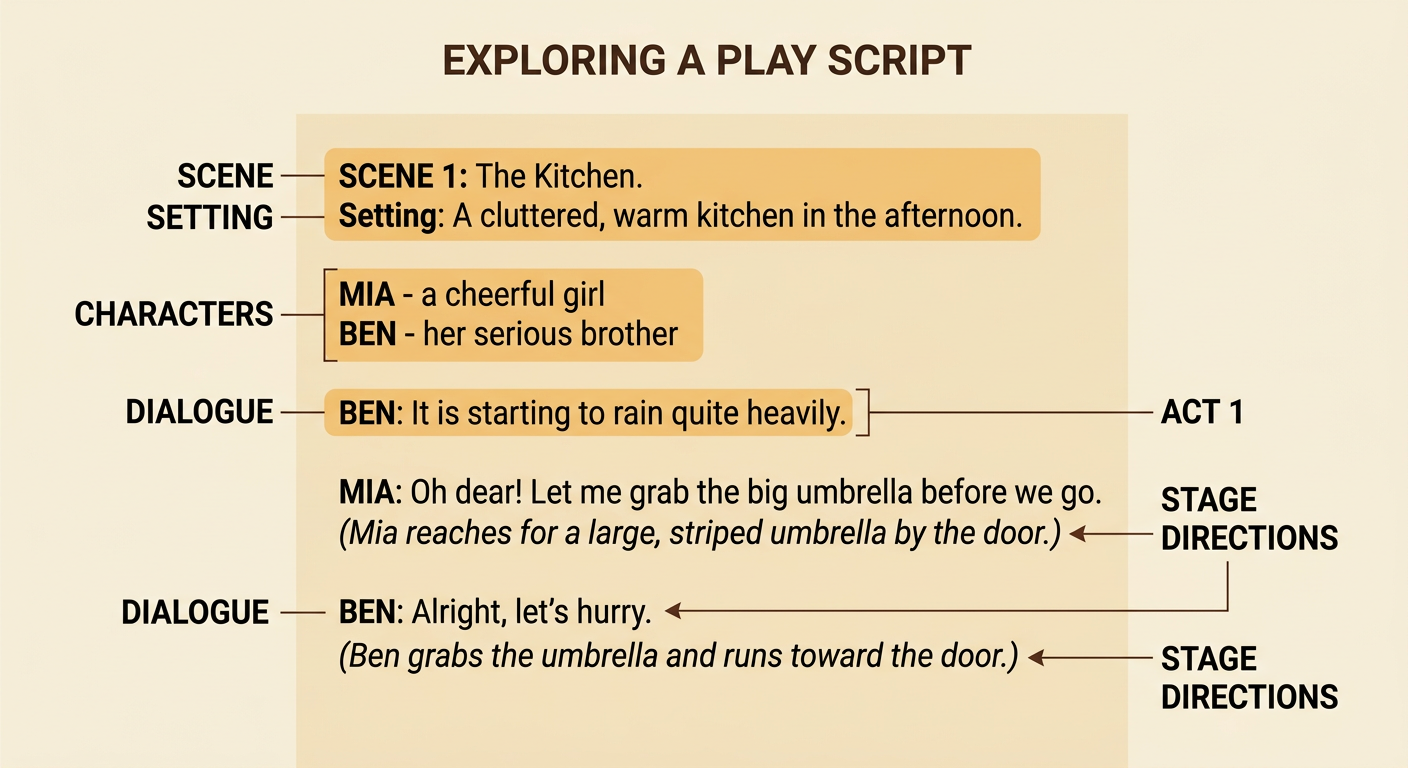
Drama is written for actors to perform before an audience. A script often begins with a cast of characters. Each spoken part is called dialogue, and the character’s name appears before the words. Stage directions tell actors how to move, speak, or react. They may also describe the setting. Stage directions are usually placed in parentheses or printed in a different style. A play may be divided into acts and smaller scenes. Consider this example: “MIA: The rain is starting! BEN: Grab the umbrella. (Ben runs toward the door.)” Mia’s and Ben’s words are dialogue. The words in parentheses are a stage direction, not words Ben says aloud. When explaining drama, mention elements such as dialogue, stage directions, characters, acts, or scenes and describe how they guide the performance.
Recognize Prose Features
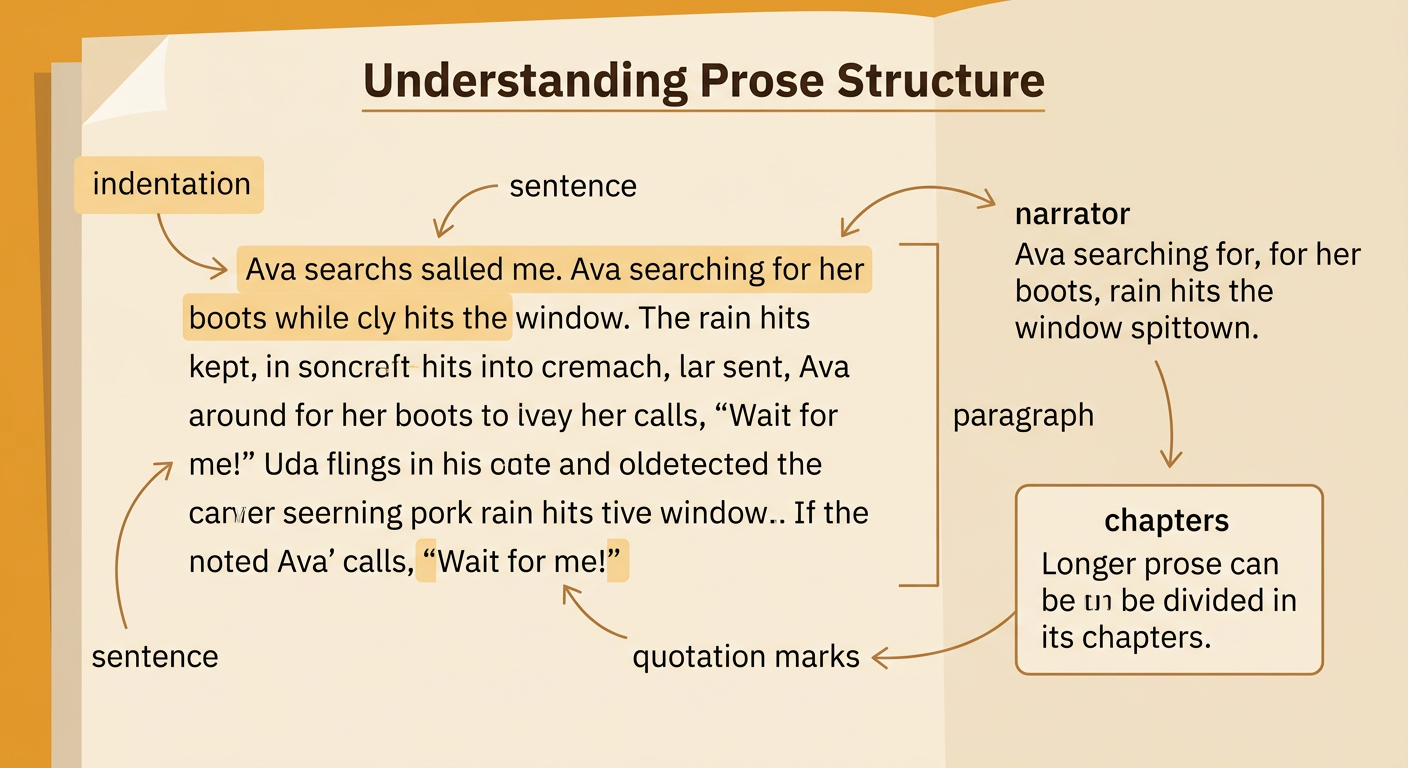
Prose is the form used in most short stories, novels, biographies, and articles. It is arranged in complete sentences and paragraphs rather than poetic lines or script dialogue. A paragraph groups connected sentences about an event or idea. Prose usually has a narrator, the voice that tells the story or explains information. Fictional prose can include characters, setting, plot, and dialogue inside quotation marks. For example: “Rain struck the window as Ava searched for her boots. ‘Wait for me!’ she called to her brother.” These sentences form part of a paragraph. A narrator describes Ava’s actions, while quotation marks show her spoken words. Unlike a play, the passage does not use Ava’s name before her speech or include stage directions. Longer prose texts may be organized into sections or chapters.
Compare Text Structures
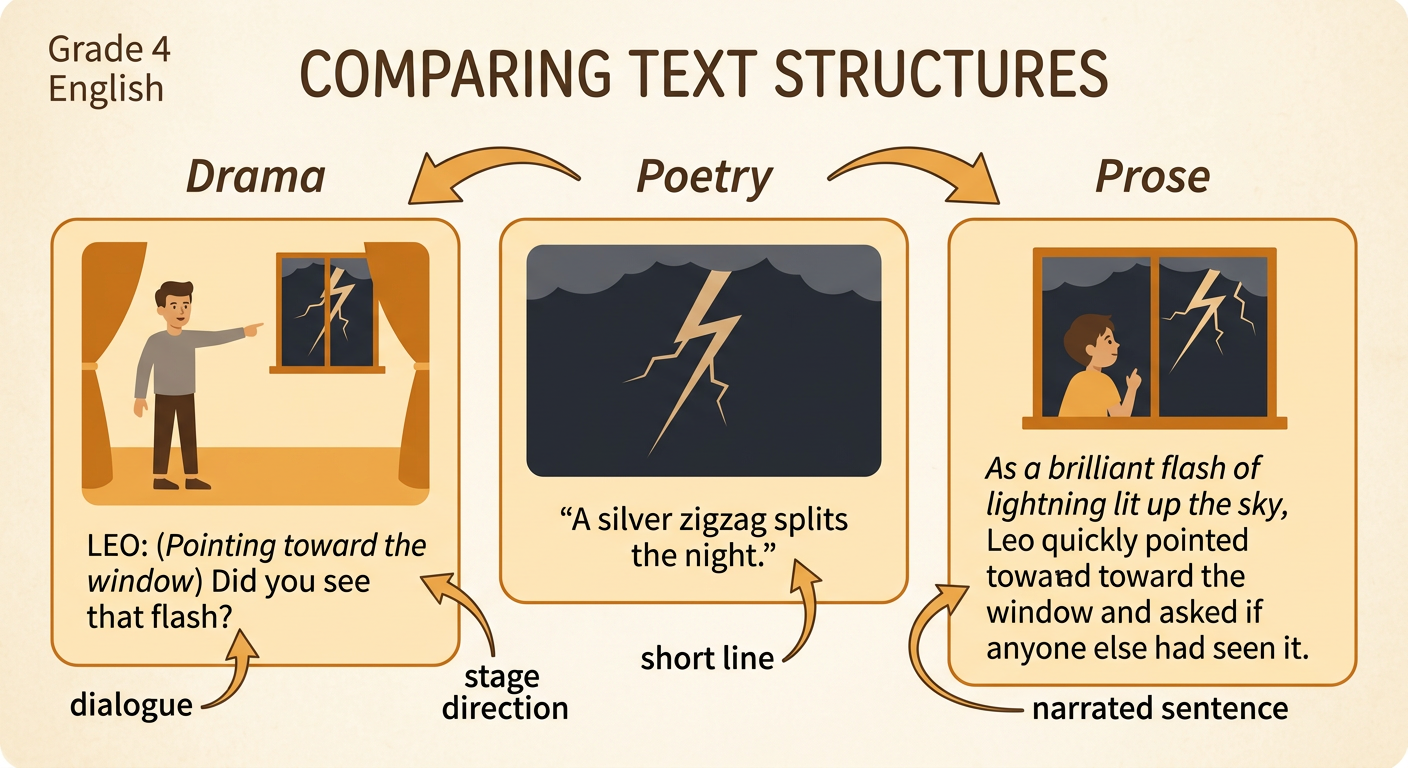
To compare structures, ask how each text is arranged and how that arrangement affects the reader. Consider a child seeing lightning. A poem might say, “A silver zigzag splits the night,” placing the image on one short line for emphasis. A drama might say, “LEO: Did you see that? (He points toward the window.)” The character name and stage direction prepare the moment for performance. Prose might say, “A silver flash crossed the sky, and Leo pointed toward the window.” The complete sentence lets a narrator describe both the lightning and Leo’s action. All three examples present the same event, but they organize it differently. When comparing, use specific structural terms. You might explain, “The poem uses a short line, the drama uses dialogue and a stage direction, and the prose passage uses a narrated sentence.”
Complete an Exit Check
Read each example and identify its literary form and structural evidence. Example A says, “Wind shakes the trees. It tosses the leaves. Then suddenly, everything stills.” The words are arranged as three short lines, so the text is poetry. Example B says, “NORA: The wind stopped. (She steps outside slowly.)” The character name, dialogue, and stage direction show that it is drama. Example C says, “Nora stepped outside after the wind stopped, listening for any sound.” The complete sentence and narrator show that it is prose. Now explain one major difference between two forms. A strong response might say, “Drama uses character names and stage directions to guide a performance, while prose uses sentences and paragraphs narrated for a reader.” Always name the form, point to its structural elements, and explain what those elements do.
