Exploring Transformations on the Coordinate Plane
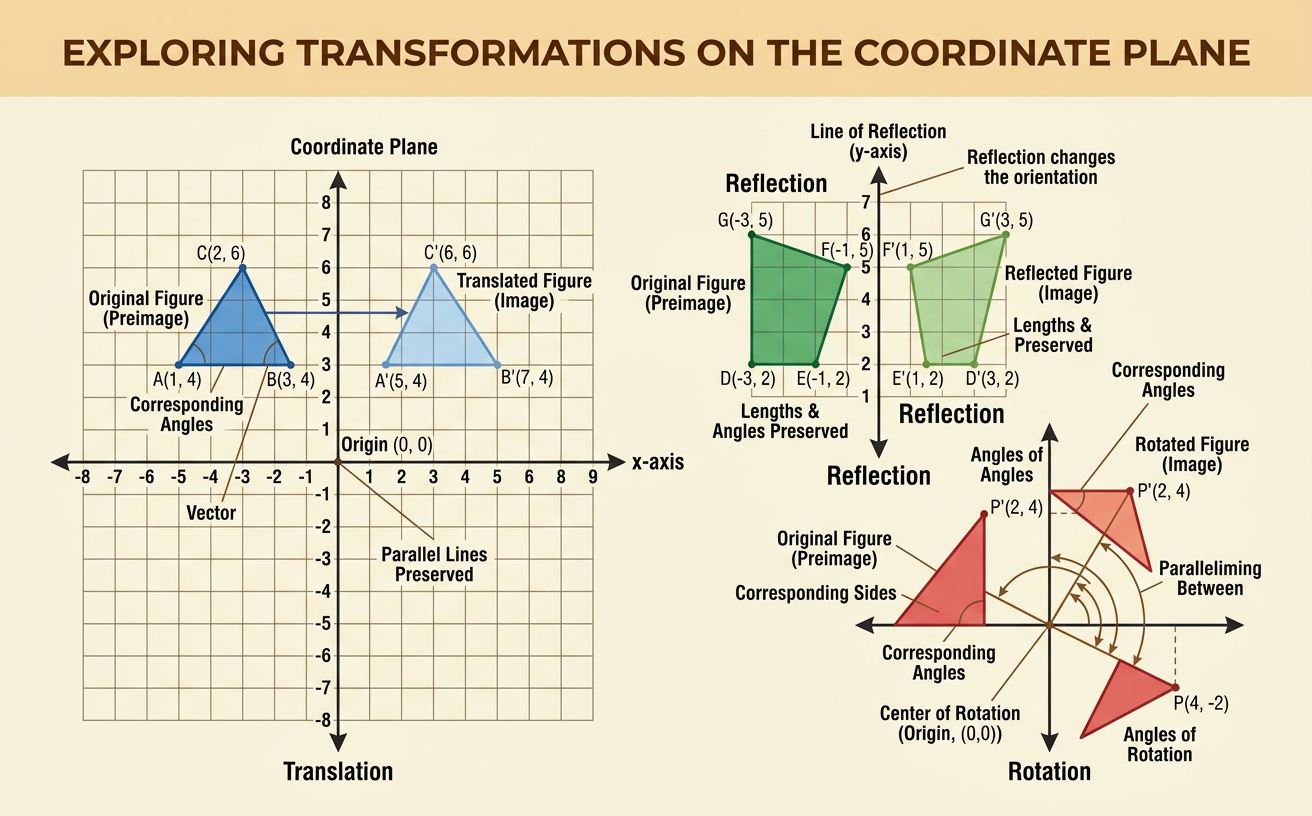
Students use coordinates and geometric reasoning to investigate how translations, reflections, and rotations preserve lengths, angle measures, and parallel lines.
Illustrations are auto-generated and may be placeholders. They can be refreshed to match the narration.
Identify Rigid Transformations
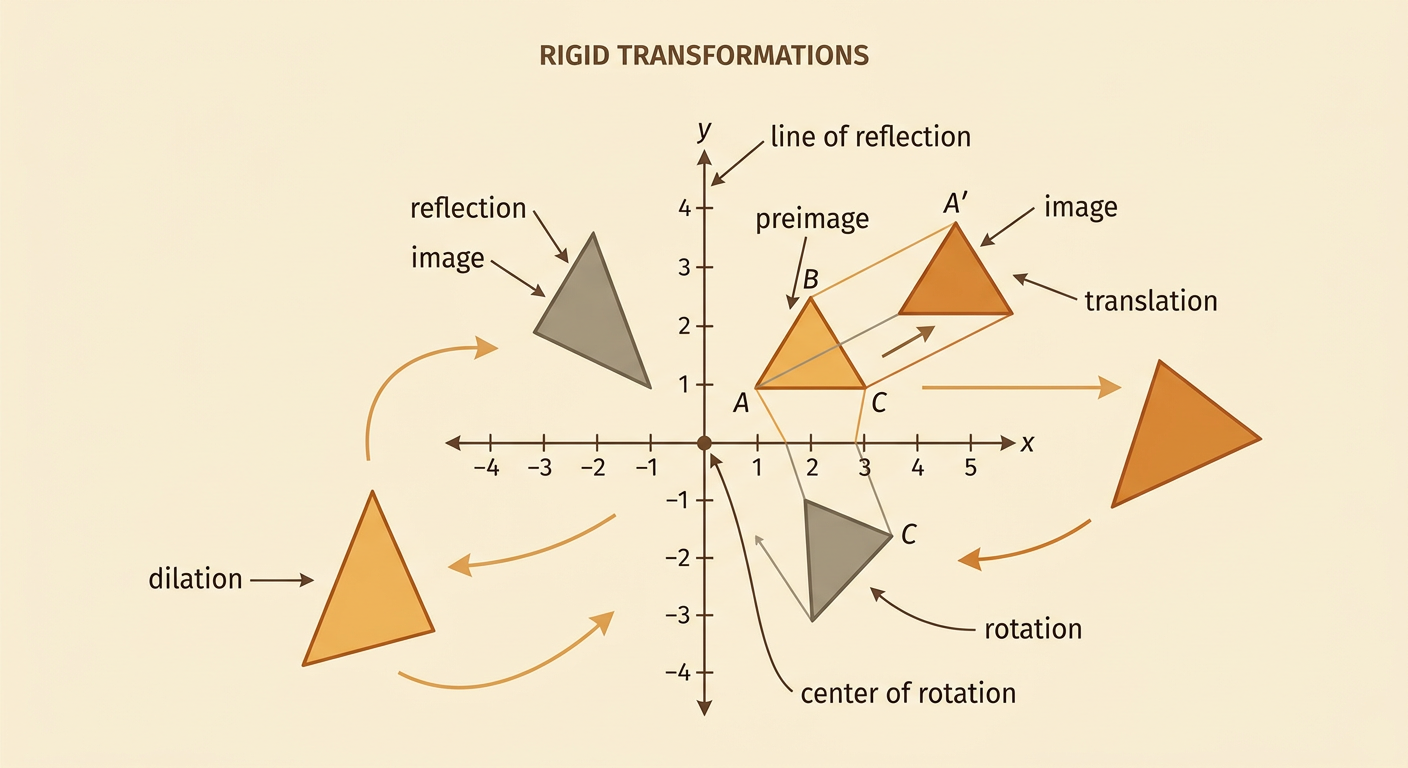
A rigid transformation moves a figure without changing its size or shape. The three rigid transformations are translations, reflections, and rotations. A translation slides every point the same distance in the same direction. A reflection flips a figure across a line called the line of reflection. A rotation turns a figure around a fixed point called the center of rotation. For example, translate triangle ABC two units right and one unit up. Point A(1, 1) moves to A′(3, 2), and every other vertex follows the same movement. The original triangle is the preimage, and the moved triangle is the image. Because the transformation is rigid, corresponding side lengths and angle measures remain equal. A dilation is not a rigid transformation because it changes the size of a figure.
Apply Coordinate Rules
Coordinate rules describe exactly where each point moves. A translation right h units and up k units follows the rule (x, y) → (x + h, y + k). Reflections across the x-axis and y-axis follow (x, y) → (x, −y) and (x, y) → (−x, y). A 90-degree counterclockwise rotation around the origin follows (x, y) → (−y, x). For example, begin with P(2, 1). Translating P three units left and four units up gives P′(−1, 5). Reflecting P across the y-axis gives P′(−2, 1). Rotating P 90 degrees counterclockwise gives P′(−1, 2). Apply a rule to every vertex of a figure, not just one point, and carefully preserve the order of the vertices.

Compare Preimage and Image
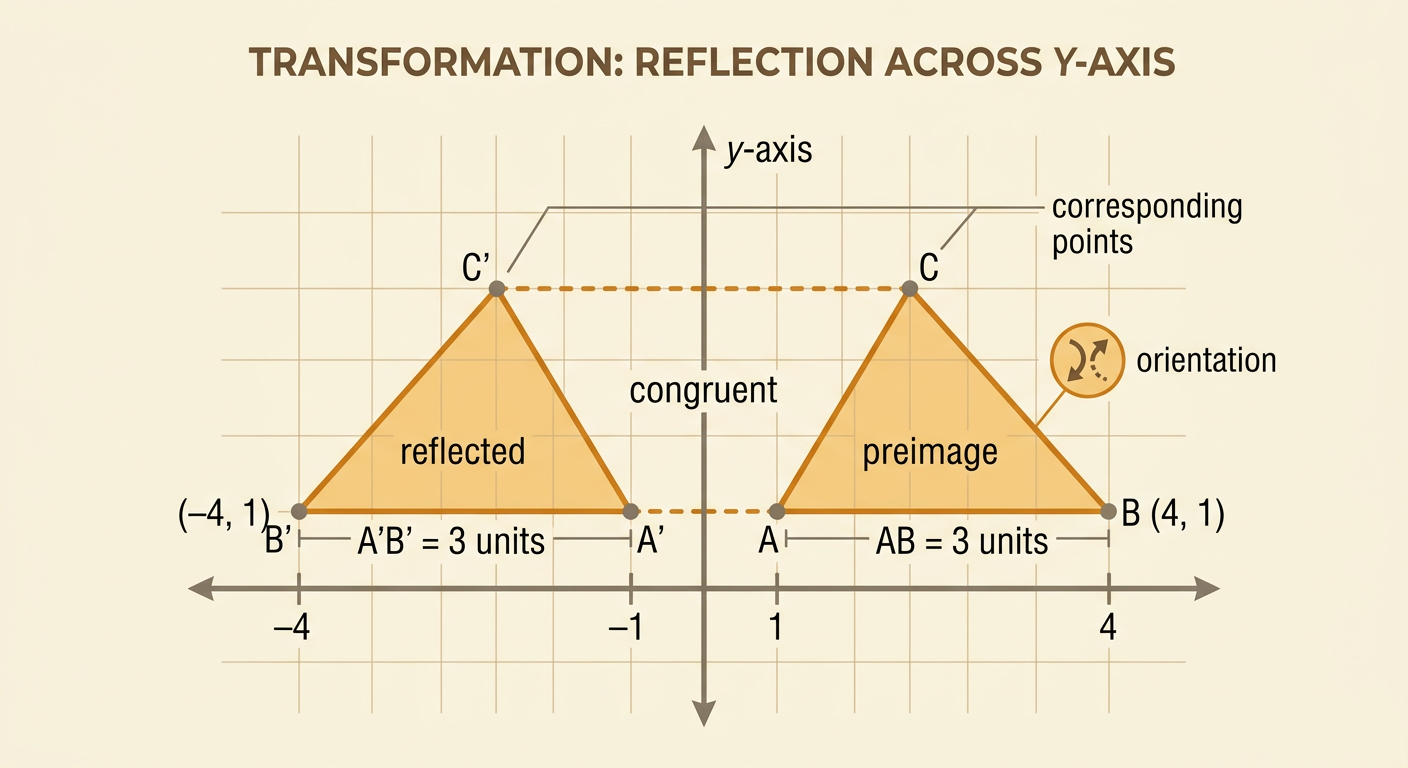
To compare a preimage with its image, match corresponding vertices in the same order. Suppose triangle ABC has vertices A(1, 1), B(4, 1), and C(2, 3). Reflecting it across the y-axis produces A′(−1, 1), B′(−4, 1), and C′(−2, 3). Points A and A′ are corresponding points, as are B and B′ and C and C′. Each pair is the same horizontal distance from the y-axis but lies on the opposite side. Segment AB and segment A′B′ both have length 3 units. The reflected triangle faces the opposite direction, but it has the same side lengths and angle measures. This shows that orientation may reverse during a reflection even though the figure remains congruent to its preimage.
Verify Preserved Properties
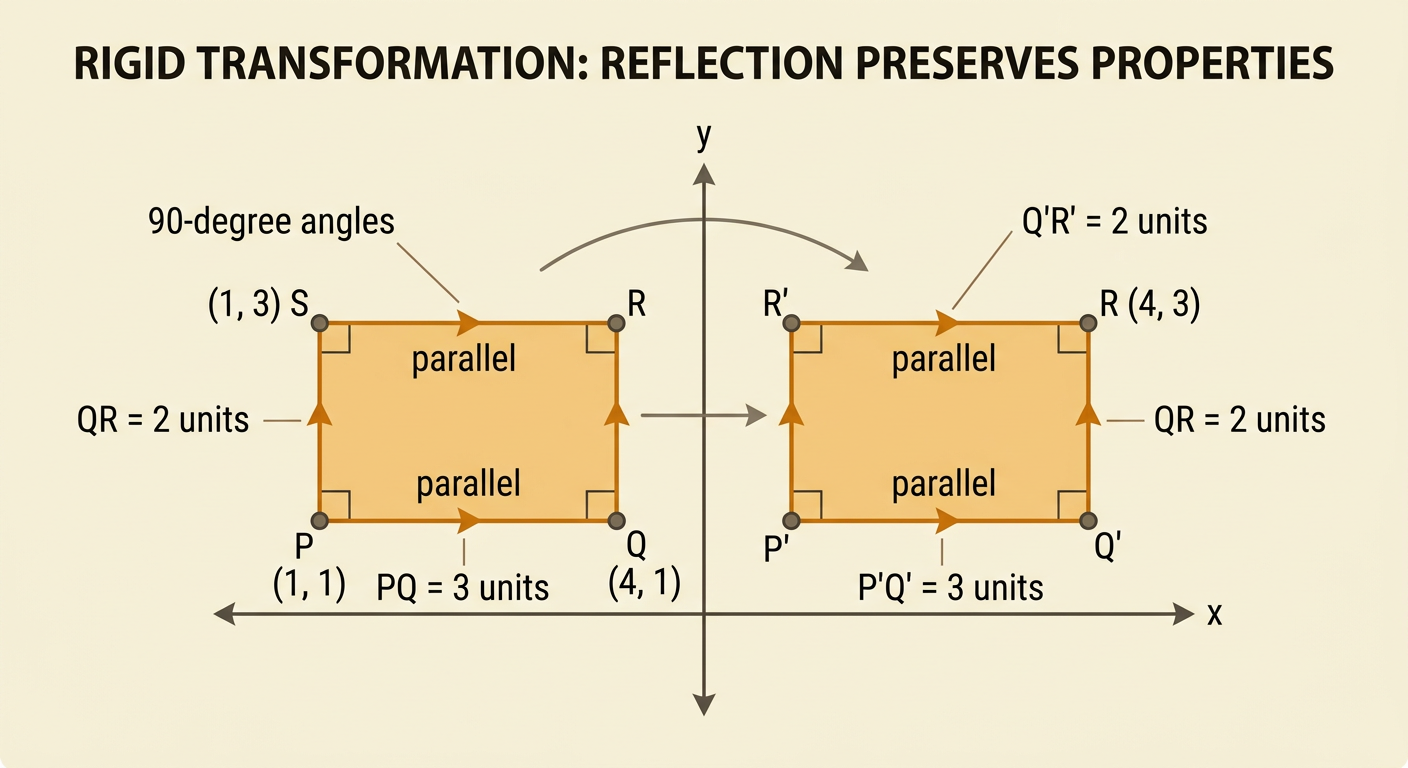
You can verify preserved properties by measuring or calculating before and after a transformation. Consider rectangle PQRS with P(1, 1), Q(4, 1), R(4, 3), and S(1, 3). Reflecting it across the y-axis gives P′(−1, 1), Q′(−4, 1), R′(−4, 3), and S′(−1, 3). Segment PQ is 3 units long, and P′Q′ is also 3 units long. Segment QR and Q′R′ are both 2 units long. All four angles remain 90 degrees. In the original rectangle, PQ is parallel to SR. In the image, P′Q′ is parallel to S′R′. Each side lies on a line, and each original line maps to another line. These comparisons experimentally confirm that reflections preserve lengths, angle measures, lines, and parallel relationships.
Complete a Transformation Challenge
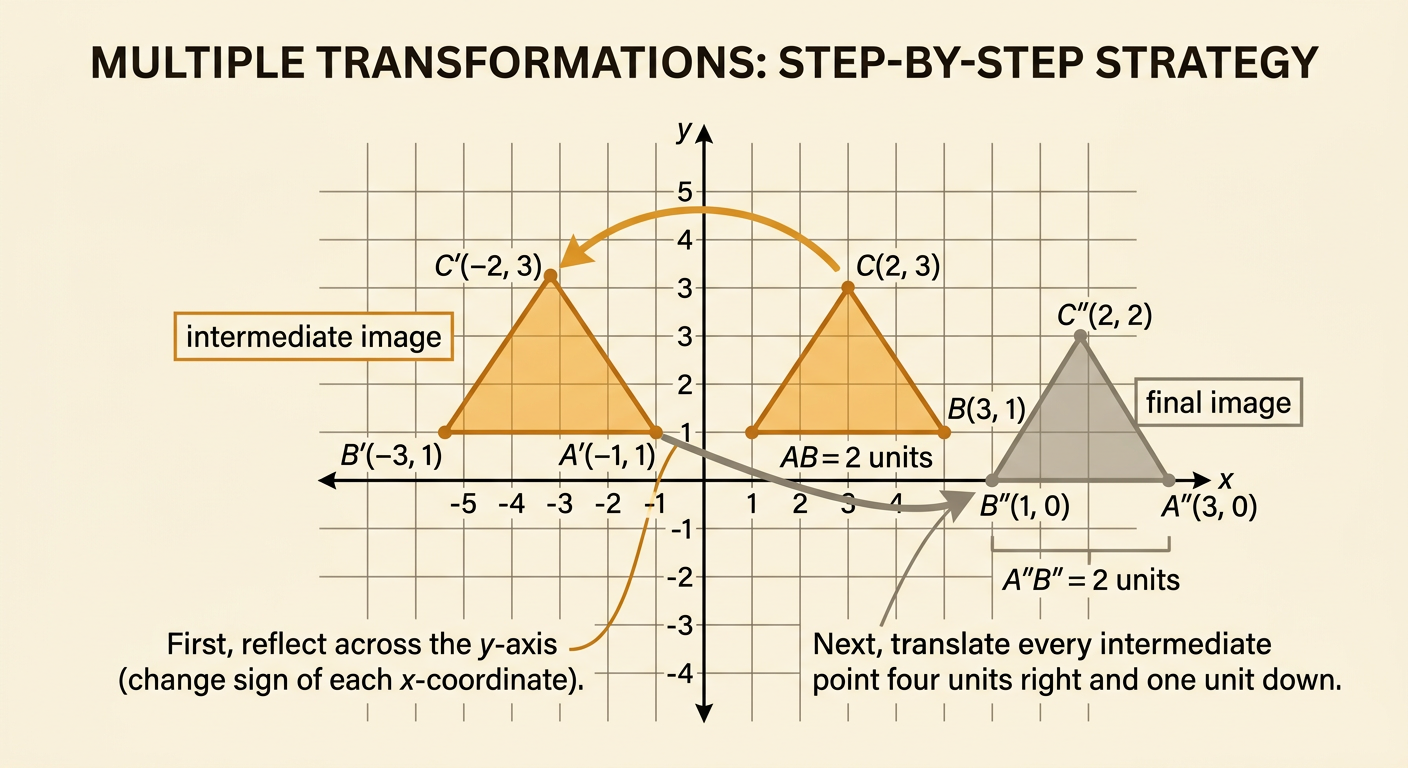
Use coordinate rules one step at a time when a challenge includes more than one transformation. Start with triangle ABC at A(1, 1), B(3, 1), and C(2, 3). First reflect the triangle across the y-axis. The intermediate points are A′(−1, 1), B′(−3, 1), and C′(−2, 3). Next translate the reflected triangle four units right and one unit down. The final image has A″(3, 0), B″(1, 0), and C″(2, 2). Check your work by comparing corresponding lengths. Segment AB is 2 units long, and segment A″B″ is also 2 units long. The base remains horizontal, so its image lies on a line parallel to the original base. Recording the intermediate image prevents you from combining rules incorrectly and makes each transformation easier to verify.