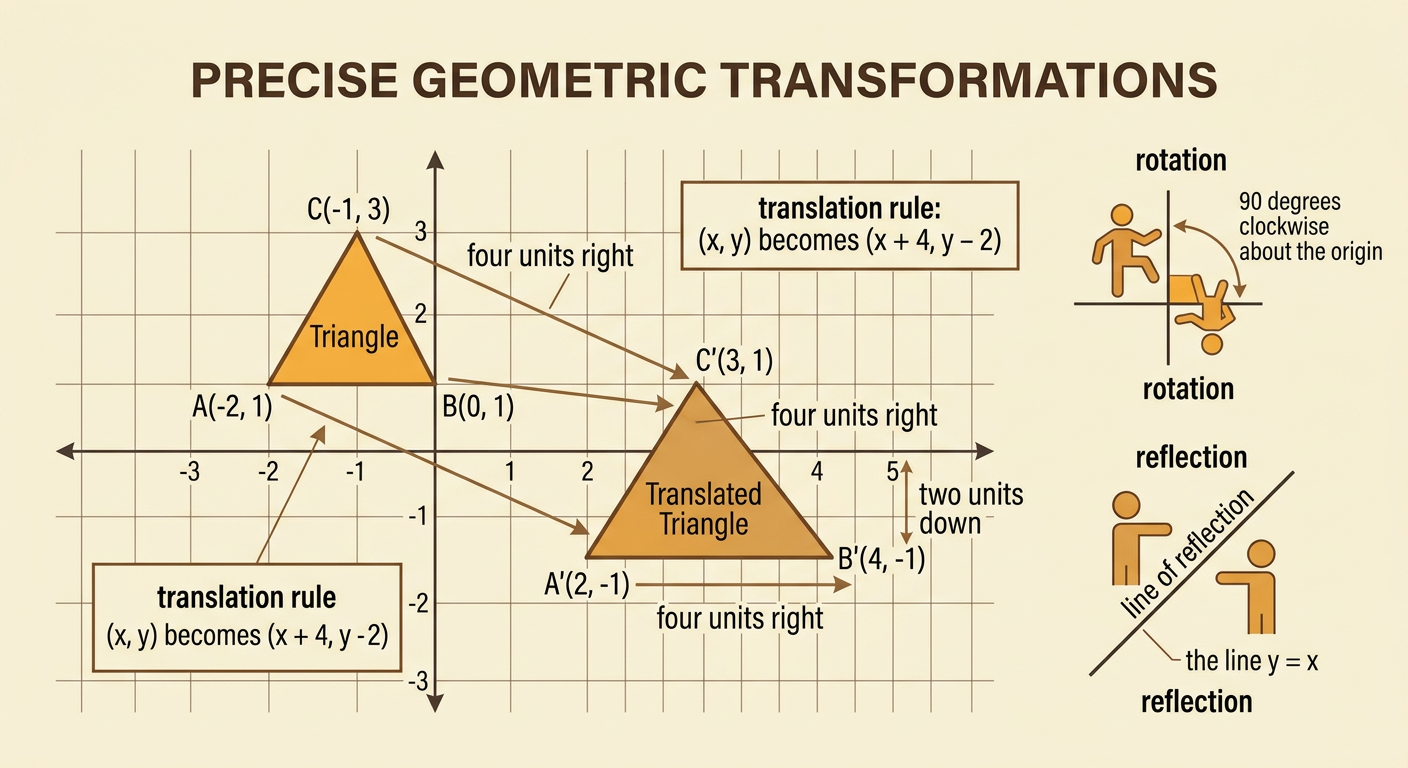
Exploring Translations, Rotations, and Reflections
Students identify and describe how translations, rotations, and reflections move figures while preserving lengths and angle measures.
Illustrations are auto-generated and may be placeholders. They can be refreshed to match the narration.
Review Coordinate-Plane Vocabulary
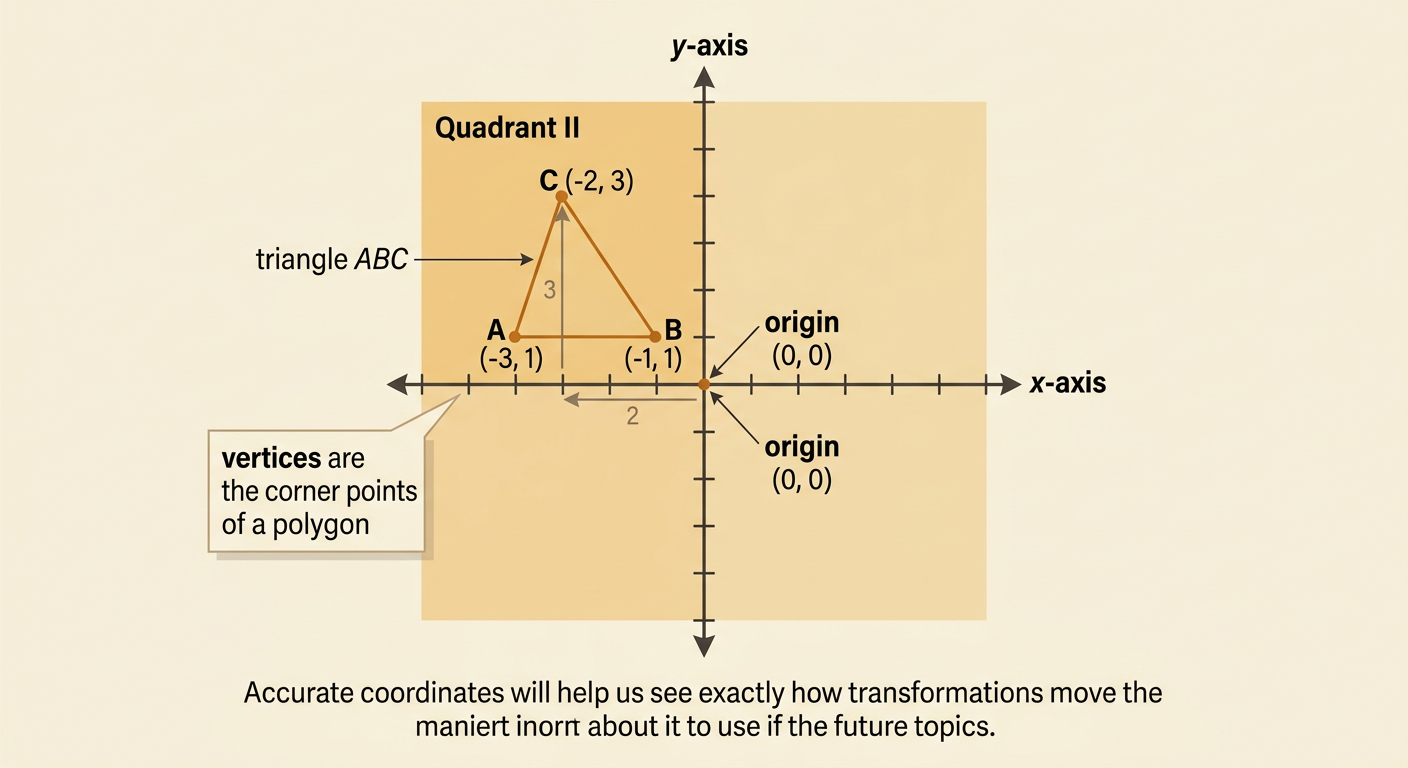
A coordinate plane has a horizontal x-axis and a vertical y-axis. The axes intersect at the origin, (0, 0), and divide the plane into four quadrants. An ordered pair, (x, y), gives a point’s location. Start at the origin, move horizontally according to x, and then move vertically according to y. Positive x-values are to the right, while positive y-values are above the origin. A polygon’s corner points are called vertices. For example, triangle ABC can have vertices A(-3, 1), B(-1, 1), and C(-2, 3). All three points are in Quadrant II because their x-values are negative and their y-values are positive. Accurate coordinates help you compare a figure before and after a transformation.
Identify the Three Rigid Transformations
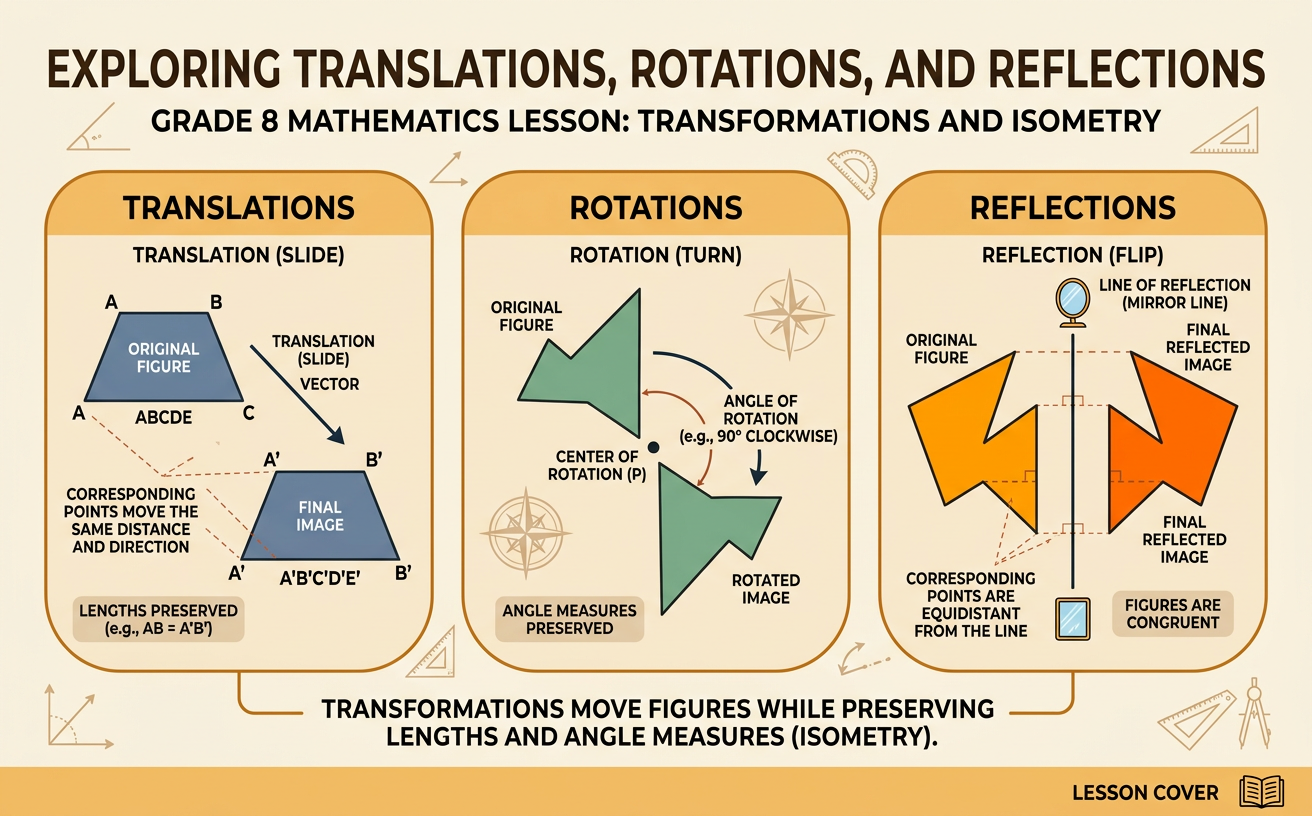
A rigid transformation moves a figure without changing its size or shape. A translation slides every point the same distance in the same direction. A rotation turns a figure through a given angle around a fixed center. A reflection flips a figure across a line of reflection, creating a mirror image. For example, begin with P(2, 1). Translating P three units left and two units up produces P'(-1, 3). Rotating P 90 degrees counterclockwise about the origin produces P'(-1, 2). Reflecting P across the y-axis produces P'(-2, 1). Although these transformations place the point in different locations, each follows one consistent rule. When an entire figure is transformed, that same rule must be applied to every vertex.

Track How Vertices Move
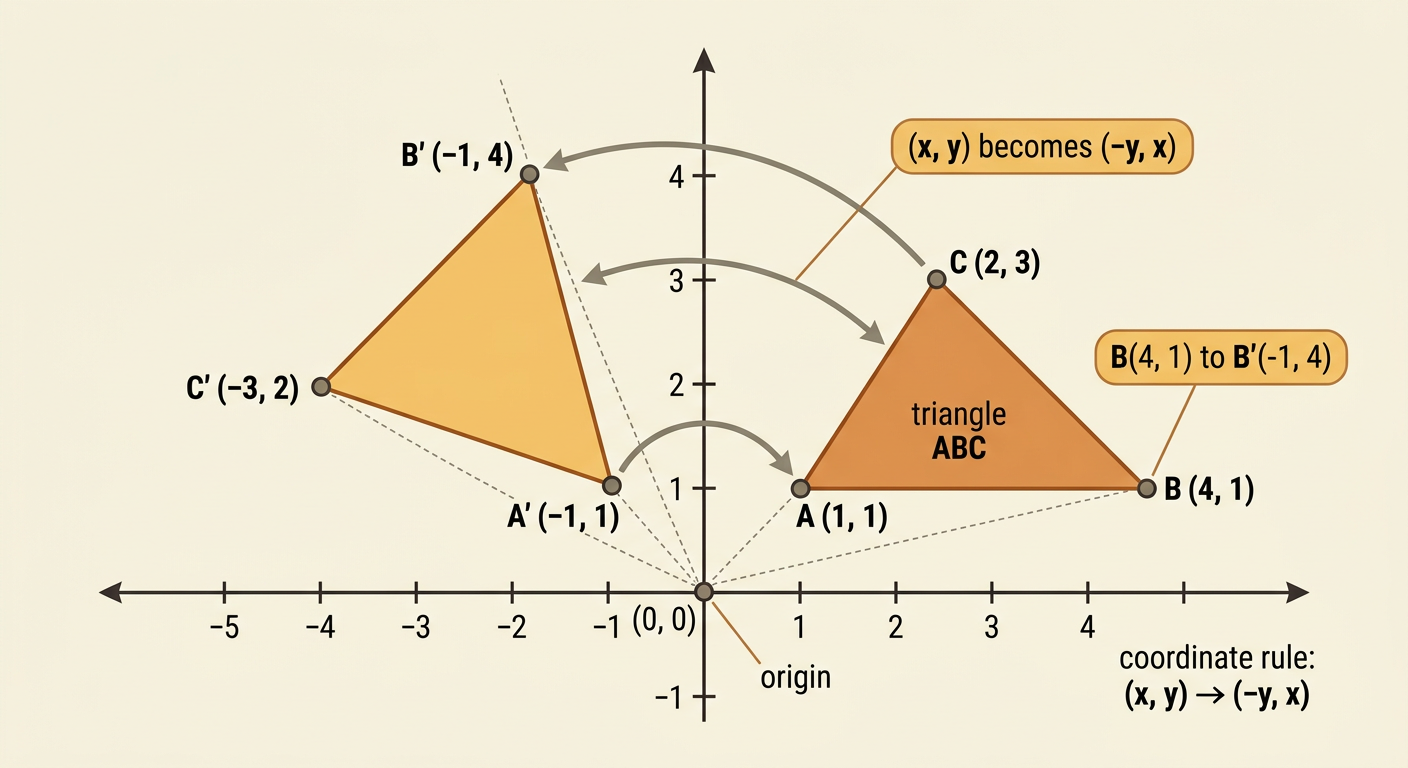
To track a transformed figure, match every original vertex with its image. Unprimed letters name the original points, and primed letters name their images. Consider triangle ABC with A(1, 1), B(4, 1), and C(2, 3). Rotate the triangle 90 degrees counterclockwise around the origin. The coordinate rule is (x, y) becomes (-y, x). Applying the rule gives A'(-1, 1), B'(-1, 4), and C'(-3, 2). Keep the vertex order consistent: A corresponds to A', B corresponds to B', and C corresponds to C'. Connecting A', B', and C' in the same order creates the rotated triangle. Tracking vertices carefully prevents reversed labels and makes it easier to verify that every point followed the same transformation rule.
Test Preserved Lengths and Angles
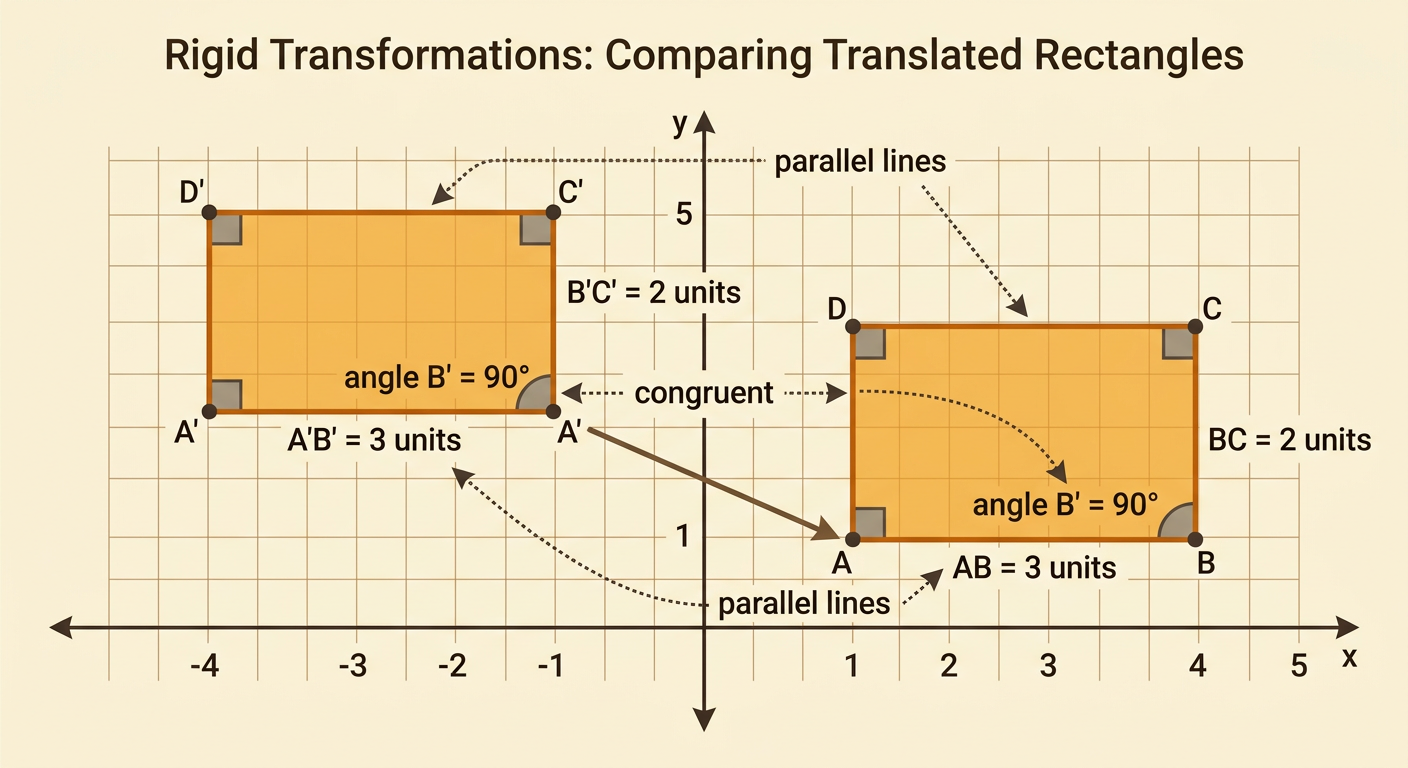
Rigid transformations preserve segment lengths, angle measures, parallel lines, and congruence. You can test these properties with a ruler, protractor, grid, or distance calculations. Rectangle ABCD has A(1, 1), B(4, 1), C(4, 3), and D(1, 3). Translate it five units left and two units up. The image has A'(-4, 3), B'(-1, 3), C'(-1, 5), and D'(-4, 5). Before and after the translation, AB and A'B' are both 3 units, while BC and B'C' are both 2 units. Angles B and B' both measure 90 degrees. Also, AB is parallel to CD, and A'B' is parallel to C'D'. Because all corresponding measurements match, the original rectangle and its image are congruent.
Describe a Transformation Using Precise Rules
A precise transformation description states the type of movement and all required details. For a translation, give the horizontal and vertical changes. The rule (x, y) becomes (x + 4, y - 2) means four units right and two units down. Applied to A(-2, 1), B(0, 1), and C(-1, 3), it gives A'(2, -1), B'(4, -1), and C'(3, 1). For a rotation, name the center, angle, and direction, such as 90 degrees clockwise about the origin. For a reflection, identify the line of reflection, such as the x-axis or the line y = x. Avoid vague statements such as “the figure moved over.” A complete rule allows another person to reproduce the image exactly and check every corresponding vertex.