
Family Traits: Similar but Not Exactly Alike
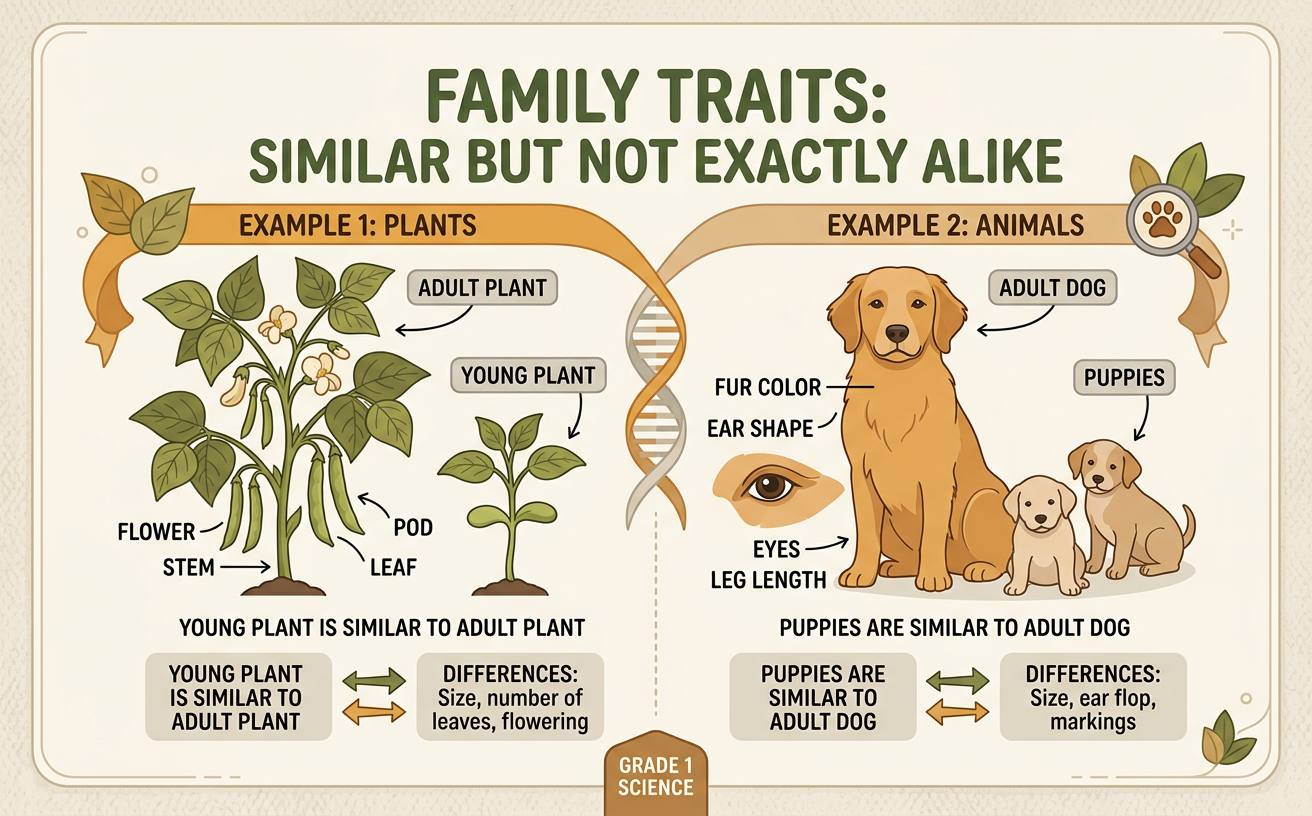
Students compare young plants or animals with their parents to identify inherited similarities and natural differences.
Illustrations are auto-generated and may be placeholders. They can be refreshed to match the narration.
Meet the Parent and Young
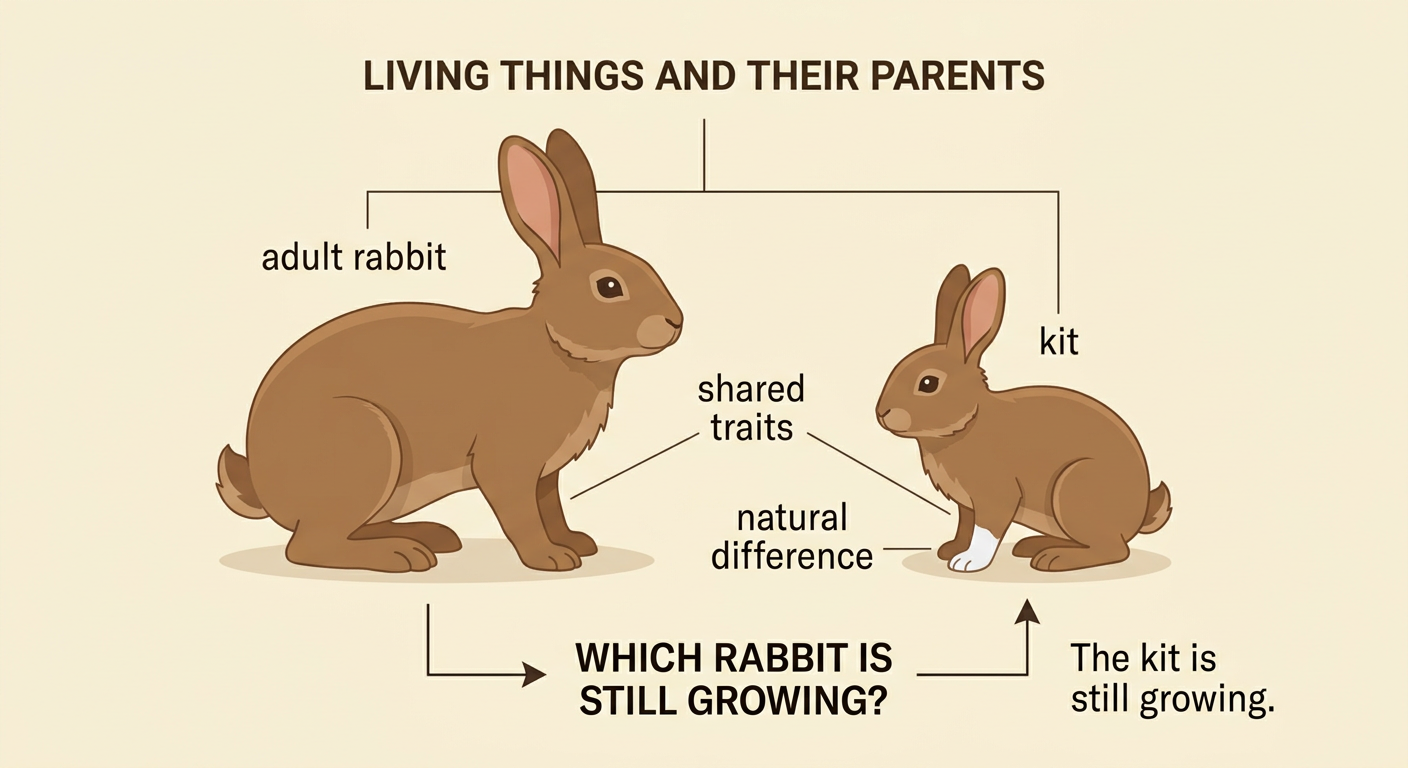
Living things have parents, and young living things belong to the same kind as their parents. A young rabbit, called a kit, grows into an adult rabbit. Look at an adult rabbit and its kit. Both may have long ears, soft fur, four legs, and a short tail. These shared traits help us see that they are related. However, they are not exactly alike. The kit is smaller because it is still growing. It might also have a white foot while the adult has brown feet. The white foot is a natural difference. As we study each parent and young pair, we will look for traits that are alike and traits that are different.
Observe Their Traits
A trait is a feature we can observe, such as fur color, ear shape, or markings. Observe one trait at a time. First, compare the rabbits’ ears. Both have long ears with rounded tips, so that trait is alike. Next, compare their fur. Most of the fur is brown on both rabbits, but the kit has a white foot. That marking is different. We can also measure or compare body size, but remember that a young rabbit is smaller because it has not finished growing. Use careful words such as brown, white, long, short, spotted, or solid. Record only what you can see or measure. A drawing, a few words, or a tally mark can help you save each observation.

Sort Similarities and Differences
Now sort the observations. Place each trait card under Alike or Different. The card showing long ears goes under Alike because both rabbits have long ears. The card showing brown body fur also goes under Alike. The white-foot card goes under Different because only the young rabbit has that marking. Body size can go under Different, but add a note that the kit is still growing. Next, organize the cards into three trait categories: ear shape, fur color, and markings. Sorting helps us see patterns without saying that every rabbit family is the same. Other rabbit families may share different traits. If a trait is hard to compare, observe again before sorting it. Scientists use evidence instead of guessing.

Make a Class Picture Graph
Combine the class observations in a picture graph. Each team chooses the clearest shared trait it found in a rabbit parent-and-young pair. Place one rabbit picture in the matching category: same ear shape, same fur color, or same type of markings. One picture stands for one team. Suppose six teams report the same ear shape, four report the same fur color, and two report the same type of markings. The ear-shape category has the most pictures. The markings category has the fewest. Ear shape has two more pictures than fur color. Count carefully and compare the three categories. The graph summarizes only what our class observed. It does not mean that every rabbit family will have the same results.

Share an Evidence-Based Claim
An evidence-based claim is an idea supported by observations. Our claim can be: Young rabbits are like, but not exactly like, their parents. Add evidence from the rabbit example. Both rabbits had long ears, brown body fur, four legs, and short tails. The young rabbit was smaller and had one white foot. Then explain how the evidence supports the claim. The shared traits show how the young rabbit is like the adult. The different size and foot marking show that it is not exactly alike. Work together to create a class page with the claim, a labeled drawing, and two or three evidence sentences. When sharing, name the traits you observed instead of saying only, “They look alike.”
