
Fat as Fuel: How Our Bodies Use Food
Students use pictures and movement to learn that lipids, also called fats, come from food and can be changed by the body into energy or stored for later.

Illustrations are auto-generated and may be placeholders. They can be refreshed to match the narration.
What Does Our Body Need?
Our body needs food, water, and air to live and grow. Food gives the body materials to build strong parts and energy to work, play, think, and stay warm. Different foods provide different nutrients, so eating a variety of foods helps meet our needs. Imagine eating toast with sunflower seed butter before going to the park. The food enters your body, and your body changes it into smaller parts it can use. Some parts help build and repair your body. Other parts can provide energy for running, climbing, and playing. People make choices about which foods to eat. Choosing a mix of fruits, vegetables, grains, protein foods, and foods containing fats can help the body get what it needs.

Meet Lipids, or Fats
Lipids are nutrients often called fats. Lipids are found in foods such as avocado, seeds, nuts, eggs, fish, dairy foods, and plant oils. Many foods contain more than one kind of nutrient. For example, an egg contains fat and protein. Our bodies need some fat. Fat can provide energy, help build cell parts, and help the body use certain vitamins. The body can also save some fat for later. Imagine a small amount of avocado spread on toast. The avocado provides lipids, while the toast provides other nutrients too. Foods with fat can be part of a varied meal. We do not need to call a food “good” or “bad.” Instead, we can notice what it provides and choose suitable amounts.

Model: Eat, Change, Use, or Store
We can use a model to show what happens after we eat food containing fat. First, we eat the food. Next, digestion breaks the food into smaller parts. These parts can move through the body. The body may use some of the fat to provide energy. If the energy is not needed right away, the body can store some fat for later. Picture eating avocado on toast. Your body digests the meal and moves the smaller nutrient parts where they are needed. Some can help provide energy for walking to school. Some may be stored until the body needs energy another time. The body does not make this choice by thinking. Its organs and cells carry out these steps automatically.
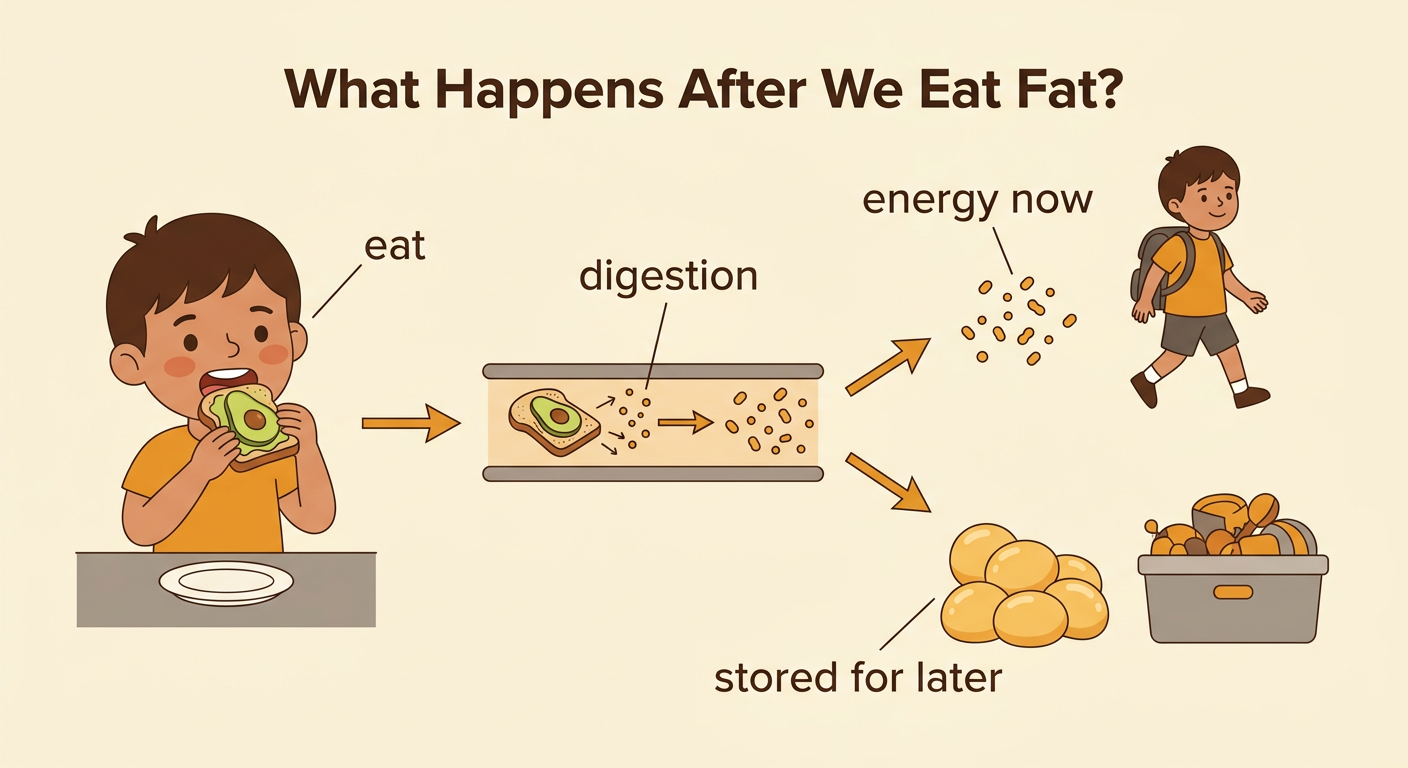
Move to Show Energy in Action
Let us use movement to act out the model. First, pretend to take one bite of food. Next, gently move your hands in a circle near your stomach to show digestion. Then choose one of two actions. Jog in place slowly for five counts to show the body using energy now, or fold your hands and crouch quietly to show energy stored for later. Stand up and repeat the steps with the other ending. Food does not make our bodies move instantly like turning on a light. The body must digest food and change its nutrients before cells can use them. Take turns, give classmates space, and listen when another student explains an action. Together, say the steps: “Eat, change, use, or store.”

Sort and Count Food Pictures
Food pictures can be sorted into categories. Use eight cards showing avocado, sunflower seed butter, an egg, olive oil, an apple, a carrot, rice, and strawberries. Place avocado, sunflower seed butter, egg, and olive oil in the category labeled “Foods that provide fat.” Place apple, carrot, rice, and strawberries in the category labeled “Other pictured foods.” Count each group. There are four cards in each category, so the groups are equal in this example. Real foods often contain several nutrients, and even foods in the second group help our bodies in other ways. Talk with a partner about the sort and listen to your partner’s idea. Then explain one food choice. For example, olive oil can add fat and flavor, but using a large amount also adds more energy than a small amount.

Draw and Tell What Happens to Fat
Fold a paper into four boxes to make your own model. In the first box, draw a food containing fat, such as avocado toast. In the second box, draw a stomach and intestine to show digestion changing the food into smaller parts. In the third box, draw yourself walking or playing to show energy being used. In the fourth box, draw a storage symbol, such as a small closed container, to show that some fat can be stored for later. Add arrows to show the order. Then tell a partner what happens in your picture. You might say, “I eat avocado. My body digests it. The fat can help provide energy or be stored.” Ask one question about your partner’s drawing and answer one question about your own.
